
Ramadan is the month the Quran was revealed (Al-Baqarah 2:185), and it has always been the month of the Quran for Muslims. Every night of Ramadan, Jibril would meet the Prophet ﷺ to go over the Quran with him (Sahih al-Bukhari 6), and in the year he passed away they went through it twice (Sahih al-Bukhari 4998).
For students of hifz, Ramadan can be the most productive month of the year, or a month where everything falls behind because of fasting, late nights and broken routines. A bit of planning makes the difference.
Revision first, new memorization second
Following the example of Jibril and the Prophet ﷺ, many teachers treat Ramadan as a month of revision more than new memorization. The goal is to come out of the month with everything you’ve memorized stronger than it went in.
Some ways to set your goal:
- If you’ve memorized a few surahs: perfect them, and add one or two more.
- If you’ve memorized several juz: recite all of it from memory at least once during the month.
- If you’re a hafiz: a full khatm from memory, ideally more than one, perhaps by leading or following taraweeh.
New memorization is fine if you have the time and energy, but make the daily lesson modest. A small lesson you actually remember beats an ambitious one that collapses in the second week.
Plan around the fast
Fasting changes your energy across the day. Most people find:
- Suhoor and after Fajr is the best time for focused memorization. You’ve eaten, the house is quiet, and your mind is fresh.
- The afternoon is hard for new memorization. Use it for light revision or listening.
- After iftar and taraweeh works for revision if you’re not too tired, in short sessions.
Write a simple timetable before Ramadan starts, with your revision portions mapped to the days. For example, a hafiz aiming for one khatm in the month needs to recite one juz a day. Someone with five juz could recite one juz a day and go through everything six times in the month.
Taraweeh as revision
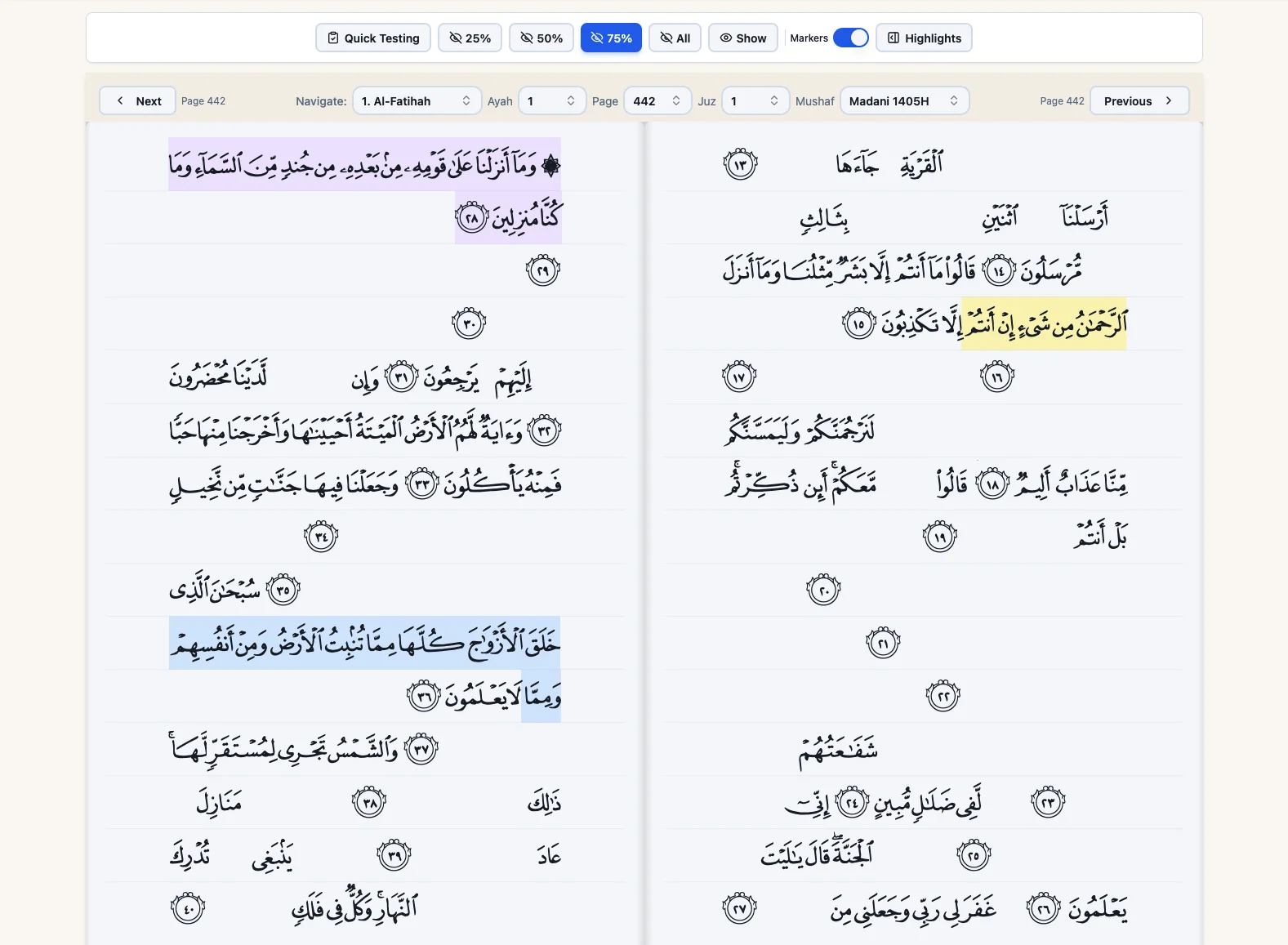
Taraweeh is a ready-made revision session. If your local masjid completes the Quran over the month, follow along in your head and notice which pages you can’t keep up with. Those are the pages to revise the next morning.
If you lead taraweeh, at home or at the masjid, your preparation is your revision. Plan which portion you’ll recite each night and revise it during the day.
The Prophet ﷺ said that whoever stands in prayer during Ramadan out of faith and hoping for reward will have their past sins forgiven (Sahih al-Bukhari 2009).
Free tool
Leading taraweeh, or reciting from memory in your own night prayer? Get each night’s pages split across every pair of rak’ahs, finishing by night 27 or 29. Open the taraweeh planner →
The last ten nights
In the last ten nights, the Prophet ﷺ would strive harder, pray through the night and wake his family (Sahih al-Bukhari 2024). Long night prayers are an ideal time to recite large portions of what you’ve memorized. Plan to recite your strongest juz in these nights, and save some of your best revision for them.
Don’t burn out in week one
Many people start Ramadan with huge plans, manage them for a week, and then crash. Set your daily target at what you can sustain for thirty days. Day one is a bad guide. If you finish early, add more. It’s much more encouraging to exceed a modest plan than to fall behind an ambitious one.
After Eid
You find out how well Ramadan went in Shawwal. It’s common to stop everything after Eid and find a month later that you’ve forgotten much of what you revised.
- Keep a daily minimum going straight through Eid, even 10 minutes.
- In the first week of Shawwal, set your normal routine back up, with sabqi and manzil.
- Write down what worked in Ramadan, like the early morning slot, and carry it into Shawwal.
Sabaq, Sabqi and Manzil Explained can help you set up a routine that lasts beyond the month.
Track it
When your days are full, it’s easy to lose track of what you’ve revised. Keep a simple list of your juz and tick each one off as you recite it, in prayer or out of it, so your Ramadan revision covers everything.