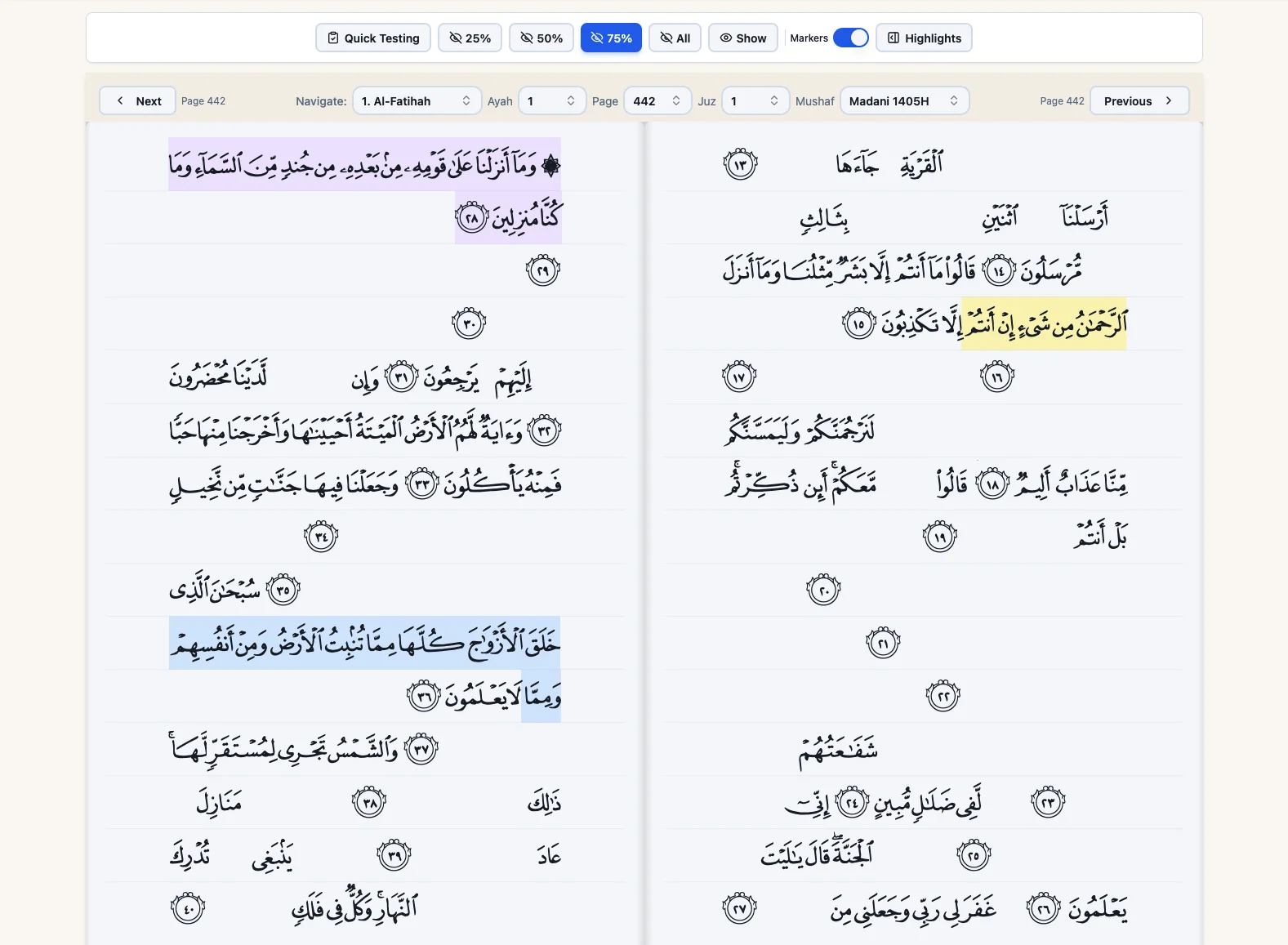

If you’ve spent time in a hifz class in the UK, South Africa, North America or South Asia, you’ve probably heard the words sabaq, sabqi and manzil. They’re the backbone of the traditional madrasa system, and once you understand them, planning your own hifz gets much easier.
The terms come from Urdu, borrowing Arabic words, and different schools use slightly different names. Some say “sabqi” for what others call “para”, or “dhor” for manzil. The structure underneath is the same everywhere.
Sabaq: the new lesson
Sabaq (the word South Asian madrasas use for “lesson”) is today’s new memorization. It might be three lines for a beginner or two pages for an advanced student.
The sabaq is usually prepared the day before or early in the morning, then recited to the teacher. If it’s not fluent, the student repeats it the next day instead of moving on.
How to do it well:
- Listen to it, read it carefully, then memorize ayah by ayah, joining each new ayah to the ones before.
- Recite it several times through the day, including in salah.
- Don’t move on until it’s clean. A shaky sabaq becomes a shaky sabqi, and then a page that stays weak for years.
For a full method, see How to Memorize One Page of the Quran a Day.
Sabqi: the recent lessons
Sabqi is the revision of your most recent lessons. In many madrasas it means the last juz or so, though some teachers define it as the last seven to fifteen lessons, or the last 10 to 20 pages.
Sabqi is recited every day, usually before the new sabaq. It exists because recently memorized material is the most fragile part of your hifz. It feels strong because it’s fresh, which is exactly why students skip it, and a month later they’ve forgotten it.
Rules many teachers use:
- Sabqi is recited every day, without exception.
- It’s recited from memory, ideally to the teacher or another person.
- If sabqi has more than a couple of mistakes, the next day’s sabaq is reduced or skipped.
That last rule sounds harsh, but it protects you. It’s much cheaper to fix a page in its second week than in its second year.
Shaykh Abdur-Rahman Mangera’s version keeps the previous five to seven lessons in daily review, so each new lesson gets at least five more days of attention before it joins the wider revision cycle (Zamzam Academy).
Manzil: everything else
Manzil is the revision of all your older memorization, done in a rotating cycle. The word means a stage or station, and the Quran is traditionally divided into seven manzils for people who complete a recitation every week.
In the hifz class sense, your manzil is everything you’ve memorized that’s older than your sabqi. You recite a fixed portion of it every day so that, over a week or two, you cycle through all of it.
How big your daily manzil should be depends on how much you’ve memorized:
| Total memorized | Daily manzil | Cycle |
|---|---|---|
| Under 3 juz | 5 to 10 pages | About a week |
| 5 juz | About 15 pages | A week |
| 10 juz | 1 juz | 10 days |
| 20 juz | 1 to 1.5 juz | 2 to 3 weeks |
| 30 juz | 1.5 to 3 juz | 10 to 20 days |
More detail on cycles is in How to Revise the Quran.
Free tool
Mark each page of your manzil as strong, shaky or weak and get a daily revision cycle that brings the weak pages back more often. Open the manzil planner →
Putting it together: a daily session
Here’s what a typical day looks like for a student with five juz memorized who learns half a page a day:
- Sabqi (15 minutes): recite the last 10 to 15 pages from memory.
- Sabaq (30 minutes): memorize half a page and recite it until it’s fluent.
- Manzil (30 to 40 minutes): recite 15 pages of older material from memory.
The order matters. Doing sabqi first warms you up and catches problems while you’re fresh. Some teachers put manzil first. Very few put sabaq first, because it tends to eat the rest of the session.
When there’s no time
On a short day, cut in this order:
- Cut the sabaq first. Missing a new lesson costs one day.
- Then shrink the manzil, but don’t skip it completely. Even five pages keeps the cycle moving.
- Keep the sabqi. It’s the layer you’re most likely to forget.
Adapting it at home
You don’t need to be in a madrasa to use this structure. If you’re memorizing on your own:
- Keep a notebook with three columns: today’s sabaq, the sabqi range, and today’s manzil range.
- Recite your sabqi to someone at least once or twice a week.
- Recite in salah: sabqi in the sunnah prayers, manzil in night prayer.
How to Memorize the Quran at Home by Yourself has more on studying alone.
Why this works
This structure lines up well with what memory research has found. You forget material you’ve just learned fastest, so it gets daily review. As it stabilizes, the gaps between reviews can grow. Spreading practice out over time leads to much better long-term memory than packing it together (Cepeda and colleagues, 2006).
It also reflects the Prophet’s description of the Quran as camels that need tying (Sahih al-Bukhari 5031). Applied to hifz, that means watching your newest pages most closely.
The Quran Memorizer daily review follows the same idea. It gives you recent material every day, rotates through the rest a portion at a time, and leans its questions toward the spots you keep getting wrong, so you have something like sabqi and manzil even without a teacher keeping the register.
More guides: Should you pause new memorization to revise? · How to keep a hifz mistake log