Most people who set out to memorize the Quran don’t stop because the Arabic is too hard. They stop because the plan they started with doesn’t survive an ordinary month. A lesson that felt fine in week one starts to crowd out revision by week six, older surahs start to go, and the whole thing gets shelved.
So start in a way that lasts: get the groundwork right before your first lesson, learn how a single day’s memorization actually works, and build revision in from the beginning so the pages you learn in January are still there in December.
Start with your reading
You can’t memorize what you can’t read correctly. If you still hesitate over letters, or you aren’t sure where a long vowel goes, fix that first. Every mistake in your reading will be memorized right along with the words, and unlearning a mispronunciation you’ve repeated two hundred times is far harder than learning it properly once.
That doesn’t mean you need a full tajweed course before you begin. You need to read fluently from the mushaf, pronounce the letters properly, and have someone who can correct you. We go into this in more detail in Do You Need Tajweed Before Starting Hifz?.
Pick one mushaf and stay with it
Your memory doesn’t only store words. It stores where they sit on the page: the ayah that starts at the top left, the surah heading halfway down, the line that ends on a particular word. Huffaz lean on this picture constantly, which is why switching between print layouts makes memorization harder.
Choose one mushaf and use it for everything: memorizing, revising, reciting to your teacher. For most English speakers that will be the 15-line Madani mushaf, where almost every juz is 20 pages and every page ends at the end of an ayah. If you grew up reading the Indo-Pak script, that’s fine too. The important thing is that you stop switching. There’s a full explanation in Why You Should Memorize From One Mushaf.
Hakiki, an Indonesian scholar who memorized the Quran in under two years, has carried the same copy since he started. A different edition, he explained to Hartford International University, would disrupt the mental map he’d built of where each verse sits on each page.
Find someone to recite to
A teacher does two things you can’t do for yourself. They hear mistakes you can’t hear, and they give you a fixed appointment that makes you prepare.
If you can sit with a qualified teacher in person, do it. If you can’t, an online teacher twice a week is far better than none. And if even that isn’t possible right now, recite to a family member who reads well while they follow along in the mushaf. They won’t catch everything, but they’ll catch skipped words, swapped ayat and wrong endings, which are most of what goes wrong.
Finding a Hifz Teacher covers what to look for and what to do in the meantime.
Decide where to start
Most people begin with Juz Amma, the 30th juz, and work backwards from An-Nas. The surahs are short, you already recite many of them in salah, and finishing a whole surah every few days builds momentum. Others start with surahs they want for night prayer, like Al-Mulk, or begin at Al-Baqarah and go in order.
There’s no single right answer. If you’re new, Juz Amma is the easiest place to build the habit. Our guide on which surahs to memorize first goes through the options. If you’d rather plan by juz, here’s what’s in each juz and where each one starts.
Size your daily lesson honestly
Here’s the part most beginners get wrong. They pick a daily amount based on how much they can learn in one sitting, when the real limit is how much they can learn and keep reviewing every day.
A rough starting point:
- Completely new to hifz: 3 to 5 lines a day.
- Some experience, reading fluently: half a page a day.
- Experienced, with time and a teacher: a page a day.
Then watch what happens over two weeks. If yesterday’s lesson comes back cleanly the next morning and your revision still fits in the time you have, you can add a little. If revision is getting skipped, cut the new lesson. Of all the choices you’ll make early on, this one matters most. How Much Quran Should You Memorize Each Day? goes deeper on this. It also helps to know how long a page takes to recite, because your revision has to fit into the same day.
Free tool
Know your daily amount? Turn it into a day-by-day schedule with exact pages, lines and revision built in. Open the hifz plan generator →
How to memorize a single lesson
Different teachers use different methods, and we compare the main ones in Hifz Methods Compared. Most of them share the same shape:
- Listen first. Play the passage from a reciter you like two or three times while following in the mushaf. This settles the pronunciation and the rhythm before you start repeating anything.
- Read it correctly, several times. Read the whole lesson from the mushaf slowly, ten times or so, paying attention to how each ayah begins and ends.
- Memorize one ayah at a time. Look, recite, then close your eyes and recite again. Don’t move on until you can say the ayah without looking.
- Join each new ayah to the one before. Once ayah 2 is solid, recite 1 and 2 together. Then 3 on its own, then 1 to 3. Most mistakes happen at the joins, so this step matters more than it looks.
- Recite the whole lesson from memory. Then do it again later in the day, ideally in salah.
Some people like to start the lesson after Fajr and recite it in the sunnah prayers through the day. Others use the last part of the night. Pick a time you can protect most days.
Whatever you do, don’t rush. Allah told the Prophet ﷺ not to move his tongue hastily with the Quran while it was being revealed (Al-Qiyamah 75:16-19). The point there was about revelation, but the habit of slowing down and listening fully before repeating is a good one for anyone memorizing.
Build revision in from day one
The Prophet ﷺ compared someone who knows the Quran by heart to the owner of tied camels: tie them up and you hold on to them, let them loose and they wander off (Sahih al-Bukhari 5031). In another narration he said it slips away faster than camels do (Sahih al-Bukhari 5033). New to words like sabaq, sabqi and manzil? Our hifz vocabulary explains them.
So plan your revision before you plan your new lesson. Most hifz programs split it into three parts:
- Sabaq: today’s new lesson.
- Sabqi: the last week or two of lessons, reviewed every day.
- Manzil: everything older, reviewed in rotation.
In the beginning your manzil is tiny, so this can feel like overkill, but the habit is much easier to form while the amount is small. Sabaq, Sabqi and Manzil Explained walks through how to set it up, and How to Revise the Quran covers revision once your hifz grows. If older surahs are already getting shaky, here’s how to stop forgetting what you memorize.
A good rule of thumb: at least as much time on revision as on new memorization, and more as you go on. Huffaz who’ve finished often spend almost all their Quran time on revision.
Test yourself properly
Reading a page you memorized and thinking “yes, I know this” is not a test. Recognition is much easier than recall. You only find out what you really know when the mushaf is closed.
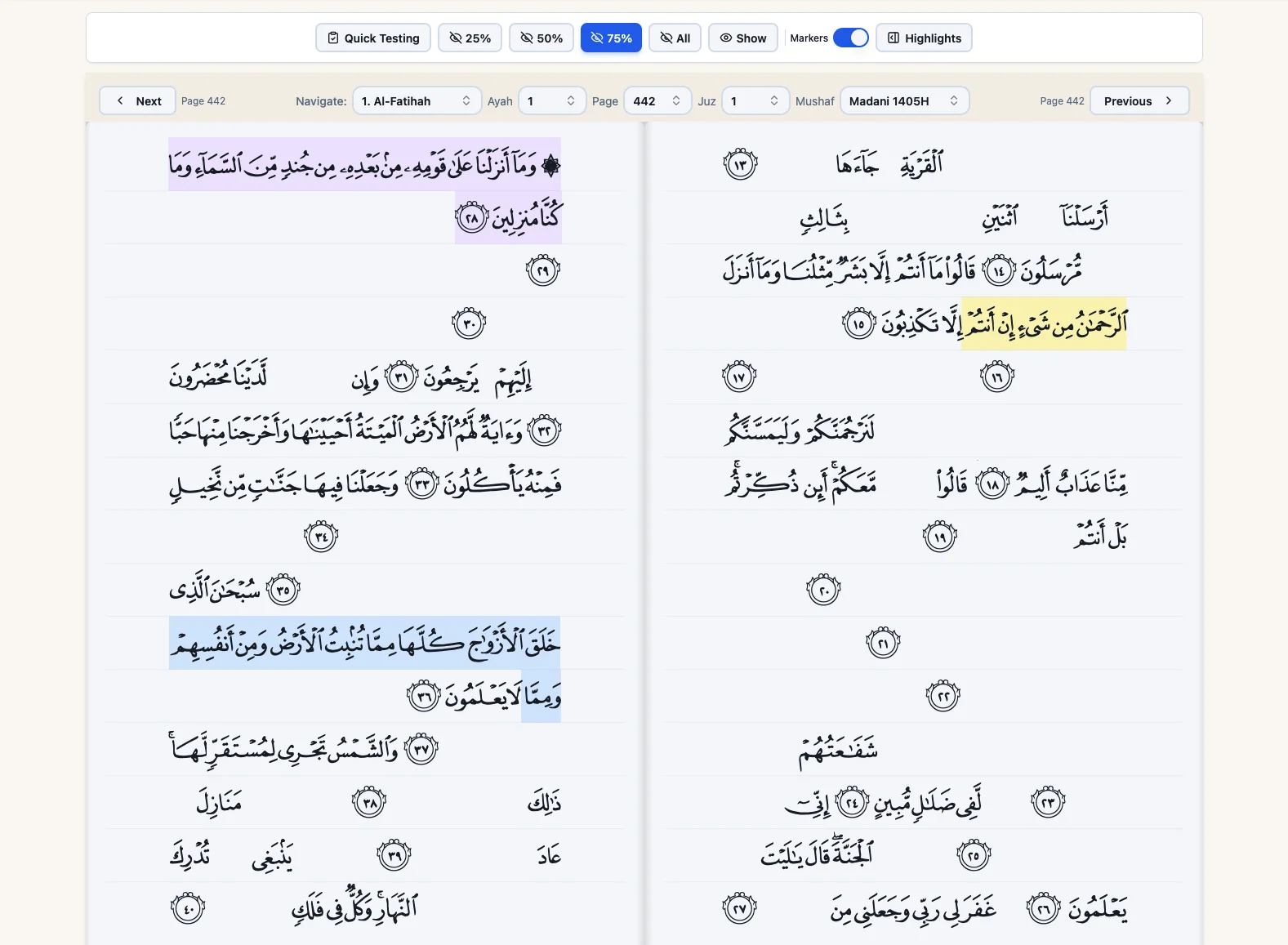
Good tests include reciting a passage to someone else, starting from a random ayah, saying which ayah comes next, and reciting in salah. The Hifz Test guide has more ideas. This is also what the Quran Memorizer app is built for: it lets you hide parts of the mushaf page, tests you with questions like next ayah and missing words, and brings back the places you get wrong more often.
Expect it to be hard sometimes
Some weeks your lesson will go in easily. Other weeks you’ll spend three days on four lines. That’s normal, and the Prophet ﷺ spoke directly to it: the one who recites fluently is with the honorable scribes, and the one who struggles and stumbles through it gets two rewards (Sahih Muslim 798a).
So the struggle isn’t wasted. What matters most is that you keep going, even if slowly. The deed Allah loves most is the one done regularly, even if it’s small (Sahih al-Bukhari 6464).
A simple first month
If you want something concrete, here’s a plan for a complete beginner starting with Juz Amma:
- Week 1: An-Nas to Al-Kafirun. Learn one short surah a day and recite all of them every morning.
- Week 2: Al-Kawthar to Al-Humazah. Same pattern. Start reciting week 1’s surahs in salah.
- Week 3: Al-Asr, At-Takathur and Al-Qari’ah. Al-Qari’ah is longer, so give it two days if you need to.
- Week 4: Al-Adiyat and Az-Zalzalah, then a full review of everything so far, recited to someone.
After a month you’ll have around 16 surahs and, more importantly, a daily routine that includes both new lessons and revision. That routine is what carries you through the rest of the Quran.
Common questions
How long does it take to memorize the whole Quran?
At a page a day with no breaks, about 20 months. Most people take two to five years once you count revision days, travel, illness and Ramadan. We break the numbers down in How Long Does It Take to Memorize the Quran?
Can I memorize the Quran as an adult?
Yes. Plenty of people start in their 30s, 50s and later. Adults usually have less time than children but more discipline and a better grasp of meaning. See Quran Memorization for Adults.
What if I don’t understand Arabic?
A large share of the world’s huffaz don’t speak Arabic. Knowing the meaning helps, but it isn’t required. Memorizing the Quran When You Don’t Speak Arabic has practical tips.
Is there a special dua for memorizing?
There’s no authentic dua specifically for memorization, but there are good general ones from the Quran. We cover them, along with one popular narration that scholars have graded weak, in Is There a Dua for Memorizing the Quran?