Walk into a hifz class in Birmingham, Jeddah or Jakarta and you’ll hear different words for the same things. A teacher in a UK madrasa asks for your sabaq, a teacher in the Gulf wants your tasmi’, and a pesantren in Indonesia calls it setoran. Add the tajweed terms, the ways the mushaf is divided and the milestones like ijazah, and it’s a lot to pick up, especially if you’re learning as an adult or teaching your own children.
This is the vocabulary a hifz student actually meets, in plain English, with the Arabic and what each word looks like in practice. Where we have a fuller guide, it’s linked.
The daily system: memorizing and revising
Sabaq سَبَق. Today’s new lesson: the lines or page you’re memorizing for the first time. It’s the word used in South Asian and UK madrasas; in Indonesian pesantren the same idea is called ziyadah, and in Arabic-speaking classes simply new memorization (hifz jadid). More: Sabaq, sabqi and manzil explained.
Sabqi سبقي. Your recent lessons, usually the last week or so of new lines, or the juz you’re currently working through. Some madrasas call this sabaq para. These pages are fragile, so they’re recited every day until they settle.
Manzil (revision) مَنْزِل. Everything older than your sabqi, revised in a rotating cycle so that every juz you’ve memorized comes round regularly. The word means a stage or station. It has a second meaning too; see the seven manzils below. More: Free manzil planner.
Dhor دَوْر. A word used in some UK and South African madrasas for revising older juz, close in meaning to manzil. If your teacher says “do your dhor”, they mean old revision.
Muraja’ah / murojaah مُرَاجَعَة. Revision in Arabic, and the word you’ll hear across the Arab world and, as murojaah, in Indonesia and Malaysia. Teachers often split it into near revision of recent pages and far revision of everything else. More: How to revise the Quran.
Takrar تَكْرَار. Repetition: reading or reciting the same lines many times to fix them in memory. Some methods prescribe a set number, such as twenty readings of each ayah.
Talqin تَلْقِين. Learning by hearing and repeating: the teacher recites a phrase and the student says it back. It’s how young children learn before they can read, and how many adults correct their pronunciation.
Tasmi’ تَسْمِيع. Reciting from memory to someone who listens and corrects you. It’s the Gulf and Arab-world word for what a South Asian madrasa calls “giving your sabaq” (sabaq sunana in Urdu), and Indonesian pesantren call setoran.
Mistake log. Not a traditional term, but a habit many teachers ask for: a written list of every slip, with the exact wording that went wrong. More: How to keep a hifz mistake log.
Milestones, people and places
Hifz حِفْظ. Memorization of the Quran, and in everyday use the whole work of memorizing and then protecting what you’ve memorized. The root means to guard or preserve.
Hafiz / hafiza / huffaz حَافِظ / حَافِظَة / حُفَّاظ. Someone who has memorized the whole Quran: hafiz for a man, hafiza for a woman, huffaz in the plural. You’ll also see hafidh and haafiz. More: What does hafiz mean?
Khatm خَتْم. Completing the whole Quran, either by reading it through or by reciting it from memory. Many people aim for a khatm in Ramadan. More: Pages a day for a Ramadan khatm.
Ijazah إِجَازَة. A licence from a qualified teacher confirming that you recite the Quran correctly, usually after reciting the whole of it to them. It often comes with a sanad. More: What is an ijazah?
Sanad سَنَد. The chain of teachers, each of whom recited to the one before, going back to the Prophet ﷺ. An ijazah with a sanad places you in that chain.
Halaqah حَلْقَة. A circle: a class where students sit with a teacher to recite and be corrected, in a masjid, a school or online.
Tahfiz تَحْفِيظ. A memorization programme or school, as in a tahfiz class or a full-time tahfiz school. Spelled tahfidz in Indonesia and tahfiz in Malaysia.
Musabaqah مُسَابَقَة. A Quran competition. In memorization competitions, judges usually give a random ayah and ask the student to continue from there. More: Practising random-ayah tests.
How the Quran is divided
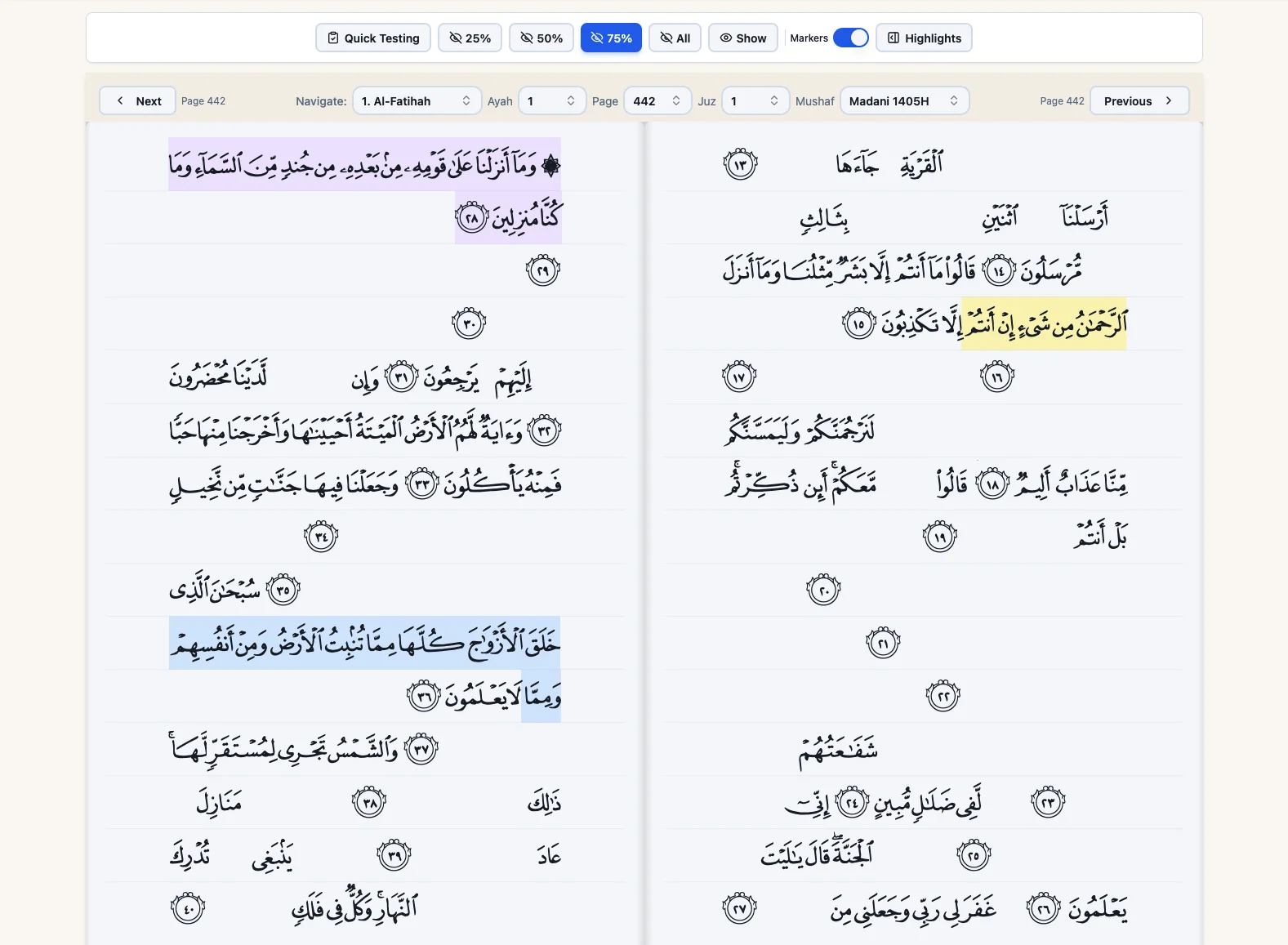
Mushaf مُصْحَف. A printed or written copy of the Quran. Hifz students usually stick to one layout, because the memory of each page becomes part of the hifz. The 15-line Madani mushaf has 604 pages; many South Asian students use a 13-line Indo-Pak mushaf with a different page layout. More: Why to memorize from one mushaf.
Juz (para, sipara) جُزْء. One of thirty roughly equal parts of the Quran, about 20 pages each in the Madani mushaf (between 19 and 23 in practice). In South Asia it’s called a para or sipara. Here’s where each one starts in the 15-line Madani mushaf (and what’s in each juz):
| Juz | Starts at | Page | Juz | Starts at | Page |
|---|---|---|---|---|---|
| 1 | Al-Fatihah 1:1 | 1 | 16 | Al-Kahf 18:75 | 302 |
| 2 | Al-Baqarah 2:142 | 22 | 17 | Al-Anbiya 21:1 | 322 |
| 3 | Al-Baqarah 2:253 | 42 | 18 | Al-Mu’minun 23:1 | 342 |
| 4 | Ali ‘Imran 3:93 | 62 | 19 | Al-Furqan 25:21 | 362 |
| 5 | An-Nisa 4:24 | 82 | 20 | An-Naml 27:56 | 382 |
| 6 | An-Nisa 4:148 | 102 | 21 | Al-‘Ankabut 29:46 | 402 |
| 7 | Al-Ma’idah 5:82 | 121 | 22 | Al-Ahzab 33:31 | 422 |
| 8 | Al-An’am 6:111 | 142 | 23 | Ya-Sin 36:28 | 442 |
| 9 | Al-A’raf 7:88 | 162 | 24 | Az-Zumar 39:32 | 462 |
| 10 | Al-Anfal 8:41 | 182 | 25 | Fussilat 41:47 | 482 |
| 11 | At-Tawbah 9:93 | 201 | 26 | Al-Ahqaf 46:1 | 502 |
| 12 | Hud 11:6 | 222 | 27 | Adh-Dhariyat 51:31 | 522 |
| 13 | Yusuf 12:53 | 242 | 28 | Al-Mujadila 58:1 | 542 |
| 14 | Al-Hijr 15:1 | 262 | 29 | Al-Mulk 67:1 | 562 |
| 15 | Al-Isra 17:1 | 282 | 30 | An-Naba 78:1 | 582 |
Hizb حِزْب. Half a juz. The Quran has 60 of them, and in much of the Arab world and North Africa daily reading and revision are counted in hizbs.
Rub’ رُبْع. A quarter of a hizb (rub’ al-hizb), marked in the margin of many mushafs. There are 240, and they make handy units for a short daily revision portion.
Manzil (one of seven) مَنْزِل. The Quran is also divided into seven manzils, so that someone reading a manzil a day finishes the whole Quran in a week. Their starting surahs give the memory aid fami bi shawq (فمي بشوق): Al-Fatihah, Al-Ma’idah, Yunus, Bani Isra’il (Al-Isra), Ash-Shu’ara, wa As-Saffat and Qaf. In the Madani mushaf they begin on pages 1, 106, 208, 282, 367, 446 and 518.
Ruku’ رُكُوع. A paragraph-like section of a surah, marked with the letter ع in the margin of Indo-Pak mushafs. Imams traditionally used them to decide how much to recite in each rak’ah. There are a little over 550, and the count varies slightly between prints.
Ayah / ayat آيَة / آيَات. A verse of the Quran (ayat in the plural, also written ayahs). There are 6,236 in the common count. Each one ends with a numbered circle in the mushaf.
Surah سُورَة. A chapter. There are 114, from Al-Fatihah to An-Nas, ranging from three ayat (Al-Kawthar, Al-‘Asr, An-Nasr) to 286 (Al-Baqarah).
Recitation and sound
Tajweed تَجْوِيد. The rules for reciting the Quran correctly: where each letter comes from, how long sounds are held, and how letters affect each other. Most teachers want basic tajweed in place before serious hifz begins. More: Do you need tajweed before hifz?
Makharij مَخَارِج. The points in the throat and mouth where each letter is produced. Many common mistakes, like ح said as ه, are makharij mistakes.
Ghunnah غُنَّة. The nasal sound in letters like ن and م, held for a set length in certain rules.
Madd مَدّ. Lengthening a vowel sound, for two counts or more depending on the rule.
Lahn jali and lahn khafi لَحْن جَلِيّ / خَفِيّ. Clear mistakes that change a letter, vowel or meaning (jali), and subtle tajweed mistakes that don’t (khafi). Teachers treat the first as essential to fix before anything else.
Waqf signs عَلَامَات الوَقْف. The small marks above the text showing where to stop, where stopping is better, and where not to stop. They matter for meaning, and they help when you’re dividing a passage into chunks to memorize. More: What each waqf sign means.
Tarteel تَرْتِيل. Measured, unhurried recitation, from the command in Al-Muzzammil 73:4 to “recite the Quran with measured recitation”.
Murattal and mujawwad مُرَتَّل / مُجَوَّد. Two styles of recording. Murattal is steady recitation at a normal pace, the kind most people memorize with. Mujawwad is slower and melodic, often recorded live. More: The best reciters for memorization and how long each surah takes to recite.
Qira’at and riwayah قِرَاءَات / رِوَايَة. The authentic ways the Quran has been recited and passed down. Most of the world recites in the riwayah of Hafs from ‘Asim; Warsh from Nafi’ is common across North and West Africa. Your mushaf follows one riwayah, and your hifz should match it.
Isti’adha and basmala اِسْتِعَاذَة / بَسْمَلَة. Seeking refuge with Allah from Shaytan before reciting (a’udhu billahi minash-shaytanir-rajim), and saying bismillahir-rahmanir-rahim, which begins every surah except At-Tawbah.
Sajdat at-tilawah سَجْدَة التِّلَاوَة. The prostration made when reciting certain ayat, marked in the mushaf (15 places in the Madani mushaf). Worth knowing before you lead prayer or recite for a teacher. More: All 15 places of prostration.
Tricky spots
Mutashabihat مُتَشَابِهَات. Ayat that are identical or nearly identical to ayat elsewhere, where the tongue tends to jump from one surah to another. Every hifz student meets them, and they need their own method. More: How to memorize similar verses.
Lawh لَوْح. A wooden writing board. In Mauritania and parts of West Africa, students write each day’s lesson on a lawh and recite it until they’ve earned the right to wash it clean. More: Memorizing by writing.
The same idea, different words
If you move between teachers, apps or countries, this table translates the everyday words:
| What it means | UK and South Asia | Arab world and Gulf | Indonesia and Malaysia |
|---|---|---|---|
| Today’s new lesson | Sabaq | Hifz jadid | Ziyadah |
| Recent lessons | Sabqi, sabaq para | Muraja’ah qaribah (near revision) | Murojaah |
| Older revision | Manzil, dhor | Muraja’ah ba’idah (far revision) | Murojaah |
| Reciting to the teacher | Sabaq sunana (giving your sabaq) | Tasmi’ | Setoran |
| A thirtieth of the Quran | Para, sipara | Juz | Juz |
| Memorization programme | Hifz class | Tahfiz | Tahfidz |
Spelling changes too. British, Gulf and South Asian English write memorise and memorisation; American and Canadian English write memorize and memorization, which is what we use here. Hifdh and hafidh are the same words as hifz and hafiz. The Arabic letter ظ is written “dh” by some and “z” by others, and you’ll see both on books, apps and madrasa websites.
Learning the words is the easy part. If you want to see how the daily system fits together, start with how to revise the Quran, and when you’re ready to check yourself, the free hifz test asks you from random points in whatever you’ve memorized.
Questions people ask
What is sabqi?
Sabqi is your recent lessons, usually the last week or so of new lines, recited every day until they settle. Some madrasas call it sabaq para. It sits between sabaq, today’s new lesson, and manzil, the older revision.
How much sabqi should I do a day?
A common setting is the last 7 to 14 days of lessons. At half a page a day that’s about 3½ to 7 pages; at a page a day it’s 7 to 14. If yesterday’s lesson still needs the mushaf, lean towards the longer end. Sabaq, sabqi and manzil explained shows how to balance all three.
How many manzils are in the Quran?
Seven, so reading one manzil a day finishes the Quran in a week. In the Madani mushaf they begin on pages 1, 106, 208, 282, 367, 446 and 518. In hifz classes the same word also means your older revision.
What is a hizb, and how many are in a juz?
A hizb is half a juz, so there are two in every juz and 60 in the whole Quran. Each hizb splits into four quarters (rub’), which gives 240 in all.