To memorize Surah Al-Fajr, learn it in its four parts at two or three mushaf lines a day, and give ayat 15 and 16 a day to themselves. Those two are built on the same frame, and they’re the pair people mix up.
The whole surah is 30 ayat on 16 lines of the Madani mushaf (all of page 593 and the top three lines of 594), about three minutes of recitation. A week is comfortable. At five lines a day, four days is realistic.
This is Surah 89, “The Dawn”, the one that opens with wal-fajr. It shares its name with the dawn prayer, but if you were looking for what to recite at Fajr, that’s a different search.
At a glance
- Surah: 89, Al-Fajr (“The Dawn”). Makkan. 30 ayat, 137 words by quran.com’s count.
- Where it sits: juz 30 (para 30), pages 593 to 594 of the 604-page Madani mushaf. It starts at the top of a fresh page, right after Al-Ghashiyah.
- Length: 16 lines, one full page plus three. It’s the fourth longest surah in juz 30 by lines, after An-Naba, An-Nazi’at and Al-Mutaffifin.
- Time to recite: about 2 minutes with Sa’ud ash-Shuraym, 3¼ with Mishary Alafasy and 5¼ with al-Husary’s teaching recitation.
- Time to memorize: 4 days at 5 lines a day, 3 at half a page, 2 at a full page. Seven unhurried days with the plan below.
- Hardest spot: 89:15 and 89:16, stacked on lines 9 and 10 of page 593. Same frame, five differences.
If you’re working backwards from An-Nas, as our Juz Amma plan does, Al-Fajr comes in week 5, right after Al-Balad. You’ll already know where it has to end: Al-Balad’s title is on line 4 of page 594, directly under Al-Fajr’s last line.
Surah Al-Fajr at a glance
- Surah
- 89
- Juz
- 30
- Mushaf
- Pages 593 to 594
- Ayat
- 30
- Length
- About a page
- Recited in
- about 3 minutes
How many days will it take?
| New lines a day | Days |
|---|---|
| 3 (a few lines) | 6 days |
| 5 (a third of a page) | 4 days |
| 7 (half a page) | 3 days |
| 10 (two thirds of a page) | 2 days |
| 15 (a full page) | 2 days |
Counts days of new memorization on the 16 lines of Surah Al-Fajr. Add revision on top. Make a day-by-day plan.
Test yourself
Memorized Surah Al-Fajr? Find the ayat you’re not sure of.
Quran Memorizer asks you what comes next, which ayah is missing and which look-alike ayah goes where, on the same Madani mushaf pages you learned from. With Premium, Daily Review brings your weakest ayat back first, so you can revise Surah Al-Fajr a little every day.

Free to start, no card needed. On the web or iPhone, choose Surah Al-Fajr as what you want to be tested on.
More on Surah Al-Fajr: All surah guides
What is Surah Al-Fajr about, part by part?
It’s long by Juz Amma standards, but the order is easier to remember than that suggests, because each part sounds different. The oaths all rhyme on rā’, the nations on -ād, and the two tests are answered with four verbs ending in -ūna. Then the last four ayat turn and speak to one soul, in the feminine. Once you can hear those changes, the order gets much easier to remember.
Read a translation of each part before you memorize it. Al-Fajr’s ayat are short (the first one is a single word), and short ayat are easy to say and just as easy to shuffle. Knowing the meaning is how you remember their order. The English we quote is the Saheeh International translation.
1. The oaths (89:1-5)
وَٱلْفَجْرِ ﴿١﴾
وَلَيَالٍ عَشْرٍ ﴿٢﴾
وَٱلشَّفْعِ وَٱلْوَتْرِ ﴿٣﴾
وَٱلَّيْلِ إِذَا يَسْرِ ﴿٤﴾
هَلْ فِى ذَٰلِكَ قَسَمٌ لِّذِى حِجْرٍ ﴿٥﴾
The surah opens by swearing by four things: the dawn, ten nights, the even and the odd, and the night as it passes. Then 89:5 asks whether all that isn’t oath enough “for one of perception”. Ibn Kathir explains the word behind “perception”, ḥijr, as the intellect (Ibn Kathir on 89:1-5).
The ten nights are usually taken as the first ten of Dhul-Hijjah. That’s the note in the Saheeh International translation, and Ibn Kathir reports it from Ibn ‘Abbas, Mujahid and others.
“The even and the odd” has several explanations among the early scholars. You’ll often see a narration saying it means the prayer, but it’s graded Da’if by Darussalam, and at-Tirmidhi himself calls it gharib (Jami’ at-Tirmidhi 3342), so don’t lean on it.
The sound is the memory aid here. All five ayat end on the letter rā’: fajr, ‘ashr, watr, yasr, ḥijr. When the rhyme changes, the oaths are over.
2. The nations (89:6-14)
أَلَمْ تَرَ كَيْفَ فَعَلَ رَبُّكَ بِعَادٍ ﴿٦﴾
إِرَمَ ذَاتِ ٱلْعِمَادِ ﴿٧﴾
ٱلَّتِى لَمْ يُخْلَقْ مِثْلُهَا فِى ٱلْبِلَـٰدِ ﴿٨﴾
وَثَمُودَ ٱلَّذِينَ جَابُوا۟ ٱلصَّخْرَ بِٱلْوَادِ ﴿٩﴾
وَفِرْعَوْنَ ذِى ٱلْأَوْتَادِ ﴿١٠﴾
ٱلَّذِينَ طَغَوْا۟ فِى ٱلْبِلَـٰدِ ﴿١١﴾
فَأَكْثَرُوا۟ فِيهَا ٱلْفَسَادَ ﴿١٢﴾
فَصَبَّ عَلَيْهِمْ رَبُّكَ سَوْطَ عَذَابٍ ﴿١٣﴾
إِنَّ رَبَّكَ لَبِٱلْمِرْصَادِ ﴿١٤﴾
“Have you not considered how your Lord dealt with ʿAad”, asks 89:6, and the surah names them in turn. First ‘Ad and Iram, “who had lofty pillars”, then Thamud, “who carved out the rocks in the valley”, and Pharaoh, “owner of the stakes”.
The translators’ footnote explains Iram as another name for the first people of ‘Ad, the people Hud was sent to, and Pharaoh’s stakes as the ones “by which he tortured people”. Then all of them together: they oppressed within the lands, increased corruption, and your Lord poured on them “a scourge of punishment”. 89:14 closes the part: “Indeed, your Lord is in observation.”
The rhyme does the same job it did in the oaths. Eight of the nine ayat end in -ād, from bi-‘ād to al-mirṣād. The odd one out is 89:13, which ends on ‘adhāb, the punishment itself. Once you’ve noticed that, it’s hard to put 89:13 anywhere else.
3. The two tests (89:15-20)
89:15 and 89:16 are printed side by side in the slips section below, with their translation. Here are the four ayat that answer them:
كَلَّا ۖ بَل لَّا تُكْرِمُونَ ٱلْيَتِيمَ ﴿١٧﴾
وَلَا تَحَـٰٓضُّونَ عَلَىٰ طَعَامِ ٱلْمِسْكِينِ ﴿١٨﴾
وَتَأْكُلُونَ ٱلتُّرَاثَ أَكْلًا لَّمًّا ﴿١٩﴾
وَتُحِبُّونَ ٱلْمَالَ حُبًّا جَمًّا ﴿٢٠﴾
The surah turns from nations to one person. When his Lord tests him with generosity, he says “My Lord has honored me.” When He tests him by restricting his provision, he says “My Lord has humiliated me.” The footnote on the first is blunt: “He is proud rather than grateful, attributing the favor to his own merit.”
89:17 answers both speeches with kallā, “No!” Ibn Kathir explains that being given and being held back are both tests, met with thanks in the first case and patience in the second (Ibn Kathir on 89:15-20).
Then the surah names the real failings, speaking to “you” in the plural: not honoring the orphan, not urging one another to feed the poor, devouring inheritance, and loving wealth “with immense love”. Those four ayat each have a verb ending in -ūna: tukrimūna, taḥāḍḍūna, ta’kulūna, tuḥibbūna. Honor, urge, eat, love. Say the four verbs on their own a few times and you have the order of 89:17-20.
4. The Day, and the soul at rest (89:21-30)
كَلَّآ إِذَا دُكَّتِ ٱلْأَرْضُ دَكًّا دَكًّا ﴿٢١﴾
وَجَآءَ رَبُّكَ وَٱلْمَلَكُ صَفًّا صَفًّا ﴿٢٢﴾
وَجِا۟ىٓءَ يَوْمَئِذٍۭ بِجَهَنَّمَ ۚ يَوْمَئِذٍ يَتَذَكَّرُ ٱلْإِنسَـٰنُ وَأَنَّىٰ لَهُ ٱلذِّكْرَىٰ ﴿٢٣﴾
يَقُولُ يَـٰلَيْتَنِى قَدَّمْتُ لِحَيَاتِى ﴿٢٤﴾
فَيَوْمَئِذٍ لَّا يُعَذِّبُ عَذَابَهُۥٓ أَحَدٌ ﴿٢٥﴾
وَلَا يُوثِقُ وَثَاقَهُۥٓ أَحَدٌ ﴿٢٦﴾
A second kallā opens the last part. The earth is pounded flat, “your Lord has come and the angels, rank upon rank”, Hell is brought near, and man remembers at the point where remembering can’t help him.
He’ll say he wishes he had “sent ahead [some good] for my life”, and the footnote in Saheeh International says which life: “The everlasting life of the Hereafter.” 89:25 and 89:26 say that no one’s punishment or binding on that Day will match His. Then the voice changes completely, and four short ayat speak to the soul at rest. Their Arabic and meaning are further down, under ayat 27-30.
How do you memorize Surah Al-Fajr in a week?
Each day’s new portion is two or three lines, between 18 and 29 words, cut where the meaning breaks. Before the new portion, recite everything you’ve already learned from memory. By day 6 that warm-up is all of page 593, about two and a half minutes at Alafasy’s pace, which works out to roughly 12 seconds a line.
| Day | New ayat | Page: lines |
|---|---|---|
| 1 | 89:1-8 | 593: 3 to 5 |
| 2 | 89:9-14 | 593: 6 to 8 |
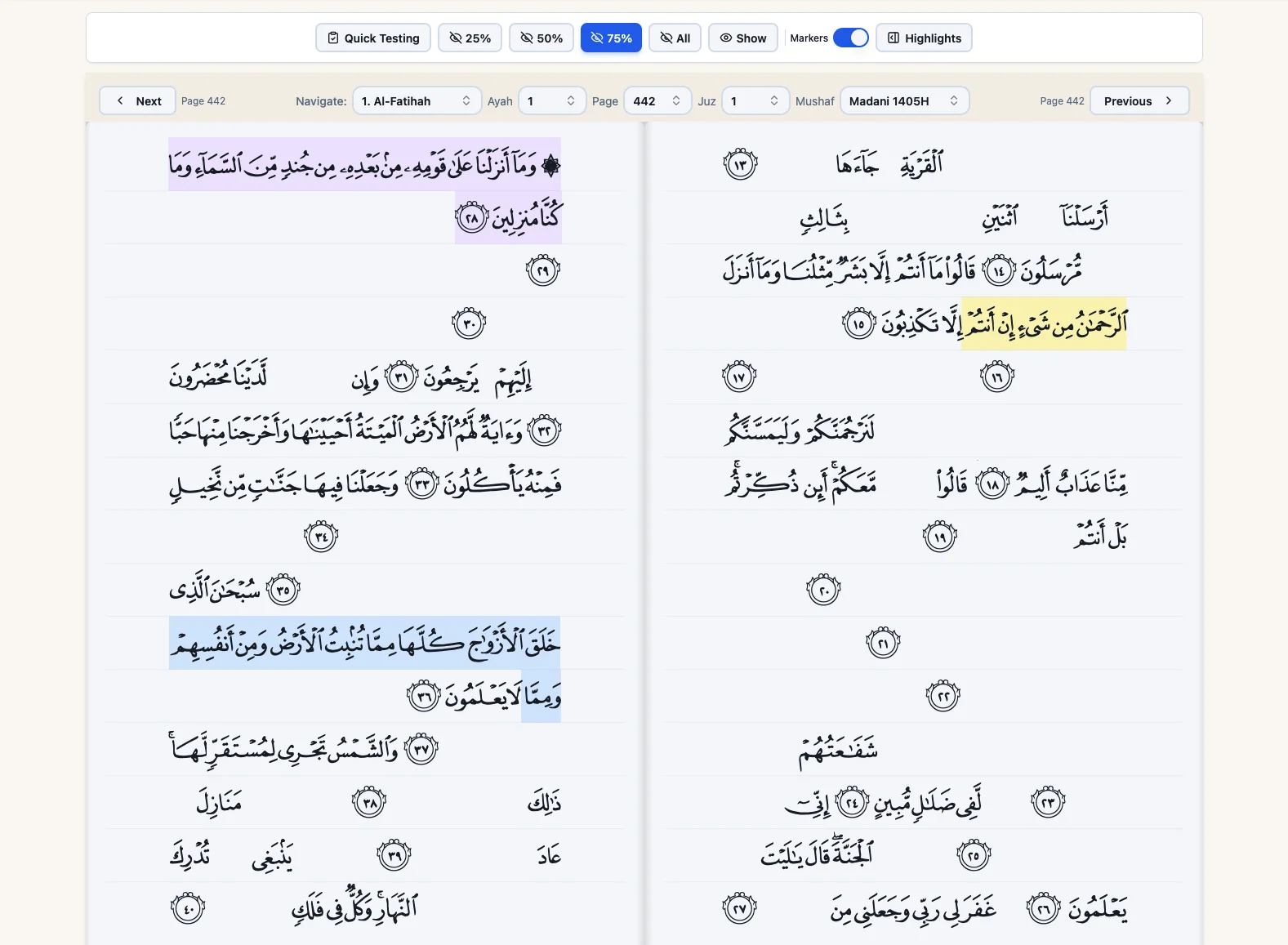
| 3 | 89:15-16 | 593: 8 to 10 |
| 4 | 89:17-20 | 593: 11 to 13 |
| 5 | 89:21-23 | 593: 13 to 15 |
| 6 | 89:24-30 | 594: 1 to 3 |
| 7 | Review only | Whole surah |
Day 1 is exactly lines 3 to 5, so it’s the cleanest page picture of the week: eight ayat, from the oaths into ‘Ad and Iram. Day 2 finishes the nations on line 8.
Day 3 is short on purpose. 89:15 and 89:16 are only two ayat, 21 words, but they’re the pair that trips up a lot of people, so they get a day to themselves. Learn 89:15 until it’s smooth, then learn 89:16 by its five differences. Once you can hear what changes, 16 stops feeling like a new ayah to learn from scratch.
Tip: 89:15’s first word, fa-ammā, is the last word of line 8. If you memorize by sight, you’ll picture line 9 starting with al-insānu and drop the fa-ammā, and that’s the very word that tells you you’re in 15 and not 16. Read the end of line 8 and the start of line 9 as one phrase from day 3 onward.
We split days 5 and 6 at the page break instead of at 89:27. Day 5 then ends on the last line of page 593, which gives you the whole of that page as one picture.
Day 6 puts the man who says “I wish” and the soul told “return” in the same lesson. They’re two outcomes of the same Day, and hearing them back to back helps you remember both.
Day 7 is for joins. Start cold from 89:15, 89:17, 89:21 and 89:24, which means beginning that ayah without the one before it to carry you. Then recite the whole surah to someone, or check yourself against the mushaf line by line.
Moving faster? At half a page a day, take it in three blocks of five or six lines: 89:1-14, 89:15-20 and 89:21-30. At exactly five lines a day it’s four days, and at a page a day it’s two, the same counts as our chart of how long each surah takes to memorize. For the two-day version, split it where page 593 ends: that page on day one, the three lines at the top of 594 on day two.
Free tool
Want it on a calendar? The plan generator maps Al-Fajr to dates at your own pace: six short lessons at 3 lines a day, four at 5. Open the hifz plan generator →
Which recitation should you learn it from?
These are the lengths of quran.com’s full-surah audio for Al-Fajr. The files may include the bismillah and a little silence, so allow a few seconds either way. Murattal means a steady, measured recitation. Muallim is al-Husary’s teaching version, with room left to repeat after him.
To follow along, play it on quran.com and choose Mahmoud Khalil Al-Husary (Muallim) as the reciter. If you can’t read Arabic yet, quran.com can show a transliteration under each ayah. Use it to check a sound, and let the audio do the teaching.
| Reciter | Al-Fajr |
|---|---|
| Sa’ud ash-Shuraym | 2:00 |
| Abdur-Rahman as-Sudais | 2:22 |
| Hani ar-Rifai | 2:35 |
| Yasser ad-Dossari | 2:50 |
| Abdul Basit (murattal) | 3:08 |
| Khalifa al-Taniji | 3:12 |
| Mishary Alafasy | 3:15 |
| al-Minshawi (murattal) | 3:40 |
| al-Husary (murattal) | 5:15 |
| al-Husary (muallim, teaching) | 5:16 |
Learn new lines with al-Husary. At about 20 seconds a line he’s slow enough that you can hear every letter and repeat a phrase back before he moves on. That’s what you want on day 3, for the twins, and on day 5, where dakkan dakkā and ṣaffan ṣaffā need both words heard clearly.
Once a part is in, switch to Alafasy or al-Minshawi for everyday listening. Recite along with ash-Shuraym’s two-minute version for a quick full run on revision days. At that speed, any hesitation of your own shows up straight away. For how these reciters compare across the whole Quran, see our reciters ranked by pace.
What page is Surah Al-Fajr on?
Pages 593 and 594 of the 604-page Madani mushaf: all 13 text lines of page 593 and the top three lines of 594. (Lines 1 and 2 of page 593 are the surah title and the bismillah.) Here’s which ayah falls on which line.
| Page, line | Ayat on it |
|---|---|
| 593, line 3 | 89:1 to 89:4 |
| 593, line 4 | 89:5, 89:6 (its marker opens line 5) |
| 593, line 5 | 89:7, 89:8 |
| 593, line 6 | 89:9, 89:10 |
| 593, line 7 | 89:11, 89:12, first word of 89:13 |
| 593, line 8 | Rest of 89:13, 89:14, first word of 89:15 |
| 593, line 9 | Rest of 89:15 |
| 593, line 10 | 89:16 |
| 593, line 11 | 89:17, start of 89:18 |
| 593, line 12 | Last word of 89:18, 89:19 |
| 593, line 13 | 89:20, start of 89:21 |
| 593, line 14 | Second dakkā of 89:21, 89:22, start of 89:23 |
| 593, line 15 | Rest of 89:23 |
| 594, line 1 | 89:24, 89:25 |
| 594, line 2 | 89:26, 89:27, first word of 89:28 |
| 594, line 3 | Rest of 89:28, 89:29, 89:30 |
A few things in that map save real time.
- The whole surah is one open spread. Pages 593 and 594 face each other, and Al-Fajr starts at the top of the right-hand page. If you memorize by picturing the page, one look takes in all 16 lines.
- Lines 9 and 10 are the twins. 89:15 fills line 9 and 89:16 fills line 10 on its own. Stacked like that, they look like one line written twice, which is why people swap them.
- Page 594 opens on yaqūlu. Page 593 ends with 89:23, man remembering, and your eye crosses the spread to 89:24, yaqūlu yā laytanī, the man saying he wishes he’d sent something ahead. Learn the last word of the right page and the first word of the left as a single sound: adh-dhikrā, yaqūlu.
Where do people slip?
Three places inside the surah cause most of the trouble: the twin ayat 15 and 16, the two kallās and the doubled words. After those come a handful of smaller slips, and five ayat that sound like ayat in surahs you probably already know.
How do you tell ayat 15 and 16 apart?
Here they are one above the other, as on lines 9 and 10 of page 593 (89:15’s first word, fa-ammā, actually ends line 8):
فَأَمَّا ٱلْإِنسَـٰنُ إِذَا مَا ٱبْتَلَىٰهُ رَبُّهُۥ فَأَكْرَمَهُۥ وَنَعَّمَهُۥ فَيَقُولُ رَبِّىٓ أَكْرَمَنِ ﴿١٥﴾
وَأَمَّآ إِذَا مَا ٱبْتَلَىٰهُ فَقَدَرَ عَلَيْهِ رِزْقَهُۥ فَيَقُولُ رَبِّىٓ أَهَـٰنَنِ ﴿١٦﴾
And as for man, when his Lord tries him and [thus] is generous to him and favors him, he says, “My Lord has honored me.”
Al-Fajr 89:15-16, Saheeh International translation. Compare translations on quran.com
But when He tries him and restricts his provision, he says, “My Lord has humiliated me.”
Both are built on idhā mā btalāhu and fa-yaqūlu rabbī, in the same order. The first phrase, “when He tries him”, appears in these two ayat and nowhere else in the Quran. Here’s everything that changes between them:
- The first letter. 89:15 opens fa-ammā (فَأَمَّا); 89:16 opens wa-ammā (وَأَمَّآ). In 16 the alif carries a madd sign and you stretch it, because a hamza follows in idhā. In 15 it runs straight into al-insānu.
- Who’s named. 89:15 names him: al-insānu, man. 89:16 doesn’t repeat it.
- Whose Lord. 89:15 has rabbuhu, “his Lord”, right after the verb. 89:16 drops it, which is why the English switches to “He tries him”.
- The test itself. In 15 it’s two verbs, fa-akramahu wa na”amahu: He’s generous to him and favors him. In 16 it’s fa-qadara ‘alayhi rizqahu: He restricts his provision.
- The verdict. Akraman, “has honored me”, against ahānan, “has humiliated me”. Both are written without a final yā’ in the mushaf, and in Hafs, the recitation most printed mushafs follow, you stop on them just as written.
To remember which comes first, borrow from surahs you may already know. Every pair of ammā sentences in juz 30 puts wa-ammā second, and almost all of them open with fa-ammā: Al-Qari’ah (101:6 and 101:8), Al-Layl (92:5 and 92:8), Ad-Duha (93:9 and 93:10) and An-Nazi’at (79:37 and 79:40) all run that way. Al-Fajr does the same. Fa first, wa second.
Then follow the root k-r-m. It appears twice in 89:15 (fa-akramahu, akraman) and comes straight back in 89:17’s answer: lā tukrimūna l-yatīm. He thinks being given means being honored. The answer uses the same root: “No! But you do not honor the orphan”.
89:16 has no k-r-m in it at all. And if you want a small memory aid, the ayah where he’s given more is the longer one, 11 words to 10.
For pairs like this anywhere in the Quran, our guide to memorizing similar verses without mixing them up has the full routine.
Which kallā comes next?
Al-Fajr has two, and each one starts something different. The first, 89:17, is kallā, bal lā tukrimūna l-yatīm. It answers the two speeches. The second, 89:21, is kallā idhā dukkati l-arḍu dakkan dakkā, and it opens the Day.
The common slip is leaving 89:16 and jumping straight to kallā idhā dukkati, which drops the four ayat about the orphan, the poor, inheritance and wealth. The reverse happens too: you finish 89:20 and say kallā bal a second time. The fix is to ask what has just happened. After his two speeches comes bal, the correction. After the love of wealth comes idhā, the Day.
The page helps as well. The first kallā opens line 11 of page 593. The second comes mid-line on line 13, straight after ḥubban jammā.
The doubled words in 89:19-22
Four ayat in a row end the same way, on a word with a doubled letter and a long -ā: lammā, jammā, dakkā, ṣaffā. In the last two, the word before it is the same word again, dakkan dakkā and ṣaffan ṣaffā, which the translation gives as “pounded and crushed” and “rank upon rank”.
The slip is saying dakkan or ṣaffan once and moving on. It’s easiest to do in 89:21, because the second dakkā drops to the start of line 14 and your eye has already left the line. Neither repeated pair appears anywhere else in the Quran, so there’s nothing to confuse them with. You just have to say both.
Smaller slips inside the surah
- The night oath. 89:4 is wal-layli idhā yasr. Juz 30 has four more ayat that open wal-layli idhā, in At-Takwir, Ash-Shams, Al-Layl and Ad-Duha (81:17, 91:4, 92:1 and 93:2). Al-Fajr’s is the night that passes, and it ends on rā’ like the rest of its oaths.
- Fil-bilād twice. 89:8, allatī lam yukhlaq mithluhā fil-bilād, is about Iram, so it’s the feminine allatī. 89:11, alladhīna ṭaghaw fil-bilād, is about all of them, so it’s the plural alladhīna. Same ending, different opener.
- Punish, then bind. 89:25 is fa-yawma’idhin lā yu’adhdhibu ‘adhābahu aḥad and 89:26 is wa lā yūthiqu wathāqahu aḥad. Each verb takes its own noun from the same root, and both end on aḥad. Punishment comes first.
- Yawma’idhin three times in three ayat. Twice inside 89:23, then once more opening 89:25. Only the third takes fa-, and 89:24 in between has none: it starts straight on yaqūlu.
- Enter, and enter. 89:29 is fadkhulī fī ‘ibādī; 89:30 is wadkhulī jannatī. Fa first, wa second, and only the first has fī. “Wadkhulī fī jannatī” is the slip to listen for.
- A word spelled with a silent alif. 89:23 opens وَجِا۟ىٓءَ, written with an extra alif marked by a small circle. It’s read wa jī’a, and it can catch you out the first time you read it from the page.
Which ayat in other surahs sound like Al-Fajr?
- 89:6 opens exactly like Al-Fil 105:1, alam tara kayfa fa’ala rabbuka, then goes bi-‘ād where Al-Fil goes bi-aṣḥābil-fīl. No other ayah in the Quran begins this way.
- Pharaoh’s phrase in 89:10, wa fir’awna dhil-awtād, turns up in Sad 38:12 as wa fir’awnu dhul-awtād. The case ending differs because Al-Fajr’s Pharaoh is still part of the sentence that began in 89:6.
- Feeding the poor comes up three times. Al-Fajr 89:18 has wa lā taḥāḍḍūna, “you do not encourage one another”. Al-Haqqah 69:34 and Al-Ma’un 107:3 both have wa lā yaḥuḍḍu, “he does not encourage”. Al-Fajr’s is the only one in the plural.
- 89:23 and An-Nazi’at 79:35 share yatadhakkaru l-insānu. Al-Fajr’s follows yawma’idhin and runs on to wa annā lahu dh-dhikrā. An-Nazi’at’s follows plain yawma and ends mā sa’ā.
- The wish in 89:24 is yā laytanī qaddamtu li-ḥayātī. In Al-Haqqah 69:25 it’s yā laytanī lam ūta kitābiyah, and the last ayah of An-Naba (78:40) ends yā laytanī kuntu turābā. Listen for what’s wished for: deeds sent ahead, a record never given, or being dust.
To drill those joins, Quran Memorizer’s next-ayah test with the scope set to Al-Fajr is a good fit. Run it until 89:16 into 89:17, 89:20 into 89:21 and 89:23 across the spread into 89:24 come without a pause.
The mutashabihat practice shows you a shared phrase and asks you to place it in the right surah and ayah, the same skill you need for look-alikes like 89:6 and 105:1. You can try the hifz test first. It runs in any browser, Android phones included.
What do ayat 27-30 of Surah Al-Fajr mean?
They’re addressed to the believer’s soul. It’s called “reassured”, told to return to its Lord “well-pleased and pleasing”, and welcomed among His servants and into His Paradise. Ibn Kathir says these words are said to the soul at death and again on the Day of Judgment. They’re the last four ayat of Al-Fajr, 13 words on lines 2 and 3 of page 594.
يَـٰٓأَيَّتُهَا ٱلنَّفْسُ ٱلْمُطْمَئِنَّةُ ﴿٢٧﴾
ٱرْجِعِىٓ إِلَىٰ رَبِّكِ رَاضِيَةً مَّرْضِيَّةً ﴿٢٨﴾
فَٱدْخُلِى فِى عِبَـٰدِى ﴿٢٩﴾
وَٱدْخُلِى جَنَّتِى ﴿٣٠﴾
[To the righteous it will be said], “O reassured soul,
Al-Fajr 89:27-30, Saheeh International translation. Compare translations on quran.com
Return to your Lord, well-pleased and pleasing [to Him],
And enter among My [righteous] servants
And enter My Paradise.”
The soul addressed here is an-nafs al-mutma’innah, often written nafsul mutmainnah: the soul at rest, which the translation renders “reassured soul”. That exact phrase appears only in 89:27.
For pronunciation, here’s our own simple transliteration, with a stop at the end of each ayah. It’s a reading aid only, and no substitute for hearing a teacher or a reciter.
Yā ayyatuhan-nafsul-muṭma’innah.
Irji’ī ilā rabbiki rāḍiyatan marḍiyyah.
Fadkhulī fī ‘ibādī.
Wadkhulī jannatī.
Ibn Kathir compares it to the glad tidings the angels bring the believer as he dies (Ibn Kathir on 89:27-30).
That echoes an authentic hadith about the death of a righteous person, in which the angels come and say, “Come out, O good soul” (Sunan Ibn Majah 4262, graded Sahih by Darussalam). The hadith is about the moment of death and doesn’t comment on this ayah. Still, it shows you what Ibn Kathir means.
An-nafs, the soul, is feminine in Arabic, and every word said to it agrees. So the call is yā ayyatuhā, where you’re used to yā ayyuhā, and then come irji’ī, rabbiki, rāḍiyatan marḍiyyatan, fadkhulī and wadkhulī. Yā ayyatuhā appears only here in the whole Quran.
Hear the -ī and -ki endings as one voice speaking to one soul, and you won’t slide back into the masculine forms you know from yā ayyuhal-ladhīna āmanū.
The word rabb, Lord, comes eight times in Al-Fajr. Seven times it’s rabbuka (or rabbaka), rabbuhu or rabbī: your Lord, his Lord, my Lord. The eighth and last is rabbiki, with the feminine -ki, said to the soul at rest. If you lose your place in 89:27-30, that -ki tells you where you are.
Watch for the same trap as fa-ammā. 89:28’s first word, irji’ī, is the last word on line 2 of page 594, and the rest of the ayah is on line 3. Picture line 3 on its own and you’ll start at ilā rabbiki, so memorize irji’ī ilā rabbiki as one unit.
Is there a special benefit to reciting Surah Al-Fajr?
You’ll see long lists of benefits for Al-Fajr online. We couldn’t find a verified hadith that promises a specific reward for reciting this surah, so we won’t repeat them.
What is authentic connects to its second ayah. The ten nights it swears by are usually taken as the first ten of Dhul-Hijjah, and the Prophet ﷺ said no good deeds done on other days are better than those done in these days (Sahih al-Bukhari 969). The version in Sunan Abi Dawud 2438, graded Sahih by Al-Albani, adds “that is, the first ten days of Dhu al-Hijjah”.
Revising Al-Fajr
For the week after day 7, recite it once a day from memory, in salah whenever you can. At two to three minutes, it’s a comfortable length for one rak’ah of a sunnah or night prayer.
Then fold it into your regular revision: once a week for the first month, then on whatever cycle you use for the rest of Juz Amma. A surah this size takes about three minutes, so a weekly pass costs almost nothing, and it’s the weekly pass that stops you mixing up 89:15 and 89:16 again.
Twice a week, test the joins instead of starting from the top. Begin cold at the same four joins as day 7, plus 89:27. If you can only get going from wal-fajr, you know the surah as one long chain, and our piece on why you can recite from the start but not from a random ayah explains what to do about it.
Once a month, close the mushaf and picture the spread. Recite page 593 to the bottom, then cross to the three lines at the top of 594. If you hesitate at the crossing, repeat adh-dhikrā, yaqūlu a few times as one phrase and go again.
If 89:15 and 89:16 still swap after two weeks, carry on testing them. The effort counts: the Prophet ﷺ said that the one who recites the Quran with difficulty, stumbling through it, “will have two rewards” (Sahih Muslim 798a).
Start tonight with day 1: lines 3 to 5 of page 593, the first eight ayat. Tomorrow, recite them from memory before you add Thamud and Pharaoh.