If you want one name, it’s Mahmoud Khalil al-Husary. He’s slow, he’s exact, and generations of students have memorized the Quran with his voice in their ears. If his pace drives you up the wall, try Muhammad Siddiq al-Minshawi, who is nearly as precise and gets through the Quran in about two thirds of the time.
That’s the short answer. The longer one depends on where you are. A beginner sounding out new ayat needs something different from a hafiz checking a juz on the drive to work. And before any of that, it helps to know what you’re actually listening to, because the same reciter can sound completely different from one recording to the next.
We looked at 12 popular recitations and timed 11 of them across all 114 surahs, using the full recordings on quran.com. The numbers are below, along with what each voice is like to learn from.
At a glance
- Best for new memorization: Al-Husary.
- Best for children: Al-Minshawi with children.
- Best all-rounder: Mishary Alafasy.
- Best for quick revision: Saud ash-Shuraim.
- The range: the whole Quran takes 18 hours in the quickest voice, 42½ in Al-Husary’s murattal and 47½ in his teaching recording.
Murattal, mujawwad and teaching recordings
Search for any well-known reciter and you’ll usually find more than one recording. The labels matter more than most people realize.
Murattal
Murattal comes from tartil, the word used in Surah Al-Muzzammil:
“Or add to it, and recite the Quran with measured recitation.”
Al-Muzzammil 73:4, Saheeh International translation. Compare translations on quran.com
A murattal recording is recitation the way you’d do it yourself in salah or in front of a teacher: clear, steady, every rule of tajweed applied, with no musical elaboration. The reciter moves through the surah without going back to repeat lines, so one ayah follows the next exactly as it will when you recite from memory.
This is the style to memorize from. Every recording on our list is murattal or a teaching recording.
Mujawwad
Mujawwad, from tajwid, is the elaborate style, much closer to a performance. The reciter takes long breaths, holds the madd at the longest lengths the rules allow, moves between melodic modes, and often repeats an ayah two or three times with a different tune each time. Many of the classic Egyptian mujawwad recordings were made live, and you can hear the audience responding between ayat.
It’s lovely to listen to, but it’s hard to memorize from. You won’t recite like that in salah, the repetitions blur the order of the ayat, and a single page can take several minutes. Abdul Basit and Al-Minshawi both recorded famous mujawwad sets, so if you’re memorizing with either of them, check that you’ve picked the murattal.
Teaching recordings
A few reciters also recorded specifically for learners. Al-Husary’s teaching recording is the best known: even more deliberate than his murattal, made to be followed word by word. Al-Minshawi recorded one with a group of children who repeat each part after him, which is about as close as audio gets to sitting in a halaqah.
Tahqiq, tadwir and hadr: the three speeds
Scholars of tajweed describe three acceptable speeds of recitation. Tahqiq is the slowest and most careful, used for teaching. Tadwir is the middle pace. Hadr is quick, with every rule still observed. Murattal recordings range from tadwir to hadr, which is why the same surah can take one reciter twice as long as another.
For new memorization, slower is easier to copy. For revision, a quicker pace gets you through more in the time you actually have.
How to choose a reciter for memorizing
Four things decide it, roughly in this order.
- Pace. When ayat are new, you need time to hear each word. A slow reciter can feel tedious on day one and wonderful by day ten, when you notice you can recite along without stumbling.
- Clarity. You’re going to copy this voice, so you need to hear every letter, every ghunnah and every stop. A reciter with a lot of ornament is lovely in Taraweeh and hard to imitate at your desk.
- Consistency. Pick one voice for the passage you’re memorizing and stay with it. The tune gets stored with the words, and it’s a strong cue later on, when your memory hesitates.
- Riwayah. Everything on this list is in Hafs from Asim, the riwayah of most printed mushafs. If yours is in Warsh or another riwayah, find a reciter who recites in it. Al-Husary, for one, recorded in more than one.
Try the shadow test before you commit. Play one ayah, pause, and recite it straight back. If you can match the pace without rushing or dragging, that reciter fits where you are right now.
Pace compared
Measured from the complete recordings on quran.com and rounded. Al-Mulk makes a handy benchmark: 30 ayat over a little more than two pages.
| Reciter | Al-Mulk | Ya-Sin | Whole Quran |
|---|---|---|---|
| Al-Husary (teaching recording) | 10 min | 26 min | 47½ hr |
| Al-Husary | 11 min | 24 min | 42½ hr |
| Abdul Basit (murattal) | 8 min | 14 min | 30½ hr |
| Mishary Alafasy | 7½ min | 18 min | 29½ hr |
| Al-Minshawi (murattal) | 7 min | 16 min | 29 hr |
| Khalifa al-Tunaiji | 7 min | 16 min | 27½ hr |
| Yasser ad-Dosari | 6½ min | 15 min | 26 hr |
| Abu Bakr ash-Shatri | 6½ min | 14 min | 26 hr |
| Hani ar-Rifai | 6 min | 14 min | 25½ hr |
| Abdur-Rahman as-Sudais | 6 min | 12½ min | 21 hr |
| Saud ash-Shuraim | 4½ min | 10 min | 18 hr |
Read across the Al-Mulk column: the same 30 ayat take 4½ minutes with Ash-Shuraim and 11 with Al-Husary. The words and rules are the same, but one takes well over twice as long.
Most audio apps let you slow playback to 0.75×. That turns almost any reciter here into a learning pace, so you don’t have to give up a voice you love.
The 12 recitations
1. Mahmoud Khalil al-Husary
If hifz teachers had to agree on one voice, it would probably be this one. Al-Husary was among the first to record the complete Quran in murattal, and he did it with the precision of someone teaching rather than performing. Each letter comes from its proper place, the ghunnah is held for exactly its length, and he stops where the waqf marks tell him to.
He’s also the slowest regular recitation we timed: 11 minutes for Al-Mulk, 42½ hours for the whole Quran. That’s a feature when you’re learning. It can test your patience when you’re revising a juz you’ve known for years, which is why many people keep him for new ayat and switch to someone quicker for review.
2. Al-Husary’s teaching recording
Slower again, at 47½ hours for the whole Quran, and made for one purpose: to be followed. If you’re still building fluency in reading while you memorize, start here. You’ll outgrow it, and that’s the point.
3. Muhammad Siddiq al-Minshawi (murattal)
Al-Minshawi’s murattal has a warmth that’s hard to describe and easy to recognize after a few minutes of listening. It’s clear enough to learn from, with a note of sadness in his voice that makes some passages easier to remember. At about 7 minutes for Al-Mulk, he covers the Quran in roughly two thirds of Al-Husary’s time.
He’s the natural next step when Al-Husary starts to feel too slow but you aren’t ready to give up precision. One thing to watch: his mujawwad set sits right next to the murattal in most apps, and the two are easy to mix up.
4. Al-Minshawi with children
Al-Minshawi recites a short portion, then a group of children repeats it after him. For young learners it’s close to ideal. They hear the correct version, then hear other children doing exactly what they’re about to do. Plenty of adult beginners use it too, and there’s no reason not to.
5. Mishary Rashid Alafasy
The Kuwaiti imam’s voice is everywhere: phone apps, car stereos, the background of countless Islamic videos. It’s melodic without being elaborate, and steady at about 7½ minutes for Al-Mulk. Because so many people already know his recitation by ear, he’s a sensible choice if you first picked up a surah from listening and want to revise it the same way.
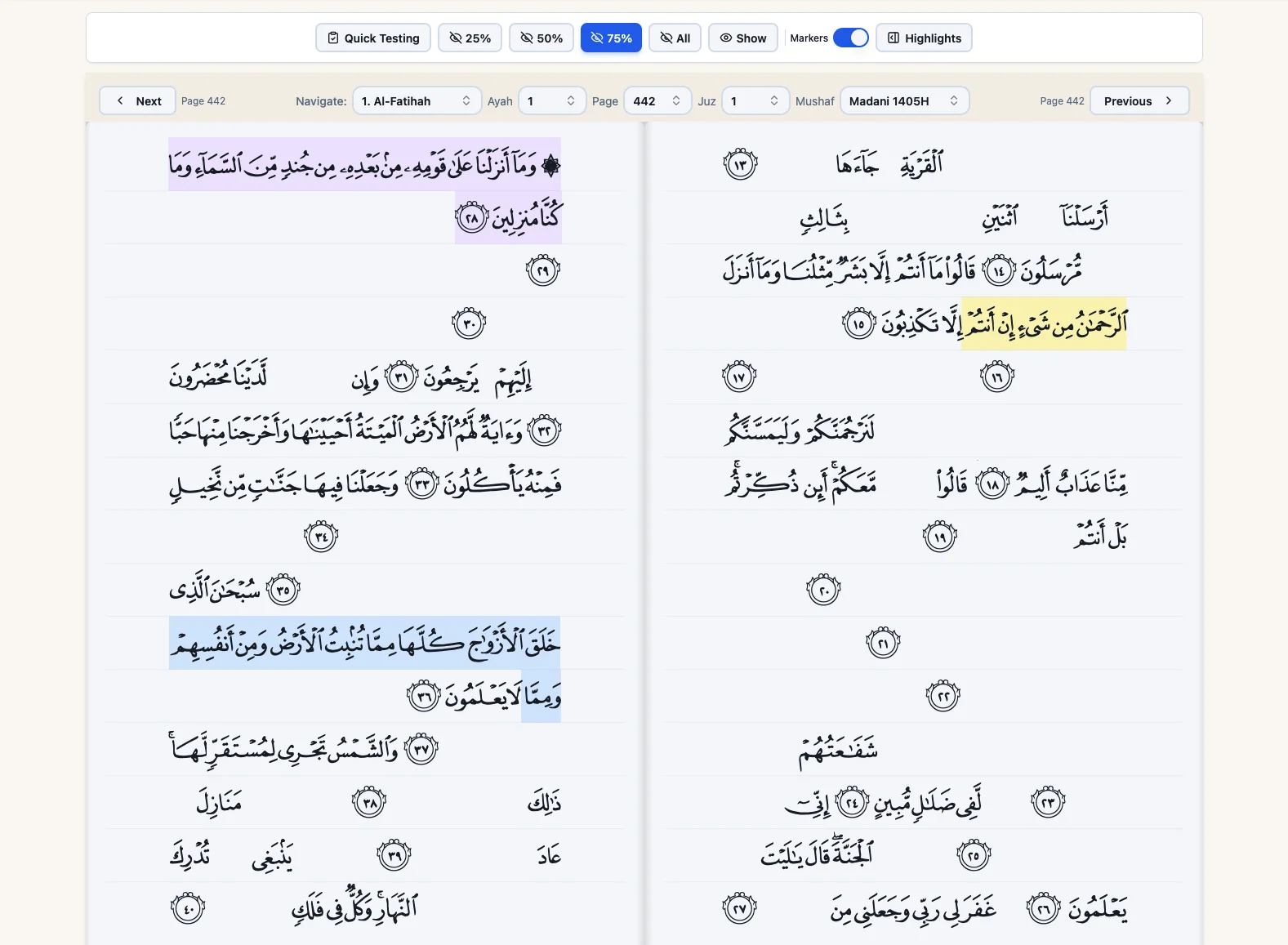
If you memorize with him, our Listen & Identify mode uses his recitation. You hear a short clip and name the surah, which is a good check that you know your surahs by ear as well as by sight.
6. Abdul Basit Abdus-Samad (murattal)
Most people know Abdul Basit from his mujawwad recordings and the remarkable breath control in them. His murattal is calmer, but you can still hear it in the long, resonant madd that leave no doubt about how many counts they get. At 8 minutes for Al-Mulk, it’s one of the slower murattal recordings we timed.
It’s excellent for hearing madd lengths clearly. It’s harder to copy, simply because few of us have that range. If you find yourself straining to match him, memorize with Al-Minshawi and keep Abdul Basit for listening.
7. Khalifa al-Tunaiji
A clean Emirati recitation with very little ornament, at about 7 minutes for Al-Mulk. Less famous than the names around it, and that’s part of the appeal: there’s nothing to distract you. A good everyday voice once you’re past the beginner stage.
8. Yasser ad-Dosari
A distinctive, heartfelt voice, now one of the imams of Masjid al-Haram, and one many people first heard through Taraweeh clips. About 6½ minutes for Al-Mulk. He’s lovely for revising surahs you already know by listening. For new memorization, his expressive style is a little harder to follow word by word.
9. Abu Bakr ash-Shatri
Calm and gentle, slightly quicker than Al-Minshawi, and very easy to listen to for a long stretch. If your revision happens on a commute or while your hands are busy with something else, this is a voice that won’t wear you out.
10. Hani ar-Rifai
Tender and emotional, at about 6 minutes for Al-Mulk. You can hear him feel the meaning, especially in the ayat of warning and of mercy, and some people find that makes a passage easier to remember. Better for reflective listening than for drilling new lines.
11. Abdur-Rahman as-Sudais
An imam of Masjid al-Haram for decades, and the voice many people hear in their heads when they think of Ramadan nights in Makkah. Brisk and forceful: 21 hours for the whole Quran, half of Al-Husary’s time. That makes him excellent for revising what you know and difficult for learning something new, unless you slow the playback down.
12. Saud ash-Shuraim
The quickest recitation we timed: Al-Mulk in about 4½ minutes, the whole Quran in 18 hours. It’s fluent hadr with every rule in place, and once a surah is solid it makes a fast, honest check. If you can keep up with Ash-Shuraim from memory, that surah is in good shape.
Which reciter for which stage
- Just starting, or still learning to read: Al-Husary’s teaching recording, then his murattal.
- Memorizing steadily and reading fluently: Al-Husary or Al-Minshawi.
- Children: Al-Minshawi with children.
- Daily revision: Alafasy, Ash-Shatri or As-Sudais.
- Covering a lot of revision quickly: Ash-Shuraim.
- Preparing to lead Taraweeh: practice alongside the reciter whose pace you want, then recite the same portion with no audio at all.
One reciter or several?
For the passage you’re memorizing, one. Your memory stores the rhythm along with the words. Change voices halfway through a surah and you’ll notice the seams later: a spot where you always hesitate, usually right where the recording changed.
For revision, mix them. Hearing a familiar surah in an unfamiliar voice is a surprisingly good test. If you can still follow along word for word, you know that surah well.
Read next: memorizing the Quran by listening, for how to use audio step by step.
Questions people ask
Can I memorize from a mujawwad recording?
You can, but it’s harder than it needs to be. The repetitions and long pauses make it difficult to hold the order of the ayat, and you won’t recite that way yourself. Listen to mujawwad, memorize from murattal.
Is a fast reciter less correct?
No. Hadr is an accepted speed, and the reciters on this list observe the rules at every pace. Speed matters for learning: at a quick pace you can’t hear small details clearly enough to copy them, so start slow and speed up once you know the surah better.
Is it okay to slow down a recording?
Yes. 0.75× is usually enough to turn a quick reciter into a learning pace. Much slower than that and the audio starts to sound warped, and at that point a naturally slower reciter is the better choice.
A setup that works
- Choose one slow voice (Al-Husary or Al-Minshawi) for new memorization.
- Listen to the day’s passage three times with the mushaf open before you repeat anything.
- Choose one quicker voice (Alafasy, As-Sudais or Ash-Shuraim) for revision.
- Recite your revision from memory first, then play it back to check.
Pick one voice and give it a fair two weeks before you judge it. The right reciter is the one you’ll actually press play on tomorrow morning.