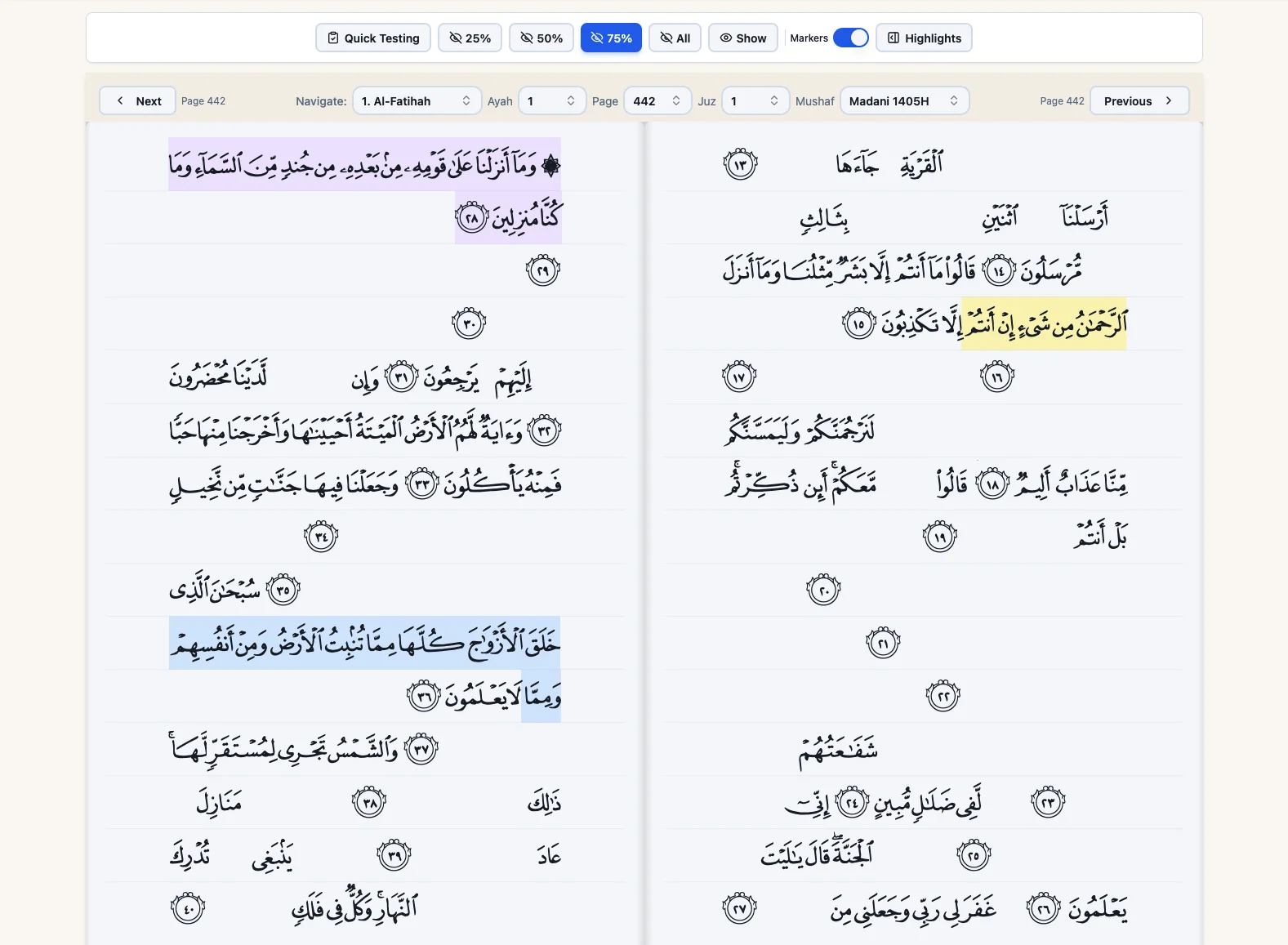
Ask a hafiz which mistakes they make most, and similar passages will be near the top of the list. You’re reciting smoothly through one surah, hit a phrase that also appears somewhere else, and suddenly you’re in the wrong surah without noticing. These near-identical passages are called mutashabihat, and every student of hifz has to deal with them sooner or later.
They respond well to a specific kind of practice. Repeating the passage more doesn’t usually fix it. Pinning down the exact difference, then practicing it in context, does.
Why similar passages are so hard
Memory works partly by association. When you reach a familiar phrase, your mind reaches for what usually comes next. If the same phrase appears in two places, your memory has two possible continuations, and it tends to pick whichever one you’ve practiced more.
That’s why another round of repetition doesn’t solve it. You become more familiar with the passage, but you never train yourself to choose correctly at the point where the two paths split.
Step 1: Find the exact point where you switch
Before you collect lists of similar ayat, look at your own mistakes. Next time you slip, ask your teacher or listener to stop you at the first word that’s wrong. Then work out what happened:
- Did you swap a single word, like a name or a preposition?
- Did you jump into another passage and carry on from there?
- Did you add or drop a phrase that exists in the other version?
These are different problems. A note that says “I mix up these two pages” won’t help much. A note that says “In 26:124 the name is Hud, not Nuh” will.
Step 2: Compare the two places side by side
A simple example: one name
Surah Ash-Shu’ara tells the stories of several prophets with almost the same wording. Here are the openings of the accounts of Nuh and Hud:
إِذْ قَالَ لَهُمْ أَخُوهُمْ نُوحٌ أَلَا تَتَّقُونَ
إِذْ قَالَ لَهُمْ أَخُوهُمْ هُودٌ أَلَا تَتَّقُونَ
Only the name changes. The ayat that follow are also identical in places: 26:107 and 26:125 are word for word the same. So what tells you which story you’re in?
Use the ayah before
The ayah before each one names the people: Nuh’s people in 26:105, and ‘Ad in 26:123. If you always practice starting one ayah earlier, the context tells you which name comes next. That’s far more reliable than trying to remember the name in isolation.
A harder example: several small differences
Al-Baqarah 2:136 and Al Imran 3:84 are very close, but differ in four places:
| Al-Baqarah 2:136 | Al Imran 3:84 |
|---|---|
| قُولُوٓا۟ (say, plural) | قُلْ (say, singular) |
| أُنزِلَ إِلَيْنَا | أُنزِلَ عَلَيْنَا |
| أُنزِلَ إِلَىٰٓ إِبْرَٰهِـۧمَ | أُنزِلَ عَلَىٰٓ إِبْرَٰهِيمَ |
| وَمَآ أُوتِىَ ٱلنَّبِيُّونَ | وَٱلنَّبِيُّونَ |
A useful way to remember: Al-Baqarah has “ila” twice and repeats “wa ma utiya”. Al Imran has “‘ala” twice and doesn’t repeat it. Whatever pattern helps you, write it down.
Another classic pair
The command to Adam and his wife appears in Al-Baqarah 2:35 and Al-A’raf 7:19. Al-Baqarah begins “wa qulna ya Adam” and says “wa kula minha raghadan haythu shi’tuma”. Al-A’raf begins simply “wa ya Adam” and says “fa kula min haythu shi’tuma”, without “minha raghadan”.
Step 3: Write it down
Keep a small notebook just for similar passages. For each pair:
- Write both references.
- Write the two versions one above the other.
- Underline or circle every difference.
- Add any memory aid that helps you, clearly marked as your own aid. (A mnemonic helps you remember. It doesn’t explain why Allah chose those words. For that, read tafsir or ask a teacher.)
Writing is especially good for this kind of mistake, because it forces you to notice every letter. There’s more on that in Memorizing the Quran by Writing It.
Step 4: Practice each passage in context
Now practice each passage on its own, starting a few ayat before the point where you usually switch and continuing a few ayat after. The aim is to make the correct path feel natural when you approach the fork.
Don’t drill the different word in isolation. You might be able to say “Hud” when asked, but still say “Nuh” when you reach that point mid-recitation.
Step 5: Test it fairly
Once each passage is solid separately, test them together. Ask someone to start you at a point a few ayat before the fork in one of the passages, without telling you which.
Make sure the starting point actually identifies the passage. If they start you on 26:107, which is identical to 26:125, you have no way of knowing which story they meant. That’s a bad test, and getting it “wrong” tells you nothing. Start from an ayah that’s unique to one passage.
The mutashabihat mode in the Quran Memorizer app works this way: it highlights a phrase that appears in more than one place and asks which ayah you’re actually looking at, with enough context to make the question fair. It covers more than 70 groups of commonly confused phrases.
Step 6: Revisit after a gap
Check the pair again a few days later and then a couple of weeks later. If you still choose correctly after a gap, the fix has held. If not, go back to step 4.
Once a pair is solid, let it return to your normal revision. You don’t need to drill it forever, just keep an eye on it. A Hifz Revision Plan for the Pages You Keep Forgetting explains how to keep weak spots in view without letting them take over your whole revision.
A note on patience
Mutashabihat take time. Even experienced huffaz still have pairs they need to watch. Each pair you sort out is one less place where you’ll end up in the wrong surah.
More guides: How to keep a hifz mistake log · You remember the ayah but not the surah