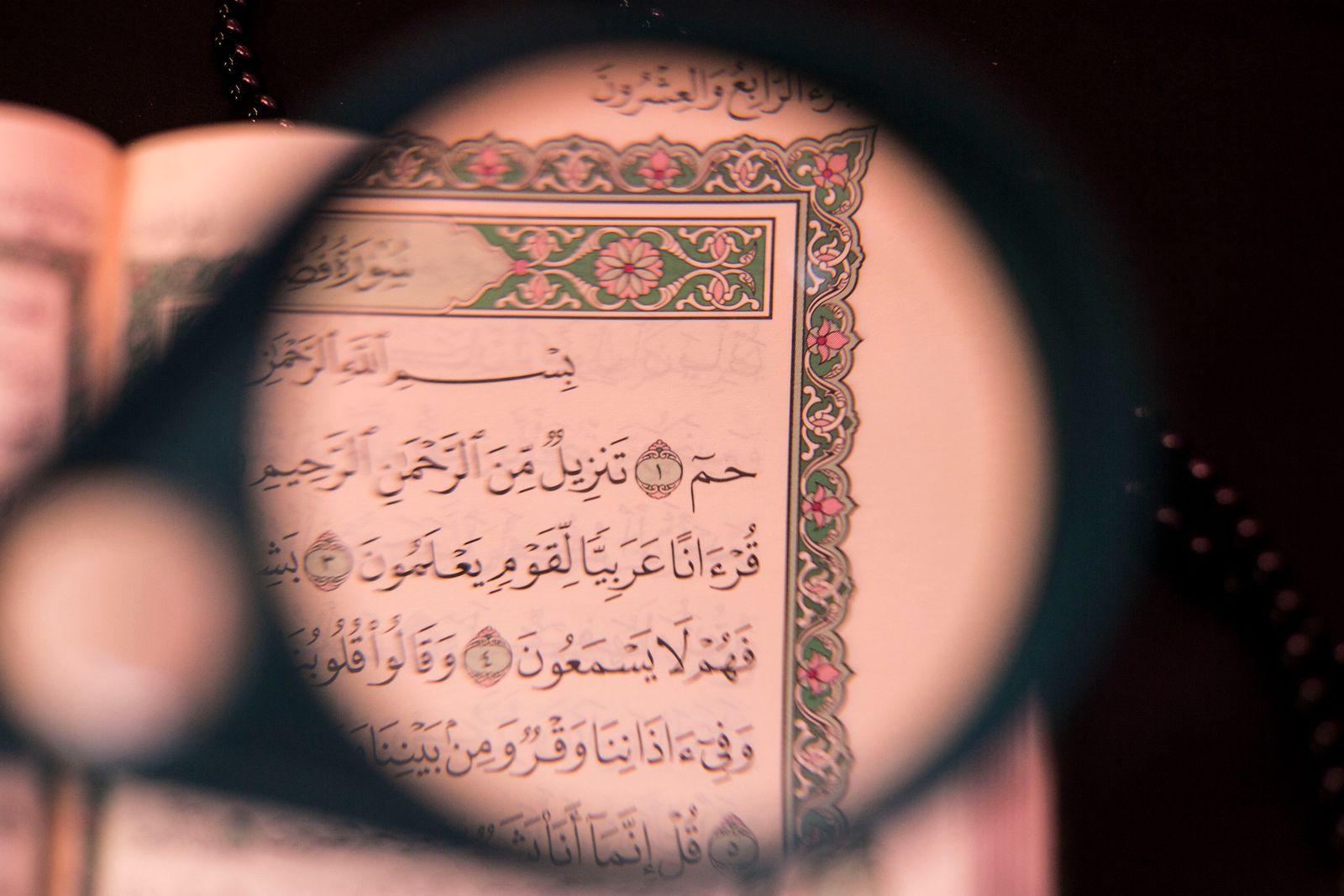
Most hifz test questions fall into eight kinds, and one of them dominates: “carry on from here”. The rest test what reciting from the top never shows you: what came before, which surah you’re in, how an ayah ends, the similar-ayah traps, where an ayah sits on the page, the order of the surahs, and holding steady across a page break.
Every page number below is from the 604-page Madani mushaf (15 lines a page), so you can check each example in your own copy. For the ways to run a test (a listener, a recording, salah, writing it out), see our guide to ten ways to test your hifz.
At a glance
- The core question: “carry on from here”, starting at an ayah, a ruku, a page, a surah or a juz.
- The checks on the joins: what comes before, what comes next, and which surah you’re in.
- One real exam (NED University, Karachi, 2026): three starting points, one from each third of the Quran, half a page to a page each time.
- Juz Amma for practice: 37 surahs, 564 ayat, 23 pages (582 to 604), 40 to 60 minutes to recite in full.
- What a quiz can’t check: pronunciation and fluency. Those still need someone listening.
What does a real hifz exam look like?
Formats vary between madrasas, competitions and universities, so it helps to look at one that’s written down. NED University of Engineering and Technology in Karachi gives extra merit to hafiz applicants, and its 2026 rules for the Hifz-ul-Quran examination spell out how the test runs. It’s one university’s exam, but it’s a useful model because every step is on paper.
- The Quran is split into three sections: juz 1 to 10, 11 to 20 and 21 to 30. You get one question from each.
- The questions sit in sealed envelopes and the student picks one.
- A question can be the beginning of a juz, a ruku or a surah, and you continue reciting from there.
- The examiner may ask for anything from half a page to a full page.
- You’re expected to begin within a reasonable time. Long pauses can count as weak retention. Some prompting is allowed, but repeated prompts may earn you an extra question.
- You have to pass all three sections. Miss a question and you get another from the same section, so a strong candidate normally answers three, and a weaker one may be given four to six.
- The result is Pass or Fail. There are no marks.
Competitions add scoring. The ADAMS Center in Virginia published its 2026 Quran competition rules with 100 points per contestant: 75 for memorization (25 for each of three passages), 15 for pronunciation and 10 for tarteel and voice. Knowing the name of the surah counts toward the memorization score. A warning costs half a point and a correction costs a full one.
Not every big competition is built on questions at all. As of October 2026, the Dubai International Holy Quran Award asks entrants, who must have memorized the whole Quran, for a three-minute recitation video, then brings finalists to Dubai to lead taraweeh at major mosques there, with a public vote deciding the winners (Khaleej Times, July 2026). That rewards voice and tajweed. The questions below are what you’ll meet in a classroom.
Your teacher’s weekly test will be smaller and friendlier, but it’s made from the same parts.
What questions are asked in a hifz test?
We’ve used Juz Amma for every example because it’s the part most learners memorize first, and because it’s packed with near-identical ayat. Ask a friend to read the Arabic prompts aloud, or cover the answers and test yourself. Translations are Saheeh International, quoted from quran.com.
1. “Carry on from here”
The teacher reads the opening words of an ayah and stops. You pick up the recitation and carry on until told to stop. A good starting point in An-Naba is ayah 31:
إِنَّ لِلْمُتَّقِينَ مَفَازًا
“Indeed, for the righteous is attainment…” (An-Naba 78:31, Saheeh International). It opens page 583, and it’s where the surah turns from punishment to the reward of the righteous. People who’ve only ever recited An-Naba from ayah 1 often stall here for a second or two, because they’ve never started cold in the middle. They know the words; they just don’t have the run-up.
A shorter version: the teacher reads Al-Ghashiyah 88:17, “Then do they not look at the camels – how they are created?”, and you give 88:18:
وَإِلَى ٱلسَّمَآءِ كَيْفَ رُفِعَتْ
“And at the sky – how it is raised?” Then the mountains and the earth follow, in that order.
To practice, open your mushaf anywhere you’ve memorized, read the first two words of an ayah, close it, and recite five ayat. Do that from ten different places and you’ll find the cold starts quickly. Our guide to reciting from a random ayah goes deeper on this one.
2. “What comes before this?”
Now the teacher reads an ayah and asks for the one before it. It sounds easy, and it’s often the question that catches people, since nobody recites backwards. Try ‘Abasa 80:24:
فَلْيَنظُرِ ٱلْإِنسَـٰنُ إِلَىٰ طَعَامِهِۦٓ
“Then let mankind look at his food…” The ayah before is 80:23:
كَلَّا لَمَّا يَقْضِ مَآ أَمَرَهُۥ
“No! He [i.e., man] has not yet accomplished what He commanded him.”
Al-Fajr gives an easier one. The prompt is 89:28, “Return to your Lord, well-pleased and pleasing [to Him],” and the answer is 89:27, “[To the righteous it will be said], ‘O reassured soul,’” which opens يَـٰٓأَيَّتُهَا ٱلنَّفْسُ. This one’s easier, because the call comes before the instruction, and the meaning carries you back.
That’s the practice method too. Go through a surah from the last ayah to the first, saying the ayah before each one and noticing why it comes first. Our piece on next-ayah and previous-ayah practice has a full drill for strengthening those joins.
3. “Which surah is this from?”
The examiner reads an ayah and you name the surah, sometimes with the ayah number or the juz. Short, rhetorical ayat are the hardest to place, and Juz Amma has a whole family of them. The question مَآ أَدْرَىٰكَ مَا (“what can make you know what is…”) appears ten times in juz 30, nine of them opening with وَ (“and”):
- يَوْمُ ٱلدِّينِ, the Day of Recompense: Al-Infitar 82:17, then again straight after in 82:18, which opens with ثُمَّ (then) instead of وَ.
- سِجِّينٌ and عِلِّيُّونَ: both in Al-Mutaffifin, at 83:8 and 83:19.
- ٱلطَّارِقُ, the night comer: At-Tariq 86:2.
- ٱلْعَقَبَةُ, the difficult pass: Al-Balad 90:12.
- لَيْلَةُ ٱلْقَدْرِ, the Night of Decree: Al-Qadr 97:2.
- ٱلْقَارِعَةُ and then هِيَهْ: Al-Qari’ah 101:3 and 101:10.
- ٱلْحُطَمَةُ, the Crusher: Al-Humazah 104:5.
The word after “mā” is your clue. Only three of the ten contain the surah’s own name (At-Tariq, Al-Qadr and Al-Qari’ah), so a teacher who wants to test you is more likely to pick one of the others. Al-Humazah 104:5 is the classic trap: the ayah says al-hutamah, and under pressure it’s easy to answer “Al-Hutamah”. There’s no such surah. If you know juz 29 as well, add Al-Haqqah 69:3, Al-Muddaththir 74:27 and Al-Mursalat 77:14 to the set.
To practice, say the surah name out loud every time you begin a revision portion, and again whenever you cross into a new one. If you can recite an ayah perfectly and still can’t say where it’s from, read why you remember the ayah but forget the surah.
4. “How does this ayah end?”
The teacher reads the start of an ayah and you supply the ending, often just the last word. Al-A’la is good practice because its endings rhyme on the same long “ā”: 87:1 ends ٱلْأَعْلَى (the Most High), 87:2 ends فَسَوَّىٰ (and proportioned), 87:3 ends فَهَدَىٰ (and guided). When every ending sounds alike, the rhyme stops helping, and you need to know which verb goes where.
Some teachers push this further and ask for the vowel on the final letter, as you’d say it if you joined the ayah to the next one instead of stopping. That checks you know the grammar of the ending as well as its sound. The drill is short: before moving on to the next ayah, say the last word of the current one out loud. It helps you get into the next ayah.
5. “What comes next?” when the ayah appears twice
This is the trap question, built on mutashabihat (ayat that are identical or nearly so). The teacher reads an ayah that appears in two places and waits to see which road you take. The clearest example in Juz Amma sits on two consecutive pages:
إِنَّ ٱلْأَبْرَارَ لَفِى نَعِيمٍ
“Indeed, the righteous will be in pleasure…” It’s Al-Infitar 82:13 on page 587 and Al-Mutaffifin 83:22 on page 588, word for word. In Al-Infitar the next ayah turns to the opposite group:
وَإِنَّ ٱلْفُجَّارَ لَفِى جَحِيمٍ
“And indeed, the wicked will be in Hellfire.” In Al-Mutaffifin it stays with the righteous:
عَلَى ٱلْأَرَآئِكِ يَنظُرُونَ
“On adorned couches, observing.” A good examiner will read the ayah without telling you which surah it’s from.
Three more to have ready:
- “On adorned couches, observing” itself appears twice inside Al-Mutaffifin, at 83:23 and 83:35. Start from the second one and it’s easy to loop back into the first.
- Al-Inshiqaq 84:25 and At-Tin 95:6 differ by one letter. Al-Inshiqaq has lahum ajrun (لَهُمْ أَجْرٌ); At-Tin has falahum ajrun (فَلَهُمْ أَجْرٌ).
- An-Nazi’at 79:34 and ‘Abasa 80:33 both open fa-idha ja’ati (“But when there comes”). An-Nazi’at continues with at-tammatul-kubra, the greatest Overwhelming Calamity; ‘Abasa continues with as-sakhkhah, the Deafening Blast. Adjacent surahs, consecutive pages.
The fix is to learn each pair together and attach one detail to each side. Al-Infitar puts the two groups in back-to-back ayat (82:13 and 82:14), so the righteous are followed straight away by the wicked. In Al-Mutaffifin the righteous get a whole passage, so the next ayah stays with them. Write the pairs side by side in a notebook. Our guide to similar Quran verses lays out the full method.
6. “Which ayah opens page 583?”
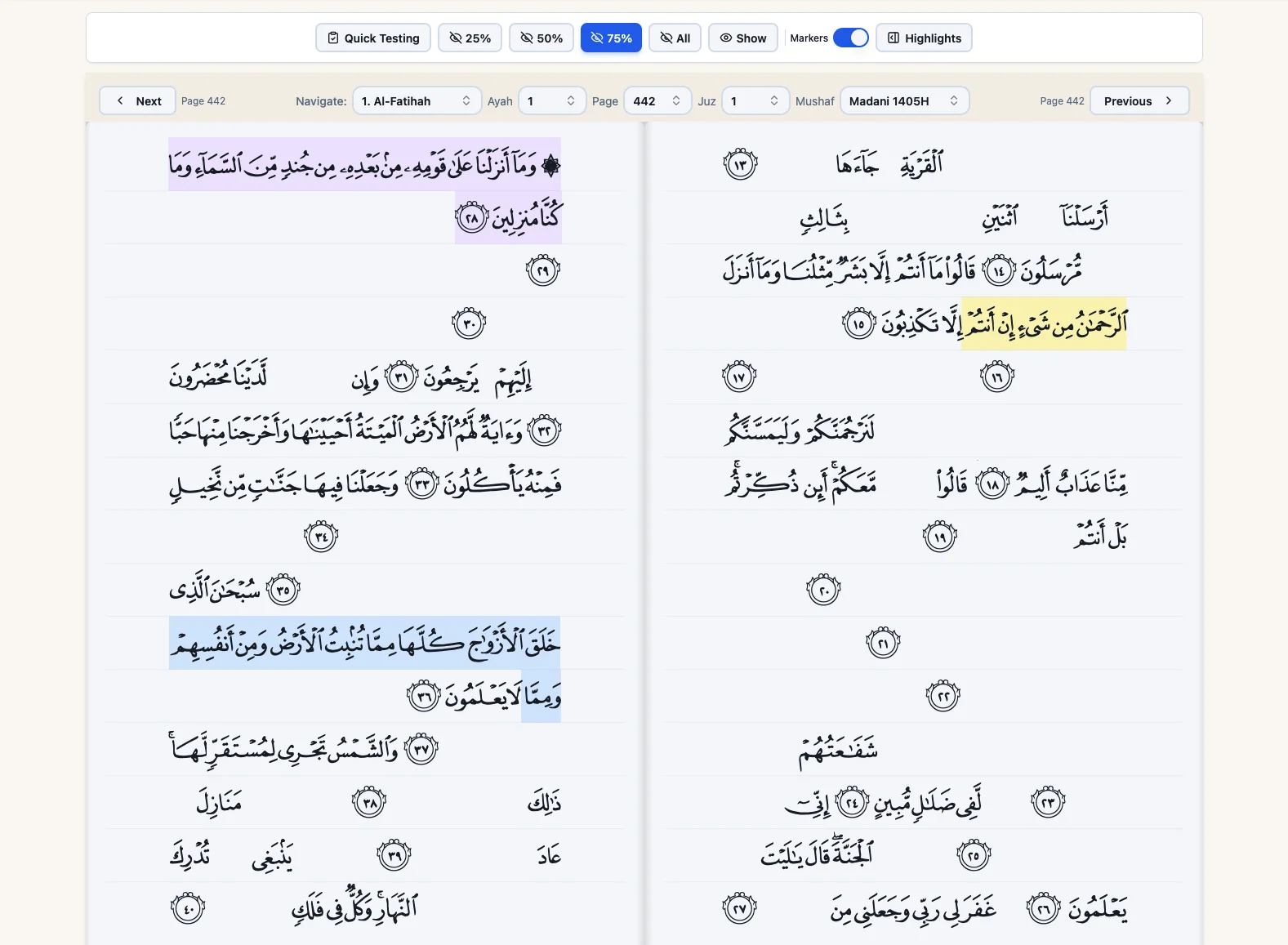
Page questions test visual memory of the mushaf, which some huffaz rely on more than they realize. Expect “which ayah opens this page?”, “what’s on the last line?” or “is this near the top or the bottom?” Here’s the first ayah on every page of Juz Amma:
| Page | First ayah on the page |
|---|---|
| 582 | An-Naba 78:1 |
| 583 | An-Naba 78:31 |
| 584 | An-Nazi’at 79:16 |
| 585 | ‘Abasa 80:1 |
| 586 | At-Takwir 81:1 |
| 587 | Al-Infitar 82:1 |
| 588 | Al-Mutaffifin 83:7 |
| 589 | Al-Mutaffifin 83:35 |
| 590 | Al-Buruj 85:1 |
| 591 | At-Tariq 86:1 |
| 592 | Al-A’la 87:16 |
| 593 | Al-Fajr 89:1 |
| 594 | Al-Fajr 89:24 |
| 595 | Ash-Shams 91:1 |
| 596 | Al-Layl 92:15 |
| 597 | At-Tin 95:1 |
| 598 | Al-Qadr 97:1 |
| 599 | Al-Bayyinah 98:8 |
| 600 | Al-‘Adiyat 100:10 |
| 601 | Al-‘Asr 103:1 |
| 602 | Quraysh 106:1 |
| 603 | Al-Kafirun 109:1 |
| 604 | Al-Ikhlas 112:1 |
Look closely at the surahs that start a page. Ten of them have their title at the top: An-Naba, At-Takwir, Al-Buruj, Al-Fajr, At-Tin, Al-Qadr, Al-‘Asr, Quraysh, Al-Kafirun and Al-Ikhlas. Four more (‘Abasa, Al-Infitar, At-Tariq and Ash-Shams) have their title on the last line of the page before, so their page opens with the basmala. That’s a classic page-position question in itself.
The rest start somewhere in the middle of a page, so a question like “where does Al-A’la begin?” has a less obvious answer. Its title sits on line 8 of page 591 and its first ayah on line 10, straight after the 17 ayat of At-Tariq.
Tip: Page 589 opens with Al-Mutaffifin 83:35, the second “On adorned couches, observing”. If you picture that line at the top of a fresh page, it’s much harder to confuse it with 83:23, which sits in the middle of page 588.
7. “Which surah comes after Al-Buruj?”
Order questions are quick, and they suit younger children well. After Al-Buruj (85) comes At-Tariq (86). Before Al-Fajr (89) is Al-Ghashiyah (88). After Ad-Duha (93) comes Ash-Sharh (94). They matter more than they look, because a student who knows the order can recover the next surah’s opening when a long recitation runs past the end of one.
Practice by reciting the names from An-Naba (78) to An-Nas (114), then backwards, then from a random number. Five minutes on the bus is plenty.
8. “Recite across the page break”
This is what a formal exam question really asks for: a long stretch from a cold start, and a long stretch nearly always crosses a page. It shows whether your pace holds and whether you stop mid-ayah to search for words. Page breaks are where weak spots show.
If you memorized from a printed mushaf, the turn of the page is a small gap in your memory as well. The last line of one page and the first line of the next were never in front of you at the same time. Look at the table above: page 584 starts at An-Nazi’at 79:16, one ayah into the story of Musa, which opens on the last line of page 583. Page 592 starts at Al-A’la 87:16, near the end of the surah. A teacher who wants to see how solid you are will start you two lines before one of those breaks.
Practice by reciting from the last two lines of one page into the first two lines of the next, without turning over. Then record yourself once a week reciting a whole page and the one after. The pauses you don’t notice while reciting are obvious on playback.
How is a hifz test marked?
Teachers and judges listen for four things.
- Getting started. A quick start shows the ayah is there. NED’s rules expect you to begin within a reasonable time, and a long silence before the first word can read as weak retention, even if what follows is perfect.
- Prompts. When you stall, the teacher feeds you the next word or two. In Urdu this is giving a luqmah; in Arabic it’s called fath. One prompt in a long passage is normal. Three in half a page tells the teacher the passage needs work.
- Corrections. If you go wrong and fix it yourself straight away, it usually counts for less than a correction from the teacher. The ADAMS rules, for example, take off a full point for a correction and half a point for a warning.
- Recitation quality. Tajweed, clear letters and a steady pace. This is the part a teacher or partner has to hear.
Asked whether someone who makes mistakes can still be called a hafiz, Mufti Ebrahim Salejee of Isipingo Beach, South Africa, answered yes. A test shows you where to revise.
How can you practice these questions on your own?
Reciting to a listener is the oldest test there is. Jibril reviewed the Quran with the Prophet ﷺ every Ramadan (Sahih al-Bukhari 4997), and huffaz have recited to one another ever since. The Quran describes itself as preserved in people’s hearts:
“Rather, it [i.e., the Qur’ān] is distinct verses [preserved] within the breasts of those who have been given knowledge. And none reject Our verses except the wrongdoers.”
Al-‘Ankabut 29:49, Saheeh International translation. Compare translations on quran.com
Between lessons, though, there isn’t always someone free to test you. A few ways round that:
- Make your own hifz test sheet. One you write yourself covers exactly what you’ve memorized. Write 20 ayah references on slips of paper, spread across your hifz, and mix in the trap pairs from question 5. Draw three a day and answer each one aloud before checking.
- Hand this page to someone. A parent, sibling or friend doesn’t need to be a hafiz to read the Arabic prompts and follow along in a mushaf while you answer.
- Test yourself silently. On a train or in a library, write the answer on paper or use a tap-to-answer quiz.
Quran Memorizer’s test modes ask questions 2 to 6 in this guide: the ayah before or after, how an ayah begins and ends, which surah, similar ayat and the mushaf page. You set the scope, from a few ayat to a surah or a juz, so Juz Amma on its own works. Try it in the web test. For questions 1 and 8, carry on reciting to a person.
Questions people ask
How many questions are in a hifz test?
It depends on who’s testing. NED University’s 2026 exam asks three questions, one from each third of the Quran, and gives another from the same section if you miss one. A strong candidate normally answers three, and a weaker one may be given four to six. A weekly madrasa test might be two or three starting points from recent lessons.
Can you fail a hifz test because of one mistake?
Usually not. NED’s examiners may give a limited prompt, and a quick self-correction generally counts for less than a teacher’s correction. What fails a question is a long silence at the start, repeated prompts, or getting lost in a passage. NED gives you another question from the same section before deciding.
Which hifz test question is the hardest?
For many learners it’s the similar-ayah trap, because your memory offers two correct continuations and only one fits. “What comes before?” is a close second, because almost nobody practices backwards. Both get easier with deliberate practice on the pairs in this guide.
How long does a hifz test take?
Each NED-style question is half a page to a page, which is roughly one to three minutes of recitation. Three questions with the pauses between them take ten minutes or so. Reciting all of Juz Amma takes 40 to 60 minutes, so a whole-juz test is a separate sitting.
Before your next test
Pick the two question types you dread and practice only those this week. For a lot of people that’s the backward join and the trap pairs. If you’d like the weak ayat chosen for you, Quran Memorizer’s Daily Review (Premium) builds each session from your own answers, so the ones you miss come back first. Start with the backward joins in one surah tonight, and test the trap pairs again on Friday.