There’s a big difference between recognizing a passage and being able to recite it. When you read a page you memorized, it feels familiar, and familiarity feels like knowledge. The only way to find out what you actually know is to test it with the mushaf closed.
Testing also strengthens memory. In a well-known experiment, students who tested themselves on a passage remembered far more of it a week later than students who spent the same time rereading (Roediger and Karpicke, 2006). So a good hifz test is also good revision.
Here are ten ways to test yourself, roughly from the most common to the most demanding, and what to do with what you find. Several of them you can try right now in our free online Quran memorization test.
1. Recite to a listener
This is the classic test, and it’s still the best one. Someone follows in the mushaf while you recite from memory. Ask them to let you pause briefly before prompting, so you get a chance to recover on your own. Note every place they had to help.
A teacher will catch tajweed mistakes as well as memory errors. A family member who reads well will still catch skipped words, swapped ayat and wrong endings.
2. Record yourself
Recite a page into your phone, then play it back while following in the mushaf. You’ll hear mistakes you didn’t notice in the moment, especially small ones like a dropped “wa” or a changed vowel. This is the best option when nobody is available to listen.
3. Start from a random ayah
Open the mushaf at a random page, read the first ayah, close it, and continue reciting. If you can only recite a surah from the beginning, you don’t know it as well as you think. Random starts expose that.
4. Say what comes next
Have someone read the end of an ayah and ask you to recite the next one. Or the reverse: they read an ayah and you say what came before it. These test the joins between ayat, which is where most hesitations happen.
5. Name the surah and ayah
Someone reads a phrase, and you say which surah it’s from and roughly where. This is especially useful for similar passages, where the same phrase appears in several places.
Make sure the phrase actually identifies one place. If a listener reads a phrase that appears identically in two surahs, you can’t know which they meant, and “getting it wrong” tells you nothing.
6. Recite in salah
Prayer is a demanding test because there’s no mushaf and no prompt. Use your recent lessons in sunnah prayers and older juz in night prayer. If a passage falls apart in salah, it needs work.
7. Recite a whole juz in one go
Once a week or so, recite a full juz from memory without stopping, then check it. Long recitations reveal weaknesses that short tests miss, like fatigue in the middle of a juz or a page you always rush.
8. Write it out
Write a page from memory, then compare it word by word with the mushaf. This is the strictest test there is, because you can’t blur over a word you’re unsure of. It’s slow, so save it for pages that keep giving trouble. Memorizing the Quran by Writing It has more on this.
9. Hide the page
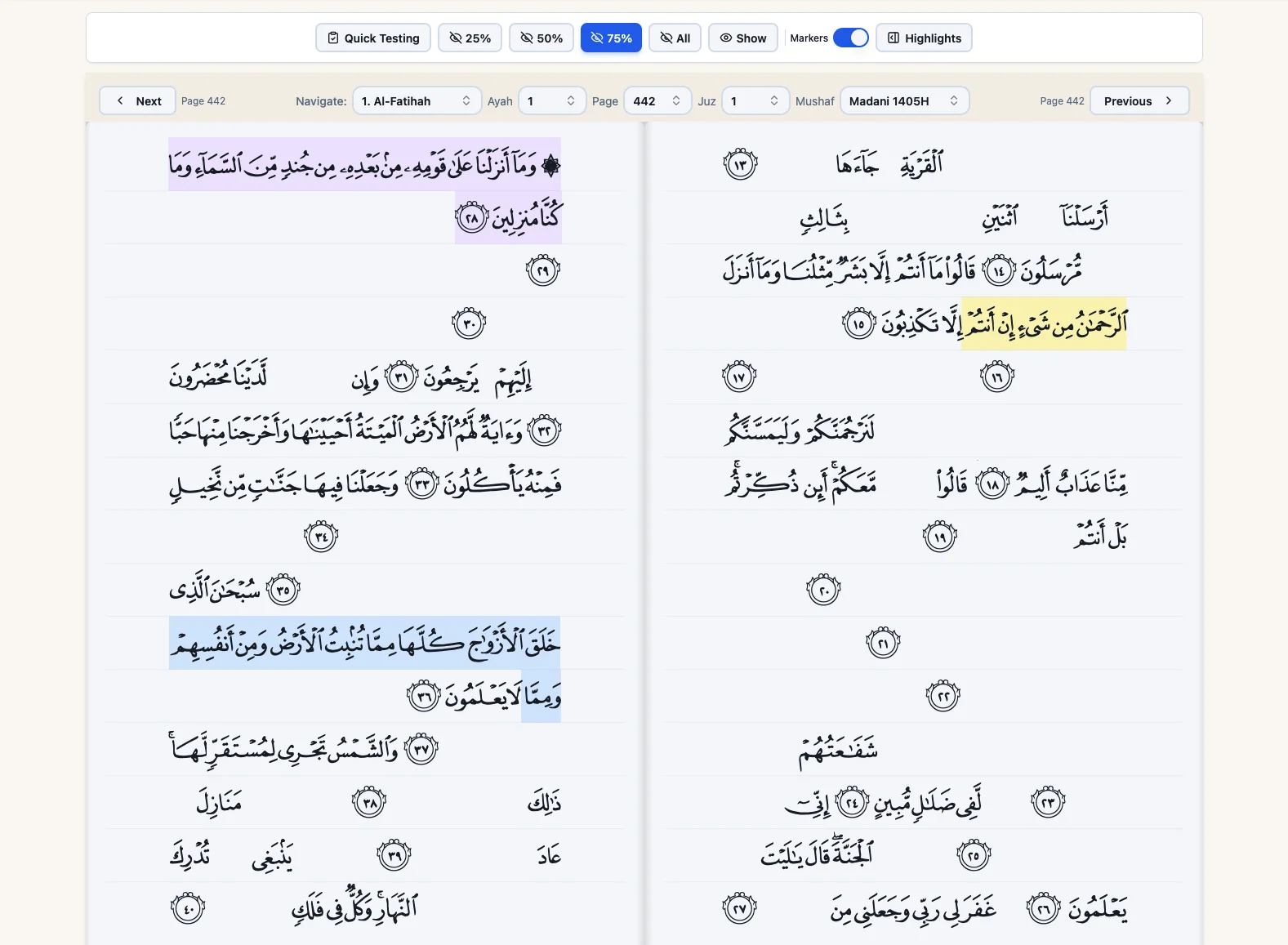
Cover part of the mushaf page, recite the hidden part, then uncover it to check. The Quran Memorizer app does this digitally, hiding 25%, 50%, 75% or all of a Madani page, so you can test against the layout you memorized from.
10. Use varied quiz questions
Apps and question cards can test specific skills: completing an ayah, putting ayat in order, naming the surah, spotting the meaning of a word. The Quran Memorizer test mode asks many of these question types, from next and previous ayah to similar ayat, and shows which areas are weaker.
What quizzes can and can’t tell you
A quiz with answer choices lets you recognize and eliminate. Recitation makes you produce the words yourself, in order, without help. So you can score well on a quiz and still struggle to recite a passage smoothly. Both results are true. They’re measuring different things.
Use quizzes to find weak spots quickly, then follow up with recitation. After a quiz question, close the app and recite the surrounding passage from memory. And remember that a screen can’t hear your pronunciation. Get your recitation heard by someone qualified.
Turning results into a plan
Testing is only useful if you act on it. After each test:
- Mark every mistake in your mushaf with a light pencil dot, or note it in a notebook with the reference.
- Sort the mistakes by type: forgotten opening, weak join, similar passage, mispronunciation, or a whole section that’s vague.
- Fix the specific problem. A weak join needs the two ayat around it repeated together. A similar passage needs a side-by-side comparison. A vague section needs relearning.
- Retest after a gap. Check again a few days later. If the fix held, the dot can come off.
A Hifz Revision Plan for the Pages You Keep Forgetting explains how to fit these repairs into your regular revision without letting them take over.
How often to test
- Recent lessons: every day, as part of your daily review.
- Older material: as you revise it, which should mean every page gets tested every few weeks.
- A deeper test, like a full juz to a listener: once a week or once a month.
A simple test you do every day is worth more than an elaborate one you never get around to.
Questions people ask
Is there a free online hifz test?
Yes. Our free hifz test runs in any browser, including on Android phones, so there’s nothing to install. Choose a few ayat, a surah or a juz, and it asks you things like which ayah comes next, which surah a passage is from and which words are missing.
Is there a hifz test app?
Quran Memorizer is on iPhone and iPad, and the same tests work in the web app at app.quranmemorizer.com on Android phones and laptops. It’s one account across both, so your answers and progress follow you from one device to the other.
What questions do hifz teachers ask?
Mostly three kinds. They read the end of an ayah and you continue, they ask you to recite from a random point, and they read an ayah and ask what comes before it. Expect similar passages too, since that’s where students mix up surahs. There’s a longer list in our guide to hifz test questions.
How often should I test my hifz?
Test recent lessons every day. Test older pages as they come round in revision, so each one gets checked every few weeks. Once a week or once a month, do one deeper test, like a full juz recited to a listener.
More guides: Reciting from a random ayah: a spot-test routine · Next-ayah and previous-ayah practice · How to test your hifz without a partner · Preparing for your teacher’s spot test · How to test a juz before moving on