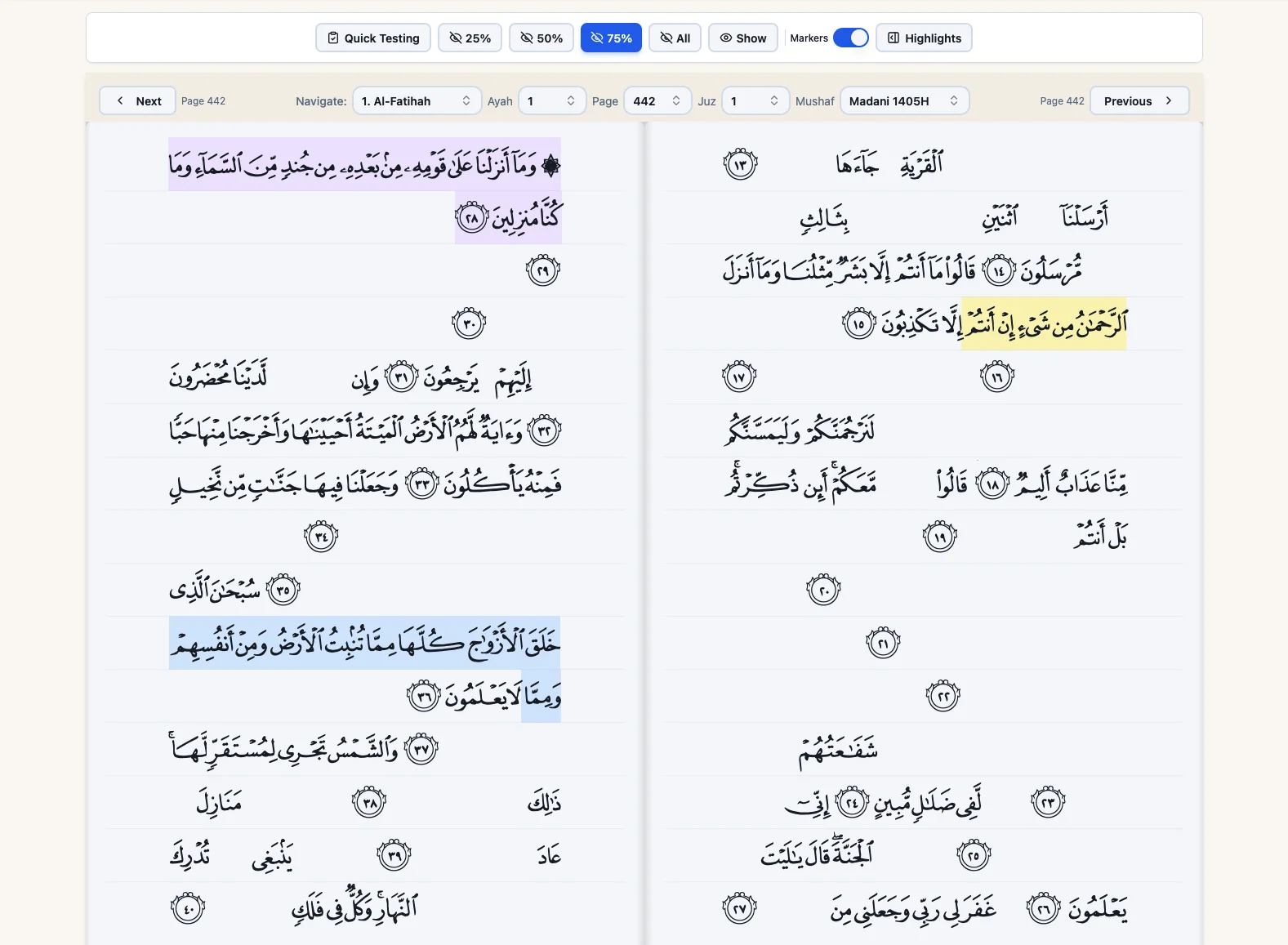

Surah Al-Jinn is 28 ayat on 28 lines of the Madani mushaf, pages 572 and 573, and at three or four lines a day you can memorize it in about ten days. The hard part is 72:3 to 72:14. Twelve ayat in a row open with wa annahu, wa annā or wa annahum, and the way through is one question: who is this ayah about? That decides the opener.
The whole surah takes about five and a half minutes with Mishary Alafasy, roughly two minutes shorter than Al-Mulk, which opens the same juz. What’s different here is the voice. Al-Jinn starts with “Say”, hands the floor to a group of jinn for fifteen ayat, returns to what was revealed to the Prophet ﷺ, then gives four more commands to “say” before it ends on what only Allah knows.
At a glance
- Surah: 72, Al-Jinn (الجن, “The Jinn”). Makkan.
- Where it sits: juz 29, pages 572 to 573 of the 604-page Madani mushaf, between Nuh (71) and Al-Muzzammil (73). The surah header and basmalah take lines 1 and 2 of page 572.
- Length: 28 ayat, 285 words, 28 lines of text: 13 on page 572 and all 15 on page 573.
- Time to recite: 3:44 with Saud ash-Shuraym, 5:30 with Mishary Alafasy, 9:09 with al-Husary’s teaching recitation (muallim).
- Time to memorize: 10 days at 3 to 4 lines a day, two of them review days. At 5 lines a day it’s 6 days of new lines, at half a page 4, at a full page 2, plus the two review days.
- The hard part: 72:3 to 72:14, about 2 minutes 25 seconds with Alafasy. It fills the rest of page 572, and its last ayah opens page 573.
Surah Al-Jinn at a glance
- Surah
- 72
- Juz
- 29
- Mushaf
- Pages 572 to 573
- Ayat
- 28
- Length
- About 1.9 pages
- Recited in
- about 6 minutes
How many days will it take?
| New lines a day | Days |
|---|---|
| 3 (a few lines) | 10 days |
| 5 (a third of a page) | 6 days |
| 7 (half a page) | 4 days |
| 10 (two thirds of a page) | 3 days |
| 15 (a full page) | 2 days |
Counts days of new memorization on the 28 lines of Surah Al-Jinn. Add revision on top. Make a day-by-day plan.
Test yourself
Memorized Surah Al-Jinn? Find the ayat you’re not sure of.
Quran Memorizer asks you what comes next, which ayah is missing and which look-alike ayah goes where, on the same Madani mushaf pages you learned from. With Premium, Daily Review brings your weakest ayat back first, so you can revise Surah Al-Jinn a little every day.

Free to start, no card needed. On the web or iPhone, choose Surah Al-Jinn as what you want to be tested on.
More on Surah Al-Jinn: All surah guides
Who’s speaking in each part of Surah Al-Jinn?
The first word sets up everything after it. Qul means “say”, so the surah opens as something the Prophet ﷺ is told to announce: it has been revealed to me that a group of jinn listened. Whatever the jinn say from there is reported inside that frame.
قُلْ أُوحِىَ إِلَىَّ أَنَّهُ ٱسْتَمَعَ نَفَرٌ مِّنَ ٱلْجِنِّ فَقَالُوٓا۟ إِنَّا سَمِعْنَا قُرْءَانًا عَجَبًا
“Say, [O Muḥammad], “It has been revealed to me that a group of the jinn listened and said, ‘Indeed, we have heard an amazing Qur’ān [i.e., recitation].”
Al-Jinn 72:1, Saheeh International translation. Compare translations on quran.com
Ibn ‘Abbas describes the morning behind it. The Prophet ﷺ had set out with some companions toward the market of ‘Ukaz, and the devils had been cut off from the news of the heaven, with flames sent against them. A group of jinn found him at Nakhla leading Fajr, listened to the recitation, and went back to tell their people. Then 72:1 was revealed, and the report closes with the line “The statement of the Jinns was revealed to him” (Sahih al-Bukhari 4921). On that occasion, Ibn ‘Abbas says, the Prophet ﷺ neither recited to the jinn nor saw them (Sahih Muslim 449). He learned what they’d said through this revelation.
Hold on to that story, because the jinn retell part of it themselves in 72:8 and 72:9: the sky they reached for was full of guards and flames, and the seats they used to listen from now have a flame waiting. Here’s the whole surah by speaker.
- 72:1, up to fa qālū (“and they said”). The Prophet ﷺ, told to report what was revealed to him. Page 572, line 3. (72:1 is split: the first half is the frame, the second half is the jinn.)
- 72:1 (from innā sami’nā) to 72:15. The jinn, speaking to their people, from line 3 of page 572 to line 2 of page 573. If you read along in Saheeh International, its quotation marks open at “Indeed, we have heard” and close at the end of 72:15.
- 72:16 to 72:19. What Allah revealed. Saheeh adds “[Allah revealed]” at 72:16 and “[He revealed]” at 72:18, and al-Baghawi notes that at 72:16 He turns to the disbelievers of Makkah. Listen for the change of “We”: in 72:16, la-asqaynāhum, “We would have given them” abundant rain, is Allah speaking. Page 573, lines 3 to 6.
- 72:20 to 72:25. The Prophet ﷺ again, told qul four times, at 72:20, 72:21, 72:22 and 72:25. The ruku division that quran.com records starts exactly at 72:20, which makes it a clean seam. Lines 6 to 12.
- 72:26 to 72:28. About Allah, Knower of the unseen, and the messengers He approves. No qul here. Lines 12 to 15, the bottom of the page.
Commentators discuss who “they” are in 72:19, the crowd that almost became a compacted mass around the servant of Allah when he stood up supplicating Him. Ibn Kathir lists three views: the jinn pressing close to hear him, the jinn telling their own people about it, or humans and jinn banding together against his message. That last one is Ibn Jarir’s choice, and Ibn Kathir calls it the most apparent, because of what comes next in 72:20. For memorizing, you only need the frame: 72:16 to 72:19 is what was revealed to the Prophet ﷺ, whoever the crowd in 72:19 turns out to be.
You’ll sometimes see Al-Jinn summed up as the jinn speaking in the first half and Allah addressing His Messenger in the second. It’s a handy shortcut, but the surah opens with qul, and the jinn’s words stop at 72:15, four ayat before the qul ayat begin. If you think in halves, 72:16 to 72:19 don’t fit anywhere. Give them their own section and they’re easy to place.
Which ayat start with wa anna, wa annahu and wa annā?
English spelling hides the difference, so start there. Wa anna means “and that”. Arabic attaches a pronoun to it, and that small ending is what you have to get right. Here’s every form in the surah:
- وَأَنَّهُۥ wa annahu (“and that he/it”): 72:3, 72:4 and 72:6 in the run, then once more at 72:19.
- وَأَنَّهُمْ wa annahum (“and that they”): 72:7 only.
- وَأَنَّا wa annā (“and that we”): 72:5, 72:8, 72:9, 72:10, 72:12 and 72:13.
- وَأَنَّا مِنَّا wa annā minnā (“and that among us”): 72:11 and 72:14.
- وَأَنَّ wa anna, with no pronoun at all: 72:18 only, wa annal-masājida lillāh.
Count them and the run from 72:3 to 72:14 holds twelve ayat: three wa annahu, one wa annahum and eight wa annā, two of which carry on with minnā. Its shape is hu, hu, nā, hu, hum, then seven nā in a row from 72:8 to 72:14. Learn that shape as a sequence of sounds before you memorize a single ayah of it.
Watch for three near-misses. Right after the run, 72:15 opens wa ammā (وَأَمَّا, “but as for”), a different word built on a mīm, and 72:16 opens wa allawi (وَأَلَّوِ), which is wa an law, “and that if”, written joined. Back at the start, 72:1 has annahu with no wa in front.
On the page, the first wa annahu (72:3) starts line 5 of page 572, right under the first two lines of text (72:1 and 72:2), and the run fills the rest of the page. Turn over and 72:14, wa annā minnā al-muslimūn, is the very first line of page 573.
How do you know which opener comes next?
Ask who the ayah is about, then check the word right after the opener. If the jinn are talking about themselves and the ayah goes on with a “we” word, it opens wa annā (“we”). If it names someone else, it opens wa annahu. Only when it goes straight on with a “they” verb is it wa annahum, and that happens once. It holds for every one of them from 72:3 to 72:19:
- The wa annā ayat all continue with “we” or “among us”: ẓanannā (we thought) in 72:5 and 72:12, lamasnā (we reached for) in 72:8, kunnā (we used to) in 72:9, lā nadrī (we don’t know) in 72:10, minnā (among us) in 72:11 and 72:14, and lammā sami’nā (when we heard) in 72:13.
- The wa annahu ayat name someone else: our Lord’s majesty in 72:3, “our foolish one” in 72:4, men from mankind in 72:6 and the servant of Allah in 72:19. 72:6 is the one to watch. It’s about a group of men, which sounds like “they”, but it names them with a noun, rijālun, so it takes annahu.
- The one wa annahum, 72:7, goes straight on ẓannū, “they thought”. It’s usually read as the men of 72:6, now as a pronoun.
Grammarians often explain the -hu in those four ayat as ḍamīr ash-sha’n, a pronoun that means something like “the matter is that”, which is why it doesn’t have to agree with what follows. You don’t need the grammar to use the pattern. Ask “who’s this about?” before you open your mouth, and you’ll know the opener.
Tip: 72:13 and 72:19 both put lammā (“when”) right after the opener, and they’re six ayat apart, so they’re easy to cross. The rule splits them at once: “when we heard” is wa annā lammā sami’nā (72:13), and “when the servant of Allah stood” is wa annahu lammā qāma (72:19).
What order do the wa anna ayat come in?
The pronoun gives you the opener. The order comes from meaning, so read 72:3 to 72:15 once in translation as a story before you memorize any of it. The list is numbered by ayah. The words in bold are what you say first; the rest is the clue that tells you where you are.
If you’re still reading with transliteration, follow along on quran.com/72 with word-by-word transliteration switched on, and use the bold opener words below as your checkpoints.
- Wa annahu ta’ālā. About our Lord: exalted is His majesty, and He hasn’t taken a wife or a son. Line 5.
- Wa annahu kāna yaqūlu. “Our foolish one” (Saheeh adds “[i.e., Iblees]”) kept saying outrageous things about Allah.
- Wa annā ẓanannā. We’d thought no human or jinn would ever tell a lie about Allah. The verb answers 72:4: yaqūlu, he kept saying, then taqūla, they would say.
- Wa annahu kāna rijālun. Men from mankind used to seek refuge with men from the jinn, and it only added to their burden, rahaqā.
- Wa annahum ẓannū. They thought, as you thought, that Allah would never send anyone. Ẓannū echoes ẓanannā from two ayat back.
- Wa annā lamasnā. We reached for the sky and found it full of guards and flames.
- Wa annā kunnā. We used to sit up there to listen; whoever listens now finds a flame lying in wait.
- Wa annā lā nadrī. So we don’t know whether harm is intended for those on earth or right guidance.
- Wa annā minnā aṣ-ṣāliḥūn. Some of us are righteous and some fall short; we were divided ways, qidadā.
- Wa annā ẓanannā. We’re certain we can’t defeat Allah on earth or escape Him by running.
- Wa annā lammā sami’nā. When we heard the guidance, we believed. It starts on line 14 and ends the page on line 15.
- Wa annā minnā al-muslimūn. Among us are Muslims, and among us the unjust, al-qāsiṭūn. First line of page 573.
- Wa ammal-qāsiṭūn. As for the unjust, they’ll be firewood for Hell. The jinn’s words end here.
The seven nā ayat, 72:8 to 72:14, get easier once you see that the story only moves forward. The jinn reach for the sky and find it guarded. They admit they don’t know what’s intended for the earth. They describe themselves honestly, accept there’s no escape from Allah, hear the guidance and believe, and then name the Muslims among them.
The page helps too. 72:8 starts on line 9 of page 572 and 72:13 finishes on line 15, so six of the seven sit at the bottom of one page, roughly one per line. The seventh, 72:14, is the first thing you see when you turn over. If you lose the order, picture where on the page you are.
Which ayat in the run get swapped?
Three pairs inside the run start with the same words. Spend your extra repetitions here.
وَأَنَّا ظَنَنَّآ أَن لَّن تَقُولَ ٱلْإِنسُ وَٱلْجِنُّ عَلَى ٱللَّهِ كَذِبًا
وَأَنَّا ظَنَنَّآ أَن لَّن نُّعْجِزَ ٱللَّهَ فِى ٱلْأَرْضِ وَلَن نُّعْجِزَهُۥ هَرَبًا
- 72:5 and 72:12 (above) match word for word up to lan. 72:5 is about what others say (taqūla) and ends kadhibā, a lie; it sits among the mixed openers. 72:12 is about the jinn themselves (nu’jiza, we can’t defeat) and ends harabā, by flight; it sits inside the seven nā.
- 72:11 and 72:14 both open wa annā minnā. 72:11 goes on to the righteous, aṣ-ṣāliḥūn, and ends qidadā. 72:14 goes on to the Muslims, al-muslimūn, and ends rashadā. A memory aid worth trying: 72:11 comes before “when we heard the guidance, we believed” in 72:13, and 72:14 comes after it, so the word “Muslims” belongs on the far side of believing. 72:14 also names al-qāsiṭūn, and 72:15 picks that word up again.
- 72:4 and 72:6 both open wa annahu kāna. 72:4 continues yaqūlu safīhunā, one fool talking. 72:6 continues rijālun, men, plural, seeking refuge. Talk first, then refuge.
Don’t use the English to separate 72:5 and 72:12. Saheeh International renders the same word, ẓanannā, as “we had thought” in 72:5 and “we have become certain” in 72:12, so the translation makes them look more different than the Arabic is.
The endings repeat too, so learn them in pairs. 72:6 and 72:13 both end rahaqā, though one is a wa annahu ayah and the other a wa annā. 72:10 and 72:14 both end rashadā. And aḥadā turns up five times in the surah, at 72:2, 7, 18, 20 and 26. Say the last word of each ayah aloud before the next opener and you’ll hear which pair you’re in.
If 72:5 and 72:12 still trade places after a week, that’s normal. The Prophet ﷺ said the one who falters in the Quran and finds it hard “will have two rewards” (Sahih Muslim 798a). For the general method of finding the exact word where two ayat part ways, see how to memorize similar verses without mixing them up.
What’s a good ten-day plan for Surah Al-Jinn?
Take three or four lines a day and the surah fits into ten days: eight days of new lines and two of review. The twelve ayat of the run are spread over the first five days, never more than three in one sitting. The split follows the openers. Day 4 finishes page 572 and day 5 opens page 573, and day 5’s revision runs across the turn, so 72:13 and 72:14 get joined while both are fresh.
Before each new lesson, listen to it about twenty times while following in the mushaf. A day’s portion lasts 35 to 47 seconds with Alafasy and 59 to 78 seconds with al-Husary’s teaching recitation, so that’s 12 to 16 minutes or 20 to 26. We’d learn with al-Husary and revise with Alafasy. At 9:09 for the surah, al-Husary gives you time to hear whether it’s annahu or annā; at 5:30, Alafasy is better for testing whether the whole thing flows.
- Day 1: 72:1 to 72:4 (page 572, lines 3 to 6). The frame, the jinn’s first words and the first two wa annahu. Before you start, say the shape of the run once so you know what’s coming.
- Day 2: 72:5 to 72:7 (lines 6 to 9). Revise 72:1 to 72:4 first. Name each opener out loud before you recite the ayah.
- Day 3: 72:8 to 72:10 (lines 9 to 12). Revise 72:1 to 72:7, and say the shape on its own: hu, hu, nā, hu, hum.
- Day 4: 72:11 to 72:13 (lines 12 to 15). Revise all of page 572 from memory. Two of today’s three are trap ayat (72:11 against 72:14 tomorrow, 72:12 against 72:5), so check how each one ends (qidadā, harabā) before you move on.
- Day 5: 72:14 to 72:17 (page 573, lines 1 to 4). Revise 72:3 to 72:15 as one piece, across the page turn.
- Day 6: 72:18 to 72:21 (lines 4 to 7). Revise 72:8 to 72:17. 72:18 is the only wa anna in the surah with no pronoun, so say wa annal-masājida slowly the first few times.
- Day 7: 72:22 to 72:24 (lines 7 to 11). Revise 72:14 to 72:21. 72:23 is the longest ayah in the surah, 16 words over lines 8 to 10, so give it a few extra repetitions of its own.
- Day 8: 72:25 to 72:28 (lines 11 to 15). Revise 72:16 to 72:24.
- Day 9: nothing new. Recite the whole surah twice. Then start cold from 72:5, 72:9 and 72:12, naming each opener before you say it.
- Day 10: nothing new. Recite the whole surah to someone following in the mushaf.
Faster than that? At five lines a day the new work takes six days, and at half a page four. Add the two review days either way. Slower is fine too. If a lesson isn’t solid, repeat it before moving on; an extra day on 72:8 to 72:13 costs far less than memorizing the order wrong and unpicking it later.
Free tool
Want Al-Jinn’s 28 lines mapped to your own start date and pace? Choose the surah and a lines-per-day pace, and the plan lays out dates, pages and lines. Open the hifz plan generator →
How do you remember the order of the qul ending?
The last nine ayat, 72:20 to 72:28, take just under two minutes with Alafasy. Four of them start with qul: 72:20, 72:21, 72:22 and 72:25. The other five each carry a sentence on from the ayah before, so counting qul won’t get you through. Follow the line of thought instead. It moves from what the Prophet ﷺ does to what only Allah knows.
- Qul innamā ad’ū. What I do: I call on my Lord alone and associate no one with Him. Ends aḥadā.
- Qul innī lā amliku. What I can’t do for you: bring you harm or right direction.
- Qul innī lan yujīranī. What no one can do for me: protect me from Allah. Both 72:21 and 72:22 start qul innī; “I can’t” comes before “no one can”.
- Illā balāghan. My part is only to convey, then a warning for whoever disobeys Allah and His Messenger.
- Ḥattā idhā ra’aw. Until they see mā yū’adūn, what they’re promised.
- Qul in adrī. What I don’t know: whether mā tū’adūn, what you’re promised, is near. The word “promised” carries you from 72:24 into 72:25.
- ‘Ālimul-ghayb. What Allah knows: the unseen, which He shows to no one except a messenger He approves, with observers before and behind him (72:27 ends raṣadā, the word that ended 72:9), so that it’s known they delivered their Lord’s messages (72:28). The surah ends on ‘adadā, the last word of page 573.
“Say, “I do not know if what you are promised is near or if my Lord will grant for it a [long] period.””
Al-Jinn 72:25, Saheeh International translation. Compare translations on quran.com
If you recite in Warsh, the run sounds different. The openers from 72:3 to 72:14, and 72:19’s, take a kasra (wa innahu, wa innā), and 72:20 opens qāla, “he said”, in place of qul. Al-Baghawi records these differences between the readers. The order of the ayat is the same; this guide follows Hafs, the reading printed in the Madani mushaf.
Which ayat in Al-Jinn get mixed up with other surahs?
Once Al-Jinn is solid, these are the spots where it can pull you into another surah, or another surah can pull you in here.
- 72:22 and Al-Kahf 18:27. Wa lan ajida min dūnihi multaḥadā, “nor will I find”, against wa lan tajida min dūnihi multaḥadā, “never will you find”. Al-Jinn has “I” because it’s what the Prophet ﷺ is told to say about himself.
- 72:20 and Al-Kahf 18:38. Wa lā ushriku bihi aḥadā here, wa lā ushriku bi-rabbī aḥadā in Al-Kahf. And 72:2 has a third version in the jinn’s voice: wa lan nushrika bi-rabbinā aḥadā.
- 72:24 and Maryam 19:75. Both have ḥattā idhā ra’aw mā yū’adūna and then fa-sa-ya’lamūna man. Maryam inserts “either punishment or the Hour” and ends sharrun makānan wa aḍ’afu jundā; Al-Jinn ends aḍ’afu nāṣiran wa aqallu ‘adadā.
- 72:23, An-Nisa 4:14 and At-Tawbah 9:63. 72:23’s warning opens like 4:14, wa man ya’ṣillāha wa rasūlahu, and continues like 9:63, lahu nāra jahannama. Then 9:63 has khālidan fīhā, while Al-Jinn has the plural khālidīna fīhā abadā, which gives it the surah’s -adā rhyme.
- 72:1 to 2 and Al-Ahqaf 46:29 to 30. The other passage where jinn listen to the Quran. Al-Ahqaf has kitāban unzila min ba’di Mūsā and yahdī ilal-ḥaqq; Al-Jinn has qur’ānan ‘ajabā and yahdī ilar-rushd.
What happens if you recite Surah Al-Jinn?
Search for the benefits of Surah Al-Jinn and you’ll find plenty of pages promising protection for you and your home if you recite it. The ones we read don’t cite a source. Islamweb’s fatwa 123092 says that, to its knowledge, no hadith singles out the merits of Al-Jinn in particular, and that many narrations about the merits of individual surahs are weak or fabricated. So we won’t promise anything beyond what’s true of every surah you learn, including the double reward for finding it hard.
What the surah itself says about the jinn is modest and specific. A group of them listened and believed. Some are righteous and some aren’t. The sky they reached for is guarded. And when men from mankind sought refuge with men from the jinn, it only increased them in burden (72:6). Learn those by meaning. They’re the run you’re memorizing.
Revising Surah Al-Jinn
For the two weeks after day 10, recite it every day before any new lesson, then move it into your regular rotation. If you use the sabaq, sabqi and manzil system, it goes into sabqi first and moves to manzil once it’s steady. Sabaq, sabqi and manzil explained walks through both. The Prophet ﷺ said to commit yourself to the Quran, because it’s “more prone to break away than a camel in its bind” (Sahih al-Bukhari 5033). A run of near-identical openers is where that happens without you noticing: you’ll still recite fluently from 72:1 while you start forgetting the order in the middle.
Four drills catch it early.
- Openers only. Recite only the bold words from the list above, 72:3 to 72:15, in order and from memory. It takes under half a minute and tells you at once whether the shape is still there.
- Start in the middle. Have someone read you the first words of 72:10 or 72:12 and carry on from there. Starting at 72:1 hides weak joins, because each ayah pulls the next one along. Our guide to why you can recite from the start but not from a random ayah has a ten-minute routine for this.
- Cover page 572. Recite down to the last line, and 72:14 should be on your lips before you turn the page.
- Say the pronoun first. For a week, pause after each ayah of the run and say “nā”, “hu” or “hum” before going on. It feels slow. It’s also the fastest way to find out which one you’ve been guessing.
Quran Memorizer’s web test is a quick way to check the run between revisions. In the app, set a test’s scope to Al-Jinn, or to 72:3 to 72:14 on its own, and use the put-the-ayat-in-order test on the run. The ayah-beginnings test asks you to recognize how each ayah opens, which is the wa annahu or wa annā question, and the next-ayah and previous-ayah tests find the joins you don’t know are weak. Pair them with reciting to a person, who’ll hear whether you said annahu or annā.
When Al-Jinn is solid, the next surah in the mushaf is Al-Muzzammil, starting on page 574, and our juz 29 plan takes you through the rest of Tabarak. Start with 72:1 to 72:4 today and say the shape out loud tonight: hu, hu, nā, hu, hum. Strong hifz is built a little every day.