To work out how long your hifz will take, divide the lines you still have to memorize by the lines in each lesson, then divide that by the number of lesson days in your week. A page a day, every single day, comes to about 20 months for the whole Quran; five lines a day on six days a week, with six weeks off a year, comes to about 6.4 years.
That’s the whole calculation. For a quick number at a common pace, our hifz calculator gives it in one tap. For your own lines, days off and start date, the sums below (or the hifz plan generator) will get you closer. The typical ranges people finish in, and what full-time students do differently, are in our guide to how long it takes to memorize the Quran.
At a glance
- Lines to memorize: 8,820 lines of ayah text in the 604-page Madani mushaf, which is 588 pages’ worth.
- The formula: lines left ÷ lines per lesson ÷ lesson days a week = weeks.
- Time off: multiply by 52 ÷ (52 minus weeks off). Six weeks off adds about 13%.
- A page a day, every day: 588 to 604 days, about 20 months.
- Reality check: after four weeks, swap your planned pace for the one you retained.
What’s the formula behind a hifz calculator?
Any hifz calculator, on a web page or the back of an envelope, comes down to the same four steps. Here they are with one example running through them: seven lines a lesson (about half a page), five lesson days a week, and six weeks a year with no new lessons.
- Lines left. Start from 8,820 and subtract anything you’ve already memorized solidly. Starting from scratch, that’s 8,820.
- Lessons. Lines left ÷ lines per lesson, rounded up. 8,820 ÷ 7 = 1,260 lessons.
- Study weeks. Lessons ÷ lesson days a week. 1,260 ÷ 5 = 252 weeks.
- Calendar weeks. Study weeks × 52 ÷ (52 minus weeks off). 252 × 52 ÷ 46 = 285 weeks, or about 5½ years.
Four lines of arithmetic, and you’ve got a date you can plan around. The two numbers that matter most are the ones people guess at: the lesson size you can really hold on to, and the weeks a year that won’t have a new lesson in them.
Why count lines instead of ayat or pages?
Because ayat vary enormously in length. Juz 30 packs 564 ayat into 271 lines, about two ayat a line. Al-Baqarah has 286 ayat across 711 lines, about two and a half lines for every ayah. So a target of “3 ayat a day” means roughly a line and a half in Juz Amma and seven or eight lines in Al-Baqarah. Same target, five times the work.
You can see the problem in any ayat-based estimate. Three ayat a day, every day, works out to about 5 years 8 months. Three lines a day, every day, comes to about 8 years. The ayat figure is shorter because the Quran averages about 1.4 lines an ayah, so three ayat is really about four lines on an average day. But you’ll never meet an average day. In Juz Amma, three ayat is a line and a half. In Al-Baqarah, it’s seven or eight. A plan in ayat feels easy at one end of the mushaf and impossible at the other.
Pages are closer, with one wrinkle. The Madani mushaf has 604 pages of 15 lines, which is 9,060 line slots, but 240 of them hold surah titles, basmalahs or the empty framing around the first two pages. That leaves 8,820 lines of ayah text, or 588 full pages. It’s why page-a-day estimates range from 588 to 604 days: one counts printed pages, the other counts only the lines that carry ayat.
Lines also fix the juz problem. Juz 30 is the longest juz on paper at 23 pages, yet it’s the lightest in text at 271 lines, because every one of its 37 surahs opens with a title line and a basmalah line, 74 lines with no new ayat to memorize. A typical juz carries about 294 lines.
If you memorize from a 13-line or 16-line copy, convert through lines too. One Madani page of text fills about 1.4 pages of a 13-line IndoPak mushaf and about 0.9 of a 16-line one. Our guide to how many pages are in the Quran has the counts for each print.
How long does hifz take at your daily pace?
Here’s the formula run for common lesson sizes, with no time off at all. Read across to the number of days a week you’ll have a new lesson. Years are rounded.
| Lines a lesson | 7 days a week | 6 days a week | 5 days a week |
|---|---|---|---|
| 3 | 8.1 years | 9.4 years | 11.3 years |
| 5 | 4.8 years | 5.7 years | 6.8 years |
| 7 (about half a page) | 3.5 years | 4.0 years | 4.8 years |
| 10 | 2.4 years | 2.8 years | 3.4 years |
| 15 (a page) | 1.6 years | 1.9 years | 2.3 years |
| 30 (two pages) | 0.8 years | 0.9 years | 1.1 years |
Two things jump out. Dropping from seven lesson days to five stretches every row by 40%. Weekends off cost more than they look. And the jump from three lines to five cuts more than three years, while the jump from 15 to 30 saves about ten months to a year. Small paces gain the most from a little extra.
If you’re not sure which row is yours, our guide to how much Quran to memorize a day gives starting points by level and a two-week test to find your real number.
How many lines a day to finish by a set date?
Run the formula backwards. If you’ve got a deadline in mind, such as starting university or a child’s twelfth birthday, work out how many lesson days you’ll really have, then divide your lines left by that.
Lines a lesson = lines left ÷ (years × (52 minus weeks off) × lesson days a week).
- Three years, six days a week, six weeks off: 8,820 ÷ (3 × 46 × 6) = 10.7, so about 11 lines a lesson.
- Five years, five days a week, six weeks off: 8,820 ÷ (5 × 46 × 5) = 7.7, so about 8 lines.
- One year, six days a week, six weeks off: 8,820 ÷ (46 × 6) = 32 lines, a little over two pages a lesson.
If you searched for a way to memorize the Quran in 30 days, here’s the sum: 8,820 ÷ 30 = 294 lines a day, about 20 pages. That’s a full juz every day, with its revision on top. It’s a full-time intensive with a teacher listening, and it’s out of reach for nearly everyone studying part time.
How much time off should you plan for?
More than you think. Holidays, exams, illness, travel, a new baby, a busy month at work: every one of those is a week with revision and no new lesson. A plan that assumes 52 lesson weeks a year will be late, and being late on a plan is discouraging in a way that a realistic plan never is.
Multiply your study weeks by 52 ÷ (52 minus weeks off):
| Weeks off a year | Multiply by | 5 lines, 6 days a week |
|---|---|---|
| 0 | 1.00 | 5.7 years |
| 4 | 1.08 | 6.1 years |
| 6 | 1.13 | 6.4 years |
| 8 | 1.18 | 6.7 years |
| 10 | 1.24 | 7.0 years |
| 12 | 1.30 | 7.4 years |
Our hifz calculator on the web app shows best-case figures for five common paces and suggests adding about a quarter for real life. A quarter is roughly ten weeks off a year, a fair allowance for school holidays, illness and travel. If you know your year is quieter or busier, the table above lets you be more exact.
What if you’ve already memorized some of the Quran?
Subtract its lines before you divide. Juz Amma is 271 lines. Juz 29 and 30 together are 549. A few surahs you might already have: Al-Mulk is 33 lines, Ya-Sin 84, Maryam 107 and Al-Kahf 169.
The saving is smaller than the effort Juz Amma took. Someone with Juz Amma done, memorizing five lines a day on six days with six weeks off, goes from about 6.4 years to about 6.2. With juz 29 and 30 done, ten lines on five days with six weeks off goes from about 3.8 years to 3.6. It’s the lightest juz in lines, so it shaves months rather than years.
Only subtract what you can recite without looking. A surah you learned as a child and haven’t revised in five years still belongs in your lines-left figure, at least until you’ve tested it.
Why does your pace slow down as your hifz grows?
Because revision grows and your day doesn’t. Every page you memorize joins the pile you have to recite again, and if you want to go through everything once a week, the daily load climbs fast. These figures use Alafasy’s measured pace of about 2.93 minutes a page; a learner reciting carefully is nearer four.
| Memorized | Once a week | Once a month |
|---|---|---|
| 20 pages (a juz) | 2.9 pages, 8 min | 0.7 pages, 2 min |
| 100 pages (5 juz) | 14.3 pages, 42 min | 3.3 pages, 10 min |
| 200 pages (10 juz) | 28.6 pages, 84 min | 6.7 pages, 20 min |
| 300 pages (15 juz) | 42.9 pages, 2 hr 6 min | 10 pages, 29 min |
| 400 pages (20 juz) | 57.1 pages, 2 hr 47 min | 13.3 pages, 39 min |
| 604 pages | 86.3 pages, 4 hr 13 min | 20.1 pages, 59 min |
Simple calculators, ours included, assume the lesson stays the same size from page one to page 604. For a part-time learner with a fixed hour a day, that’s optimistic. Somewhere around juz 5 to 7, a once-a-week manzil (your cycle through older memorization) fills that hour on its own: 100 pages at about four minutes a page is 57 minutes a day. From there, either the lesson shrinks or the revision cycle stretches.
You can build that into your estimate. Take ten lines a day on five days. Flat, that’s about 3.4 years before time off. Now drop to seven lines once you’ve finished juz 7: the first seven juz (2,090 lines) take 209 lessons, about 42 weeks, and the remaining 6,730 lines take 962 lessons, about 192 weeks. Total, about 4.5 years. That’s a year longer, and it’s the figure we’d plan on.
When revision and new lessons start fighting for the same hour, our guide on whether to pause new hifz to revise walks through the trade-off.
What does Ramadan do to the date?
By a few weeks a year, whichever way you go. Ramadan 2027 is expected to begin around 8 February, subject to moon sighting (The National), so it falls in the school term in the UK and Canada and in the cooler months in the Gulf. There are two sensible ways to handle it.
- A revision-only month. Stop new lessons and recite what you hold, in taraweeh, in tahajjud, after Fajr. That’s four more weeks off a year, so six weeks off becomes ten and the multiplier goes from 1.13 to 1.24. On a five-year plan, it adds about six months over the whole hifz.
- A heavier month. Go from ten lines to 15 for four weeks at five days. That’s 100 extra lines, about 6½ pages, which saves roughly two weeks of lessons per Ramadan.
Pick by what your revision needs: if your older juz are shaky, a revision Ramadan pays for itself in the months after Eid.
How long will it take you? Four worked examples
Each example uses the formula above with the time off written in, before any slowdown for revision.
A secondary school student in the UK or Canada
School terms and the long summer pull in different directions, so plan them separately.
- Term time: 5 lines × 5 days × 40 weeks = 1,000 lines.
- Summer holiday in England, about six weeks: 10 lines × 6 days × 6 weeks = 360 lines.
- No new lessons: six weeks for exams and family.
- Total: 1,360 lines a year, about 6½ years for the whole Quran. Push the summer to 15 lines a day and it drops to about 5.7.
In Canada, where summer runs closer to nine weeks, 36 term weeks and nine summer weeks at the same paces, with seven weeks off, give 1,440 lines a year. That’s about 6.1 years.
A working adult with children
Seven lines, six days a week, eight weeks a year without a new lesson: 1,260 lessons, 210 study weeks, about 248 calendar weeks. That’s roughly 4.8 years. Add the revision slowdown from the section above and five to six years is a fairer expectation.
Living in the Gulf, with Juz Amma already done
Summer travel and a revision-only Ramadan make ten weeks off a year. With 8,549 lines left at ten lines on five days, that’s 855 lessons, 171 study weeks and about 212 calendar weeks, a little over four years.
A full-time hifz student
A page a day on six days, six weeks off: 588 lessons, 98 study weeks, about 111 calendar weeks. Just over two years. A page a day holds when there’s a teacher hearing the new lesson every day and several hours left for revision, which is what full-time programs are built around.
Free tool
Choose your lines a day (from 3 to 30), lesson days and start date, and get a finish date with daily pages and revision built in. Open the hifz plan generator →
How do you check your estimate after four weeks?
Count what you retained. After four weeks, count the lines you can recite from memory, without the mushaf, including last week’s lessons. Divide by four to get your weekly rate, then divide your lines left by that rate.
Say you planned seven lines on five days, which is 140 lines in four weeks, but you can only recite 110 cleanly. Your real rate is 27.5 lines a week. With 8,710 lines left, that’s about 317 study weeks, or 6.1 years before time off. Believe the 6.1. Then decide whether to accept it, add a lesson day, or trim the lesson to something you’ll hold on to.
Tip: test from a random ayah. Reciting from the top lets momentum carry you; being dropped in at ayah 23 shows what you’ve really got, and that’s the number your estimate should run on.
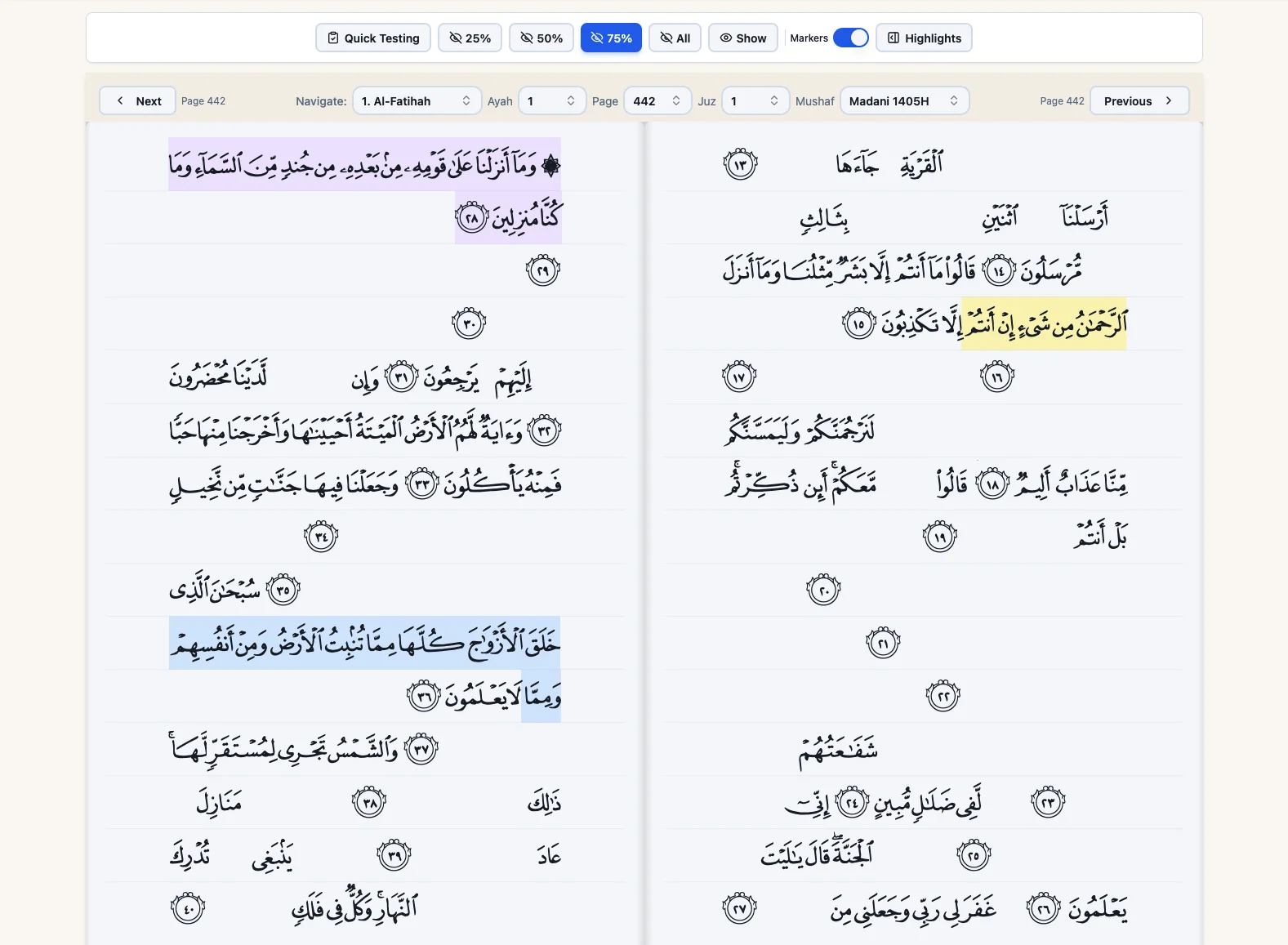
Counting what you can recite cleanly is easier when something else is asking the questions. Quran Memorizer’s hifz test works on any scope from a few ayat to a surah or juz: the next or previous ayah, missing words, ayah order, which surah. You answer on screen, and for tajweed feedback, recite to a teacher. The mushaf uses the same 604-page Madani layout as the printed one, and it runs on iPhone, iPad and any browser. Further in, Premium’s Daily Review is built from your own answers, so weak ayat come back first while the rest of what you’ve memorized rotates through in manageable portions.
What can’t a calculator tell you?
It can’t see the pages that will stall you for a week, or the similar ayat in Al-Baqarah and Al-A’raf that you’ll mix up for a month. It doesn’t know your exam year is coming. That’s why the four-week check matters more than the first estimate.
And a long number on a screen doesn’t say anything bad about you. Pick a pace you can manage, and accept the date it gives you.
لَا يُكَلِّفُ ٱللَّهُ نَفْسًا إِلَّا وُسْعَهَا
“Allāh does not charge a soul except [with that within] its capacity.”
Al-Baqarah 2:286, Saheeh International translation. Compare translations on quran.com
That’s the opening of the last ayah of Al-Baqarah. Three lines a day that you hold is a real plan. So is the week you spend on one hard page.
Questions people ask
How many days does it take to memorize the Quran?
It depends on the daily amount. Every day with no breaks: 2,079 days at 3 ayat, 1,764 at 5 lines and 588 to 604 at a page. Add your rest days and weeks off with the formula above to turn that into a date.
How many days does it take to memorize the Quran at a page a day?
Between 588 and 604 lesson days, depending on whether you count the 588 pages’ worth of ayah text or all 604 printed pages. Every day, that’s about 20 months. On six days a week with six weeks off, it’s about 2.1 years.
Should a Quran memorization calculator count ayat or pages?
Neither, if you can help it. Count lines. Ayat range from a few words to several lines, so an ayat target is much lighter in Juz Amma than in Al-Baqarah, and page counts include titles and basmalahs. Lines give an estimate that holds from the first juz to the last.
Should I count the pages I’ve already memorized?
Count only what you can recite from memory without help today. Subtract those lines from 8,820, then run the formula on what’s left.
Write your four numbers down tonight: lines left, lines a lesson, lesson days and weeks off. If you’re working back from a date, write that down too. Then start today’s lesson, and test it in four weeks. You can test your hifz on iPhone, iPad and the web.