There’s no single right answer to how much Quran to memorize each day. Three lines is right for some people and two pages for others. The useful question is a bit different: how much can you learn properly and keep reviewing, day after day, with the time you really have?
Below are some starting points, the hidden cost most people forget to budget for, and a simple way to adjust.
Starting points
| Your situation | Suggested daily lesson |
|---|---|
| Still building fluency in reading | 2 to 3 lines |
| New to hifz, reading fluently | 3 to 5 lines |
| Some experience, part time | Half a page |
| Experienced, with a teacher | One page |
| Full time, with a teacher | One to two pages |
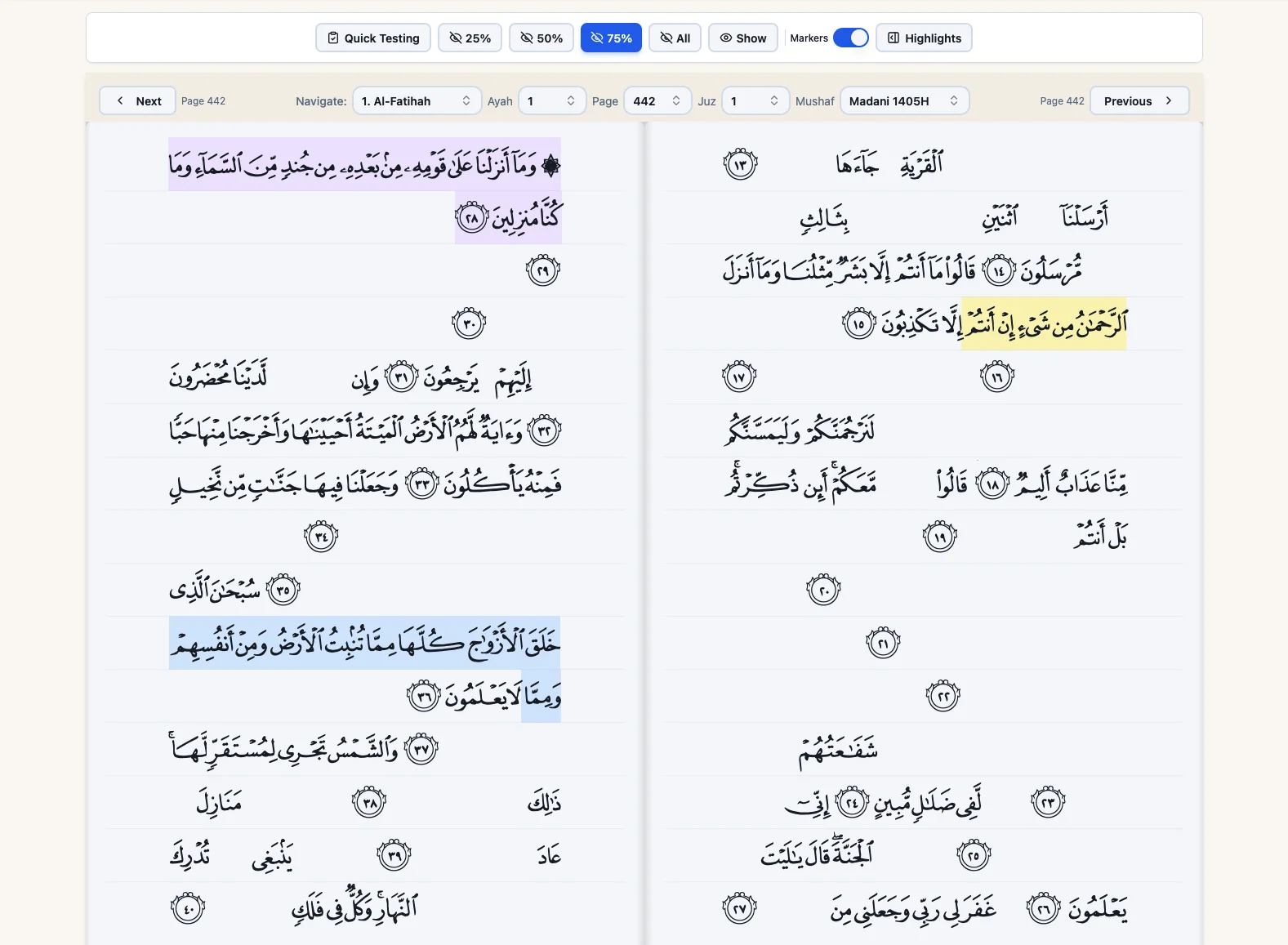
These assume the 15-line Madani mushaf. If you use a different layout, think in lines.
Treat this as a first guess. The next two weeks will tell you whether it’s right.
The part people forget to count
When people choose a daily amount, they think about how long it takes to memorize the new lesson. But the new lesson is only one part of the work. Every day you also need to:
- Recite yesterday’s lesson to check it held overnight.
- Review your recent lessons from the last week or two.
- Revise a portion of everything older.
- Get corrections from a teacher or listener, at least sometimes.
Suppose you have 30 minutes a day and spend 28 of them on the new lesson. The lesson gets done, but there’s no time for anything else. Within a month, you start forgetting last month’s pages, and you end up spending a whole week repairing them.
A rough guide: the new lesson should take no more than half your daily Quran time when you’re starting out, and less as your hifz grows. Sabaq, Sabqi and Manzil Explained shows how to divide the rest.
Lines, pages and ayat aren’t equal
Ayat vary enormously in length. Five ayat of Al-Baqarah can fill a page, while five ayat of An-Nas fit in about two lines. So “five ayat a day” means very different things in different parts of the Quran. Lines or pages are a more consistent measure, as long as you stick to one mushaf.
Some passages are also harder than others. A page with a list of names, legal details, or phrases you’ve memorized elsewhere in slightly different form will take longer than a page of narrative. It’s fine to shrink the lesson for a hard page and grow it again afterwards.
The two-week test
Start with your chosen amount and stay with it for two weeks. Each morning, before your new lesson, recite yesterday’s from memory. Then ask:
- Did yesterday’s lesson come back cleanly? One or two small slips is fine. Needing the mushaf repeatedly isn’t.
- Did my revision get done? All of it, as well as the new lesson.
- Did the session fit in my real day, not my ideal one?
If the answer to all three is yes for most of the two weeks, you can try increasing slightly, by a line or two. If any answer is often no, reduce the lesson. Don’t increase and decrease every day. Give each change a couple of weeks.
Testing beats rereading
When you check yesterday’s lesson, recite it from memory rather than reading it over. Recall is what strengthens memory: students who tested themselves on material remembered much more a week later than those who reread it for the same amount of time (Roediger and Karpicke, 2006). Reading a page makes it feel familiar. Reciting it tells you whether you know it.
Plan for your ordinary week
Choose a lesson size that works on an ordinary day. Your best day is a bad guide. If your week includes late shifts, school runs, or caring for someone, the lesson needs to fit around those.
Some people use two lesson sizes: a normal one for most days and a smaller “minimum” for hard days. On a minimum day you might do three lines and your recent revision, and nothing else. That keeps the habit alive without breaking your revision.
Free tool
Have a number in mind? See it mapped to exact pages and lines, with the date you would finish. Open the hifz plan generator →
When to slow down
Reduce your daily lesson if:
- Yesterday’s lesson often needs the mushaf.
- Revision keeps getting skipped.
- You dread your sessions.
- More than about a third of your older revision needs help.
Slowing down protects your hifz. It’s better to go slowly for years than fast for a few months and then stop. For ways to get more out of a smaller lesson, see our memorization techniques.
When to speed up
Increase your daily lesson, a little at a time, if:
- New lessons go in comfortably and come back the next day.
- All your revision fits in your time.
- You’re consistently finishing early.
What your number means for the whole Quran
To see how long different daily amounts take for the full Quran, see How Long Does It Take to Memorize the Quran? And for a step-by-step method for a full page, see How to Memorize One Page of the Quran a Day. Once you pick an amount, the hifz plan generator turns it into a dated, day-by-day schedule with revision built in.
Whatever amount you settle on, the Prophet ﷺ said the deed Allah loves most is the one done consistently, even if it’s small (Sahih al-Bukhari 6464).
Questions people ask
How much should a child memorize each day?
Children vary a lot, so treat these as rough ranges, not targets. Under 7, a few short ayat at a time, learned by listening and repeating. From about 7 to 10, 2 to 5 lines a day. From 11 to 14, around 5 lines to half a page part-time, and more in a full-time hifz school. The real check is the same as for adults: yesterday’s lesson comes back cleanly and revision still gets done. If your child goes to an evening madrasa, here’s how to help them revise at home, and how much Quran a child should memorize goes through each age in detail.
More guides: How long it takes to memorize each surah · Should you pause new memorization to revise? · Hifz plan generator