You can test your child’s Quran memorization at home without reading a word of Arabic. When you check their hifz, your job is to test recall (did they get stuck, skip an ayah, need a prompt, lose their place) while their teacher looks after tajweed, and recall is something you can hear, count and write down with an open mushaf and a phone.
That split matters, because plenty of parents feel they can’t take part. They didn’t grow up reading the Quran fluently, their child now recites faster than they can follow, and the madrasa seems like the only place anything can be checked. It isn’t. Ten minutes, an open mushaf and a recording you can pause will tell you a lot about what’s holding up between lessons.
At a glance
- What you check: recall. Pauses, skips, prompts, restarts and lost places.
- What the teacher checks: tajweed and pronunciation.
- What you need: the same mushaf your child uses at madrasa, a phone that plays recitation and a notebook.
- How long: 5 to 10 minutes, three or four times a week.
- Arabic you’ll learn: ten digits, so you can read ayah numbers and page numbers.
Can I really test my child if I can’t read Arabic?
Yes. Think about what a weak surah sounds like. A child who doesn’t know the next ayah stops. If they’re unsure, you’ll often hear them go back two ayat to get a run at it. And when two passages have blurred together, they jump ahead and finish early. None of that needs Arabic to notice. It needs you to know roughly where they should be on the page, and to be listening.
What you can’t judge is whether a letter came from the right place in the throat or a vowel was held for two counts or four. Leave that to the teacher and don’t try to correct it at home. If you copy what you think you heard from a reciter, you can teach your child a habit the teacher then has to undo.
Your child, meanwhile, is doing what generations of non-Arabic-speaking children have done before them. Allah describes the Quran this way:
وَلَقَدْ يَسَّرْنَا ٱلْقُرْءَانَ لِلذِّكْرِ فَهَلْ مِن مُّدَّكِرٍ
“And We have certainly made the Qur’ān easy for remembrance, so is there any who will remember?”
Al-Qamar 54:17, Saheeh International translation. Compare translations on quran.com
How do I follow along when I can’t read the words?
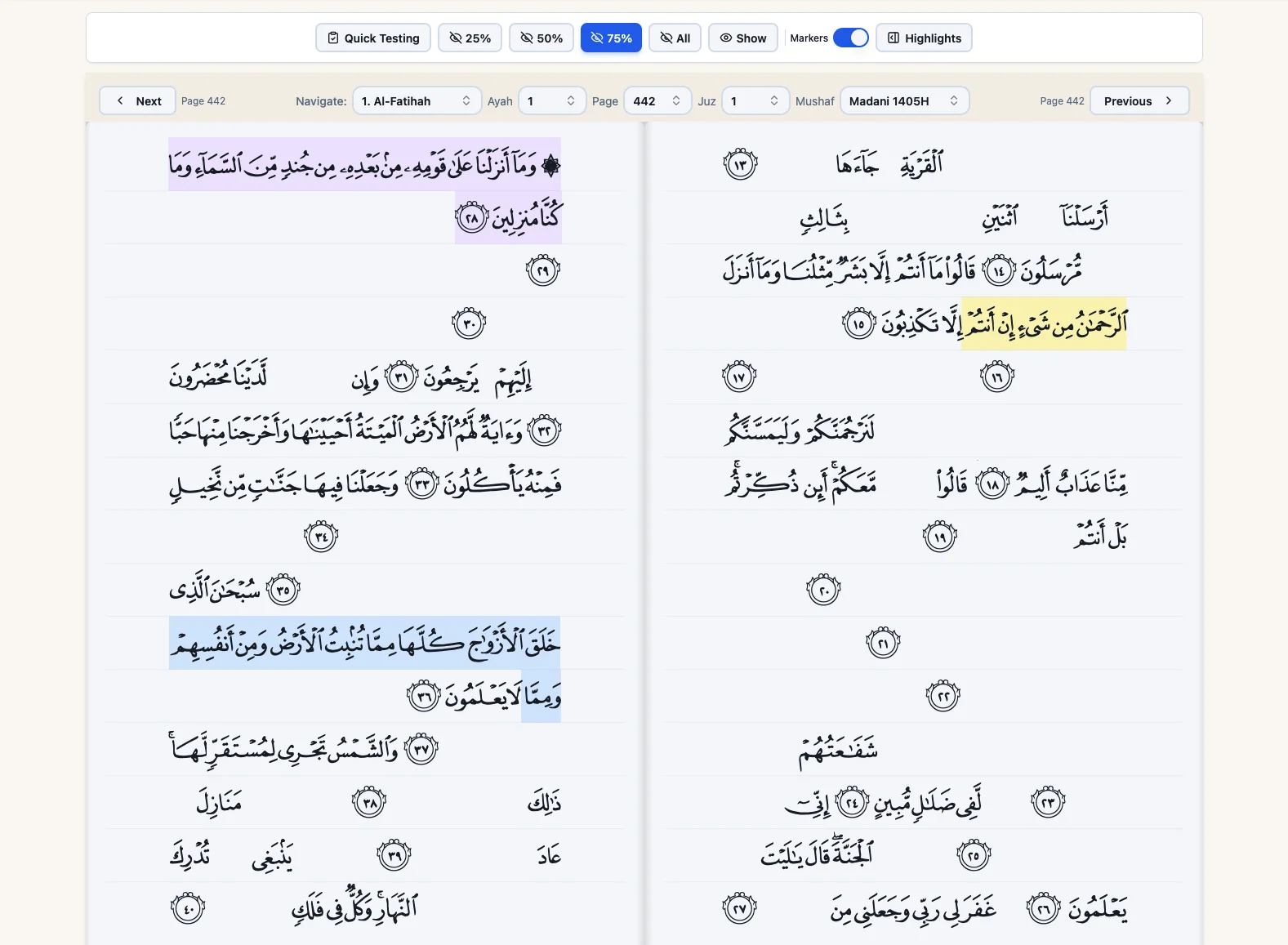
You follow the shape of the page. A printed mushaf ends each ayah with a small marker holding its number, and the lines sit in the same place on every copy of that edition. Once you can read those numbers, you can always tell which ayah your child is on.
Use the mushaf your child memorizes from, because page breaks are part of what they’ve learned. The page and line numbers in this guide are for the 604-page Madani mushaf, which has 15 lines on almost every page (only the first two pages are shorter). Many UK and Canadian madrasas use an Indo-Pak mushaf instead, with 13 or 15 lines and different page breaks. If that’s what comes home in the school bag, use it. The method doesn’t change, only the numbers do, so spend ten minutes finding where their surah starts and where its pages turn.
Learn the ten digits
Ayah markers and page numbers use Arabic-Indic digits. There are only ten, and they combine the same way ours do:
| Mushaf digit | Our digit |
|---|---|
| ٠ | 0 |
| ١ | 1 |
| ٢ | 2 |
| ٣ | 3 |
| ٤ | 4 |
| ٥ | 5 |
| ٦ | 6 |
| ٧ | 7 |
| ٨ | 8 |
| ٩ | 9 |
So ٣٠ is 30 and ٥٨٢ is page 582. The two that confuse people are ٥ (5, a small circle) and ٠ (0, a dot). Write the key on a sticky note and put it inside the cover of the family mushaf. After a week you won’t need it.
Indo-Pak mushafs often print 4, 5 and 6 in a different style: ۴ ۵ ۶. If yours does, find a page number you already know and copy the shapes you see onto the note.
Walk through one surah first
Pick the surah your child is working on and learn its layout once. Here’s Surah An-Naba (78), which opens Juz Amma, laid out in the Madani mushaf:
- Page 582, line 1 is the surah’s title and line 2 is the bismillah. The surah starts on line 3.
- Line 3 holds ayat 1, 2 and 3. The early ayat are short, two to four words each, so you’ll see several markers on one line.
- Ayah 13 sits on line 7, ayah 21 on line 11, and ayah 30 ends the page on line 15.
- Page 583 holds ayat 31 to 40, in lines 1 to 7. The closing ayat are long: 78:38 has 14 words and 78:40 has 15, so each takes up most of a line or more.
That’s about 20 lines in all. Now play a slow recitation of An-Naba and run your finger along the lines as the reciter goes. You’ll hear each ayah end with a pause, and your finger should be at a marker when it does. Do this twice and you’ll know where the long ayat are, where the page turns, and roughly how fast the surah moves.
Choose a slow reciter for this. The same surah runs very differently depending on who’s reciting:
| Reciter | An-Naba | Al-A’la | Ad-Duha |
|---|---|---|---|
| Shuraym | 2:50 | 0:58 | 0:33 |
| Alafasy | 4:37 | 1:35 | 0:54 |
| Husary | 6:34 | 2:31 | 1:23 |
| Husary, teaching pace | 7:41 | 2:46 | 1:38 |
Times are for whole-surah recordings and may include the bismillah. Husary’s teaching recitation gives you nearly three times as long as Shuraym to find your place, which is what you want while you’re learning the page. Your child’s own An-Naba will probably fall somewhere between the fastest and slowest reciters in the table.
If you read transliteration, a transliterated copy of the surah can help you catch a skipped phrase. Treat it as a map of where the words are. It can’t tell you whether they were pronounced correctly.
What does a ten-minute check look like?
First, decide what to check. Many madrasas split a child’s work three ways: the new lesson (sabaq), the last week or two of lessons (sabqi) and older revision (manzil). At home, we’d check the sabqi first. The new lesson is still fresh from class, and the recent work is the part that hasn’t settled yet. Our hifz vocabulary guide explains the other terms you’ll hear from the teacher.
Checks 3 to 5 need audio you can start at a chosen ayah. Many Quran apps and sites let you play from a single ayah: open the surah, find the ayah number and press play beside it. If yours doesn’t, play the whole surah and pause when your finger reaches the marker you want.
Then run five short checks, in this order. Each one tests something different, and you won’t need all five every day.
- From the top. Ask them to recite the surah from the beginning while you follow the markers. This is the warm-up. Children are usually strongest here, so it tells you the least, but it shows you where the obvious stops are.
- Stop and carry on. Let them finish an ayah, say “stop”, wait a few seconds, then ask them to go on with the next ayah. A child who knows the surah carries straight on. A child who’s leaning on momentum often has to go back an ayah or two to get going.
- What comes next? Play one ayah from the middle on your phone, pause it, and ask them to recite the ayah that follows. In An-Naba, play ayah 21 and see if they can continue from 22. You don’t need to understand a word. You only need to see whether what they say matches the next line in the mushaf, and whether they had to hunt for it.
- The page turn. Play 78:30, the last ayah on page 582, and ask for 78:31 at the top of page 583. If your child learns page by page, the join between two pages can be weaker than the ayat around it, so it’s worth checking on its own.
- What came before? Play an ayah and ask for the one before it. This is hard, even for strong students, so use it only when the first four go well. A child who can go backwards through a passage usually knows it thoroughly.
Once your child has a few surahs, add one more: play a random ayah from any of them and ask which surah it’s from. Short surahs at the end of Juz Amma take only a few lines each (Al-Ikhlas is on page 604, lines 3 and 4; An-Nas is lines 12 to 15), so it’s quick to test five or six in a row. For more questions like this, see our Quran quiz for kids.
Checks 2 to 4 are a version of the spot test teachers use. If your child can recite from the top but falls apart from the middle, our guide to the random ayah spot test explains why that happens and how to strengthen the joins.
Tip: Ask them to recite one of the surahs you’ve checked in their next salah. It’s a natural, low-pressure test, and you’ll hear quickly whether it holds up without a parent waiting to say “carry on”.
What does weak recall sound like?
Every child pauses sometimes. What you’re listening for is a pattern. These are the signs that a passage is shakier than it sounds:
- The same pause in the same place. A stop at ayah 22 once is nerves. A stop at ayah 22 three days running means the link from 21 to 22 isn’t there yet.
- The run-up. To get going again, they go back one or two whole ayat. Restarting the ayah they were in is normal. Going back further, again and again, is the sign. It sounds fluent, which is why parents miss it, so watch your finger: if it keeps moving back up the page, that’s a run-up.
- Finishing too early. You’re on line 9 and they’ve reached the end of the surah. They’ve jumped from one ayah to a later one that begins with similar words, and skipped everything in between.
- Speeding up. Some children race through the part they’re least sure of, as if pace will carry them over it. A sudden change in speed is worth a second listen.
- Going quiet. The voice drops or turns into a mumble for a few words, then comes back. Usually those are the words they aren’t sure of yet.
- Needing the first word. They can carry on fine once you play the start of the ayah, but can’t begin it themselves. That’s recognition without recall, and it’s common with newer lessons.
Nerves look different. A nervous child stumbles on the first try, recovers on their own, and gets it right the second time. A weak passage stumbles in the same spot however relaxed they are. If you’re not sure which you’re hearing, check it again tomorrow at a different time of day.
Should I correct mistakes as I hear them?
Mostly, no. If they stop and can’t continue, play the next ayah on your phone so they hear it, then let them carry on. Beyond that, write down what you heard and pass the rest on.
A notebook line per problem is enough: the date, the surah, the page and line, and what happened. “13 Jan, An-Naba, p582 L11, paused before 22, needed the first word” tells a teacher far more than “An-Naba was a bit wobbly”. After two weeks, the notebook shows you which spots keep coming back. Our hifz mistake log guide has a format that works well for this.
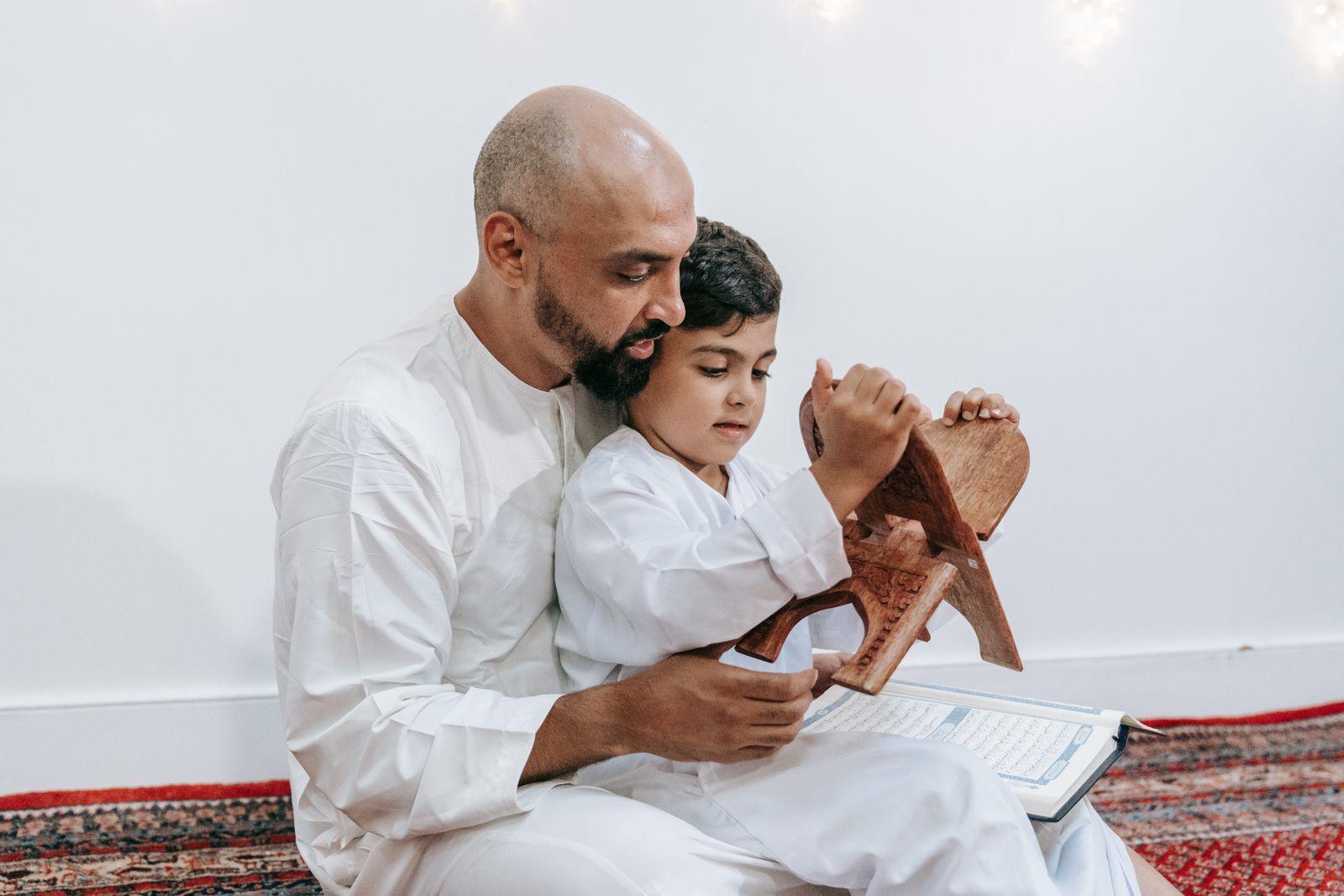
Keep the tone light. Sit beside them on the sofa. With a five- or six-year-old, two checks and a hug is a full session; older children can manage all five, and some like being the one who writes in the notebook. Five minutes that end with “that was good, ayah 22 needs some love” will get you another five minutes tomorrow. Twenty minutes of “again, from the top” won’t. The Prophet ﷺ said that the one who recites the Quran with difficulty, stumbling through it, gets two rewards (Sahih Muslim 798a). Your child’s hesitations are part of the work, and it’s worth telling them so.
Can a phone do some of the checking?
For children who can already read the Quran’s script, yes, and it takes the hardest part (knowing whether an answer is right) off your plate. Quran Memorizer’s tests ask for the ayah that comes next or before, which surah an ayah belongs to, the right order of ayat and the missing words in a passage, and it marks each answer itself. You set the scope, from a few ayat up to a surah, hand over the phone, and look at the results afterwards.
You can start with the test at app.quranmemorizer.com/test, which runs in any browser, so an Android family phone or a laptop works as well as an iPhone. Premium adds detailed progress insights, including recall accuracy and which areas are stronger or weaker, and that’s a ready-made list for the teacher.
It doesn’t listen to recitation, so it won’t tell you anything about tajweed.
When should I tell the teacher?
Tell them once your notes show a pattern. One bad evening isn’t a pattern. Any of these is worth a message:
- The same spot fails in three separate checks.
- A surah they “finished” holds up from the top but can’t be started from the middle.
- New lessons keep coming while older surahs get noticeably weaker.
- Your child is anxious or tearful before lessons, or says they’re behind.
Bring specifics: surah, page, line, what happened. Then ask what the teacher wants you to focus on at home. A teacher who knows someone is listening between lessons can point you to the surahs that most need revising that week. Our list of questions to ask your hifz teacher helps if you’re not sure how to open that conversation.
Questions people ask
Do I need to learn to read Arabic to help with hifz?
No. You need the ten Arabic-Indic digits so you can read ayah and page numbers, and some practice following a recitation along the lines of the page. Learning to read Quranic Arabic is a good goal for its own sake, but you can start checking your child’s recall this week without it.
How often should I test my child’s Quran memorization at home?
Three or four short checks a week, 5 to 10 minutes each, usually beat one long session at the weekend. Short checks catch a weak join while it’s still a single ayah.
My child recites perfectly at madrasa but stumbles at home. Why?
Often because the madrasa listens from the top and you’re testing from the middle. Starting partway through needs a stronger link between ayat than reciting in one flow does. It can also be nerves with a new listener. If the stumbles stay in the same places, it’s the joins.
Should I correct my child’s tajweed?
Only if you’ve studied tajweed yourself. Otherwise note anything that sounds different from the reciter and pass it to the teacher, who can hear what’s going on and correct it properly.
Start with one surah. Learn its page with a slow recitation, run the five checks over a week and write down what you hear. If your child can read the script, the Quran Memorizer test gives them a way to check themselves between lessons, on whatever phone is in the house.