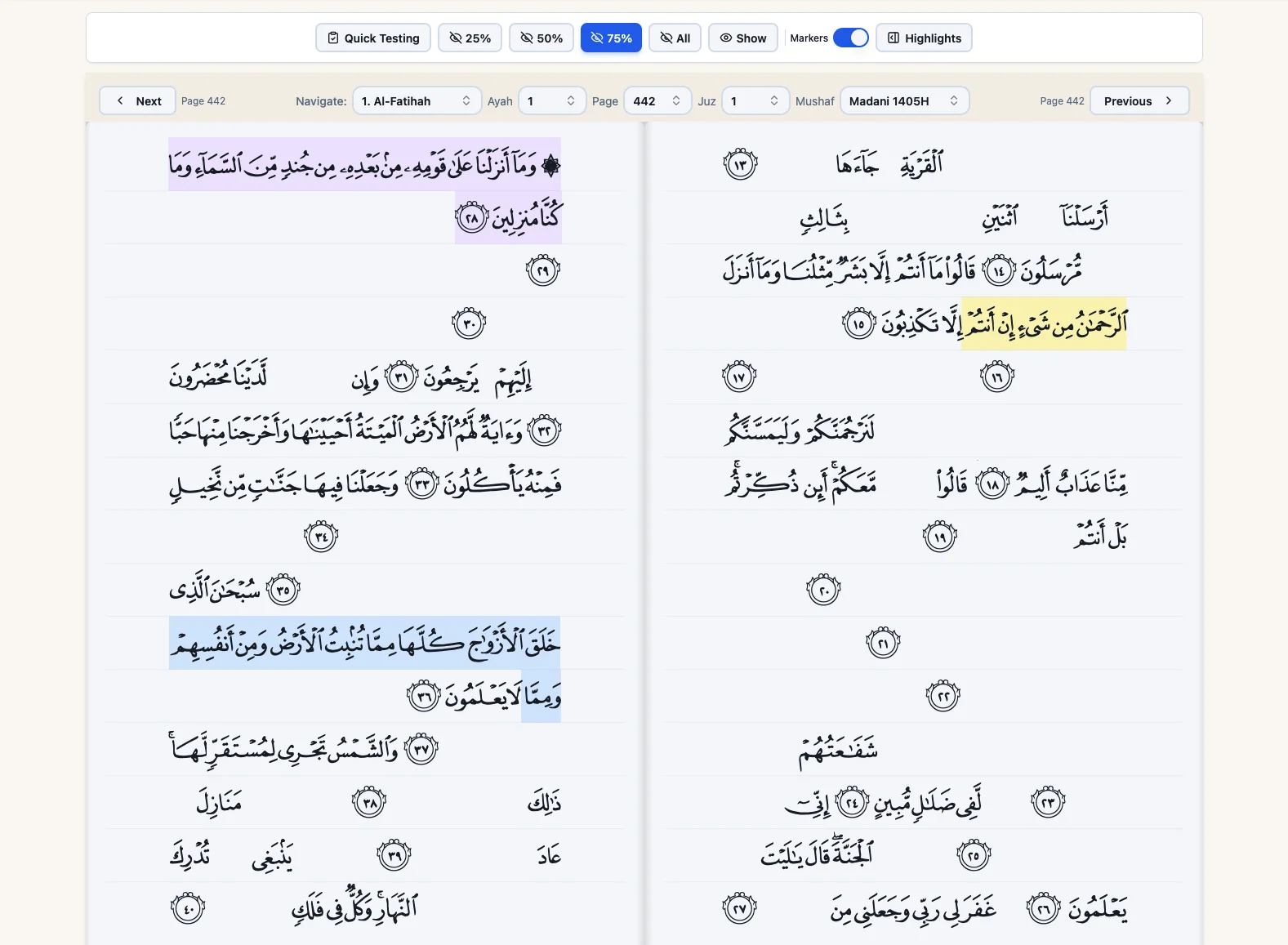
Surah Ad-Duha is 11 short ayat on 5 lines of page 596 in the Madani mushaf, and at 5 lines a day you can memorize it in two days: ayat 1 to 5 on the first, 6 to 11 on the second. Give it a third day and you’ll have Ash-Sharh as well, the 8-ayah surah printed just below it on the same page.
Ad-Duha is Surah 93, “The Morning Hours”, and it takes just under a minute to recite at Mishary Alafasy’s pace. Ash-Sharh is Surah 94, the one many people know as Alam Nashrah or Al-Inshirah. The two sit back to back on the page, and both speak straight to the Prophet ﷺ, counting Allah’s favors to him with a question that opens on the same word, alam. We’d learn them as a pair.
At a glance
- Surah: 93, Ad-Duha (“The Morning Hours”), Makkan. Its pair is 94, Ash-Sharh (“The Relief”), also called Al-Inshirah or Alam Nashrah.
- Where it sits: juz 30, page 596 of the 604-page Madani mushaf. Both surahs fit on that page, under the last three lines of Al-Layl.
- Length: 11 ayat, 40 words, 5 lines of text. Ash-Sharh adds 8 ayat, 27 words and 3 lines.
- Time to recite: 0:34 with Sa’ud ash-Shuraym, 0:54 with Alafasy and 1:38 with al-Husary’s teaching recitation (muallim). Both surahs back to back: 1:28 with Alafasy.
- Time to memorize: 2 days for Ad-Duha at 5 lines a day, 1 more for Ash-Sharh.
- In salah: one of the surahs the Prophet ﷺ named for a shorter Isha (Sahih Muslim 465a).
Five lines is small enough to learn in one evening, and some people do. We’d still split it. The meaning turns after ayah 5, and the second half is six short ayat that have to come out in strict order, which goes better on a fresh day. If you already memorize half a page a day, one day is fine, and that’s what our chart of how long each surah takes to memorize gives at your pace.
Surah Ad-Duhaa at a glance
- Surah
- 93
- Juz
- 30
- Mushaf
- Page 596
- Ayat
- 11
- Length
- 5 lines
- Recited in
- about a minute
How many days will it take?
| New lines a day | Days |
|---|---|
| 3 (a few lines) | 2 days |
| 5 (a third of a page) | 1 day |
Counts days of new memorization on the 5 lines of Surah Ad-Duhaa. Add revision on top. Make a day-by-day plan.
Test yourself
Memorized Surah Ad-Duhaa? Find the ayat you’re not sure of.
Quran Memorizer asks you what comes next, which ayah is missing and which look-alike ayah goes where, on the same Madani mushaf pages you learned from. With Premium, Daily Review brings your weakest ayat back first, so you can revise Surah Ad-Duhaa a little every day.

Free to start, no card needed. On the web or iPhone, choose Surah Ad-Duhaa as what you want to be tested on.
More on Surah Ad-Duhaa: All surah guides
What is Surah Ad-Duha about, in plain words?
Ad-Duha moves in four steps. Read them once before day 1 and you’ll know the order before you’ve learned a word of it. In a surah this short, knowing the meaning is the easiest way to remember the order.
- The oaths (93:1-2). Allah swears by the bright morning, and by the night when it’s dark and still.
- The reassurance (93:3-5). Your Lord hasn’t left you, and He doesn’t detest you. The Hereafter is better for you than this first life, and your Lord will give you until you’re satisfied. Ayah 3 answers a taunt the Prophet ﷺ heard, and the story is further down.
- Alam yajidka (93:6-8). Didn’t He find you an orphan and shelter you? He found you lost and guided you. He found you poor and made you self-sufficient.
- The instructions (93:9-11). Don’t oppress the orphan. Don’t drive away the one who asks. And speak of your Lord’s favor.
Steps 3 and 4 are where people lose the order. What helps us remember the order is a memory aid of our own (so don’t quote it as tafsir): step 4 answers step 3, item by item, in the same order.
- The orphan of 93:6 comes back as the orphan of 93:9.
- Lost, then guided, in 93:7 lines up with the petitioner in 93:10. Saheeh International’s footnote defines that petitioner as “anyone who seeks aid or knowledge”.
- Poor, then made self-sufficient, in 93:8 lines up with “the favor of your Lord” in 93:11.
Your ear can help too. Ayat 1 to 8 all close on a long -ā: ḍuḥā, sajā, qalā, ūlā, tarḍā, āwā, hadā, aghnā. Then the sound changes. The last three ayat end taqhar, tanhar, ḥaddith, each on a hard stop. When the rhyme breaks, you’ve reached the instructions.
How to memorize Surah Ad-Duha in two days
Cut it at the end of ayah 5, where the reassurance ends and the reminders begin. That gives you 18 words on day 1 and 22 on day 2, and neither day is more than three lines of the page.
The full text of Ad-Duha
وَٱلضُّحَىٰ ﴿١﴾
وَٱلَّيْلِ إِذَا سَجَىٰ ﴿٢﴾
مَا وَدَّعَكَ رَبُّكَ وَمَا قَلَىٰ ﴿٣﴾
وَلَلْـَٔاخِرَةُ خَيْرٌ لَّكَ مِنَ ٱلْأُولَىٰ ﴿٤﴾
وَلَسَوْفَ يُعْطِيكَ رَبُّكَ فَتَرْضَىٰٓ ﴿٥﴾
أَلَمْ يَجِدْكَ يَتِيمًا فَـَٔاوَىٰ ﴿٦﴾
وَوَجَدَكَ ضَآلًّا فَهَدَىٰ ﴿٧﴾
وَوَجَدَكَ عَآئِلًا فَأَغْنَىٰ ﴿٨﴾
فَأَمَّا ٱلْيَتِيمَ فَلَا تَقْهَرْ ﴿٩﴾
وَأَمَّا ٱلسَّآئِلَ فَلَا تَنْهَرْ ﴿١٠﴾
وَأَمَّا بِنِعْمَةِ رَبِّكَ فَحَدِّثْ ﴿١١﴾
On page 596 these 11 ayat fill lines 6 to 10.
| Day | Ayat | Words |
|---|---|---|
| 1 | 93:1-5 | 18 |
| 2 | 93:6-11 | 22 |
| 3 | 94:1-8 | 27 |
Day 3 is Ash-Sharh, and it’s in the Ash-Sharh section below.
Day 1: ayat 1 to 5
Read steps 1 and 2 of the meaning first. Then listen to the whole surah with a slow reciter. Play it on quran.com and pick Mahmoud Khalil Al-Husary (Muallim) as the reciter. His teaching recitation runs 1:38 for Ad-Duha, so ten listens takes about 16 minutes. With Alafasy, ten listens is about 9. If you can’t read Arabic yet, quran.com can show a transliteration under each ayah. Use it to check a sound, and let the audio do the teaching.
Now learn line 6 as a single piece. It holds three whole ayat, the oaths and the reply, so it’s the easiest line on the page to picture:
وَٱلضُّحَىٰ ﴿١﴾
وَٱلَّيْلِ إِذَا سَجَىٰ ﴿٢﴾
مَا وَدَّعَكَ رَبُّكَ وَمَا قَلَىٰ ﴿٣﴾
On the printed page, those three ayat are one line. Then add 93:4 and 93:5, saying the la in both out loud every time: wa la-l-ākhiratu and wa la-sawfa. Recite 93:1-5 from memory until you get it clean three times running, then once more before you sleep.
Tip: 93:5 is split across two lines. Wa la-sawfa yu’ṭīka rabbuka ends line 7, and fa-tarḍā opens line 8. If you memorize by sight, your eye will want to stop at the end of line 7. Recite 93:5 in one breath, even when you’re reading it off the page.
Day 2: ayat 6 to 11
Recite yesterday’s five ayat first. Then learn 93:6-8 as one run. Only the first of the three opens with alam: alam yajidka, “did He not find you”. The next two open wa wajadaka, “and He found you”. The states go orphan, lost, poor (yatīm, ḍāll, ‘ā’il). The answers go shelter, guidance, enough (fa-āwā, fa-hadā, fa-aghnā).
“Did He not find you an orphan and give [you] refuge? And He found you lost and guided [you], And He found you poor and made [you] self-sufficient.”
Ad-Duha 93:6-8, Saheeh International translation. Compare translations on quran.com
Then learn 93:9-11 against that run, matching each instruction to the reminder in the same position. Finish with the whole surah three times from memory.
If you already know Al-Layl, start from its last three lines at the top of page 596 (92:15-21) and recite straight into Ad-Duha. Al-Layl’s last ayah, wa la-sawfa yarḍā, sits four rows above 93:5 and is the likeliest thing to cut it short, so practice that join on purpose.
At three lines a day the plan doesn’t change, because neither portion goes over three lines. That makes Ad-Duha a comfortable surah for a child. Tell it as a story first: the bright morning, the still night, “your Lord hasn’t left you”, then the orphan, the lost and the poor, and what each one was given. Then teach three lines a day.
Where do people trip up?
Almost every mistake in Ad-Duha is tiny, a particle here and a single letter there. Tiny mistakes are the ones that last for years, because they’re easy to miss in a fluent recitation. Getting them right on day 1 is far easier than unlearning them later.
Inside the surah
- Qalā in 93:3. The ayah ends wa mā qalā, “nor has He detested [you]”, and Ibn Kathir explains it to mean that He doesn’t hate you. Lengthen the wrong vowel and it turns into qāla, “he said”. That one’s about pronunciation as much as memory, so check it against a slow recitation.
- The la in 93:4 and 93:5. Wa la-l-ākhiratu, then wa la-sawfa. The usual mistake is wal-ākhiratu, with the first la gone. It tends to come from Al-A’la 87:17, which has the same phrase without it.
- Taqhar or tanhar? 93:9 ends fa-lā taqhar, with a qāf, for the orphan: don’t oppress him. 93:10 ends fa-lā tanhar, with a nūn, for the one who asks: don’t repel him. Think of where each person stands. The orphan is under your care, where the wrong would be overpowering him. The one who asks is at your door, where the wrong would be turning him away.
- Fa-ammā, then wa-ammā twice. 93:9 opens with fa; 93:10 and 93:11 open with wa. Saheeh International marks the fa in English too, with “So as for” at 93:9.
Ad-Duha against its neighbors
The harder mix-ups come from the surahs around it. Work forward through juz 30 from An-Naba and you’ll have learned most of them before Ad-Duha; work back from An-Nas and they’re still ahead of you. Either way, watch these.
93:4 and Al-A’la 87:17. This is the likeliest source of the missing la. Al-A’la says wal-ākhiratu khayrun wa abqā, “While the Hereafter is better and more enduring.” (Saheeh International, 87:17), with no la at all. Ad-Duha’s version is addressed to the Prophet ﷺ, and it carries more: la at the front, laka (“for you”) after khayrun, and mina-l-ūlā (“than the first”) at the end.
وَلَلْـَٔاخِرَةُ خَيْرٌ لَّكَ مِنَ ٱلْأُولَىٰ
وَٱلْـَٔاخِرَةُ خَيْرٌ وَأَبْقَىٰٓ
The first line is Ad-Duha’s, the second Al-A’la’s. Our guide to memorizing Al-A’la tackles the same pair from the other side.
93:5 and Al-Layl 92:21. Al-Layl ends four rows above Ad-Duha’s fifth ayah, on the same page, with wa la-sawfa yarḍā, “And he is going to be satisfied.” (Saheeh International, 92:21). Ad-Duha’s is longer: wa la-sawfa yu’ṭīka rabbuka fa-tarḍā, “And your Lord is going to give you, and you will be satisfied.” (Saheeh International, 93:5). Same opening, same root at the end.
Recite Al-Layl into Ad-Duha and the short version tries to take over. In Al-Layl it’s “he”; in Ad-Duha it’s “you”, and your Lord gives first.
وَلَسَوْفَ يَرْضَىٰ
وَلَسَوْفَ يُعْطِيكَ رَبُّكَ فَتَرْضَىٰٓ
The night oaths. Three surahs in a row swear by the night with wal-layli idhā, all on pages 595 and 596. Ash-Shams has yaghshāhā (91:4), Al-Layl has yaghshā (92:1), and Ad-Duha has sajā (93:2). Ash-Shams is the easy one to place. All 15 of its ayat end in -hā, so its night is yaghshāhā, and its first ayah gives the sun its morning, wa ḍuḥāhā. Ad-Duha’s first ayah is just wa-ḍ-ḍuḥā, a whole ayah on its own.
For the other two, look at the name. Al-Layl, “the night”, swears by the night first and the day after it. Ad-Duha, “the morning”, swears by the morning first, and its night is the still one from step 1. Further back you’ll meet yasr (89:4), ‘as’as (81:17) and idh adbar (74:33).
وَٱلَّيْلِ إِذَا يَغْشَىٰهَا
وَٱلَّيْلِ إِذَا يَغْشَىٰ
وَٱلَّيْلِ إِذَا سَجَىٰ
For pairs like these, our guide on how to stop mixing up similar verses has the full routine, starting with finding the exact word where two ayat split.
To check the joins, open the Quran Memorizer test, set the scope to Ad-Duha and run next-ayah questions until 93:5 into 93:6 and 93:8 into 93:9 come without a pause. Those are the two places the surah turns, from reassurance to reminders and from reminders to instructions. Then put 93:6-11 in the correct order a few times.
Why was Surah Ad-Duha revealed?
The authentic account is short. The Prophet ﷺ was ill and didn’t get up for the night prayer for two or three nights. A woman came and taunted him, saying she supposed his “Satan” had left him, since she hadn’t seen it near him in that time. Then Allah revealed the first three ayat of Ad-Duha. Jundub ibn Sufyan narrates it in Sahih al-Bukhari 4950 and Sahih Muslim 1797b. Some English translations add a name for the woman in parentheses; the Arabic just says “a woman”.
Other reports in the same two books tell it from another side: Jibril was delayed, and the polytheists said that Muhammad ﷺ had been forsaken (Sahih Muslim 1797a; see also Sahih al-Bukhari 1125). Bukhari and Muslim don’t get a grade line on sunnah.com, since both collections are accepted as authentic.
“Your Lord has not taken leave of you, [O Muḥammad], nor has He detested [you].”
Ad-Duha 93:3, Saheeh International translation. Compare translations on quran.com
Knowing this changes how the opening sounds. Ayah 3 is a reply, and the oaths lead up to it. Recite it as the answer to a taunt and you won’t forget which ayah comes third.
People often ask whether Ad-Duha came in the year of sorrow, the year Khadijah and Abu Talib died. None of the authentic reports above say so, and the traditional order of revelation that quran.com lists puts Ad-Duha 11th, among the earliest surahs.
Which popular stories about Ad-Duha aren’t authentic?
Many pages about Ad-Duha tell a longer story, with a pause of weeks or months and a puppy under the bed. Very little of it comes with a chain we could verify.
- How long revelation paused. Al-Qurtubi’s tafsir lists 12, 15, 25 and 40 days from different early sources, and some websites say six months. The reports disagree, and none of the longer figures comes with a reliable chain we could verify. The sahih reports speak of one to three nights of illness: a night or two in Sahih al-Bukhari 1124, two or three in 4950.
- The puppy under the bed. A popular story says a dead puppy in the house kept Jibril away, and that Ad-Duha came down after it. Ibn Hajar noted that its chain includes an unknown narrator, and he called it a rejected outlier as the reason for this surah, next to the report in Sahih al-Bukhari (Fath al-Bari 8/710).
Does Surah Ad-Duha have special benefits?
It’s Quran, and the Prophet ﷺ named it as one of the surahs for a shorter Isha (more on that in the salah section). The specific promises you’ll see online are another matter.
- How many times to recite it. You’ll see posts about reciting it 7, 41 or 100 times. No authentic report sets a number or attaches a special reward to it, so there’s nothing to count. Recite it in your prayers, and as often as you like. For memorizing, the number that matters is three clean recitations in a row from memory.
- A reward for every orphan. You’ll also see a promise of ten rewards for every orphan and every petitioner for whoever recites Ad-Duha. It comes from a long narration attributed to Ubayy ibn Ka’b that assigns a reward to almost every surah, and Ibn Hajar graded it fabricated (al-Kafi ash-Shaf).
- The Duha prayer. Nothing authentic ties the surah to Salat ad-Duha, the forenoon prayer. The narration telling people to pray Duha “with its two surahs”, Ash-Shams and Ad-Duha, was graded fabricated by al-Albani (Da’if al-Jami’ 3479). The shared name comes from the word ḍuḥā, the bright hours of the morning.
- On hard days. Ad-Duha came down to reassure the Prophet ﷺ after a taunt, so it’s natural to turn to it when you’re low. Read it with its meaning in mind. No authentic report promises a set effect from reciting it.
Why learn Ash-Sharh (Alam Nashrah) right after Ad-Duha?
Because it’s already in front of you. Ad-Duha’s text ends on line 10 of page 596. Ash-Sharh’s title is line 11, its bismillah line 12, and its 8 ayat fill lines 13 to 15. It’s also the shorter of the two: 27 words.
The words match too. Both surahs address the Prophet ﷺ directly as “you”, so the suffix -ka runs through both: wadda’aka, rabbuka, yu’ṭīka, yajidka in Ad-Duha, and laka, ṣadrak, ‘anka, wizrak, ẓahrak, dhikrak in Ash-Sharh.
Both count favors with alam: alam yajidka, “did He not find you” (93:6), and alam nashraḥ, “did We not expand” (94:1). And in the traditional order of revelation that quran.com lists, they’re 11th and 12th, back to back there as well.
You may read online that the two are really one surah. In the mushaf they’re two, each with its own title and bismillah, and Islamweb’s fatwa rests that on mass transmission (tawatur) of the Quran. A few early figures, Tawus and ‘Umar ibn ‘Abd al-‘Aziz, held that they’re one, as do Shia jurists (Islamweb fatwa 324910). For memorizing, the answer’s the same either way: learn them together.
What Ash-Sharh says
- The favors (94:1-4). Didn’t We open your chest, lift the burden that weighed on your back, and raise your mention? All four ayat end in -ak: ṣadrak, wizrak, ẓahrak, dhikrak. Ibn Kathir, citing Mujahid and Qatadah, explains the raised mention: the Prophet ﷺ is named in the shahadah, the adhan, the khutbah and the prayer.
- The promise, twice (94:5-6). With hardship comes ease, then the same words again.
- What to do with it (94:7-8). When you’ve finished, stand up for worship, and turn your longing to your Lord. The pair rhymes, fanṣab, farghab.
“For indeed, with hardship [will be] ease [i.e., relief]. Indeed, with hardship [will be] ease.”
Ash-Sharh 94:5-6, Saheeh International translation. Compare translations on quran.com
Why say it twice? Classical commentators point to the grammar. Al-‘usr, the hardship, has the definite article both times, so it’s the same hardship. Yusr, ease, is indefinite both times, so it’s two different eases. Ibn Kathir gives this reading. Al-Qurtubi traces the rule of Arabic usage behind it to the grammarian Tha’lab, and notes that al-Jurjani disputed it.
‘Umar ibn al-Khattab put the same idea in a letter to Abu ‘Ubaydah: “a hardship will not overcome two eases” (Muwatta Malik, Book 21, Hadith 6; sunnah.com shows no grade for it). Those are ‘Umar’s words. A version attributed to the Prophet ﷺ himself reaches us through al-Hasan al-Basri with no Companion named (it’s mursal), and al-Albani graded it weak (Silsilah ad-Da’ifah 4342).
The fa that tells 94:5 and 94:6 apart
94:5 opens fa-inna. 94:6 opens with a bare inna. The layout of the page helps here. On line 14, 94:5 comes right at the end, and the first word of 94:6, inna, is the last word on the line, all on its own. The rest of 94:6 opens line 15. Picture that lone inna at the edge of the line and you’ll remember it has no fa.
فَإِنَّ مَعَ ٱلْعُسْرِ يُسْرًا
إِنَّ مَعَ ٱلْعُسْرِ يُسْرًا
One for later, if you go on to juz 28. At-Talaq 65:7 ends sa-yaj’alu Allāhu ba’da ‘usrin yusrā, “Allāh will bring about, after hardship, ease [i.e., relief].” (Saheeh International, 65:7). Ba’da, after, in At-Talaq. Ma’a, with, here.
Day 3: Ash-Sharh
أَلَمْ نَشْرَحْ لَكَ صَدْرَكَ ﴿١﴾
وَوَضَعْنَا عَنكَ وِزْرَكَ ﴿٢﴾
ٱلَّذِىٓ أَنقَضَ ظَهْرَكَ ﴿٣﴾
وَرَفَعْنَا لَكَ ذِكْرَكَ ﴿٤﴾
فَإِنَّ مَعَ ٱلْعُسْرِ يُسْرًا ﴿٥﴾
إِنَّ مَعَ ٱلْعُسْرِ يُسْرًا ﴿٦﴾
فَإِذَا فَرَغْتَ فَٱنصَبْ ﴿٧﴾
وَإِلَىٰ رَبِّكَ فَٱرْغَب ﴿٨﴾
On page 596 these 8 ayat fill lines 13 to 15.
Recite Ad-Duha from memory first. Then learn 94:1-4, the four ayat that end in -ak, and read 94:2-3 as one unit: alladhī is the last word of line 13, and anqaḍa ẓahrak opens line 14. Then learn 94:5-8. Finish with both surahs back to back, which takes 1:28 with Alafasy. If you’re working backward through juz 30, you may know Ash-Sharh already. Then day 3 is only for the seam between them.
That seam is worth a minute on its own. Ad-Duha ends on fa-ḥaddith, then comes the bismillah, then alam nashraḥ. You said alam yajidka only a few ayat earlier, so your tongue may try to repeat it. Learn 94:1 with its whole phrase, alam nashraḥ laka ṣadrak, and the two alam questions stay apart.
A day or two later, test yourself cold. Start from 93:6, 93:9, 94:5 and 94:7 without saying the ayah before each one. If you find yourself running up from the top of the surah to reach them, our piece on reciting from a random ayah explains why that happens and how to fix it.
Can you recite Ad-Duha and Ash-Sharh in salah?
Yes, and it’s one of the easiest ways to revise them. Recite Ad-Duha in the first rak’ah and Ash-Sharh in the second. That follows the order of the mushaf, and it makes the first rak’ah the longer one, 11 ayat against 8. Abu Qatadah reported that in Zuhr the Prophet ﷺ recited a long surah in the first rak’ah and a shorter one in the second (Sahih al-Bukhari 759).
That order sits well with the fiqh, too. The Standing Committee (al-Lajnah ad-Da’imah), whose members included Ibn Baz, said it’s better for the second rak’ah’s surah to come after the first one’s in the mushaf (IslamQA 121139). Hanafi scholars go further. In obligatory prayers they treat mushaf order as wajib, and they count a second rak’ah longer than the first by more than two ayat as mildly disliked, makruh tanzihan (SeekersGuidance, via islamqa.org).
Reversing the two is where scholars differ, and IslamQA 7198 permits it. Learn them in mushaf order and you won’t have to think about it.
- Both in one rak’ah. IslamQA 69915 says it’s permissible, citing Ibn Mas’ud’s report of the pairs the Prophet ﷺ used to recite two to a rak’ah (Sahih al-Bukhari 775). Ad-Duha and Ash-Sharh aren’t named among his pairs, so reciting them together is permitted, though there’s no report that he paired these two.
- Ad-Duha alone. Islamweb’s fatwa 324910 says each is a surah in its own right, recited on its own and separated by the bismillah.
- For Isha. When Mu’adh made Isha too long for the people behind him, the Prophet ﷺ told him to recite surahs like Ash-Shams, Ad-Duha, Al-Layl and Al-A’la (Sahih Muslim 465a). Ad-Duha is one he named outright, and it runs under a minute with Alafasy.
You might also hear a reciter say “Allahu akbar” between the surahs from Ad-Duha onward. That’s an established practice in the reading of Ibn Kathir al-Makki, one of the seven canonical readers, as transmitted by al-Bazzi. It isn’t part of Hafs ‘an ‘Asim, the reading printed in the Madani mushaf, so if you’re memorizing from a Hafs mushaf, you don’t need to add it.
Revising Ad-Duha and Ash-Sharh
Start tonight with line 6 of page 596, the oaths and the reply. Add 93:4-5 before you sleep, and by the day after tomorrow you can have everything on that page below Al-Layl.
Then use them. Recite the pair in the two rak’ahs of a sunnah prayer a few times a week, and once a week recite page 596 from memory, starting from Al-Layl’s last three lines so the join gets practice too. Every so often, start cold from 93:9 or 94:7 instead of the top.
If you use Quran Memorizer, Daily Review (part of Premium) can rotate page 596 in with the rest of what you’ve memorized, and the ayat you miss come back first. When both surahs feel solid, our Juz Amma plan shows where they fit among the rest of juz 30.