
Not everyone has a hifz class nearby, or a schedule that fits one. Plenty of people memorize at home, around work, children and everything else, and many of them get a long way. It’s harder without a teacher in the room, but it’s very doable if you set things up so the gaps a teacher normally fills don’t stay empty.
The hard part is checking yourself when there’s nobody sitting across from you, so most of what follows is about that.
What a teacher actually does for you
Before replacing a teacher, it helps to know what you’re replacing. A good hifz teacher does four things:
- Corrects your reading. They hear mispronounced letters, missed madd and wrong vowels.
- Catches memorization errors. Skipped words, swapped ayat, a phrase borrowed from another surah.
- Sets the pace. They decide when you’re ready for the next lesson and when you need to slow down.
- Holds you to it. You prepare because you’re going to be heard tomorrow.
Studying at home, you need a plan for each of these. Some you can do yourself. Some you’ll need another person for.
1. Get your reading checked, even occasionally
This is the one thing you really can’t do alone. You won’t hear your own mispronunciations, because you’ll hear what you think you said.
If daily lessons with a teacher aren’t possible, aim for one short online session a week where you recite your recent lessons. Even twenty minutes once a week catches the mistakes that would otherwise set in permanently. Finding a Hifz Teacher covers online options and what to look for.
Between sessions, record yourself on your phone and play it back while following in the mushaf. You’ll catch more than you expect, especially skipped words and wrong endings.
2. Set up a fixed spot and a fixed time
At home, the biggest risk is that hifz becomes the thing you’ll do “later”. Give it a place and a time.
The place can be simple: a corner with your mushaf on a stand, good light, and nothing else on the table. The time should be one you can protect most days. For many people that’s straight after Fajr, before the house wakes up. For others it’s after the children are asleep.
There’s also barakah in reciting at home. The Prophet ﷺ told his companions not to turn their houses into graveyards, and said that Shaytan flees from a house where Surah Al-Baqarah is recited (Sahih Muslim 780).
3. Structure each session
Without a teacher, sessions drift. A clear order helps:
- Warm-up (5 minutes): Recite yesterday’s lesson from memory. Check it against the mushaf.
- Recent review (10 to 15 minutes): Recite the last one or two weeks of lessons.
- New lesson (20 to 30 minutes): Listen, read, memorize ayah by ayah, then join them.
- Older review (10 to 20 minutes): Your portion of the older material for today.
If you’re short on time, drop the new lesson before you drop the review. Sabaq, Sabqi and Manzil Explained explains why the review comes first.
4. Use audio as a stand-in for your teacher’s voice
At home, a reciter’s recording is your model for how each ayah should sound. Choose one clear, measured reciter and use them for every lesson. Listen to the passage several times before you start, and play it again after you’ve memorized to compare.
Memorizing the Quran by Listening has more on choosing audio and using it properly.
5. Test yourself the hard way
Reading over your memorized pages isn’t a test. You need to recall them with the mushaf closed. Some ways to do that alone:
- Recite a page from memory, then check it line by line against the mushaf.
- Open to a random page, read the first ayah, close the mushaf, and continue.
- Recite your recent lessons in salah.
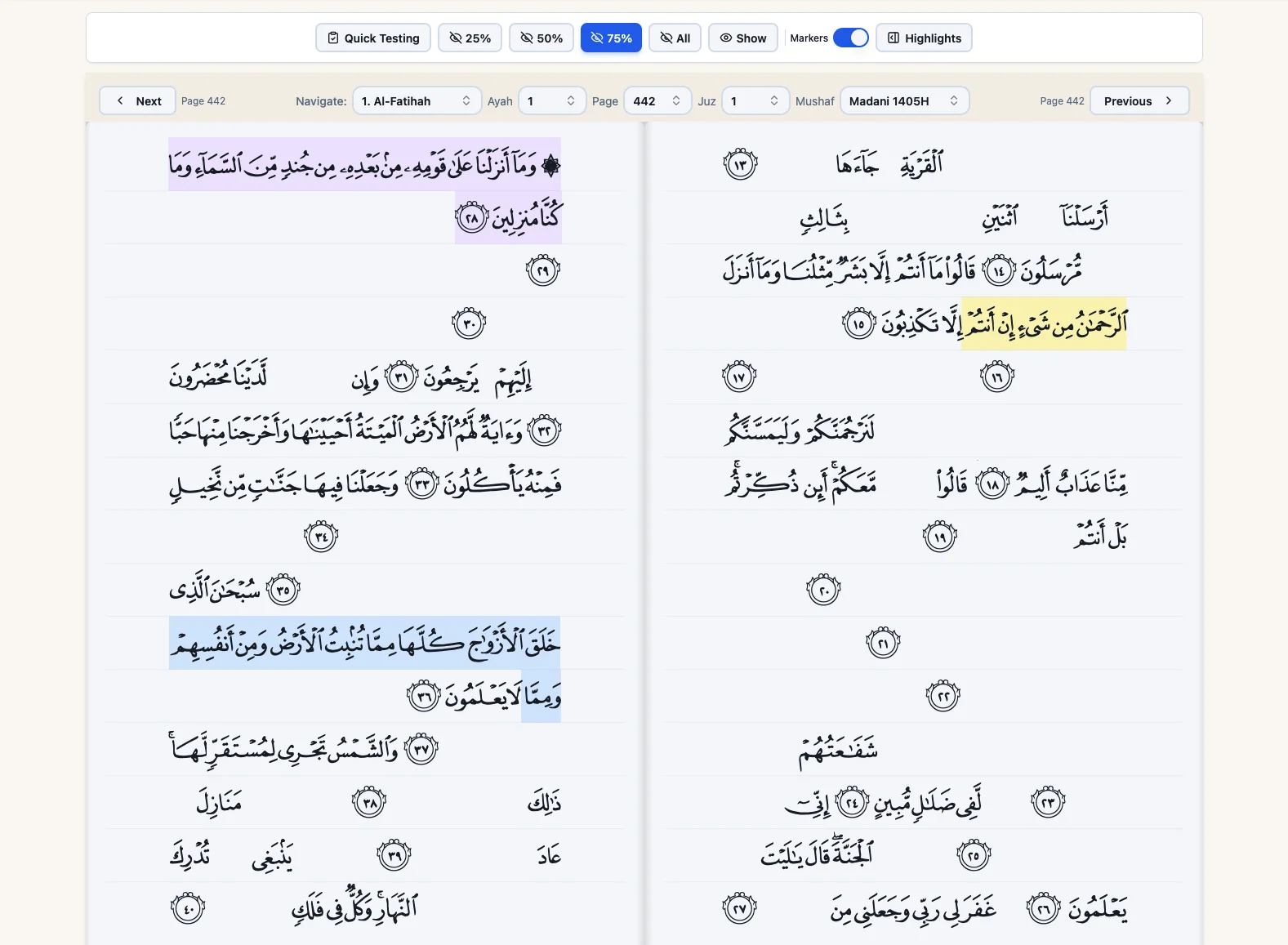
- Use an app that hides the page and asks you questions. The Quran Memorizer app does this with ten-plus quiz types and keeps track of where you keep making mistakes.
More ideas are in Hifz Test: How to Check Your Quran Memorization.
6. Find one person to recite to
Even if you can’t have a teacher, you can usually find someone who reads well: a spouse, a parent, a sibling, a friend from the masjid. Ask them to follow in the mushaf while you recite your week’s lessons once a week. They won’t catch every tajweed detail, but they’ll catch the big errors, and the appointment alone will make you prepare.
A hifz partner working on their own portion is even better. You recite to each other, and on the days you’d skip, you show up because they’re waiting.
7. Keep a simple record
A teacher keeps track of where you are. At home, you have to. A notebook works. Write down each day’s lesson, how it went, and any ayat that gave you trouble. Mark weak spots in your mushaf with a light pencil dot.
After a few weeks, the notebook tells you things you’d never notice otherwise: which day of the week you always skip, which kind of mistake you keep making, whether your lesson size is too big.
When to look for more help
Memorizing alone works well for many people, especially in Juz Amma and the shorter surahs. Consider getting more regular help if:
- You keep finding mistakes in pages you thought were solid.
- Your recordings show tajweed errors you don’t know how to fix.
- Your revision keeps falling behind and you can’t see why.
- You’ve stopped and started more than twice.
None of this means you’ve failed. It means your setup needs adjusting. The Prophet ﷺ said the best of you are those who learn the Quran and teach it (Sahih al-Bukhari 5027). Learning and teaching go together, and getting help is part of the learning.
A home routine that works
Here’s a realistic routine for someone working full time:
- Before work (30 to 40 minutes): Warm-up, recent review, new lesson of 5 to 7 lines.
- Lunch break or commute (10 minutes): Listen to tomorrow’s lesson.
- Evening (15 minutes): Older review, either reading from memory or in two rak’at of night prayer.
- Weekend: Recite the week’s lessons to someone. No new lesson on one day of the weekend, just revision.
That’s about an hour a day, and it adds up to roughly a juz every two months. For more on fitting hifz around a job, see Quran Memorization for Adults.