To memorize Surah Al-A’la, learn it in four short parts cut where the meaning changes (87:1-5, 87:6-8, 87:9-13 and 87:14-19), one part a day, and recite everything you’ve learned so far before each new part. On day five, practice starting from the middle of the surah, then pray it in witr that night.
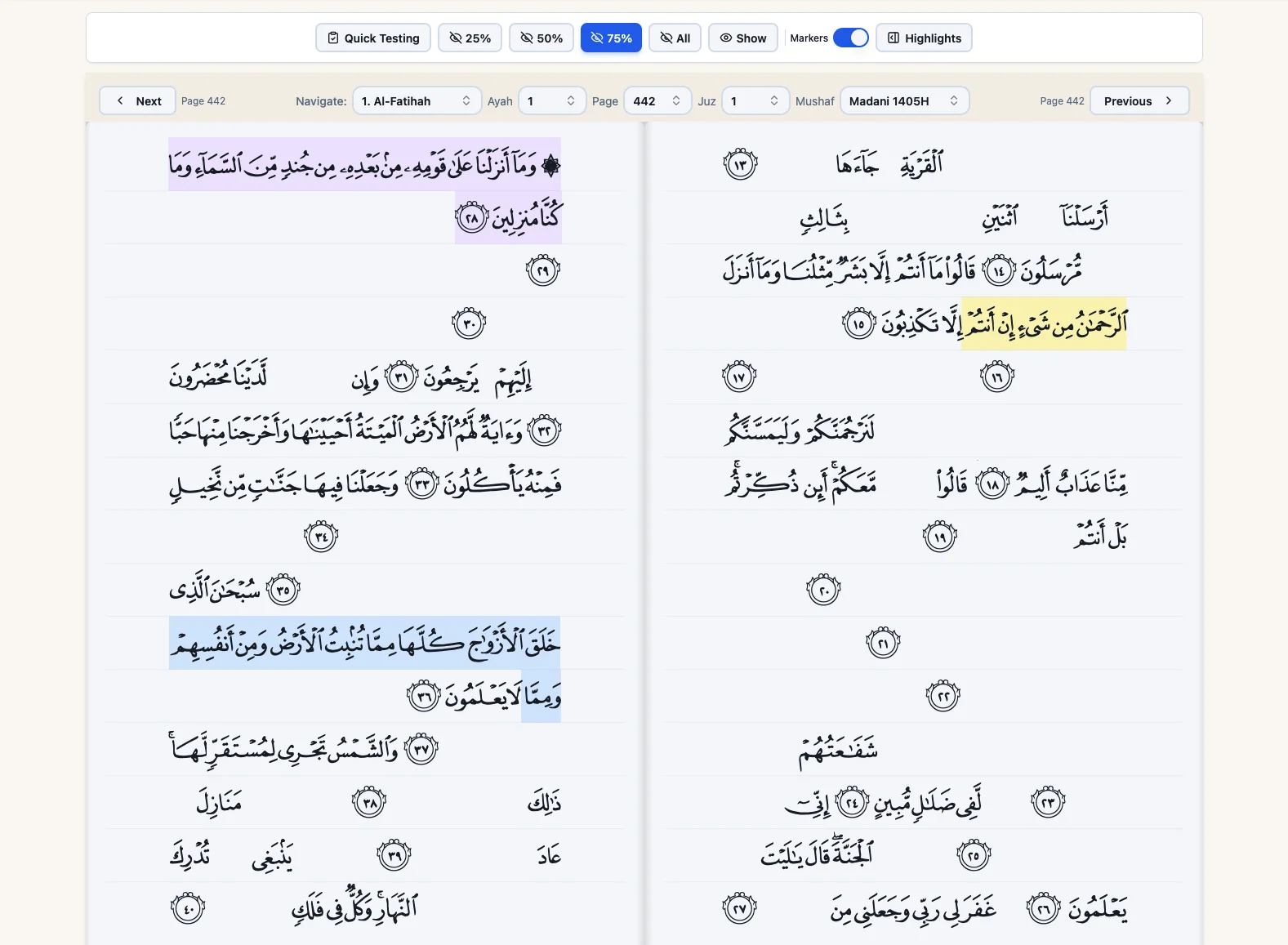
It’s 19 short ayat on 8 lines of the Madani mushaf: the last six lines of page 591 and the first two of page 592. If you’ve memorized a few surahs before, two days at five lines a day is enough. Recited at Mishary Alafasy’s pace, the whole surah takes about a minute and a half.
It’s Surah 87, “The Most High”, the one that opens sabbihisma rabbikal-a’la. Type “surah al ala” into a search bar and most of the suggestions are for Al-‘Alaq, which is Surah 96 on page 597 and opens with iqra’ bismi rabbika.
Al-A’la was already being taught in Madinah before the Prophet ﷺ arrived. Al-Bara’ ibn ‘Azib said he’d learned it, along with other surahs of the Mufassal (the shorter surahs toward the end of the Quran), before the Hijrah (Sahih al-Bukhari 3925; see also 4941).
You’ll hear it more often than its length suggests. The Prophet ﷺ recited it with Al-Ghashiyah on Fridays and on both Eids, and in the first rak’ah of a three-rak’ah witr, which is why Al-Ghashiyah gets its own section further down.
At a glance
- Surah: 87, Al-A’la (“The Most High”), also called Sabbih after its first word. Makkan.
- Where it sits: juz 30 (para 30, Juz Amma), pages 591 to 592 of the 604-page Madani mushaf. It opens hizb 60, the last of the Quran’s 60 hizbs (a hizb is half a juz).
- Length: 19 ayat, 72 words, 8 lines of text. That’s just over half a page.
- Time to recite: about 1 minute at a quick pace (ash-Shuraym, 0:59), 1:35 with Alafasy, 2:31 with al-Husary.
- Time to memorize: 2 days at 5 lines a day or at half a page, 1 day at a full page. Five days with the plan below.
- Recited with: Al-Ghashiyah (88) on Fridays and both Eids; Al-Kafirun and Al-Ikhlas in witr.
If the only surahs you know are the short ones on the last few pages, we’d still take the five days. Every ayah ends on the same sound, so the order has to come from the meaning, and it takes a few nights to learn the meaning well. For other surahs, our chart of how long each surah takes to memorize lines Al-A’la up against the rest at the same three paces.
Surah Al-A'la at a glance
- Surah
- 87
- Juz
- 30
- Mushaf
- Pages 591 to 592
- Ayat
- 19
- Length
- 8 lines
- Recited in
- about 2 minutes
How many days will it take?
| New lines a day | Days |
|---|---|
| 3 (a few lines) | 3 days |
| 5 (a third of a page) | 2 days |
| 7 (half a page) | 2 days |
Counts days of new memorization on the 8 lines of Surah Al-A'la. Add revision on top. Make a day-by-day plan.
Test yourself
Memorized Surah Al-A'la? Find the ayat you’re not sure of.
Quran Memorizer asks you what comes next, which ayah is missing and which look-alike ayah goes where, on the same Madani mushaf pages you learned from. With Premium, Daily Review brings your weakest ayat back first, so you can revise Surah Al-A'la a little every day.

Free to start, no card needed. On the web or iPhone, choose Surah Al-A'la as what you want to be tested on.
More on Surah Al-A'la: All surah guides
What is Surah Al-A’la about?
Every ayah ends on the same long -ā: a’lā, sawwā, hadā, all the way to Mūsā. Recited aloud, that single rhyme is what makes the surah flow. It also means the sound never marks a new section, so read a translation of each part before you memorize it. The five parts below are your map, each with its Arabic so you can learn straight from this page.
87:1-5, glorify your Lord. The command, then three ayat about “the One who”: created and proportioned, decreed and guided, brought out the pasture and then turned it into dark stubble.
سَبِّحِ ٱسْمَ رَبِّكَ ٱلْأَعْلَى ﴿١﴾ ٱلَّذِى خَلَقَ فَسَوَّىٰ ﴿٢﴾ وَٱلَّذِى قَدَّرَ فَهَدَىٰ ﴿٣﴾ وَٱلَّذِىٓ أَخْرَجَ ٱلْمَرْعَىٰ ﴿٤﴾ فَجَعَلَهُۥ غُثَآءً أَحْوَىٰ ﴿٥﴾
87:6-8, the promise to the Prophet ﷺ. Allah will make him recite and he won’t forget, except what Allah wills, and He’ll ease him toward ease.
سَنُقْرِئُكَ فَلَا تَنسَىٰٓ ﴿٦﴾ إِلَّا مَا شَآءَ ٱللَّهُ ۚ إِنَّهُۥ يَعْلَمُ ٱلْجَهْرَ وَمَا يَخْفَىٰ ﴿٧﴾ وَنُيَسِّرُكَ لِلْيُسْرَىٰ ﴿٨﴾
87:9-13, the reminder and who takes it. Remind. The one who fears Allah will be reminded; the wretched one avoids it and burns in the greatest Fire, neither dying there nor living.
فَذَكِّرْ إِن نَّفَعَتِ ٱلذِّكْرَىٰ ﴿٩﴾ سَيَذَّكَّرُ مَن يَخْشَىٰ ﴿١٠﴾ وَيَتَجَنَّبُهَا ٱلْأَشْقَى ﴿١١﴾ ٱلَّذِى يَصْلَى ٱلنَّارَ ٱلْكُبْرَىٰ ﴿١٢﴾ ثُمَّ لَا يَمُوتُ فِيهَا وَلَا يَحْيَىٰ ﴿١٣﴾
87:14-15, who succeeds. The one who purifies himself, mentions the name of his Lord and prays. This is the last line of page 591.
قَدْ أَفْلَحَ مَن تَزَكَّىٰ ﴿١٤﴾ وَذَكَرَ ٱسْمَ رَبِّهِۦ فَصَلَّىٰ ﴿١٥﴾
87:16-19, the choice. You prefer this world, though the Hereafter is better and more lasting, and this was already in the earliest scriptures, those of Ibrahim and Musa.
بَلْ تُؤْثِرُونَ ٱلْحَيَوٰةَ ٱلدُّنْيَا ﴿١٦﴾ وَٱلْـَٔاخِرَةُ خَيْرٌ وَأَبْقَىٰٓ ﴿١٧﴾ إِنَّ هَـٰذَا لَفِى ٱلصُّحُفِ ٱلْأُولَىٰ ﴿١٨﴾ صُحُفِ إِبْرَٰهِيمَ وَمُوسَىٰ ﴿١٩﴾
“We will make you recite, [O Muḥammad], and you will not forget, Except what Allāh should will. Indeed, He knows what is declared and what is hidden.”
Al-A’la 87:6-7, Saheeh International translation. Compare translations on quran.com
Those words were addressed to the Prophet ﷺ, which is why Saheeh adds “[O Muḥammad]”. They’re a promise Allah made to him and fulfilled. Our own hifz is held the ordinary way, by revising it. Still, anyone who’s lost an ayah they knew perfectly last month will read “and you will not forget” slowly.
Where every ayah sits on the page
| Page, line | Ayat on it |
|---|---|
| 591, line 8 | Surah title |
| 591, line 9 | Bismillah |
| 591, line 10 | 87:1, 87:2, 87:3 |
| 591, line 11 | 87:4, 87:5, first word of 87:6 |
| 591, line 12 | Rest of 87:6, 87:7, first word of 87:8 |
| 591, line 13 | Rest of 87:8, 87:9, 87:10 |
| 591, line 14 | 87:11, 87:12, start of 87:13 |
| 591, line 15 | Rest of 87:13, 87:14, 87:15 |
| 592, line 1 | 87:16, 87:17, first word of 87:18 |
| 592, line 2 | Rest of 87:18, 87:19 |
Look at the map once before day 1. It settles where to split the surah and how to cross the page.
- It splits exactly in half. 87:1-10 fills lines 10 to 13 of page 591 (37 words). 87:11-19 fills the last two lines of 591 and the first two of 592 (35 words). Four lines each, so if you’re doing the surah in two days, there’s your split.
- Page 591 ends on prayer. Its last word is fa-ṣallā, “and prays” (87:15). Turn the page and the first word is bal, “but”. Learn fa-ṣallā, bal as one sound and the page turn stops being a gap.
- Four ayat run across a line end. In three of them a single word is left on the line above: sanuqri’uka (87:6), wa nuyassiruka (87:8) and inna (87:18, alone at the end of page 592’s first line). 87:13 breaks after thumma lā yamūtu. Your eye sees the end of a line right where your tongue has to carry on, so recite each of these as one unit, even when you’re reading off the page.
How to memorize Surah Al-A’la in five days
Each day’s new portion is three to six ayat, between 14 and 23 words, cut where the meaning breaks. Before the new portion, recite everything you’ve learned so far from memory. By day 4 that’s 13 ayat, roughly a minute.
- Day 1: 87:1-5, glorify your Lord. Just under two lines, page 591 lines 10 and 11. Watch the wa: none on 87:2, then wa on 87:3 and 87:4.
- Day 2: 87:6-8, the promise. Both 87:6 and 87:8 start on the line above, so learn them as whole ayat from the start.
- Day 3: 87:9-13, the reminder and who avoids it. The wretched one (87:11-13) comes before qad aflaḥa, so don’t jump from 87:10 to 87:14.
- Day 4: 87:14-19, success and the choice. The last line of page 591 and the first two of 592. Say fa-ṣallā, bal in one breath across the page turn.
- Day 5: review only. Start cold from 87:6, 87:9, 87:11, 87:14 and 87:16, which means beginning the ayah without saying the one before it. Then recite the whole surah to someone, or against the mushaf.
That night, recite it in the first rak’ah of witr, with Al-Kafirun and Al-Ikhlas in the second and third. You almost certainly know those two already, and it’s the set the Prophet ﷺ recited in his own witr.
If you’ve memorized a handful of juz 30 surahs before, the half-way split from the map will do: 87:1-10 on day 1, 87:11-19 on day 2.
What does one day’s session look like?
This is our default routine for a short portion. The counts are a starting point, and they work because each step adds one thing to what you already have. Expect 10 to 15 minutes, a little longer on day 1.
- Read the meaning first. Read the Saheeh International translation of today’s ayat once. With one rhyme across the whole surah, the meaning is what tells you which ayah comes next.
- Listen three times. Play today’s ayat in a slow recitation while you follow the words in the mushaf.
- One ayah at a time. Recite the first ayah looking at the page until it’s clean five times in a row, then three times without looking. Then move to the next.
- Chain them. Ayat 1 and 2 together, then 1 to 3, and so on. Say the last word of each ayah and the first word of the next in one breath.
- Run everything so far. Recite from 87:1 to today’s last ayah without the page. If you stall, look, then restart that ayah from its first word.
Our step-by-step guide to memorizing the Quran uses the same routine for longer passages.
For the listening, start with Mahmoud Khalil al-Husary’s teaching recording (muallim). It runs 2:46 for the surah, slow enough to hear every letter and repeat after him. Once it’s in, Alafasy (1:35) or al-Minshawi (1:52) suit daily listening, and Sa’ud ash-Shuraym’s 59-second recitation makes a quick full run on revision days. All four are on quran.com, which can also show a word-by-word transliteration under each ayah if you can’t read the Arabic script yet. Use it for the first days and lean on the audio after that.
Free tool
Want it on a calendar? The plan generator maps Al-A’la to dates at your own pace: three short lessons at 3 lines a day, two at 5. Open the hifz plan generator →
Where do people slip in Al-A’la?
Inside the surah the trouble spots are few and predictable. The harder ones come from other surahs you already know, because Al-A’la shares whole phrases with them. If Al-A’la is one of your first surahs, read the first two parts now and come back to the rest once you’ve learned Al-Layl, Ad-Duha and Ash-Shams.
Inside the surah
Three ayat in a row begin with “the One who”, and only the first goes without wa:
ٱلَّذِى خَلَقَ فَسَوَّىٰ
وَٱلَّذِى قَدَّرَ فَهَدَىٰ
وَٱلَّذِىٓ أَخْرَجَ ٱلْمَرْعَىٰ
Each is a verb, then fa, then a second verb: khalaqa fa-sawwā, qaddara fa-hadā, and akhraja carried on into 87:5’s fa-ja’alahu. One bare, then two with wa. A fourth alladhī turns up at 87:12, describing the wretched one, and that one’s bare as well.
- Jumping from 87:10 to 87:14. Ayah 10 ends with the one who fears Allah taking the reminder, and qad aflaḥa (“he has certainly succeeded”) sounds like the natural next line. It isn’t. The wretched one who avoids the reminder (87:11-13) comes first.
- The wrong first word after the page turn. 87:16 opens with bal. The usual mistakes are wa, borrowed from the ayat on either side, or inna, which belongs to 87:18 and sits alone at the end of page 592’s first line.
- Your Lord, then his Lord. 87:1 says isma rabbika, the name of your Lord, and 87:15 says isma rabbihi, the name of his Lord. Neither has bi. On page 591, Al-A’la starts with the command to glorify His name and ends the page on someone who did, which tells you which pronoun goes where.
Sabbihisma or fasabbih bismi?
Start with the first ayah. It has three near-twins elsewhere in the Quran, which makes it Al-A’la’s main mutashabih, the word for ayat that look or sound so alike the tongue runs from one into the other. 56:74, 56:96 (the last ayah of Al-Waqi’ah) and 69:52 (the last ayah of Al-Haqqah) all read, word for word, fasabbih bismi rabbikal-‘azim. Al-A’la’s opening is the only sabbihisma rabbika in the Quran. Here they are, 87:1 first:
سَبِّحِ ٱسْمَ رَبِّكَ ٱلْأَعْلَى
فَسَبِّحْ بِٱسْمِ رَبِّكَ ٱلْعَظِيمِ
Four things change between them:
- The fa. The three “Most Great” ayat open with fa-, “so”. 87:1 starts straight on the verb.
- The bi. They say bismi; 87:1 says isma, with no bi. That changes the case ending too: isma in 87:1, bismi in the other three.
- The end of the verb. In 87:1 it’s sabbiḥi, with a helping kasra that joins it to isma. In the others it’s fasabbiḥ, ending on a sukun.
- The name at the end. Al-a’lā, “the Most High”, in 87:1. Al-‘aẓīm, “the Most Great”, in the other three.
If you memorize with a translation open, watch out. Saheeh International renders both with “exalt the name of your Lord”, so the English shows you the fa and the final name and hides the other two differences.
Two clues tell you which is which. The first is position. “Most Great” closes a passage every time: twice it’s the last ayah of a surah, and 56:74 rounds off the four questions in 56:58-73 about human creation, crops, water and fire. “Most High” opens one.
Tip: In 56:95 and 69:51, the ayah just before is about ḥaqq al-yaqīn, the truth of certainty. If you’ve just said ḥaqq al-yaqīn, the next words are fasabbih bismi rabbikal-‘azim, every time.
The second clue is salah. In bowing the Prophet ﷺ said subḥāna rabbiyal-‘aẓīm, and in prostration subḥāna rabbiyal-a’lā (Sahih Muslim 772). ‘Aẓīm belongs to ruku’, a’lā to sujud, and 87:1 is the a’lā one.
There’s also a narration from ‘Uqbah ibn ‘Amir that ties fasabbih bismi rabbikal-‘azim to ruku’ and 87:1 to sujud by name. Its grading is split on sunnah.com: Sahih by Darussalam at Sunan Ibn Majah 887, Da’if by Al-Albani at Sunan Abi Dawud 869. So for this clue, rely on Muslim 772.
For pairs like these, our guide to mutashabihat and similar Quran verses has the full routine.
Al-A’la against Al-Layl
Al-Layl (92) is also 8 lines, and the Prophet ﷺ named the two surahs in the same sentence when he told Mu’adh to shorten his prayer. Learn one and the other starts lending it phrases:
- Lil-yusrā. 87:8 is wa nuyassiruka lil-yusrā (We will ease you). 92:7 is fa sanuyassiruhu lil-yusrā (We will ease him). Al-A’la has wa and “you”; Al-Layl has fa, sa- and “him”. They’re the only two ayat in the Quran with lil-yusrā.
- Al-ashqā. In Al-A’la the wretched one avoids the reminder (87:11), then an alladhī ayah has him burn in the greatest Fire. In Al-Layl only the most wretched will burn (92:15), then an alladhī ayah says he denied and turned away. Same pieces, different order, and the only two places al-ashqā appears.
- Rabb with al-a’lā. Rabbikal-a’lā in 87:1, rabbihil-a’lā in 92:20, the second-to-last ayah of Al-Layl. The only other one in the Quran is Pharaoh’s boast in 79:24, rabbukumul-a’lā, also in juz 30.
More ayat that pull you into another surah
- 87:17 and Ad-Duha 93:4. Al-A’la has wal-ākhiratu khayrun wa abqā. Ad-Duha has wa lal-ākhiratu khayrun laka minal-ūlā, with an extra la, and laka minal-ūlā (for you, than the first) where Al-A’la has wa abqā (and more lasting).
- 87:19 and An-Najm 53:36-37. Al-A’la names the scriptures of Ibrahim, then Musa. An-Najm names Musa first, then Ibrahim “who fulfilled”, and Ibn Kathir pairs the two passages himself. In Al-A’la they come in the order they lived: Ibrahim, then Musa.
- 87:14 and Ash-Shams 91:9. Qad aflaḥa man tazakkā here, qad aflaḥa man zakkāhā there. Ash-Shams is the other surah named in the Mu’adh hadith, so you’ll likely learn it close by.
To check the joins, open the Quran Memorizer test, set the scope to Al-A’la and run next-ayah questions until 87:5 into 87:6, 87:10 into 87:11 and 87:15 across the page into 87:16 come without a pause. The mutashabihat practice trains the same skill you need for 87:1: it shows you a shared phrase and asks you to place it in the right surah and ayah.
When to recite Surah Al-A’la
In the places the Prophet ﷺ recited it: with Al-Ghashiyah in Jumu’ah and both Eids, in the first rak’ah of a three-rak’ah witr, and in shorter prayers like Isha and Zuhr. Grades below are the ones sunnah.com shows. Bukhari and Muslim don’t get a grade line there, since both collections are accepted as authentic.
In Jumu’ah and both Eids, with Al-Ghashiyah
An-Nu’man ibn Bashir reported that the Prophet ﷺ recited Al-A’la and Al-Ghashiyah in the two Eid prayers and in the Friday prayer, and when Eid fell on a Friday he recited the same two surahs in both prayers (Sahih Muslim 878a). The same report is in Sunan Abi Dawud 1122, graded Sahih by Al-Albani.
It wasn’t his only choice. On Fridays he also recited Al-Jumu’ah and Al-Munafiqun (Sahih Muslim 877a), and Al-Jumu’ah followed by Al-Ghashiyah (Sahih Muslim 878c). For Eid he also recited Qaf and Al-Qamar (Sahih Muslim 891a). All of these are sunnah. Al-A’la and Al-Ghashiyah happen to be the shortest pair: about 3½ minutes together with Alafasy. Al-Jumu’ah and Al-Munafiqun run roughly twice that.
87:14-15 also have an old link to Eid. Ibn Kathir reports that ‘Umar ibn ‘Abd al-‘Aziz would tell people to pay Sadaqat al-Fitr, the charity given before the Eid prayer, and would recite these two ayat as he did so (Ibn Kathir on 87:14). It’s one early reading of “purifies himself” among several, and a good one to have in mind when you hear Al-A’la in the Eid prayer.
In witr, with Al-Kafirun and Al-Ikhlas
This one comes through several Companions. Ubayy ibn Ka’b described a three-rak’ah witr: Al-A’la in the first rak’ah, Al-Kafirun in the second, Al-Ikhlas in the third (Sunan an-Nasa’i 1699, graded Sahih by Darussalam; also Sunan Abi Dawud 1423, graded Sahih by Al-Albani). Ibn ‘Abbas reported the same three (Jami’ at-Tirmidhi 462, graded Sahih by Darussalam), and so did ‘Abdur-Rahman ibn Abza (Sunan an-Nasa’i 1732, graded Sahih by Darussalam).
At-Tirmidhi adds that most scholars among the Companions and those after them chose this: one surah per rak’ah.
Ubayy’s report has one more detail for your own witr. When he finished, the Prophet ﷺ said Subḥānal-Malikil-Quddūs three times, drawing out the words the third time (Sunan an-Nasa’i 1699).
You’ll also see a version from ‘A’isha that puts Al-Ikhlas, Al-Falaq and An-Nas together in the third rak’ah. Here the graders differ. Sunan Abi Dawud 1424 is graded Sahih by Al-Albani; Jami’ at-Tirmidhi 463 and Sunan Ibn Majah 1173 are graded Da’if by Darussalam, and at-Tirmidhi’s own verdict was hasan gharib. The Al-A’la, Al-Kafirun, Al-Ikhlas set has more Sahih chains, and it’s the one at-Tirmidhi says most scholars chose.
In shorter congregational prayers
When Mu’adh led a long Isha that was hard on the people behind him, the Prophet ﷺ told him he should have recited Al-A’la, Ash-Shams or Al-Layl, because “the old, the weak and the needy” pray behind you (Sahih al-Bukhari 705).
Jabir ibn Samurah reported that he recited Al-A’la in Zuhr, and something longer in Fajr (Sahih Muslim 460). If you lead prayers at home or at work, this is the length the Prophet ﷺ himself pointed to.
What about the benefits of Surah Al-A’la?
You’ll find three claims online that don’t hold up as stated:
- “The Prophet ﷺ loved this surah.” The report is in Musnad Ahmad 742, and sunnah.com grades its chain Da’if (Darussalam).
- Reciting it before sleep. Some English translations list Al-A’la among the “Musabbihat” he recited before sleeping (Jami’ at-Tirmidhi 2921, graded Hasan by Darussalam). That list of surahs is the translator’s addition in parentheses; the Arabic names none.
- Easing stress or anxiety. These claims come with no source at all.
A surah the Prophet ﷺ chose for Jumu’ah, both Eids and witr doesn’t need a weak chain to recommend it.
Should you learn Al-Ghashiyah next?
Yes, if Al-A’la is the one you’ve just finished. Al-Ghashiyah starts directly below Al-A’la’s last line on page 592, under its own title and bismillah, and together they’re the Friday and Eid pair. If you’re working backwards through juz 30, the way our Juz Amma plan does, you probably learned Al-Ghashiyah first. If so, skip to the slips and the revision section.
- Surah 88, “The Overwhelming”, one of the names of the Day of Judgement. Makkan. 26 ayat, 92 words.
- 11 lines, all on page 592 (lines 5 to 15).
- About 2 minutes at Alafasy’s pace (2:01), 1:11 with ash-Shuraym, 3:30 with al-Husary.
- 3 days at 5 lines a day, 2 at half a page, 1 at a full page.
Put the two together and you have 19 lines on one open spread. In a printed Madani mushaf, Al-A’la fills the bottom of the right-hand page (591) and the first two lines of the left (592), and Al-Ghashiyah takes everything below its title. If you memorize by picturing the page, learn the spread as one picture.
What is Surah Al-Ghashiyah about?
- 88:1-7, the Overwhelming and the humbled faces. Faces worn out, a hot Fire, a boiling spring, and ḍarī’, a thorny plant that doesn’t nourish.
- 88:8-16, the faces at ease. A garden on high, a flowing spring, raised couches, then cups, cushions and carpets.
- 88:17-20, look at creation. The camels, the sky, the mountains, the earth. Ibn Kathir gives the order a picture: the camel the bedouin rides, the sky over his head, the mountain in front of him, the earth beneath him.
- 88:21-26, remind. The Prophet ﷺ is only a reminder, with no control over them; their return is to Allah, and then their account.
Unlike Al-A’la, the rhyme here changes with the sections: -ah through the opening, a break for ḍarī’ and jū’, -ah again in the garden, -at for the four “how” questions, then -ir, -ar and -hum to close. Each change of sound marks a new section, so let your ear do some of the work here.
A four-day plan for Al-Ghashiyah
| Day | New ayat | Page 592: lines |
|---|---|---|
| 1 | 88:1-7 | 5 to 7 |
| 2 | 88:8-16 | 8 to 10 |
| 3 | 88:17-20 | 11 to start of 13 |
| 4 | 88:21-26 | rest of 13 to 15 |
On day 4, finish with the whole of Al-Ghashiyah, then go back to 87:1 and recite both surahs in one run. At five lines a day it’s three days instead: 88:1-13, then 88:14-23, then 88:24-26 with a full run of both surahs.
Day 2 is the easiest of the four to picture. Lines 8, 9 and 10 of page 592 hold three ayat each (88:8-10, 88:11-13, 88:14-16), so the garden sits on the page as a neat three-by-three block.
Where Al-Ghashiyah trips people
The swap to watch most closely sits inside the pair itself. Both surahs have an ayah that opens with fadhakkir, “so remind”, and you’ll meet them in back-to-back rak’ahs whenever the two surahs are recited together:
فَذَكِّرْ إِن نَّفَعَتِ ٱلذِّكْرَىٰ
فَذَكِّرْ إِنَّمَآ أَنتَ مُذَكِّرٌ
The first is 87:9, the second 88:21. Al-A’la’s is about the reminder itself, adh-dhikrā, ending on the long -ā every Al-A’la ayah has. Al-Ghashiyah’s is about the one who reminds, mudhakkir, ending in -ir like muṣayṭir in the ayah right after it.
- The faces, with no wa. 88:2 and 88:8 both open wujūhun yawma’idhin with no wa. Al-Qiyamah (75:24) and ‘Abasa (80:40) put wa on the second face, and they put the joyful faces first. Al-Ghashiyah starts with the humbled ones.
- Two fīhā, then three wa. 88:12 and 88:13 open with fīhā; 88:14 to 88:16 open with wa.
- Lines that end on kayfa. Lines 11 and 12 both end on kayfa (how), so rufi’at and suṭiḥat start the next line. Get the order of camels, sky, mountains and earth right first; the verbs follow.
- Turned away, then disbelieved. 88:23 is tawallā wa kafar. Al-Layl (92:16) and Al-‘Alaq (96:13) have kadhdhaba wa tawallā, denied and turned away. Kafar also sets up the -ar of al-akbar that closes the next ayah.
Revising Al-A’la and Al-Ghashiyah
Once a week, recite them back to back from memory. Friday is the natural day. It’s 19 lines and about 3½ minutes at Alafasy’s pace, or just over 2 with ash-Shuraym.
- Start cold. Open from 87:6, 87:9, 87:11, 87:14, 87:16, 88:8, 88:17 and 88:21 without the ayah before. That’s every section start, plus 87:11, the ayah people skip. The random-ayah spot test explains how to run this on any passage.
- The seam between the surahs. 87:19 into 88:1 is Mūsā, the bismillah, then hal atāka. Say the last word of Al-A’la, the bismillah and the first three words of Al-Ghashiyah until the join comes without thinking. Then recite 87:9 and 88:21 side by side.
- One look at pages 591 and 592. Open the mushaf at the spread, look once, close it, and recite both surahs while you picture where each line sits.
- In salah. Al-A’la in the first rak’ah of witr, or the pair across the two rak’ahs of a sunnah prayer. Salah shows you which joins are weak, because there’s nobody to prompt you.
Start with 87:1 to 87:5 tonight: five short ayat, just under two lines of the mushaf. Five days from now you’ll know Al-A’la by heart and can recite it in witr that night. A few days after that you’ll have the pair, and from then on it’s one run through both every Friday.
Once both are solid, Daily Review in Quran Memorizer Premium can rotate them with the rest of your juz 30, so the ayat you get wrong come back first. It works on iPhone, iPad and the web.