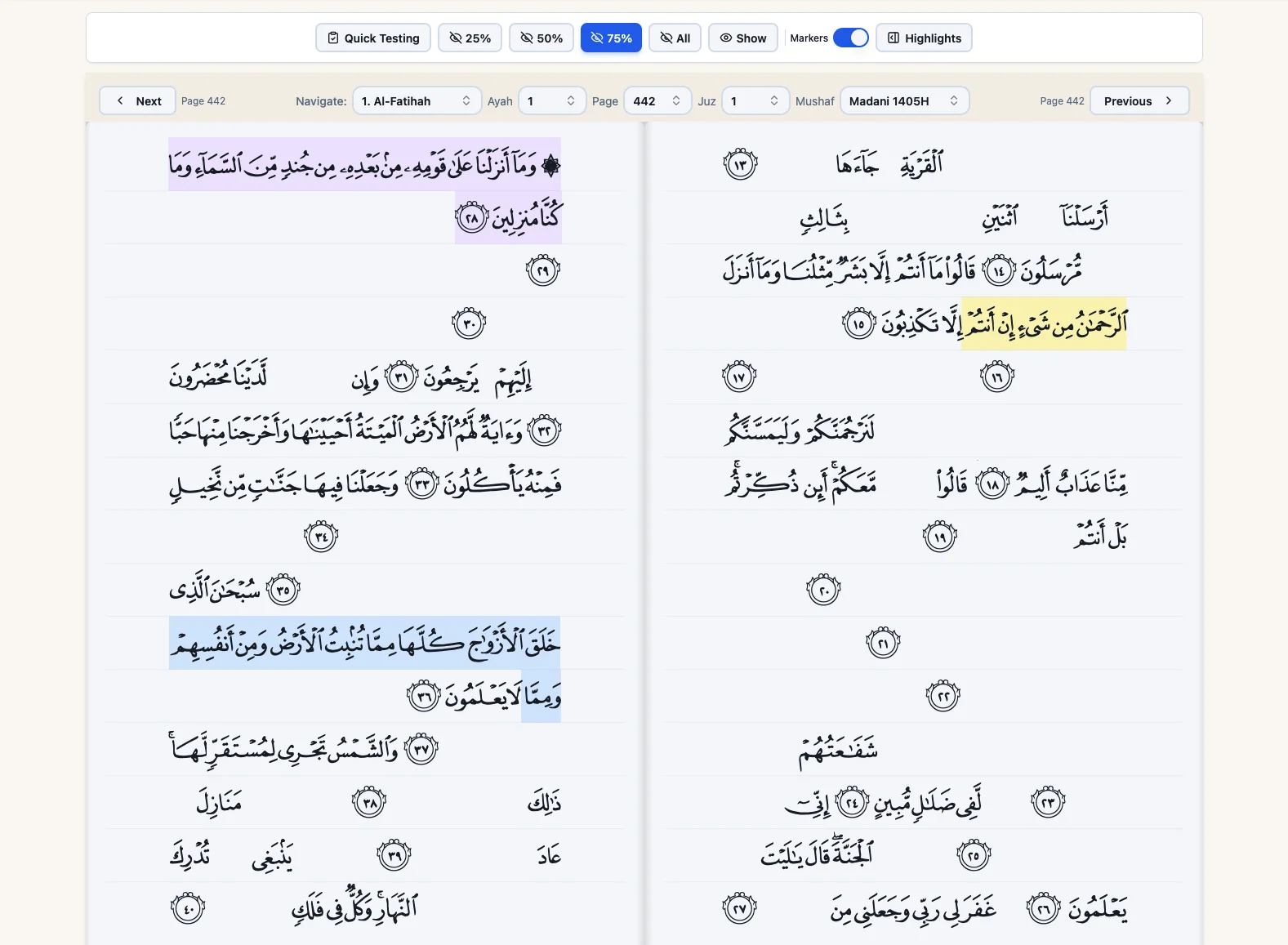
For centuries, huffaz have revised their memorization in night prayer. It’s one of the oldest ways to revise, and it still works well: no mushaf to glance at, no one to prompt you, and a time of night that Allah Himself describes as especially suited to recitation.
You don’t need to pray for hours. Even two rak’at a night, used well, can carry a large part of your revision.
Why night prayer works so well
It forces real recall
In salah there’s nothing in front of you. You either know the passage or you don’t. That makes it a far stronger test than reading from the mushaf.
The night is suited to recitation
Allah says that rising at night is more effective for focus and more suited for speech (Al-Muzzammil 73:6). The house is quiet, your phone is (hopefully) away, and the day’s distractions haven’t started.
It’s how the companions revised
Abdullah ibn ‘Amr used to recite a seventh of the Quran to his family during the day to check his memorization, so that his night prayer would go smoothly (Sahih al-Bukhari 5052). The Prophet ﷺ himself would recite long passages at night, and Hudhayfah described him reciting Al-Baqarah, An-Nisa and Al Imran in a single rak’ah (Sahih Muslim 772).
The reward is great
The Prophet ﷺ said that whoever prays at night reciting ten ayat will not be recorded among the heedless, whoever recites a hundred will be recorded among the devout, and whoever recites a thousand will be recorded among those with great reward (Sunan Abi Dawud 1398, graded sahih). And in the last third of every night Allah calls out, asking who will call on Him so He can answer (Sahih al-Bukhari 1145).
How much to recite
Start where you are. Allah says, in the same surah that describes night prayer, “so recite what is easy [for you] of the Quran” (Saheeh International) (Al-Muzzammil 73:20).
| Your level | A good nightly goal |
|---|---|
| Juz Amma or less | Two rak’at with two or three surahs you’re revising |
| A few juz | Two to four rak’at, about a page per rak’ah |
| 5 to 15 juz | Half a juz to a juz across your night prayer |
| Hafiz | A juz or more, so you complete the Quran regularly |
A simple weekly plan
Divide your revision portion for the week across the nights. For example, someone with five juz who wants to revise everything every two weeks needs about seven pages a night. Four rak’at with about two pages each would cover it.
Keep a note of where you stopped, so the next night picks up there.
Free tool
Want your night prayer to follow a revision cycle? Mark your pages strong, shaky or weak and get a daily portion you can recite at night. Open the manzil planner →
Prepare during the day
Night prayer goes much better if you’ve looked over the passage earlier. Read it through once after Asr or Maghrib, especially any parts you know are weak. If you’re nervous about a particular page, recite it quietly from memory once before you sleep.
When you stumble in prayer, don’t panic. You can pause, repeat the last ayah, or move on to a passage you know better. Note the spot and fix it the next day.
Preparing in the day is an old practice too: Abdullah ibn ‘Amr did the same. In old age he said he wished he had accepted the Prophet’s ﷺ permission to do less (Sahih al-Bukhari 5052).
If you’re not used to night prayer
Start small. Two rak’at before you sleep, before your witr, is a good beginning. Use a surah you know well. After a couple of weeks, try waking a little before Fajr for two more. Over time, many people find this becomes the part of the day they most look forward to.
Pair it with daytime revision
Night prayer is excellent for revision, but don’t rely on it alone, especially for recent lessons. Keep a daily daytime routine as well: Sabaq, Sabqi and Manzil Explained describes one. Use the daytime to fix weak spots and the night to recite.