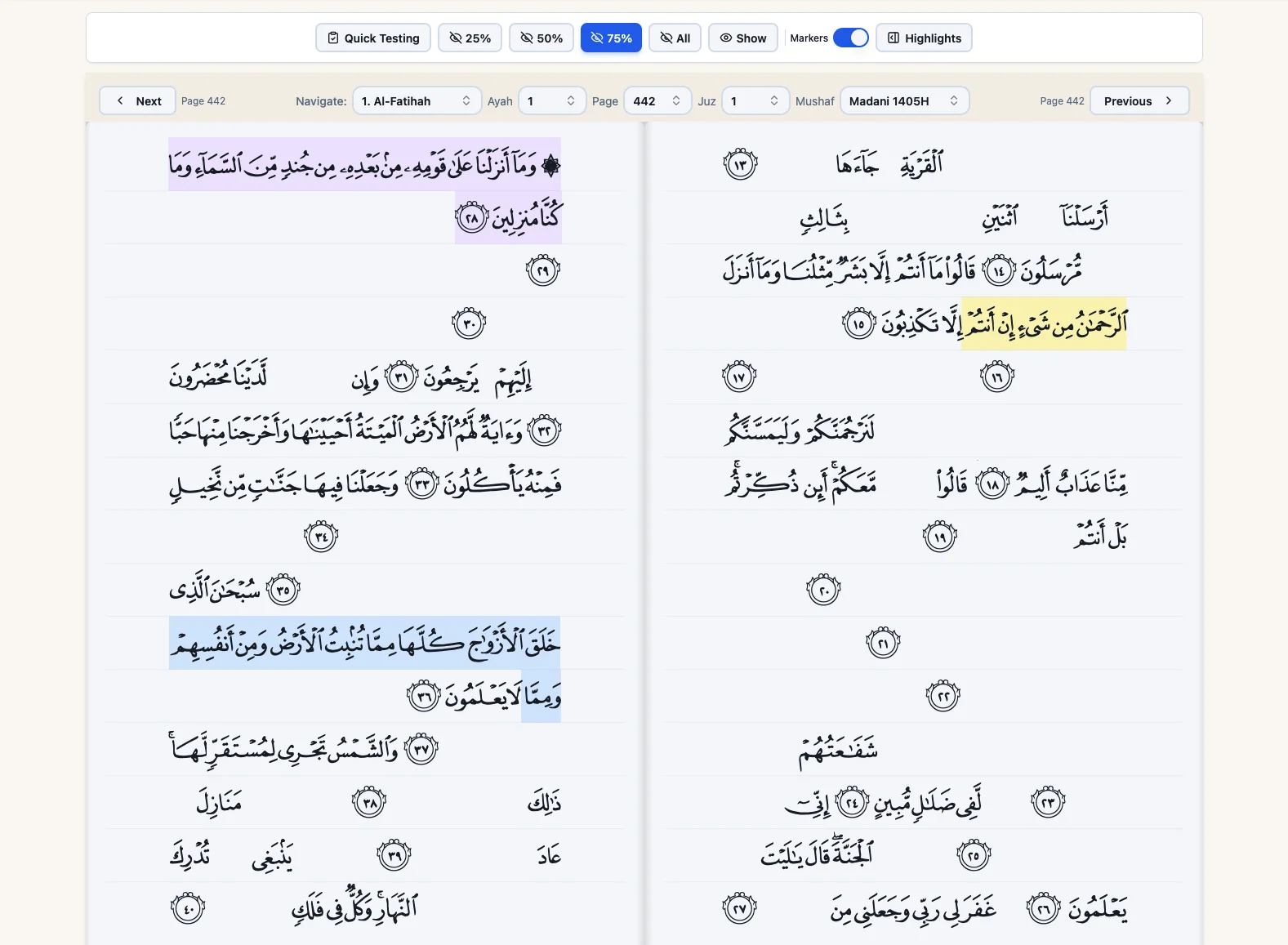

To revise the Quran so you don’t forget it, recite from memory every day in three layers: today’s new lesson, your recent lessons from the last few weeks, and a rotating share of everything older. That older share grows with your hifz: 5 to 10 pages a day if you’ve memorized 1 to 3 juz, about a juz a day at 10 to 15 juz, and 1.5 to 3 juz a day once you’ve finished the whole Quran. Recite with the mushaf closed, then open it and check.
- Sabaq: today’s new lesson.
- Sabqi: recent lessons, roughly the last one to four weeks, recited every day.
- Manzil: everything older, in a rotating cycle. The table further down has the daily amount for each stage.
Memorizing a page takes an hour, but you’ll be revising it for years, which is why teachers treat revision as the bigger half of hifz. Below you’ll find revision schedules for every stage, from your first juz to the full Quran, and ways to fix pages you keep forgetting.
Revision has a Sunnah behind it
Every Ramadan, Jibril would go over the Quran with the Prophet ﷺ, and in the year he passed away they went over it twice (Sahih al-Bukhari 4997, 4998). Allah promised to gather the Quran in the Prophet’s ﷺ heart (Al-Qiyamah 75:17), and still he reviewed it.
The companions did the same. Abdullah ibn ‘Amr would recite a seventh of the Quran to his family during the day to check his memorization, so that his night prayer would go smoothly (Sahih al-Bukhari 5052).
The three layers of revision
Most hifz teachers divide revision into layers by how recently you learned something, like the three above. The names vary, but sabaq, sabqi and manzil are the ones you’ll hear most often in English-speaking madrasas.
If any of these terms are new to you, our hifz vocabulary explains them, along with the regional names you might hear instead.
The idea is simple. New material is fragile and needs daily attention. Older material is more stable and can be reviewed less often, but never left alone. Sabaq, Sabqi and Manzil Explained covers each layer in depth.
How much to revise each day
A useful starting rule: spend at least as much time on revision as on new memorization. As your hifz grows past five juz or so, shift the balance further. Many huffaz who have finished spend almost all their Quran time on revision.
Here are sample manzil cycles by hifz size, assuming you also do daily sabqi:
| Memorized | Manzil per day | Full cycle |
|---|---|---|
| 1 to 3 juz | 5 to 10 pages | Every week |
| 5 juz | 15 pages | Every week |
| 10 juz | 20 pages (1 juz) | Every 10 days |
| 15 juz | 1 juz | Every 2 weeks |
| 20 juz | 1 to 1.5 juz | Every 2 to 3 weeks |
| 30 juz | 1.5 to 3 juz | Every 10 to 20 days |
Some traditions aim for a full khatm from memory every week, following the advice the Prophet ﷺ gave Abdullah ibn ‘Amr to complete the Quran in no less than seven days (Sahih al-Bukhari 5054). That’s a goal for full huffaz with time. Most people do well with ten days to a month.
Free tool
Not sure how to split your revision? Mark your pages strong, shaky or weak and get a daily cycle that covers everything you’ve memorized. Open the manzil planner →
Make revision real recall
Revision means reciting from memory. Reading a juz you’ve memorized is useful, but it doesn’t test or strengthen recall the way reciting with the mushaf closed does.
A good revision session looks like this:
- Recite a page (or half page) from memory.
- Open the mushaf and check it.
- Mark any mistakes or hesitations with a light pencil dot.
- Repeat the troublesome lines three to five times.
- Move on.
If you’re short on time, recite in your head rather than aloud, but do it from memory.
Use salah
Salah is the best revision tool there is, because there’s nothing to look at and no one to prompt you. Use it deliberately:
- Recite your sabqi in the sunnah prayers.
- Use part of your manzil in night prayer, even if it’s just two rak’at.
- If you lead prayer at home, plan which passage you’ll recite.
Fixing pages you keep forgetting
Every hafiz has weak pages. The mistake is treating every weak page the same way. Work out what’s going wrong:
- You forget how an ayah begins. Practice starting each ayah on the page from the first word, with the mushaf closed.
- You get stuck between ayat. Recite the end of one ayah and the start of the next, five times, until the join is automatic.
- You drift into a similar passage. Compare the two side by side and write down exactly what’s different. Memorizing Similar Verses has a full method.
- The whole page is vague. Treat it as a new lesson again: listen, read, memorize in chunks.
Then give that page extra attention for a week, reciting it daily alongside your sabqi. A Hifz Revision Plan for the Pages You Keep Forgetting goes further. If it’s whole surahs rather than single pages, start with how not to forget the Quran.
When revision falls behind
It happens to everyone: exams, a new job, a new baby, illness. When it does:
- Stop new memorization. Adding pages while your revision is collapsing makes things worse.
- Rebuild from the most recent. Get your last few juz solid first, because they’re the most fragile.
- Then work backwards. Bring older juz back one at a time.
- Restart new lessons small. A few lines a day until the cycle feels steady.
If you’ve been away for months or years, see How to Re-memorize the Quran After Forgetting It.
Keep track
Once your hifz is bigger than a few juz, you can’t keep the whole revision cycle in your head. Use a notebook, a chart on the wall, or an app. The Quran Memorizer daily review was designed around exactly this: it gives you your recent lessons every day, rotates through the rest a portion at a time, and asks more questions about the places you keep getting wrong, so your revision time goes where it’s needed.
Revision is worship too
It’s easy to feel that revision is the boring part and new pages are the real progress. But every letter you recite carries reward, whether it’s your first time through a passage or your hundredth. The Prophet ﷺ said each letter of the Quran brings a good deed, multiplied tenfold (Jami’ at-Tirmidhi 2910). Revision is a large part of what being a companion of the Quran looks like day to day.
Questions people ask
How do I revise the Quran quickly?
Recite from memory rather than rereading, and spend your time where it’s needed: give weak pages a full, careful pass and only spot-check strong ones from a random ayah. At a steady pace a page takes about 3 minutes, so a juz is roughly an hour; at a quicker pace it’s nearer 40 minutes. How to revise the Quran faster has more ways to save time without losing accuracy.
What’s the best time of day to revise?
Whichever time you can protect on most days. After Fajr is a common choice because the house is quiet, and older juz fit well into sunnah and night prayers. If evenings are your only quiet time, use them. A fixed slot matters more than the hour itself. There’s more in the best time to revise the Quran.
What should I do if I’ve forgotten a lot?
Pause new lessons, rebuild your most recent juz first, then work backwards one juz at a time, and restart new lines small once the cycle feels steady. After that, fix what caused it: our guide on how to stop forgetting what you memorize covers the daily habits, and re-memorizing the Quran after forgetting it helps if it’s been months or years.
More guides: After hifz: revising all 30 juz · Reading the mushaf vs reciting from memory · How to catch up on missed hifz revision