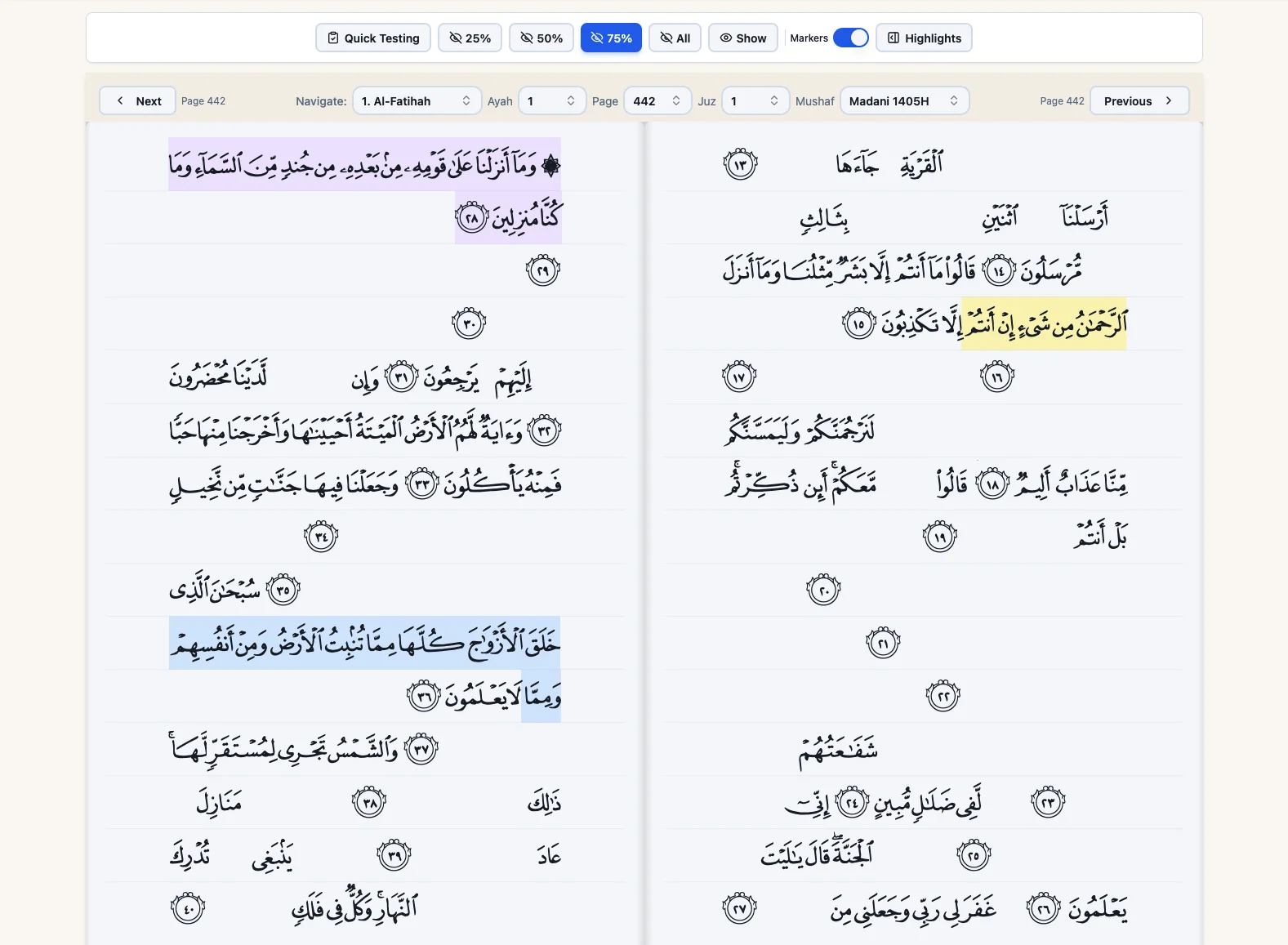

Every hafiz and every student of hifz has a handful of pages that stay weak however often they’re revised. You revise them, they feel fine, and two weeks later they’re shaky again. Meanwhile other pages come back perfectly every time without much effort.
Most revision plans treat every page the same: so many pages a day, round and round. That works for the strong pages. For the weak ones, it’s not enough, and the usual reaction (spending every session on them) starves everything else. There’s a better way to split the time.
Step 1: Test honestly
You can’t fix what you haven’t found. Over one full revision cycle, recite every page from memory and note how it went. Don’t read along. Recite, then check.
Give each page a color:
- Green: recited cleanly, or with one small slip you corrected yourself.
- Amber: needed a prompt or two, or hesitated at a join.
- Red: needed the mushaf several times, or you got lost.
Pencil a small dot in the corner of each page in your mushaf, or keep a list in a notebook. If your hifz is large, this takes a couple of weeks. It’s worth it, because from now on you know where your problems actually are.
Step 2: Look for patterns
Before you start repairing, look at the red and amber pages together. Often the problems cluster:
- The same juz. Maybe it was memorized in a rushed period, or hasn’t been revised properly in months.
- The same kind of passage. Lists, legal rulings, long ayat, or stories with similar wording.
- Similar passages. You keep drifting from one surah into another. That’s a mutashabihat problem, and it needs a different fix.
- Joins. You know each ayah but stall between them, or between the end of one page and the start of the next.
Knowing the pattern tells you which repair to use.
Step 3: Repair, one page at a time
Pick no more than two or three red pages a week. For each one:
- Listen to the page once, following in the mushaf.
- Find the trouble spots. Recite it from memory and mark exactly where it breaks down.
- Fix each spot. Recite the ayah before and after each trouble spot five times, from memory.
- Recite the whole page three times, closing the mushaf.
- Recite it the next day, before anything else.
- Add it to your sabqi (your daily recent-lessons review) for one week.
After a week, test it again. If it’s green, it goes back into the normal cycle. If not, give it another week.
Amber pages usually just need step 3 and a bit of extra attention for a few days.
Step 4: Keep the cycle moving
The trap with weak pages is that they take over. You spend all your time on the red pages and stop revising the green ones, which then start turning amber.
So protect your regular cycle. A rough split that works for many people:
- About 70% of revision time on your normal manzil cycle, everything in turn.
- About 20% on recent lessons.
- About 10% on the two or three pages you’re repairing this week.
The exact numbers don’t matter much. What matters is that repairs take a small, regular share of your revision time, and never all of it. Sabaq, Sabqi and Manzil Explained describes the regular cycle. To turn your colors into a schedule, the free manzil planner builds a revision cycle that brings amber and red pages back more often.
Step 5: Space the checks out
A page that’s been repaired is fragile for a while. Check it the next day, a few days later, a week later and then a couple of weeks later. Spreading out practice like this leads to much better long-term memory than packing it into a few days (Cepeda and colleagues, 2006).
Step 6: Take it to your teacher
Bring your list of red pages to your teacher, or to whoever hears your recitation. A completed cycle with notes is much more useful to them than “I feel like juz 7 is weak”. They may spot a cause you missed, like a word you’ve been mispronouncing for years, or a passage you’re confusing with another.
Why some pages stay weak
Some common causes worth checking:
- It was memorized too fast. Pages learned in a rush, with weak joins, never become solid.
- It isn’t recited in salah. Pages you never use in prayer get less real recall practice.
- It’s always revised in the same way. If you always revise a juz from the start, the middle pages get less attention when you’re tired. Try starting from the middle sometimes.
- You read instead of recite. Reading the page makes it feel familiar without testing recall.
If more than one of these sounds familiar, our guide on memorizing the Quran without forgetting it takes each cause and gives you a daily habit that fixes it.
Don’t be discouraged
The Prophet ﷺ said the Quran escapes from people faster than camels escape their tethers (Sahih al-Bukhari 5033). Weak pages are part of hifz for everyone. What matters is that you notice them early and keep working on them, a few at a time.
The Quran Memorizer daily review is built around this idea: it tracks how you actually answer, page by page, and gives more questions to the parts you keep getting wrong while still rotating through everything else. A notebook does the same job if you prefer paper: find the weak pages, fix them a few at a time, and revise the rest as normal.
More guides: How to keep a hifz mistake log · When you need the first words of a page to remember it