There are 15 places in the Quran marked for a prostration of recitation (sajdat at-tilawah) in the Madani mushaf, from Al-A’raf 7:206 to Al-‘Alaq 96:19. When you recite or hear one of these ayat, the Sunnah is to make a single prostration. Here is every place, with its page in the 15-line mushaf, its juz and what the ayah says.
At a glance
- 15 places are marked in the Madani mushaf, with a small line above the word and a ۩ sign in the margin.
- Schools differ on two: the Hanafi school doesn’t count Al-Hajj 22:77, and some scholars treat Sad 38:24 as a prostration of thanks.
- One prostration, with a takbir, whether you’re praying or reciting outside prayer.
All 15 places of prostration
| # | Surah | Ayah | Page | Juz | What the ayah says |
|---|---|---|---|---|---|
| 1 | Al-A’raf | 7:206 | 176 | 9 | The angels near your Lord are never too proud to worship Him, and they prostrate to Him. |
| 2 | Ar-Ra’d | 13:15 | 251 | 13 | Everyone in the heavens and the earth prostrates to Allah, and so do their shadows, morning and evening. |
| 3 | An-Nahl | 16:50 | 272 | 14 | The angels fear their Lord above them and do what they are commanded. |
| 4 | Al-Isra | 17:109 | 293 | 15 | They fall on their faces weeping, and it increases them in humility. |
| 5 | Maryam | 19:58 | 309 | 16 | The prophets fell down in prostration, weeping, when the verses of the Most Merciful were recited to them. |
| 6 | Al-Hajj | 22:18 | 334 | 17 | The sun, the moon, the stars, the mountains, the trees and many people prostrate to Allah. |
| 7 | Al-Hajj | 22:77 | 341 | 17 | “Bow and prostrate and worship your Lord.” (Not counted by the Hanafi school.) |
| 8 | Al-Furqan | 25:60 | 365 | 19 | When they’re told to prostrate to the Most Merciful, they refuse. |
| 9 | An-Naml | 27:26 | 379 | 19 | Allah, there is no god but Him, Lord of the Great Throne. |
| 10 | As-Sajdah | 32:15 | 416 | 21 | The believers fall down in prostration when they are reminded of His verses. |
| 11 | Sad | 38:24 | 454 | 23 | Dawud asks his Lord’s forgiveness and falls down, bowing in repentance. |
| 12 | Fussilat | 41:38 | 480 | 24 | The angels glorify Him night and day and never tire. |
| 13 | An-Najm | 53:62 | 528 | 27 | “So prostrate to Allah and worship Him.” |
| 14 | Al-Inshiqaq | 84:21 | 589 | 30 | When the Quran is recited to them, they do not prostrate. |
| 15 | Al-‘Alaq | 96:19 | 597 | 30 | “Prostrate and draw near.” |
Pages are for the 15-line Madani mushaf. A couple of these fall one ayah apart in some mushafs, for example An-Naml 27:25 or 26 and Fussilat 41:37 or 38, following different scholarly views on where the prostration belongs. Your mushaf’s marking is the one to follow.
What the Sunnah says
Ibn ‘Umar described the Prophet ﷺ reciting a surah with a prostration in it and prostrating, and the companions prostrating with him, so many that some couldn’t find room (Sahih al-Bukhari 1075). ‘Umar once came down from the minbar during a Friday khutbah to prostrate at the ayah in An-Nahl, and on a later Friday explained that whoever prostrates has done well and whoever doesn’t has not sinned (Sahih al-Bukhari 1077).
How to do it
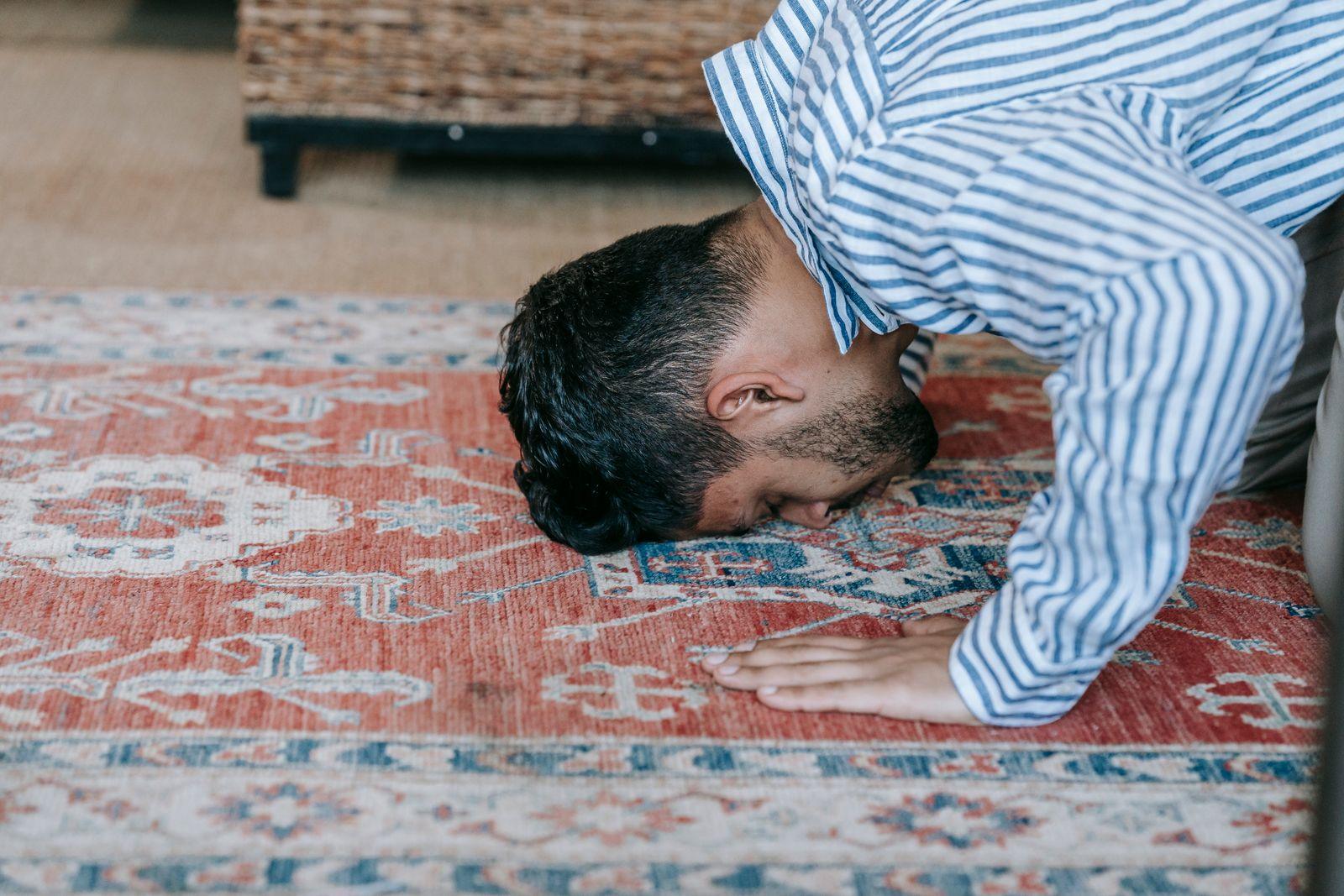
- In prayer: say Allahu akbar and go into sujud straight from standing, then say Allahu akbar again as you rise and continue reciting.
- Outside prayer: say Allahu akbar and make one prostration. Many scholars also say the takbir on rising; there’s no tashahhud or salam according to most.
- In sujud, say what you say in any prostration, such as subhana rabbiyal-a’la. A dua reported from Aisha is also widely recited:
سَجَدَ وَجْهِيَ لِلَّذِي خَلَقَهُ وَشَقَّ سَمْعَهُ وَبَصَرَهُ بِحَوْلِهِ وَقُوَّتِهِ
“My face has prostrated to the One who created it and brought forth its hearing and sight by His power and strength” (Jami’ at-Tirmidhi 580; at-Tirmidhi graded it hasan sahih, though some later scholars considered its chain weak).
For hifz students and imams
If you’re memorizing a juz with a sajdah in it, learn where it falls as part of the passage. In salah, the prostration should come naturally at that ayah, not as a surprise that breaks your flow. Imams leading taraweeh will meet all of them in a khatm, often two in a single night, so it’s worth knowing which nights they fall on. Our guide to taraweeh khatm pages per night helps with the planning, and the 30 juz of the Quran shows what each juz holds.
For other words you’ll meet in a hifz class, see our hifz vocabulary, and for the small letters above the words, what each waqf sign means.
Questions people ask
How many sajdah are there in the Quran?
The Madani mushaf marks 15 places. The Hanafi school counts 14, leaving out the second one in Al-Hajj (22:77), and some scholars treat the one in Sad (38:24) as a prostration of thanks rather than of recitation.
Is sajdat at-tilawah obligatory?
Most scholars hold that it’s a strongly recommended sunnah, based partly on ‘Umar’s statement that Allah has not made it compulsory (Sahih al-Bukhari 1077). The Hanafi school considers it wajib for the reciter and the listener.
What do I say in sajdat at-tilawah?
You can say what you say in any sujud, such as subhana rabbiyal-a’la. A dua reported from Aisha, sajada wajhi lilladhi khalaqahu wa shaqqa sam’ahu wa basarahu bi hawlihi wa quwwatih, is also widely recited (Jami’ at-Tirmidhi 580, which at-Tirmidhi graded hasan sahih, though some later scholars considered its chain weak).
Which juz has the most sajdah?
Juz 17 and juz 19 each have two, and so does juz 30, where the last two fall in Al-Inshiqaq and Al-‘Alaq.
Do I need wudu for sajdat at-tilawah?
Most scholars apply the conditions of prayer, including wudu and facing the qiblah, while some were more lenient. If you’re unsure, follow your teacher or local scholars.