To memorize Surah ‘Abasa, learn it in three blocks that follow its meaning: the blind man and the reminder (80:1-16), man’s life and his food (80:17-32), and the Day (80:33-42). Take two or three lines a day, recite everything you’ve learned so far before each new portion, and you’ll have it in a week. At five lines a day it takes three days.
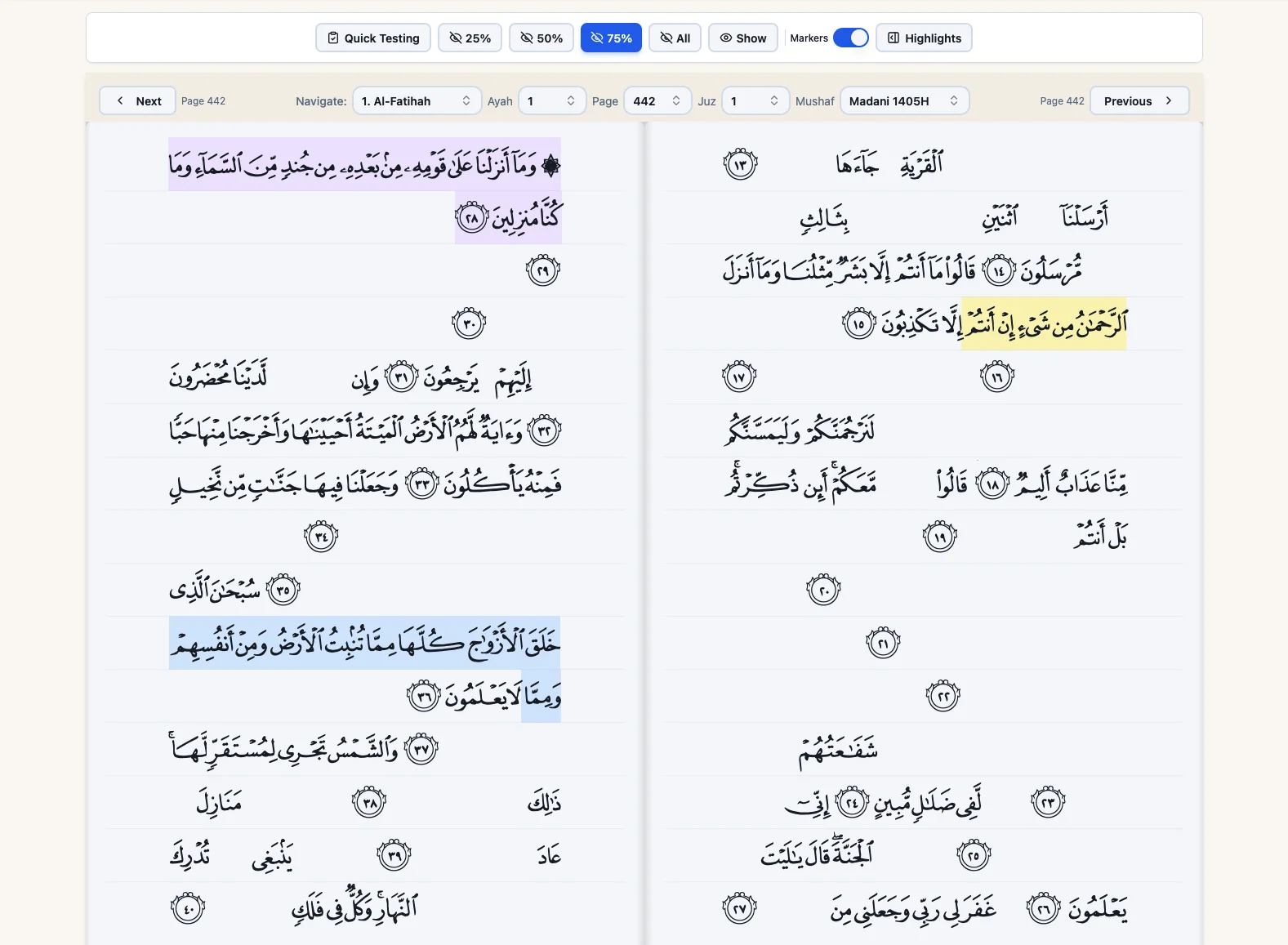
It’s 42 short ayat, nearly all of them on page 585 of the Madani mushaf: 14 lines of text, or 15 in the current print, where the last two ayat move to the top of page 586. With Mishary Alafasy it takes just over three minutes to recite.
‘Abasa is Surah 80, and it comes straight after An-Nazi’at. One page back, An-Nazi’at has an ayah identical to 80:32, followed by an ayah that opens with the same two words as 80:33. So the spot where ‘Abasa hands over from its middle block to its last is also the easiest place for your recitation to wander into the wrong surah.
If you’re working backward from An-Nas, you’ll reach ‘Abasa before An-Nazi’at. Learn 80:31-34 well now, and come back to the drills at the end when you start An-Nazi’at.
At a glance
- Surah: 80, ‘Abasa (عبس), “He Frowned”, named after its first word. Makkan.
- Where it sits: juz (para) 30, page 585 of the 604-page Madani mushaf. Its title banner is the last line of page 584, right under the end of An-Nazi’at.
- Length: 42 ayat, 133 words. Thirteen of the ayat are just two words long.
- Lines: 14 (15 in the current print, where the last two ayat sit at the top of page 586).
- Time to recite: about 2 minutes at a quick pace (Sa’ud ash-Shuraym, 2:09), 3:22 with Mishary Alafasy, 4:35 with Mahmoud Khalil al-Husary.
- Time to memorize: about a week at 2 to 3 lines a day. 3 days at 5 lines, 2 at half a page, 1 at a full page.
- Easy to confuse with: An-Nazi’at 79:33-35, one page turn earlier.
‘Abasa’s ayat average about three words, and the longest, 80:37, has six. For memorizing, that means a lot of stops: 42 ayah endings, and at each one you have to know what comes next. You can hear it, too. Alafasy takes 3:22 for ‘Abasa and 3:15 for Al-Fajr, though Al-Fajr is a line or two longer. If you’re working through the whole juz, our Juz Amma plan puts it in order with its neighbors.
Surah 'Abasa at a glance
- Surah
- 80
- Juz
- 30
- Mushaf
- Page 585
- Ayat
- 42
- Length
- 14 lines
- Recited in
- about 3 minutes
How many days will it take?
| New lines a day | Days |
|---|---|
| 3 (a few lines) | 5 days |
| 5 (a third of a page) | 3 days |
| 7 (half a page) | 2 days |
| 10 (two thirds of a page) | 2 days |
Counts days of new memorization on the 14 lines of Surah 'Abasa. Add revision on top. Make a day-by-day plan.
Test yourself
Memorized Surah 'Abasa? Find the ayat you’re not sure of.
Quran Memorizer asks you what comes next, which ayah is missing and which look-alike ayah goes where, on the same Madani mushaf pages you learned from. With Premium, Daily Review brings your weakest ayat back first, so you can revise Surah 'Abasa a little every day.

Free to start, no card needed. On the web or iPhone, choose Surah 'Abasa as what you want to be tested on.
More on Surah 'Abasa: All surah guides
What is Surah ‘Abasa about?
‘Abasa means “He Frowned”. The surah opens on a single moment in Makkah, steps back to every person’s life from creation to the grave and resurrection, and ends on the Day when each person is taken up with himself. That’s also the order of the three blocks, so the story hands you the order before you’ve memorized a word.
Why was Surah ‘Abasa revealed, and who was the blind man?
He was ‘Abdullah ibn Umm Maktum, a blind Companion. ‘A’ishah reported that “He frowned and turned away” was revealed about him. He came asking the Messenger of Allah ﷺ to guide him at a moment when the Prophet ﷺ was speaking with one of the leading men of the idolaters, and he ﷺ turned toward that man (Jami’ at-Tirmidhi 3331, graded sahih by Darussalam; at-Tirmidhi himself called it hasan gharib).
Saheeh International’s footnote to 80:5 explains the hope behind it: the man was “a certain influential member of the Quraysh whom the Prophet (ﷺ) had hoped to bring to Islām.” Ibn Umm Maktum is sometimes mixed up with ‘Abdullah ibn Mas’ud, but they’re two different Companions. The blind man of 80:2 is Ibn Umm Maktum.
“He [i.e., the Prophet (ﷺ) ] frowned and turned away
Because there came to him the blind man, [interrupting].”
‘Abasa 80:1-2, Saheeh International translation. Compare translations on quran.com
Ibn Kathir explains that Allah was directing His Messenger ﷺ to give the warning to “the noble and the weak, the poor and the rich” alike (Tafsir Ibn Kathir on 80:1), and Saheeh International’s footnote to 80:7 adds that the Prophet ﷺ “was responsible only for conveying the message”.
The blind man of 80:2 went on to become one of the two muezzins of the Prophet ﷺ, alongside Bilal (Sahih Muslim 380a). People eating suhur before a fast would carry on until they heard his adhan at dawn (Sahih al-Bukhari 617).
The Prophet ﷺ twice left him in charge of Madinah while he was away (Sunan Abi Dawud 2931, graded sahih by al-Albani) and appointed him to lead the people in prayer, blind as he was (Sunan Abi Dawud 595, graded hasan sahih by al-Albani).
Your first landmark is in the grammar. Ayat 1 and 2 speak about the Prophet ﷺ in the third person: he frowned, there came to him. From 80:3 the address turns to “you”: what would make you perceive. He, him, then you. Say that shift out loud a few times and you’ll find the first three ayat easier to remember in order.
How long does it take to memorize Surah ‘Abasa?
Surah ‘Abasa takes about a week at two or three lines a day, or three days at five lines a day if you already memorize every day. At half a page a day it’s two days, and at a full page, one.
We’d still take the week, and the reason is on line 11. At five lines a day, day 2 ends there. In the current print that’s partway through 80:31, between wa fākihatan and wa abbā. In the older print it’s two words into 80:32, so the twin ayah gets learned in halves on different days. Either way, a five-line split cuts into the last two ayat of the food list, right where ‘Abasa meets its An-Nazi’at twin.
What does one day’s session look like?
Here’s our default for ‘Abasa. The counts are set for ayat this short, so treat them as a starting point and adjust once you know how quickly you learn a line.
- Read the Saheeh International translation of the day’s ayat once. With ayat this short, the meaning is what tells you which one comes next.
- Listen to the day’s ayat three times in al-Husary’s teaching recording while you follow in the mushaf.
- Work two ayat at a time. Thirteen of ‘Abasa’s ayat are only two words long, too small to learn on their own. Read a pair looking at the page until it’s clean five times, then say it three times without looking.
- Chain the pairs. Say the last word of one ayah and the first word of the next in one breath: talahhā, kallā at 80:10-11, bararah, qutila at 80:16-17.
- Recite from 80:1 to today’s last ayah without the page. If you stall, look, then restart that ayah from its first word.
- Recite the new portion in your next sunnah or nafl prayer.
A one-week plan
Each day’s new portion ends where an ayah and a thought end. Before it, recite everything you’ve learned so far from memory. By day 6 that run is close to three minutes at Alafasy’s pace.
- Day 1, 80:1-10 (32 words). Learn 80:1-4 as the scene, then 5 to 10 as two men: the one who felt no need (5 to 7) and the one who came (8 to 10). In the current print that’s lines 2 to 4 plus the first three words of line 5.
- Day 2, 80:11-16 (15 words). It’s short, so spend the spare time joining 1 to 16 into one unbroken run.
- Day 3, 80:17-23 (27 words). A life from creation to resurrection. Recite the join from kirāmin bararah into qutila l-insān five times on its own.
- Day 4, 80:24-32 (26 words). The food list gets a day to itself. Use the food list section further down.
- Day 5, 80:33-37 (18 words). Start every repetition at 80:31, wa fākihatan wa abbā, so the only way into aṣ-ṣākhkhah you ever practice is the one from ‘Abasa’s food list (the An-Nazi’at section explains why).
- Day 6, 80:38-42 (15 words). Then 33 to 42 together, then the whole surah. In the current print this is the day you learn the page turn.
- Day 7, review only. Recite the whole surah from memory, then do the cold starts and, if you already know An-Nazi’at, the pair drills in “Revising ‘Abasa” at the end.
If the food list isn’t steady by the end of day 4, give it a second day. Eight things in five ayat is a lot of order to remember, and one extra day now costs far less than weeks of swapping grapes and olives.
Free tool
Prefer to plan by lines? Set the scope to Surah ‘Abasa and the generator splits it into five lessons at 3 lines a day, or three at 5 lines. Open the hifz plan generator →
Can you memorize Surah ‘Abasa fast?
Yes, if you already have a few surahs and a daily habit. Split it by the blocks rather than by lines, so none of the sittings cuts the food list off from its last ayah:
- Day 1: 80:1-16, 47 words.
- Day 2: 80:17-32, 53 words, the food list included.
- Day 3: 80:33-42, 33 words, then the whole surah from memory before you stop.
- Next morning: one cold run from 80:1 to 80:42, then move on.
The last sitting is the lightest of the three, which leaves room for that full run at the end of it.
Which reciter should you learn it with?
Learn new lines with al-Husary. His teaching recitation (mu’allim) runs 6:06 for the surah and stops cleanly at every ayah, which is what you want with 42 short ones. His murattal, the standard measured recitation, is 4:35. For listening through the day, Alafasy or al-Minshawi. Both sit in the middle of the table, between three and four minutes, which is easy to loop while you do something else. And once it’s memorized, a run with ash-Shuraym or as-Sudais tells you whether you can still recite it at speed.
| Reciter | ‘Abasa | An-Nazi’at |
|---|---|---|
| Sa’ud ash-Shuraym | 2:09 | 2:40 |
| Abdur-Rahman as-Sudais | 2:25 | 2:56 |
| Mishary Alafasy | 3:22 | 3:57 |
| Abdul Basit (murattal) | 3:29 | 4:15 |
| al-Minshawi (murattal) | 3:52 | 4:53 |
| al-Husary (murattal) | 4:35 | 6:33 |
| al-Husary (mu’allim) | 6:06 | 7:15 |
Those are full-surah audio lengths from the recordings on quran.com, so allow a few seconds either way for the bismillah and silence. Every reciter in the table is on quran.com, which can also show word-by-word meaning and transliteration under each ayah if you can’t read the Arabic script yet. Our ranking of reciters for memorization by pace covers more voices.
How do you teach Surah ‘Abasa to a child?
Tell the story before the first lesson, in a few plain sentences: a blind man came to the Prophet ﷺ wanting to learn, and Allah revealed these ayat to teach that the message is for everyone who comes to it, the weak and the poor as much as the rich and influential. Then give each day of the plan two days. Try the food list as a finger count (1, 2, 2, 1, 2), and say “mother, then father” out loud before 80:35. Our guide to helping your child memorize the Quran covers the routine around it.
How do the 42 ayat split into three blocks?
Forty-two ayat of two and three words are hard to remember as one list. Three blocks are much easier, and the rhymes change inside each one, which gives your ear something to follow. The clearest break comes at 80:32, right before the Day begins.
- Ayat 1-16, the blind man and the reminder. 47 words, lines 2 to 6 of page 585 in the current print, about a minute with Alafasy.
- Ayat 17-32, man’s life and his food. 53 words, lines 7 to 12, about 80 seconds.
- Ayat 33-42, the Day. 33 words, from line 12 to the top of page 586, just under a minute.
Ayat 1-16: the blind man and the reminder
عَبَسَ وَتَوَلَّىٰٓ ﴿١﴾ أَن جَآءَهُ ٱلْأَعْمَىٰ ﴿٢﴾ وَمَا يُدْرِيكَ لَعَلَّهُۥ يَزَّكَّىٰٓ ﴿٣﴾ أَوْ يَذَّكَّرُ فَتَنفَعَهُ ٱلذِّكْرَىٰٓ ﴿٤﴾ أَمَّا مَنِ ٱسْتَغْنَىٰ ﴿٥﴾ فَأَنتَ لَهُۥ تَصَدَّىٰ ﴿٦﴾ وَمَا عَلَيْكَ أَلَّا يَزَّكَّىٰ ﴿٧﴾ وَأَمَّا مَن جَآءَكَ يَسْعَىٰ ﴿٨﴾ وَهُوَ يَخْشَىٰ ﴿٩﴾ فَأَنتَ عَنْهُ تَلَهَّىٰ ﴿١٠﴾ كَلَّآ إِنَّهَا تَذْكِرَةٌ ﴿١١﴾ فَمَن شَآءَ ذَكَرَهُۥ ﴿١٢﴾ فِى صُحُفٍ مُّكَرَّمَةٍ ﴿١٣﴾ مَّرْفُوعَةٍ مُّطَهَّرَةٍۭ ﴿١٤﴾ بِأَيْدِى سَفَرَةٍ ﴿١٥﴾ كِرَامٍۭ بَرَرَةٍ ﴿١٦﴾
Ayat 1 to 10 all end on a long -ā: tawallā, a’mā, yazzakkā, dhikrā and on to talahhā. Then 80:11 opens with kallā, “No!”, and the endings change to -rah: tadhkirah, dhakarah, mukarramah, muṭahharah, safarah, bararah. That change marks the move from the scene itself to the description of the Quran as a reminder, recorded in honored, purified sheets carried by noble angels (80:11-16).
Inside the scene, watch four pairs.
- 80:3 and 80:7 both open wa mā and both end yazzakkā. Only the middle changes: yudrīka la’allahu in 3, ‘alayka allā in 7. Yazzakkā occurs in these two ayat and nowhere else in the Quran.
- 80:6 and 80:10 both open fa-anta. The first has lahu taṣaddā, attention given to him, the man who felt no need. The second turns to ‘anhu talahhā, distracted from him, the man who came striving.
- 80:5 and 80:8: the first ammā man has no wa, the second (wa ammā man jā’aka yas’ā) has one. So the scene runs in two halves, 5 to 7 about one man and 8 to 10 about the other.
- 80:3 and 80:4: yazzakkā with a doubled zāy, then yadhdhakkaru with a doubled dhāl. That one’s a pronunciation slip as much as a memory slip, so have a teacher or a careful listener check it once.
Ayat 17-32: man’s life, then his food
قُتِلَ ٱلْإِنسَـٰنُ مَآ أَكْفَرَهُۥ ﴿١٧﴾ مِنْ أَىِّ شَىْءٍ خَلَقَهُۥ ﴿١٨﴾ مِن نُّطْفَةٍ خَلَقَهُۥ فَقَدَّرَهُۥ ﴿١٩﴾ ثُمَّ ٱلسَّبِيلَ يَسَّرَهُۥ ﴿٢٠﴾ ثُمَّ أَمَاتَهُۥ فَأَقْبَرَهُۥ ﴿٢١﴾ ثُمَّ إِذَا شَآءَ أَنشَرَهُۥ ﴿٢٢﴾ كَلَّا لَمَّا يَقْضِ مَآ أَمَرَهُۥ ﴿٢٣﴾ فَلْيَنظُرِ ٱلْإِنسَـٰنُ إِلَىٰ طَعَامِهِۦٓ ﴿٢٤﴾ أَنَّا صَبَبْنَا ٱلْمَآءَ صَبًّا ﴿٢٥﴾ ثُمَّ شَقَقْنَا ٱلْأَرْضَ شَقًّا ﴿٢٦﴾ فَأَنۢبَتْنَا فِيهَا حَبًّا ﴿٢٧﴾ وَعِنَبًا وَقَضْبًا ﴿٢٨﴾ وَزَيْتُونًا وَنَخْلًا ﴿٢٩﴾ وَحَدَآئِقَ غُلْبًا ﴿٣٠﴾ وَفَـٰكِهَةً وَأَبًّا ﴿٣١﴾ مَّتَـٰعًا لَّكُمْ وَلِأَنْعَـٰمِكُمْ ﴿٣٢﴾
Al-insān, man, is named at the start of this block and again halfway through. 80:17 is qutila l-insānu mā akfarah, “Destroyed [i.e., cursed] is man; how disbelieving is he” in Saheeh International, whose footnote narrows it to “those who deny Allāh’s message”. 80:24 is fal-yanẓuri l-insānu ilā ṭa’āmih, let mankind look at his food.
Between the two sits a whole life in order. 80:18 asks the question (min ayyi shay’in khalaqah, from what did He create him?) and 80:19 answers it (min nuṭfatin khalaqah). Then thumma opens 80:20, 21 and 22: the way eased for him, death and a grave, then resurrection when Allah wills. Created, eased, buried, raised.
Seven ayat in a row end on a -ahu pronoun, from akfarah to amarah, and 80:23 closes the passage with the surah’s second kallā.
Why does a food list follow a description of the grave and the resurrection? Ibn Kathir calls 80:24 onward “a call to reflect upon Allah’s favor”, and points out that plants coming to life from lifeless earth are evidence that bodies can be brought back to life (Tafsir Ibn Kathir on 80:17-32). That’s your thread from 80:22 to 80:24.
Ayat 33-42: the Day a man flees his family
فَإِذَا جَآءَتِ ٱلصَّآخَّةُ ﴿٣٣﴾ يَوْمَ يَفِرُّ ٱلْمَرْءُ مِنْ أَخِيهِ ﴿٣٤﴾ وَأُمِّهِۦ وَأَبِيهِ ﴿٣٥﴾ وَصَـٰحِبَتِهِۦ وَبَنِيهِ ﴿٣٦﴾ لِكُلِّ ٱمْرِئٍ مِّنْهُمْ يَوْمَئِذٍ شَأْنٌ يُغْنِيهِ ﴿٣٧﴾ وُجُوهٌ يَوْمَئِذٍ مُّسْفِرَةٌ ﴿٣٨﴾ ضَاحِكَةٌ مُّسْتَبْشِرَةٌ ﴿٣٩﴾ وَوُجُوهٌ يَوْمَئِذٍ عَلَيْهَا غَبَرَةٌ ﴿٤٠﴾ تَرْهَقُهَا قَتَرَةٌ ﴿٤١﴾ أُو۟لَـٰٓئِكَ هُمُ ٱلْكَفَرَةُ ٱلْفَجَرَةُ ﴿٤٢﴾
The last block is ten ayat, under a minute with Alafasy. If you came here for 80:34-37, the ayat about fleeing your own family, this is the block. It opens with aṣ-ṣākhkhah, which Saheeh International footnotes as “the piercing blast of the Horn which signals resurrection”, adding that it’s also a name for the Day of Resurrection.
“But when there comes the Deafening Blast
On the Day a man will flee from his brother
And his mother and his father
And his wife and his children,
For every man, that Day, will be a matter adequate for him.”
‘Abasa 80:33-37, Saheeh International translation. Compare translations on quran.com
In this block, the family order is where mistakes tend to happen. It’s the brother first, on his own, then two pairs: mother and father (80:35), wife and children (80:36). An easy slip is abīhi wa ummihi, father first. The ayah puts the mother first.
Your ear can help here. The three family ayat end akhīh, abīh, banīh, and 80:37 closes the run with a fourth -īh, yughnīh. When the -īh sound stops, the family is done.
80:37 is an ayah the Prophet ﷺ recited as an answer. He said people would be gathered barefoot and unclothed, and when a woman asked whether people would see one another’s nakedness, he answered her with this ayah (Jami’ at-Tirmidhi 3332, graded hasan by Darussalam; at-Tirmidhi called it hasan sahih).
Then the faces. 80:38 starts wujūhun with no wa; 80:40 starts wa wujūhun. Two ayat for the bright faces (38-39), two for the dusty, darkened ones (40-41), then the verdict in 42. Yawma’idhin, “that Day”, comes three times in the block, in 37, 38 and 40.
Where does each ayah sit on page 585?
Two Madani prints are in common use, and ‘Abasa is one of the places where they differ. Here’s a quick way to tell which one you have. Turn to page 586. If its first line is tarhaquhā qatarah and the end of ‘Abasa, above At-Takwir’s title, you have the current King Fahd Complex print, and the map below is yours. If the page opens with At-Takwir’s title, you have the older 1405 AH print from the mid-1980s. All 42 ayat fit on page 585 in that one, and some of your line breaks fall a little differently.
If you use an Indo-Pak mushaf, the page and line numbers here won’t match yours. The blocks and the day-by-day plan go by ayah, so they work in any mushaf.
| Page, line | Ayat |
|---|---|
| 584, 15 | Surah title |
| 585, 1 | Bismillah |
| 585, 2 | 1 to 3 |
| 585, 3 | 4 to 6 |
| 585, 4 | 7 to 9 |
| 585, 5 | 10 to 12, start of 13 |
| 585, 6 | End of 13, 14 to 16 |
| 585, 7 | 17, 18, start of 19 |
| 585, 8 | End of 19, 20, 21, start of 22 |
| 585, 9 | End of 22, 23, 24 |
| 585, 10 | 25, 26, start of 27 |
| 585, 11 | End of 27, 28 to 30, start of 31 |
| 585, 12 | End of 31, 32, 33, start of 34 |
| 585, 13 | End of 34, 35, 36, start of 37 |
| 585, 14 | End of 37, 38 |
| 585, 15 | 39, 40 |
| 586, 1 | 41, 42 |
Where an ayah’s words end one line and its number circle starts the next (6, 24 and 38), we’ve listed it with its words. If you memorize by picturing the page, three spots in that map matter.
- The first block is exactly lines 2 to 6, and line 7 starts cleanly on qutila l-insān.
- Line 12 holds the whole turning point: wa abbā, all of 80:32, all of 80:33 and yawma yafirru. If you picture only one line of ‘Abasa, make it this one.
- Page 585 ends on 80:40, ‘alayhā ghabarah, and the next words, tarhaquhā qatarah, are over the page. If you memorize by page, it’s easy to stop at 40 and never notice two ayat are missing, so say ghabarah, tarhaquhā as one sound before you turn.
The page can also tell you which twin you’re on. In your mushaf, one of the two is split after lakum and the other sits whole. In the current print it’s An-Nazi’at’s 79:33 that breaks, across lines 7 and 8 of page 584. In the 1405 print it’s ‘Abasa’s 80:32, across lines 11 and 12. Learn which one breaks in your copy and the page itself tells you where you are.
How do you remember the food list in order (80:24-32)?
This is an easy stretch to mix up. Eight things that grow are spread over five ayat, most of those ayat only two words long, and the meaning alone won’t tell you that grapes come before olives.
“Then let mankind look at his food –
How We poured down water in torrents,
Then We broke open the earth, splitting [it with sprouts],
And caused to grow within it grain
And grapes and herbage
And olive and palm trees
And gardens of dense shrubbery
And fruit and grass –
[As] enjoyment [i.e., provision] for you and your grazing livestock.”
‘Abasa 80:24-32, Saheeh International translation. Compare translations on quran.com
The eight, in order, in Saheeh International’s wording:
- ḥabbā (حَبًّا), grain, 80:27
- ‘inaban (عِنَبًا), grapes, 80:28
- qaḍbā (قَضْبًا), herbage, 80:28
- zaytūnan (زَيْتُونًا), olive, 80:29
- nakhlā (نَخْلًا), palm trees, 80:29
- ḥadā’iqa ghulbā (حَدَآئِقَ غُلْبًا), gardens of dense shrubbery, 80:30
- fākihatan (فَـٰكِهَةً), fruit, 80:31
- abbā (أَبًّا), grass, 80:31
Five patterns help you remember that order, taken in the order you’ll recite them.
- Water, split earth, then grain. 80:25 and 80:26 each repeat their verb as a noun, ṣababnā … ṣabbā and shaqaqnā … shaqqā, the same doubled sound you know from dakkan dakkā in Al-Fajr. Then fa-anbatnā in 80:27 starts the list.
- The shape is 1, 2, 2, 1, 2. Ayah 27 has one item, 28 and 29 have two each, 30 has one with its adjective, 31 has two. Tap the numbers out on your fingers as you recite and a missing ayah shows up at once.
- People’s food comes before animals’ food, at both ends. 80:28 pairs grapes with qaḍb, which Ibn Kathir explains as moist green plants that animals graze on. 80:31 pairs fruit with abb, which Ibn ‘Abbas described as what the earth grows for grazing animals and not for people. Then 80:32 names them in that same order: “for you and your grazing livestock” (Saheeh International). That pattern is our own memory aid, built on Ibn Kathir’s glosses.
- Trees sit in the middle. 80:29 is the tree ayah, olives and palms, and 80:30 is the gardens.
- Three rare words help too. Qaḍbā, ghulbā and wa abbā occur nowhere else in the Quran, so they can only ever belong here.
Expect these four slips. Olives and palms jump ahead of grapes. Nakhlā sneaks into 80:31 as wa fākihatan wa nakhlā. 80:30 drops out altogether, since two words are easy to skip. Or 80:31 runs straight into 80:33.
If you’ve memorized An-Naba, there’s one more. It has ḥabban wa nabātā / wa jannātin alfāfā (78:15-16), grain and vegetation, then gardens. If your gardens come out as jannāt, you’ve drifted into An-Naba. ‘Abasa’s are ḥadā’iq.
Which ayat does ‘Abasa share with An-Nazi’at?
One word for word, and the ayah after it nearly. 80:32 is the same as 79:33, and 80:33 opens with the same two words as 79:34. An-Nazi’at describes the heaven, then the earth with its water, pasture and mountains, closes that passage with 79:33 and opens the Day with 79:34. ‘Abasa closes its food list with 80:32 and opens the Day with 80:33. One page turn separates them, 584 to 585.
“And the mountains He set firmly
As enjoyment [i.e., provision] for you and your grazing livestock.
But when there comes the greatest Overwhelming Calamity –
The Day when man will remember that for which he strove,”
An-Nazi’at 79:32-35, Saheeh International translation. Compare translations on quran.com
Is 80:32 the same as 79:33?
Yes, word for word. An-Nazi’at 79:33, page 584:
مَتَـٰعًا لَّكُمْ وَلِأَنْعَـٰمِكُمْ
‘Abasa 80:32, page 585:
مَّتَـٰعًا لَّكُمْ وَلِأَنْعَـٰمِكُمْ
Three words, the same letters: matā’an lakum wa li-an’āmikum. The one mark that differs is the shadda on the first mīm of 80:32. It’s a joined-reading mark. Recite 80:31 into 80:32 without stopping and the tanween of wa abban merges into the mīm with a nasal hum (idgham with ghunnah). An-Nazi’at’s 79:32 ends arsāhā, with no tanween, so 79:33 has nothing to merge.
Tip: Recite the join aloud. If you hear that hum going into matā’an, you came from abbā, and you’re in ‘Abasa.
Wa li-an’āmikum occurs in these two ayat and nowhere else in the Quran. Both twins also break the rhyme around them. An-Nazi’at’s passage runs banāhā, sawwāhā, ḍuḥāhā, daḥāhā, mar’āhā, arsāhā, and ‘Abasa’s food list runs on -ā. Then each ends on -kum, the only -kum ending in ‘Abasa. When you hear it, you’re on the seam, and the next ayah decides the surah.
How is 80:33 different from 79:34?
An-Nazi’at 79:34:
فَإِذَا جَآءَتِ ٱلطَّآمَّةُ ٱلْكُبْرَىٰ
‘Abasa 80:33:
فَإِذَا جَآءَتِ ٱلصَّآخَّةُ
The first two words are identical, fa-idhā jā’ati, “But when there comes”. The third is the switch: aṭ-ṭāmmatu in An-Nazi’at (“Overwhelming Calamity”), aṣ-ṣākhkhah in ‘Abasa (“the Deafening Blast”). And An-Nazi’at adds a fourth word, al-kubrā, “the greatest”, where ‘Abasa stops at three.
It’s no surprise they swap. The two nouns are built alike: feminine, opening on an emphatic letter (ṭā’ in one, ṣād in the other), with a long ā before a doubled consonant. So in Hafs, the reading the Madani mushaf is printed in, each is held for six counts. Said aloud, they weigh the same. Fa-idhā jā’ati followed by a noun occurs in these two ayat only, and each of the two nouns appears just once in the whole Quran.
A memory aid to try: the longer surah gets the longer phrase. An-Nazi’at, with 46 ayat, has al-kubrā. ‘Abasa’s is short and sharp, like its ayat.
Which ayah comes after each twin?
Both following ayat open yawma ya-, so the real decision comes a word later. 79:35 is yawma yatadhakkaru l-insānu mā sa’ā, the Day man will remember what he strove for. 80:34 is yawma yafirru l-mar’u min akhīh, the Day a man will flee from his brother. In An-Nazi’at, man remembers. In ‘Abasa, a man runs.
Add the ayah before each twin and you get two short runs you can say in one breath:
- An-Nazi’at 79:32-35: mountains, provision, the greatest Calamity, man remembers.
- ‘Abasa 80:31-34: fruit and grass, provision, the Deafening Blast, a man flees.
A test does more here than rereading, because rereading shows you the next ayah and a test makes you produce it. In Quran Memorizer, run the next-ayah test on An-Nazi’at and then on ‘Abasa, and the question that matters comes up again and again: what comes after matā’an lakum wa li-an’āmikum? The mutashabihat practice (for ayat that look or sound alike) comes at it from the other side. It shows you the shared phrase and asks you to place it in the right surah and ayah. For the general method behind pairs like this, see how to stop mixing up similar verses.
What are the benefits of Surah ‘Abasa?
You’ll find posts telling you to recite ‘Abasa 41 times, usually with a long list of benefits attached. We couldn’t find a verified hadith that promises a specific reward for reciting ‘Abasa, so we won’t repeat any of them.
One authentic hadith does belong here, and al-Bukhari placed it in his chapter on ‘Abasa itself. ‘A’ishah reported that the Prophet ﷺ said the one who recites the Quran and has memorized it is with “the noble righteous scribes”, the same three words 80:15-16 use for the angels, and the one who recites it though it’s hard for him gets a double reward (Sahih al-Bukhari 4937).
So when you reach bi-aydī safarah, kirāmin bararah in your own recitation, you’re reciting the description of the company that hadith places memorizers in. And if ‘Abasa’s short ayat tangle for the first few days, the second half of the hadith is for you.
Revising ‘Abasa
Revise it as a pair with An-Nazi’at. Recited separately, each surah feels fine, because the confusion only shows up when one runs into the other’s territory. So these drills put them side by side on purpose.
- Back to back. For the first week after you finish, recite 79:27-36 and then 80:24-37 in one go, once a day. Begin each twin from the ayah before it, 79:32 (the mountains) or 80:31 (fruit and grass), where the two surahs still sound different. After that week, recite both surahs whole once a week: about 7 minutes with Alafasy, 11 with al-Husary’s murattal.
- The split prompt. Someone reads matā’an lakum wa li-an’āmikum, fa-idhā jā’ati and names a surah; you finish. Then reverse it: they read yawma yafirru or yawma yatadhakkaru, and you supply the two ayat before it.
- Cold starts. Begin at 80:11, 80:17, 80:24, 80:33 and 80:38 without warming up from the top, plus 80:41 if you use the current print. Our guide to reciting from a random ayah turns this into a ten-minute routine.
- Pray it in blocks. Each block runs about a minute with Alafasy, so 80:1-16 and 80:17-32 fit the two rak’ahs of a sunnah prayer, and 80:33-42 can go into the next day’s.
Which other ayat sound like ‘Abasa?
Once you’ve got An-Nazi’at straight, these are the next ones to check, all from the last two juz. The Juz Amma ones come first.
- At-Tariq 86:5 also opens fal-yanẓuri l-insānu, then asks what man was created from. ‘Abasa sends him to his food. These are the only two ayat that open this way.
- Wujūhun yawma’idhin appears in six ayat: 80:38 and 40, Al-Ghashiyah 88:2 and 8, and Al-Qiyamah 75:22 and 24 in juz 29. Al-Qiyamah and ‘Abasa put wa on the second one; Al-Ghashiyah has it on neither.
- Al-Muddaththir 74:54-55, in juz 29. Kallā innahu tadhkirah there, kallā innahā tadhkirah in 80:11. The pronoun is the only difference, and the next ayah, fa-man shā’a dhakarah, is identical in both.
- Al-Ma’arij 70:11-13, also juz 29, lists family on the Day too, in a different order: children, then wife and brother, then kindred. Each has an ayah that opens wa ṣāḥibatihi (80:36 and 70:12), so listen for the word after it: banīh here, akhīh in Al-Ma’arij.
Start with 80:1-10 today, and recite it once tomorrow before you add 80:11-16. That’s the whole method, repeated six times.
When the whole surah feels solid, Quran Memorizer can test it alongside An-Nazi’at on iPhone and iPad, or in any browser with the web app.