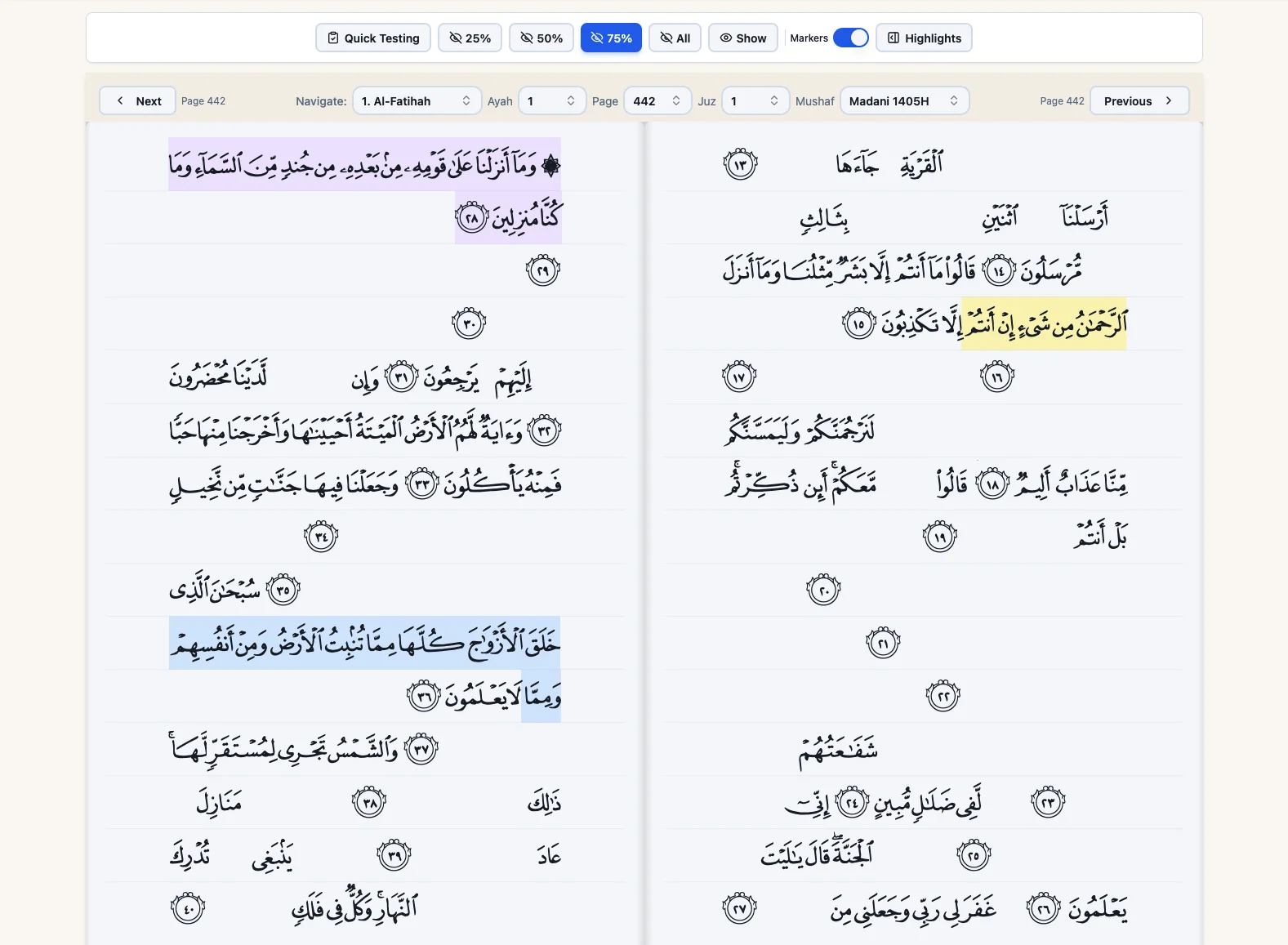
Waqf signs are the small letters printed above the words of the mushaf that tell you where you may stop, where you should stop and where you shouldn’t. The Madani mushaf uses six of them, plus a small seen for a brief pause without breath. Here’s what each one means, with a real example of each, and how the signs in an Indo-Pak mushaf differ.
At a glance
- م stop here. لا don’t stop here (unless it’s the end of an ayah).
- ج stop or continue, either is fine. قلى stopping is better. صلى continuing is better.
- ∴ ∴ stop at one of the two places, not both. س pause briefly without taking a breath.
The six stop signs of the Madani mushaf
| Sign | Name | What it means |
|---|---|---|
| مـ | Waqf lazim | A necessary stop. Continuing would join two phrases in a way that changes the meaning. |
| لا | Al-waqf al-mamnu’ | Don’t stop here. If you run out of breath, go back a word or two and start again. |
| ج | Waqf ja’iz | Stopping and continuing are equally fine. |
| قلى | Al-waqf awla | You may continue, but stopping is better. |
| صلى | Al-wasl awla | You may stop, but continuing is better. |
| ∴ ∴ | Mu’anaqah | Two marks close together. Stop at either one, but not at both. |
These six are explained on the last pages of the King Fahd Complex mushaf. If your copy is a different print, check its own key at the back first, because the shapes and the rules attached to them aren’t the same in every tradition.
Know your stops and want to check the ayat around them? Test your hifz with the mushaf closed.
Each sign with an example
مـ Waqf lazim: stop
إِنَّمَا يَسْتَجِيبُ الَّذِينَ يَسْمَعُونَ ۘ وَالْمَوْتَىٰ يَبْعَثُهُمُ اللَّهُ
Al-An’am 6:36. “Only those who hear will respond. But the dead, Allah will resurrect them.” Read straight through and it sounds as if the dead are among those who respond. The stop after yasma’un keeps the two groups apart. The same sign sits in Yunus 10:65 and Ya-Sin 36:76, after “let not their speech grieve you”, so the next words aren’t heard as part of what they said.
لا: don’t stop
In Al-Baqarah 2:25 the sign falls after rizqan, in the middle of “whenever they are provided with fruit from it, they will say, This is what we were provided with before”. Stopping there leaves the sentence hanging. If you do run out of breath at a لا, the usual practice is to go back a word or two and pick up again so the phrase is heard whole.
At the end of an ayah it’s different. Most scholars of recitation say you can stop at an ayah end even if a لا is printed there, since stopping at each ayah is itself a Sunnah.
ج, قلى and صلى: choices
These three are by far the most common signs in the mushaf. All of them allow a stop; they differ only in which is preferred. Al-Baqarah 2:26 has a ج after “a mosquito or what is larger than it” and a صلى after “the truth from their Lord”. Ali ‘Imran 3:7 has three قلى in a row, the first after “except Allah”, where many scholars prefer to stop.
∴ ∴ Mu’anaqah: one or the other
ذَٰلِكَ الْكِتَابُ لَا رَيْبَ ۛ فِيهِ ۛ هُدًى لِّلْمُتَّقِينَ
Al-Baqarah 2:2. Stop after la rayba and the next phrase reads “in it is guidance for the righteous”. Stop after fihi and it reads “no doubt in it; guidance for the righteous”. Both are sound. Stopping at both leaves fihi standing alone, which is what the sign rules out. You’ll meet the same pair of dots in a handful of other places, such as Al-Ma’idah 5:26.
The small seen: a pause without breath
A small س above a word marks a saktah: a pause of about two counts without taking a breath, then you carry on. In the riwayah of Hafs it comes in four places, each of which would otherwise run two words together in a misleading way:
- Al-Kahf 18:1, after ‘iwaja, before qayyiman at the start of ayah 2.
- Ya-Sin 36:52, after marqadina, before hadha.
- Al-Qiyamah 75:27, between man and raq.
- Al-Mutaffifin 83:14, between bal and rana.
The sign is also printed in Al-Haqqah 69:28, after maliyah. There a pause is one of two accepted ways to read it, the other being to merge it into the next word. Ask your teacher which they want from you.
If you use an Indo-Pak mushaf
The 13-line mushaf used across South Asia, and in many UK and Canadian madrasas, uses an older and larger set of signs, mostly from the system of as-Sajawandi. The ones you’ll see most:
| Sign | Usually explained as |
|---|---|
| ○ | End of an ayah. A good place to stop. |
| م | Necessary stop, as in the Madani mushaf. |
| ط | Waqf mutlaq. Stopping is better, though continuing isn’t wrong. |
| ج | Stopping is allowed. |
| ز | Stopping is allowed, but continuing is better. |
| ص | A place you may stop if you need breath, though the sentence goes on. |
| لا | Don’t stop, unless it’s at the end of an ayah. |
Other marks, such as ق, قف, ك and وقفة, are explained a little differently from one teacher to the next. The key printed in your own mushaf, and your teacher, are the reference.
Why it matters for hifz
When you memorize, you also memorize where you breathe. If you stop in the wrong places while learning a page, those stops become part of the hifz and come back every time you recite it, including in salah and in front of a teacher. Learning a page with its signs from the start costs nothing extra and saves you unlearning it later. It also helps with similar verses, since where you pause is often a clue to which passage you’re in.
For the other words you’ll hear in class, see our hifz vocabulary. For the other marks in the margin, see the 15 places of prostration.
Questions people ask
What does the small meem mean in the Quran?
It’s the sign of a necessary stop (waqf lazim). Stopping there keeps the meaning clear; running on would join two phrases in a way that changes what’s being said, as in Al-An’am 6:36.
Is it a sin to ignore a waqf sign?
Most scholars say the signs are guidance from the scholars of recitation rather than rulings of fiqh, so ignoring one isn’t a sin in itself. Deliberately stopping or starting in a way that distorts the meaning is a different matter, which is why teachers take the signs seriously.
What does لا mean at the end of an ayah?
Inside an ayah, لا means don’t stop there. At the end of an ayah most scholars of recitation say you may still stop, because stopping at the end of each ayah is itself a Sunnah.
What are the three dots in the Quran?
They’re the mu’anaqah (embracing) stop. The dots appear in two places close together, and you stop at one or the other, not both. Al-Baqarah 2:2 is the best-known example.
Why do waqf signs differ between mushafs?
Different printing traditions follow different scholars. The Madani mushaf uses a short set of six signs; the Indo-Pak mushaf uses an older, larger set based on the work of as-Sajawandi. Both aim at the same thing: stopping where the meaning allows it.