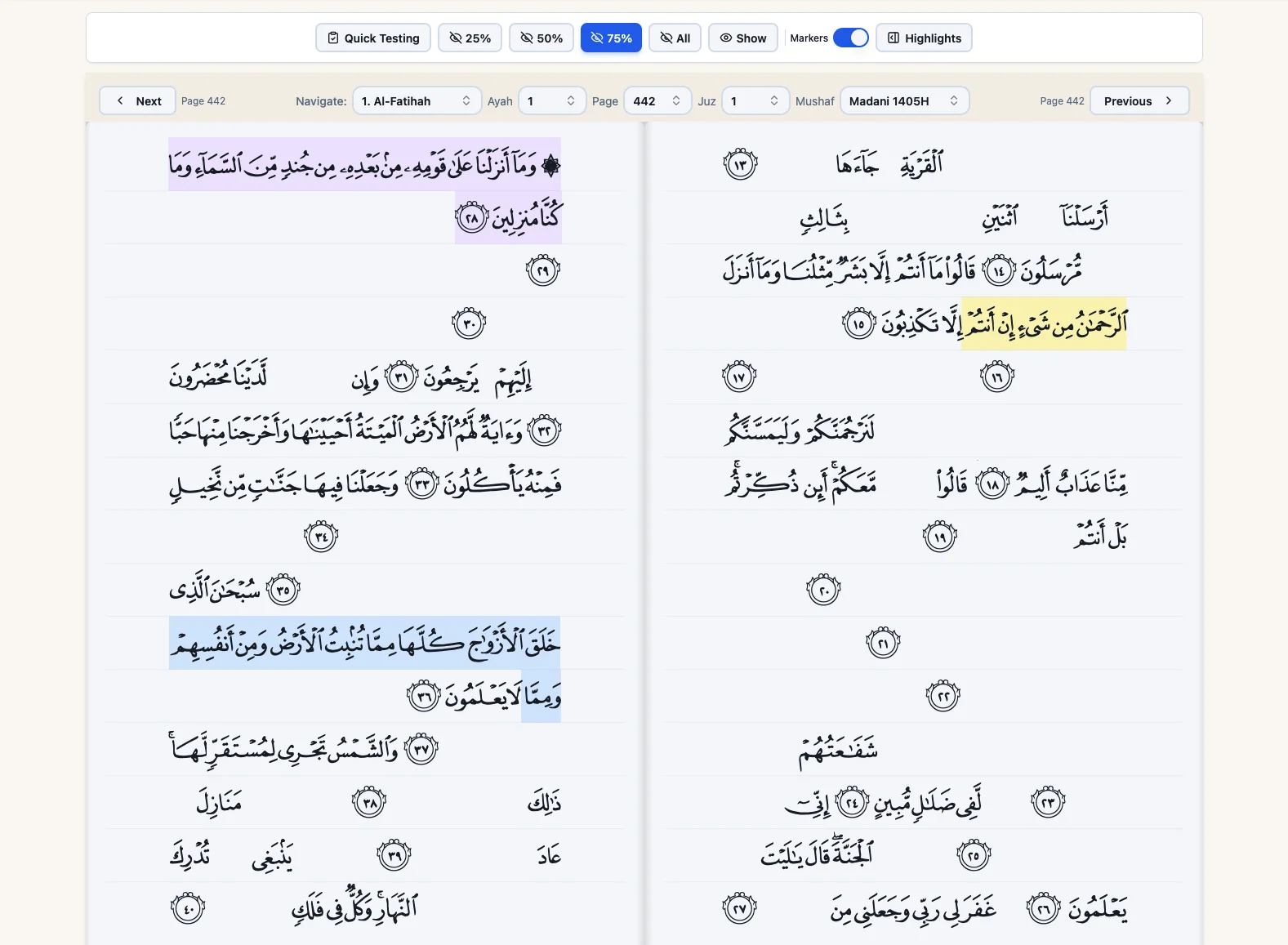
About five weeks (34 days), if you learn five lines a day. Surah Al-Kahf is 110 ayat on 169 lines of the 15-line Madani mushaf, about 11½ pages once you count its title and basmala, so a page a day gets you there in 12 days and three lines a day in 57. Want it in a month? Average a little over seven lines a day, six days a week, and use Fridays for review: 24 lessons and four Fridays make 28 days.
Where you’ll lose time is the top of page 300. Ayat 54 to 57 fill its first nine lines, and each one has a close twin in another surah. Two of those twins sit together on page 291 of Al-Isra, so if you learned juz 15 in order, expect page 300 to take two days.
At a glance
- Where it sits: juz 15 and 16, pages 293 to 304. Juz 16 begins at 18:75, the top of page 302.
- Length: 110 ayat on 169 lines, about 11½ pages: the bottom of page 293, then 11 full pages.
- Time to recite: about 21 minutes with Ash-Shuraym, 33 with Alafasy, 48 with Al-Husary.
- Time to memorize: 34 days of lessons at 5 lines a day, four weeks at about 7 lines with Friday reviews, 12 days at a page a day.
- Each lesson: 1 to 2 minutes of audio, so ten listens take under 20 minutes.
How many days at your pace?
Choose the pace you could still manage in a week when work runs late. The middle column counts new lines only. The last adds one review day for every six lessons, rounded up, which is the Friday pattern the plan below uses.
| Lines a day | Days | With review days |
|---|---|---|
| 3 | 57 | 67 |
| 5 | 34 | 40 |
| 7 (about half a page) | 25 | 30 |
| 10 | 17 | 20 |
| 15 (a page) | 12 | 14 |
The four-week plan comes in two days under the 7-line row because it averages a shade over seven lines (169 lines over 24 lessons) and cuts every lesson where an ayah ends.
Al-Kahf often comes with a head start: years of reading it every Friday. If that’s you, the sound and the order are already in your ear, and ten lines a day is realistic. Starting cold, or teaching a child? Three lines is plenty. A page a day is a common pace in full-time hifz classes.
We’d pick five to seven lines for most people. Five lines is about a minute of Alafasy’s audio, small enough for a workday with time left to revise yesterday’s lesson. Seven is under a minute and a half, the pace of the plan below. At five, a few days will be a single long ayah: 18:17, 18:19, 18:21 and 18:22 run 3.7 to 4.6 lines each.
Why lines and not ayat? Answers you’ll find online usually count ayat: five a day for 22 days, say. Al-Kahf makes that a poor guide, because its ayat run from two words (18:85) to 38 (18:19). Five ayat can be under four lines (18:88 to 92) or almost seventeen (18:18 to 22). A line is the same size every day.
Read next: how long it takes to memorize each surah, worked out the same way in lines and pages.
How long does it take to read Surah Al-Kahf?
About half an hour: 33 minutes at Alafasy’s pace, and anywhere from 21 to 48 minutes across seven well-known reciters. Al-Husary’s teaching recording runs close to an hour:
| Reciter | Time |
|---|---|
| Saud Ash-Shuraym | 21:21 |
| Abdur-Rahman As-Sudais | 23:37 |
| Yasser Ad-Dossari | 29:03 |
| Mishary Alafasy | 33:16 |
| Muhammad Siddiq Al-Minshawi | 34:56 |
| Abdul Basit (murattal) | 38:47 |
| Mahmoud Khalil Al-Husary | 47:41 |
| Al-Husary, teaching recording | 56:51 |
These are the lengths of the full-surah recordings in minutes and seconds, pauses included. Murattal means steady, measured recitation, the style learners usually memorize from. Abdul Basit is also known for slower, more melodic mujawwad recordings; the time here is his murattal one. Al-Husary’s teaching (muallim) recording is slower again, nine minutes longer than his standard one, and it was made for learners who repeat after him.
Each day in the plan below is one to two minutes of Alafasy’s audio, so ten listens fit in under 20 minutes. If you already play a recording of Al-Kahf on Fridays, memorize with that reciter. Much of the sound is learned already, and when you recite from memory later, their pace and pauses help you move from one ayah into the next.
If you’re timing your Friday reading, the narration behind it says that whoever recites Al-Kahf on a Friday will have light shining for them until the next Friday (Mishkat al-Masabih 2175, graded hasan by al-Albani). You’ll sometimes see it credited to Sahih Muslim 809. That number belongs to a different hadith, the one about memorizing the first ten ayat (Sahih Muslim 809a).
Read next: how long it takes to read each surah, with every surah and juz timed for 11 reciters.
Can you memorize Al-Kahf in a month?
Yes. Six lessons a week, cut where the ayat end, and Friday for review: 24 lessons and four Fridays make 28 days. Start on a Saturday and the six lessons run through Thursday. The weeks follow the stories, so they aren’t equal. Weeks 1 and 2 run close to eight lines a day, week 3 about seven and week 4 about five. In ayat, that’s four or five a day on average, anywhere from two (18:21 and 22) to eight (18:66 to 73). Week 4 is the lightest at 31 lines, which leaves the last Friday for the whole surah from memory.
| Week | Ayat | Lines | Alafasy |
|---|---|---|---|
| 1 | 1 to 26 | 47 | 8:32 |
| 2 | 27 to 53 | 47 | 9:13 |
| 3 | 54 to 82 | 44 | 8:40 |
| 4 | 83 to 110 | 31 | 6:51 |
Free tool
Prefer five lines a day, or a different day off? Pick Al-Kahf, your pace and your days, and the planner dates every lesson. It splits by whole lines, so some lessons stop mid-ayah. Open the hifz plan generator →
Every day, before the new lesson, recite yesterday’s from memory, then the week so far. Even on Thursday that’s under ten minutes at Alafasy’s pace. From week 2 on, start Friday with the earlier weeks as well as the new one, so no part of the surah goes three weeks without being recited.
Tip: Make Friday the review day. You’re reading Al-Kahf that day anyway, so recite what you’ve learned so far from memory first, then read the whole surah from the mushaf as you normally would.
Week 1: the opening and the People of the Cave
- 18:1 to 8. From line 12 of page 293 to line 5 of page 294. The page turns after 18:4.
- 18:9 to 14. The cave story starts at 18:9, the ayah the surah takes its name from.
- 18:15 to 17. Crosses onto page 295 after 18:15. Ayah 17 alone is almost four lines.
- 18:18 to 20. The heaviest day, at just over nine lines, because 18:19 is the longest ayah in the surah. It takes you to the bottom of page 295.
- 18:21 and 22. Two long ayat that fill the top half of page 296.
- 18:23 to 26. Under six lines, ending on line 14 of page 296. It includes the two ayat behind saying in sha’ Allah: “And never say of anything, ‘Indeed, I will do that tomorrow,’ Except [when adding], ‘If Allah wills.’” (18:23 to 24, Saheeh International translation).
On Friday, recite 18:1 to 26 from memory. If you already know the first ten ayat, spend day 1 reciting them and start day 2 at 18:11.
Week 2: the two gardens
- 18:27 to 29. From line 14 of page 296 onto page 297.
- 18:30 to 33. The two gardens begin at 18:32, near the foot of page 297.
- 18:34 to 39. Onto page 298. Ayah 39 holds words you’ll know already: ma sha’ Allah, la quwwata illa billah.
- 18:40 to 45. To the bottom of page 298. Ayah 45 has a twin in Yunus.
- 18:46 to 49. The top half of page 299.
- 18:50 to 53. The bottom half, starting with the Iblees ayah.
Days 5 and 6 together are exactly page 299, so on Friday you can check that page as one block before reciting the whole week.
Week 3: page 300, then Musa and Al-Khidr
- 18:54 to 56. Page 300, lines 1 to 6. Short on purpose, because these are the twin ayat.
- 18:57 to 59. Lines 6 to 13. 18:57 has a second twin in its back half: “Indeed, We have placed over their hearts coverings” opens with inna ja’alna here, and with wa ja’alna in Al-An’am 6:25 and Al-Isra 17:46.
- 18:60 to 65. Musa sets out at 18:60, and the lesson crosses onto page 301.
- 18:66 to 73. The ship, and Al-Khidr’s first two warnings.
- 18:74 to 78. The boy, the wall and the parting. Juz 16 begins at 18:75, the first line of page 302.
- 18:79 to 82. The explanations, ending on line 14 of page 302.
On Friday, start cold at the top of page 300 and recite to 18:82 without a running start from page 299.
Week 4: Dhul-Qarnayn and the close
- 18:83 to 87. From the end of line 14 of page 302 onto page 303.
- 18:88 to 93. Six short ayat, about five lines.
- 18:94 to 98. The barrier, ending on line 2 of page 304.
- 18:99 to 102. The last ten ayat begin at 18:101, in the middle of this lesson.
- 18:103 to 106. Barely four lines.
- 18:107 to 110. The last six lines of page 304, and the end of the surah.
The last Friday is the whole surah from memory. That’s 33 minutes at Alafasy’s pace and longer when you’re reciting without the page, so give it a quiet hour.
Read next: our story-by-story guide, How to Memorize Surah Al-Kahf.
Can you memorize Al-Kahf in a week?
Only with a big head start and a lot of free time. Seven days means 24 lines a day, about 1.6 pages, every day for a week. A Friday reader with whole days free can get there. With a full-time job, a week is a squeeze, and you’ll only remember a sprint like that if you do the revision after it.
If you try it, book the week after as well. Recite all 169 lines the next morning, again three days later and again a week later. That’s three sittings of half an hour or more on top of your normal revision, so put them in the calendar before day 1.
In one day? We wouldn’t. About 11½ pages is 12 days of new lines even at a hifz class’s page a day. What does fit into a week is the two ends: the first ten ayat and the last ten together come to about 24 lines, three or four a day.
Which ayat slow people down?
The ayat that cost the most time are the ones with near-copies in other surahs, known as mutashabihat (ayat that look alike). Al-Kahf’s come from all over the Quran, but its two neighbors supply the ones you’ll meet first: Al-Isra, just before it in juz 15, and Maryam, just after. Learn juz 15 in order and Al-Isra’s versions will still be fresh when you reach page 300.
In mushaf order: 18:46 and 18:50 on page 299 (week 2), 18:54 to 57 at the top of page 300 (week 3), the Musa and Dhul-Qarnayn repeats on pages 301 to 303 (weeks 3 and 4), and 18:109 and 110 at the very end.
Page 300 opens with four ayat that have twins elsewhere
Start with 18:54, the first ayah on the page, and Al-Isra 17:89 on page 291. Both open with wa laqad sarrafna, “And We have certainly diversified”. Then the word order flips.
وَلَقَدْ صَرَّفْنَا فِى هَـٰذَا ٱلْقُرْءَانِ لِلنَّاسِ مِن كُلِّ مَثَلٍ ۚ وَكَانَ ٱلْإِنسَـٰنُ أَكْثَرَ شَىْءٍ جَدَلًا
“And We have certainly diversified in this Quran for the people from every [kind of] example; but man has ever been, most of anything, [prone to] dispute.”
Al-Kahf 18:54, Saheeh International translation. Compare translations on quran.com
وَلَقَدْ صَرَّفْنَا لِلنَّاسِ فِى هَـٰذَا ٱلْقُرْءَانِ مِن كُلِّ مَثَلٍ فَأَبَىٰٓ أَكْثَرُ ٱلنَّاسِ إِلَّا كُفُورًا
“And We have certainly diversified for the people in this Quran from every [kind of] example, but most of the people refused except disbelief.”
Al-Isra 17:89, Saheeh International translation. Compare translations on quran.com
Al-Kahf puts the Quran before the people (fi hadhal-Qur’ani lin-nas), then turns to al-insan, man, and ends on jadala, arguing. In Al-Isra the people come first (lin-nasi fi hadhal-Qur’an) and come back at the end, refusing. We searched all 6,236 ayat: the Quran-first order with “for the people” appears only in 18:54.
The next three ayat on the page do the same thing:
- 18:55 and 17:94. The Arabic matches word for word up to al-huda, guidance. Then Al-Kahf adds “and from asking forgiveness of their Lord”, while Al-Isra goes straight to “except that they said, ‘Has Allah sent a human messenger?’”
- 18:56 and 6:48. Both begin “And We send not the messengers except as bringers of good tidings and warners.” From there Al-An’am turns to whoever believes and reforms. Al-Kahf goes back to arguing: wa yujadilu, from the same root as the jadala that closed 18:54 two ayat earlier.
- 18:57 and 32:22. “And who is more unjust than one who is reminded of the verses of his Lord”, then one small word: fa-a’rada (“but turns away”) in Al-Kahf, thumma a’rada (“then he turns away”) in As-Sajdah.
17:89 and 17:94 are both on page 291, and their twins are the first two ayat of page 300, in the same order. If you know Al-Isra, recite page 291 once before you learn page 300 and say out loud where each pair splits.
18:50 shares its opening with four other ayat
Al-Baqarah 2:34, Al-A’raf 7:11, Al-Isra 17:61, Al-Kahf 18:50 and Ta-Ha 20:116 describe the same moment in the same Arabic: the angels told to prostrate to Adam, and all of them prostrating except Iblees. (7:11 gets there after a longer opening.) Iblees is named in other ayat too, but only these five share that wording, and they part ways straight after his name. In Saheeh International’s wording:
- 2:34: “He refused and was arrogant and became of the disbelievers.”
- 7:11: “He was not of those who prostrated.”
- 17:61: “He said, ‘Should I prostrate to one You created from clay?’”
- 18:50: “He was of the jinn and departed from [i.e., disobeyed] the command of his Lord.”
- 20:116: “he refused.”
Al-Kahf is the only one of the five that says kana minal-jinn, he was of the jinn. The version most likely to cut in is 17:61, eleven pages earlier in the same juz, where Iblees answers back about clay.
18:46 ends differently in Maryam
ٱلْمَالُ وَٱلْبَنُونَ زِينَةُ ٱلْحَيَوٰةِ ٱلدُّنْيَا ۖ وَٱلْبَـٰقِيَـٰتُ ٱلصَّـٰلِحَـٰتُ خَيْرٌ عِندَ رَبِّكَ ثَوَابًا وَخَيْرٌ أَمَلًا
“Wealth and children are [but] adornment of the worldly life. But the enduring good deeds are better to your Lord for reward and better for [one’s] hope.”
Al-Kahf 18:46, Saheeh International translation. Compare translations on quran.com
وَيَزِيدُ ٱللَّهُ ٱلَّذِينَ ٱهْتَدَوْا۟ هُدًى ۗ وَٱلْبَـٰقِيَـٰتُ ٱلصَّـٰلِحَـٰتُ خَيْرٌ عِندَ رَبِّكَ ثَوَابًا وَخَيْرٌ مَّرَدًّا
“And Allah increases those who were guided, in guidance, and the enduring good deeds are better to your Lord for reward and better for recourse.”
Maryam 19:76, Saheeh International translation. Compare translations on quran.com
Same middle, different last word: amala, hope, in Al-Kahf, and maradda, recourse, in Maryam. Al-Kahf’s ayah opens with wealth and children, the things people pin their hopes on, and closes on hope. 18:46 is the first ayah of page 299, and Maryam is the next surah, so expect the mix-up once you start Maryam.
One ayah earlier, 18:45 shares its middle with Yunus 10:24: rain sent down from the sky, mingling with the plants of the earth. Yunus takes three more lines to finish. Al-Kahf’s version is short: it opens wadrib lahum mathal where Yunus has innama mathal, and it moves from the plants turning to dry remnants scattered by the winds straight to its close, Allah’s power over all things.
The last two ayat have twins in Luqman and Fussilat
18:109 and Luqman 31:27 describe the same scene in different words: the sea as ink, and the words of Allah outlasting it. Al-Kahf opens with qul (“Say”), says “my Lord” twice and brings one more sea, “the like of it”. Luqman has the trees of the earth as pens and seven more seas, and says “the words of Allah” once. If your 18:109 starts reaching for trees, you’ve crossed into Luqman.
18:110 and Fussilat 41:6 are identical for their first half, word for word: qul innama ana basharun mithlukum yuha ilayya annama ilahukum ilahun wahid. After that, the two go separate ways. Fussilat says “so take a straight course to Him and seek His forgiveness” and ends on lil-mushrikin. Al-Kahf turns to whoever hopes for the meeting with his Lord, and closes the surah on ahada, with the -a sound that runs through Al-Kahf.
Inside the surah: lines that come back with one change
- Al-Khidr’s warning, three times. 18:67 is “Indeed, with me you will never be able to have patience.” 18:72 adds “Did I not say”, and 18:75 adds one more word, laka: “Did I not tell you”. Since 18:75 opens juz 16 and page 302, the juz starts on the longer version.
- Musa’s objections. Three ayat open fantalaqa hatta idha, “So they set out, until when”: the ship at 18:71, the boy at 18:74 and the town with the wall at 18:77. The first two also end on the same words, laqad ji’ta shay’an, “You have certainly done a … thing”, and only the last word changes: imra, grave, then nukra, deplorable. The third ends differently, with law shi’ta lattakhadhta ‘alayhi ajra, “If you wished, you could have taken for it a payment.” Maryam 19:27 has the ending once more, laqad ji’ti shay’an fariyya, so it follows you into the next surah.
- One letter fewer. 18:78 says ma lam tastati’ (تَسْتَطِع) and 18:82 says ma lam tasti’ (تَسْطِع). The final telling drops one letter, the ta (ت). 18:97 uses both forms inside one ayah. Listen to 18:78 and 18:82 with your reciter before you learn them. The missing ta is easy to skip past by eye and obvious by ear.
- Dhul-Qarnayn’s three routes. Fa-atba’a sababa, “So he followed a way”, at 18:85, then thumma atba’a sababa, “Then he followed a way”, at 18:89 and 18:92. Fa is “so”, straight on; thumma is “then”, after a gap. It’s the same switch as 18:57 and As-Sajdah 32:22. He reaches the setting of the sun, then its rising, then a pass between two mountains, all on page 303.
How do you know it’s really memorized?
Reciting the whole surah from 18:1 on a Friday tells you the order is there. The harder check is starting cold, the way a teacher does when they say “begin at 18:60” and wait. Every page from 294 to 304 opens with a new ayah, so you have eleven fixed places to start from:
| Page | First ayah |
|---|---|
| 294 | 18:5 |
| 295 | 18:16 |
| 296 | 18:21 |
| 297 | 18:28 |
| 298 | 18:35 |
| 299 | 18:46 |
| 300 | 18:54 |
| 301 | 18:62 |
| 302 | 18:75 |
| 303 | 18:84 |
| 304 | 18:98 |
Try pages 300 and 302 first. Then pick any page number, recite three lines from its first ayah, and check. A page that needs a running start is the page to revise this week. Our guide to reciting from a random ayah explains why that’s harder than starting at the top, and how to practice it.
Revising Al-Kahf
After week 4, recite on Fridays from memory instead of from the mushaf. If 35 to 40 minutes won’t fit, recite one half from memory, read the other from the page and swap halves the next Friday. Any page that needed a look goes into the next week’s revision.
Don’t leave all the revision to Friday, though. Two pages a day from memory, Saturday to Thursday, takes the whole surah round once a week, and it’s about six minutes a day at Alafasy’s pace. Do it after a prayer you already pray, so you don’t have to decide when each day.
Then test the joins. The Quran Memorizer test lets you set a scope, from a few ayat to the whole surah, and asks for the ayah that comes before or after the one it shows you. Set it to 18:54 to 57 for a round on page 300 alone, or to 18:67 to 82 for the turn into juz 16. It’s free to start, and one account carries your progress between the web app and iPhone or iPad.
If it takes you eight weeks instead of five, take the eight. The Prophet ﷺ said that the one who finds the Quran hard and stumbles in it has two rewards (Sahih Muslim 798a). Your first lesson is 18:1 to 8, about nine lines. Learn it on Saturday, say it from memory on Sunday before you add 18:9, and by Friday you’ll be reciting the People of the Cave.