About nine days, if you learn five lines of Surah Ar-Rahman a day. It has 78 ayat, but 31 of them are the same four-word refrain, so the whole surah fits on 45 lines of the 15-line Madani mushaf, three pages’ worth. A page a day gets you there in three days, and three lines a day in fifteen.
That makes it far shorter than its ayah count suggests. Ya-Sin has 83 ayat on 84 lines; Ar-Rahman has 78 on barely more than half that.
Where Ar-Rahman costs you time is the order. From ayah 28 on, almost every other ayah is the refrain, so the work is remembering which short ayah comes next. Near the end, two pairs of gardens (ayat 46 to 61 and 62 to 77) start out matching and then switch their order.
At a glance
- Where it sits: juz 27 (para 27), pages 531 to 534. It’s exactly one quarter-hizb on its own, which helps if your class assigns revision by quarters.
- Length: 78 ayat (verses) on 45 lines, three pages’ worth, in three rukus.
- The refrain: 31 of the 78 ayat, about 16 of the 45 lines.
- Time to recite: about 6 minutes with Ash-Shuraym, 11½ with Alafasy, 17 with Al-Husary.
- Time to memorize: 9 days at 5 lines a day, 6 at half a page, 3 at a page.
How many days at your pace?
Choose the pace you could manage on an ordinary Tuesday. The counts are new lines only, in the 15-line mushaf.
| Lines a day | Days | Who it suits |
|---|---|---|
| 3 | 15 | Kids, or a first long surah |
| 5 | 9 | Adults with a job |
| 7 | 7 | Steady daily revisers |
| 10 | 5 | Relearning it after time away |
| 15 (a page) | 3 | Full-time students |
Half a page, seven and a half lines, works out to six days. If you’ve seen 12 to 15 days quoted elsewhere, that’s roughly three to four lines a day on this table.
We’d pick five lines for most people. In Ar-Rahman, five lines hold four or five new ayat with refrains between them, which is about as many as you can put in order before the next lesson. At a page a day, day 3 would hold the back half of the first gardens and all of the second, the exact pair people mix up, with no night’s sleep between them.
Our surah-by-surah table rounds Ar-Rahman up to 3¼ pages and ten days at five lines. Counted line by line in the mushaf, it’s 45 lines, which is where the nine comes from.
Budget one review day per week of new lines, too. Nine days of five lines plus one review day is the ten-day plan below, with the review folded into day 6, the lightest.
Free tool
Want dates on the calendar at three or ten lines a day? The plan generator splits Ar-Rahman by whole lines, so nudge each day’s end to the nearest refrain. Open the hifz plan generator →
How many pages is Surah Ar-Rahman?
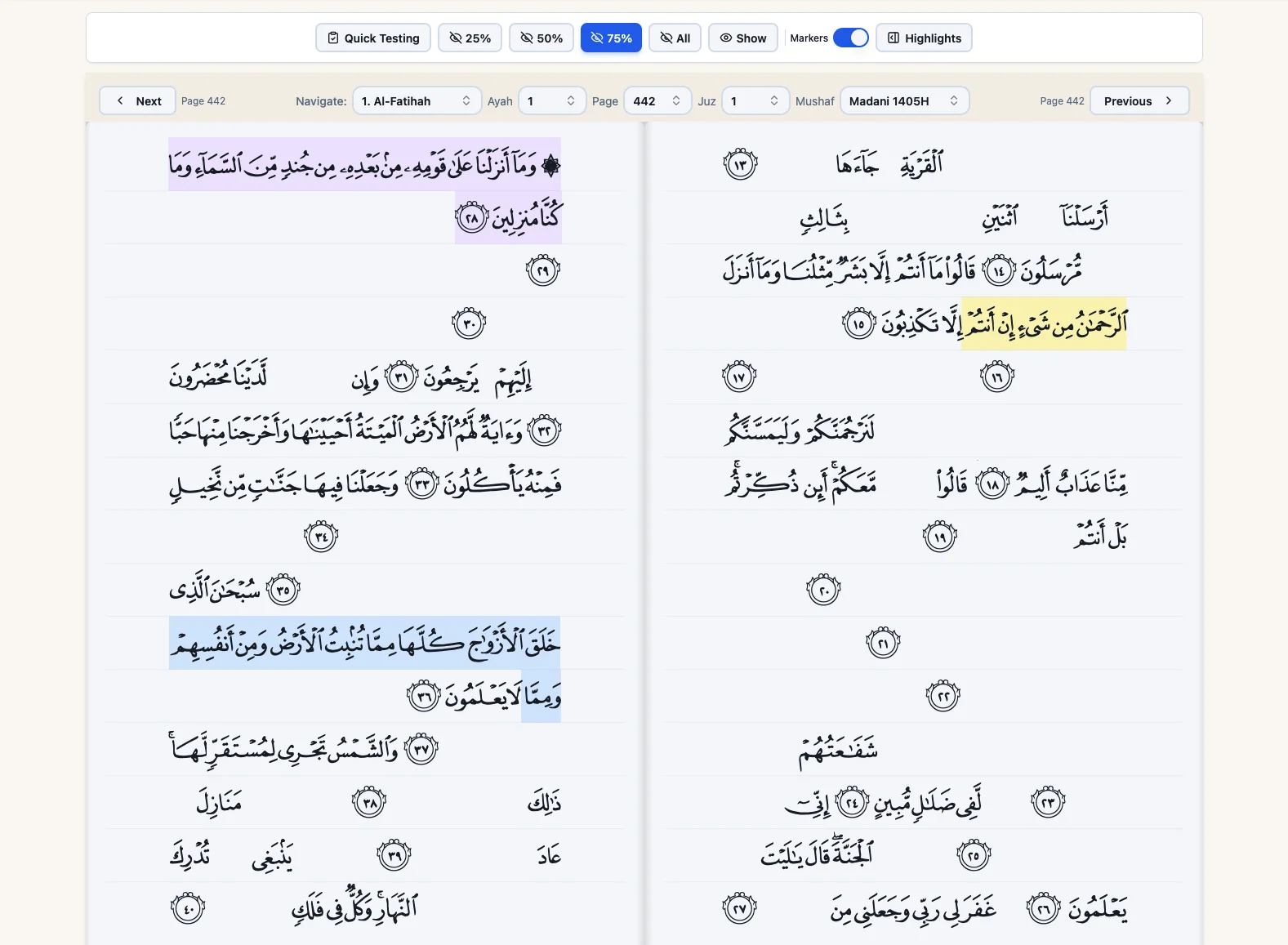
About three pages’ worth, spread over four. Its 45 lines start on line 7 of page 531 and end on line 6 of page 534. That’s 9 lines at the bottom of 531, all of 532 and 533, and 6 at the top of 534, with the page turns after 55:16, 55:40 and 55:67.
In mushafs that print ruku markers, as many South Asian copies do, it has three rukus: ayat 1 to 25, 26 to 45 and 46 to 78.
The refrain is why the line count is so low. It’s 124 of the surah’s 351 words, about 16 of its 45 lines, and you’ll know it by heart within a day or two. That leaves 47 ayat on about 29 lines, a little under two pages of new material.
How many times is the refrain repeated?
Thirty-one times. The refrain is fa-bi-ayyi ala’i rabbikuma tukadhdhiban (you’ll also see it spelled fabi ayyi ala i rabbikuma tukazziban), and it first appears as ayah 13.
فَبِأَىِّ ءَالَآءِ رَبِّكُمَا تُكَذِّبَانِ
“So which of the favors of your Lord would you deny?”
Ar-Rahman 55:13, Saheeh International translation. Compare translations on quran.com
Saheeh International notes that the “you” is literally “you two”, addressing mankind and jinn. The refrain stands as its own ayah at 55:13, 16, 18, 21, 23, 25, 28, 30, 32, 34, 36, 38, 40, 42, 45, 47, 49, 51, 53, 55, 57, 59, 61, 63, 65, 67, 69, 71, 73, 75 and 77.
There’s a pattern in that list. The first 12 ayat have none at all, and the spacing is uneven up to 55:25. Then it falls on every even ayah from 28 to 42 and every odd ayah from 45 to 77. The last ayah, 55:78, isn’t a refrain.
Counting them as you recite takes practice, and our guide to memorizing Ar-Rahman shows the pattern that makes counting easy.
How long does Ar-Rahman take to recite?
About 11½ minutes at a steady pace, and anywhere from 6 to 17 depending on the reciter. These are the lengths of full recordings of the surah.
- Saud Ash-Shuraym: 6.2 minutes
- Abdur-Rahman As-Sudais: 7.9 minutes
- Yasser Ad-Dossari: 8.8 minutes
- Muhammad Siddiq Al-Minshawi: 8.8 minutes
- Abdul Basit Abdus-Samad: 10.2 minutes
- Mishary Alafasy: 11.5 minutes
- Mahmoud Khalil Al-Husary: 17.1 minutes in his murattal, his measured-pace recording, or 15.9 in his teaching recording
For learning new lines, we’d pick Al-Husary. At 17 minutes he’s the slowest on the list, slow enough to follow word by word. For revision, Ash-Shuraym’s six minutes fits into a short break.
We also timed the refrain itself, ayah by ayah, in three recordings using quran.com’s verse timings. It came to about two-fifths of the recording every time. Alafasy spends 4.7 of his 11.5 minutes on the 31 refrains, roughly nine seconds each. Ash-Shuraym spends 2.5 of 6.2 minutes, and Al-Husary 7.4 of 17.1.
So if you learn by listening on repeat, four minutes in every ten go to the one ayah you’ll know by day two. Put those nine seconds to work. Pause the audio on each refrain and say the next ayah before the reciter does.
Read next: how long it takes to read other surahs, timed the same way.
What does a ten-day plan look like?
A little under five lines a day, cut where the ayat end. After day 1, every day finishes on a refrain or on the last ayah, so you always stop on a line you already know. Each day is also under two minutes of Alafasy’s recitation. Day 5, the longest, runs about 1 minute 43 seconds, so even ten listens of a day’s portion take under 20 minutes.
Before each new lesson, recite Ar-Rahman from the top to wherever you’ve reached. By day 9 that’s 55:1 to 61, about nine minutes even at Alafasy’s pace.
- Day 1: ayat 1 to 9, page 531, lines 7 to 11. The opening run with no refrain, from the Most Merciful and the Quran to the sun and moon, then the three ayat about the balance (7 to 9).
- Day 2: ayat 10 to 16, lines 11 to 15, down to the bottom of page 531. The earth and its fruit, the first refrain at 55:13, then man from clay and jinn from fire as a pair (14 and 15) before the second refrain at 55:16.
- Day 3: ayat 17 to 25, page 532, lines 1 to 5. The two sunrises and two sunsets, the two seas, pearl and coral, the ships. Four refrains, but none between 19 and 20, so the barrier follows the two seas directly.
- Day 4: ayat 26 to 32, page 532, lines 5 to 9. Everyone on earth perishes and the Face of your Lord remains, two ayat with no refrain between them. Then everyone in the heavens and earth asks of Him, and Allah tells mankind and jinn that He will attend to them.
- Day 5: ayat 33 to 40, lines 9 to 15, to the bottom of page 532. The heaviest day at about six and a half lines, because 55:33 alone runs nearly two. The challenge to jinn and men, the flame and smoke, the sky splitting open.
- Day 6: ayat 41 to 45, page 533, lines 1 to 3. The lightest day, about three lines. The criminals known by their marks, then Hell and the scalding water, with no refrain between 43 and 44. Use the spare time to recite days 1 to 5 straight through.
- Day 7: ayat 46 to 55, page 533, lines 4 to 9. The first pair of gardens, with their branches, two flowing springs, every fruit in pairs, and the believers reclining on beds lined with brocade.
- Day 8: ayat 56 to 61, page 533, lines 9 to 12. The women limiting their glances, rubies and coral, and “Is the reward for good [anything] but good?” (55:60, Saheeh International).
- Day 9: ayat 62 to 69, from line 13 of page 533 to the first line of page 534. The second pair of gardens, dark green, with two spouting springs, fruit, palms and pomegranates. Practice the page turn after 55:67.
- Day 10: ayat 70 to 78, page 534, lines 2 to 6. The women, the pavilions, the green cushions, then the closing praise of your Lord’s name. Finish with the whole surah once from the start.
Why ten and not nine? A strict nine-day split at exactly five lines would put 55:60 to 69 in one lesson, so the end of the first gardens and the start of the second fall on the same day. That’s the pair people mix up. Ten days lets each set of gardens end where it ends.
Our main Ar-Rahman guide has its own ten-day plan, with eight days of new ayat and two of review. This one spreads the new ayat across all ten days, cut by mushaf lines. Either works; pick the one that matches how you like to revise.
On days 7 to 10, watch the reclining ayah. It comes on day 7 in the first gardens and not until day 10 in the second.
Is Ar-Rahman hard to memorize?
Its length is the easy part. People lose days in two places. One is the ayah after each refrain. The other is the second set of gardens, which borrows the first set’s wording and then changes the order.
What comes after the refrain?
From 55:28 to 55:77 the surah follows one pattern: a short ayah, the refrain, another short ayah, the refrain. Since the refrain sounds the same every time, it gives you no clue about what’s next, and the only thing carrying you forward is your memory of the order of the ayat between them.
Rhyme won’t rescue you either. Of the 78 ayat, 69 end on the letter nun, every refrain included.
The nine that end on another letter make good markers. Seven end in mim (55:10, 11, 24, 27, 41, 72 and 78) and two in ra (55:14 and 15). The most useful is 55:72, fil-khiyam. It’s the only ayah in either set of gardens that doesn’t end in nun, and it sits right in the stretch where the second set changes order.
Four times, two ayat sit together with no refrain between them. Man from clay and jinn from fire (14 and 15). The two seas and the barrier (19 and 20). Everyone perishes, the Face remains (26 and 27). And Hell, with those who circulate between it and scalding water (43 and 44).
People either add a refrain that isn’t there or skip the second ayah. The last pair, 43 and 44, sits exactly where the refrain switches from even ayat to odd ones, which is a handy way to remember both facts at once.
Tip: Recite Ar-Rahman with every refrain left out. In the gardens that’s 46, 48, 50, 52 and every even ayah to 76. Once you can recite that list, putting the refrains back is easy.
The two pairs of gardens, 55:46 to 61 and 55:62 to 77
Each passage runs 16 ayat, eight descriptions with a refrain after each. The first four descriptions sit in matching positions, 16 ayat apart, and each pair shares something.
- 55:46 and 55:62 both end on jannatan (two gardens), with completely different openings: wa liman khafa maqama rabbihi in the first, wa min dunihima in the second.
- 55:48 and 55:64 are the short ones. Dhawata afnan is two words, and mudhammatan is a single word, one of only two one-word ayat in the surah (the other is 55:1).
- 55:50 and 55:66 share their first two words and change only the last.
- 55:52 and 55:68 both open with fihima and mention fruit, min kulli fakihatin zawjan in the first and fakihatun wa nakhlun wa rumman in the second.
فِيهِمَا عَيْنَانِ تَجْرِيَانِ
“In both of them are two springs, flowing.”
Ar-Rahman 55:50, Saheeh International translation. Compare translations on quran.com
فِيهِمَا عَيْنَانِ نَضَّاخَتَانِ
“In both of them are two springs, spouting.”
Ar-Rahman 55:66, Saheeh International translation. Compare translations on quran.com
If the two swap on you, use the alphabet. Ta comes before nun in Arabic, and f comes before s in English, so tajriyan, flowing, belongs to the first gardens and naddakhatan, spouting, to the second.
After those four, the order changes, and this is where the extra days usually go.
- First gardens: reclining on brocade-lined beds (54), the women limiting their glances (56), rubies and coral (58), then the reward for good being nothing but good (60).
- Second gardens: good and beautiful women (70), reserved in pavilions (72), untouched (74), and only then reclining, this time on green cushions (76).
People carry the first order into the second set and recite the reclining ayah too early, or attach qasiratut-tarf (limiting their glances) to 55:70. Part of the pull is the root. Qasirat in 55:56 and maqsurat in 55:72 both come from qaf, sad, ra, so the second gardens sound as if they should hold the first set’s phrase.
And 55:74, lam yatmithhunna insun qablahum wa la jann, is word for word the last six words of 55:56. In the first gardens it’s the second clause of one ayah. In the second it stands alone, with 55:72 between it and the women. Compare 55:39, which ends insun wa la jann with no qablahum; that extra word belongs only to the gardens.
To drill it without a listener, set Quran Memorizer’s put-in-order test to 55:62 to 77. It gives you those ayat out of sequence to put back in place. Run it until the green cushions come after the women every time.
Smaller twins inside the surah
- 55:27 and 55:78 end almost identically, rabbika dhul-jalali wal-ikram and rabbika dhil-jalali wal-ikram. In 55:27 the phrase describes the Face (wajhu), so it’s dhu; in 55:78 it follows rabbika, so it’s dhi.
- 55:7, 8 and 9 all end on al-mizan, the balance, and the last vowel moves: al-mizana, then al-mizani, then back to al-mizana. You only hear it when you join one ayah to the next, which is exactly when it goes wrong.
If you already know other surahs
Two ayat in particular have close relatives elsewhere, and so does the refrain. 55:24, wa lahul-jawaril-munsha’atu fil-bahri kal-a’lam, shares its ending with Ash-Shura 42:32, wa min ayatihil-jawari fil-bahri kal-a’lam. Only Ar-Rahman has al-munsha’at.
And 55:17 is dual, Lord of the two sunrises and the two sunsets, where Al-Muzzammil 73:9 has the singular (al-mashriqi wal-maghrib) and Al-Ma’arij 70:40 the plural (al-mashariqi wal-magharib).
The one to watch if you’re memorizing juz 27 in order is An-Najm 53:55, on page 528, three pages before Ar-Rahman’s first refrain. It opens with the same three words, fa-bi-ayyi ala’i rabbika, with the singular rabbika where Ar-Rahman has rabbikuma, and it ends tatamara, on An-Najm’s long -a rhyme.
فَبِأَىِّ ءَالَآءِ رَبِّكَ تَتَمَارَىٰ
“Then which of the favors of your Lord do you doubt?”
An-Najm 53:55, Saheeh International translation. Compare translations on quran.com
Read next: how to memorize similar verses without mixing them up, for the side-by-side method.
Can you memorize Ar-Rahman in one day?
Yes, and it’s a fairer goal here than for most surahs this long. Take out the refrain and you’re left with about 29 lines of new material. Plenty of people have also heard Ar-Rahman recited for years before they sit down to learn it.
Learning it in one day usually gets you the sound, and two-fifths of that sound is the refrain. What it rarely gets you is the order of the ayat between the refrains, and that’s usually loose by day three.
If you try it, work in four sittings that follow the surah’s own breaks: ayat 1 to 25, 26 to 45, 46 to 61 and 62 to 78. Recite from the top after each one. Then recite the whole surah again the next morning, three days later and a week later. That next-morning recitation is the easiest one to skip, and it’s the one that shows whether the order between the refrains held overnight.
How do you know it’s really memorized?
Reciting from 55:1 to the end is the first test, and you’ll probably pass it early with Ar-Rahman because the refrain carries you along. These are harder, and they tell you more.
- Start at 55:41 or 55:62 without running up from the top.
- Have someone read you any ayah from 28 to 77, then say the ayah that comes after the next refrain.
- Recite the second gardens, 62 to 77, on their own, and check that the reclining ayah comes last.
- Check your refrain count where the subject changes: 8 by 55:30 (creation and its favors), 15 by 55:45 (the Day of Judgment and Hell), 23 by 55:61 (the first gardens) and 31 by 55:77 (the second).
- Close the mushaf and recite each of the four pages, 531 to 534, then open it and check every line.
Starting from the middle is the test people tend to avoid. Here’s why you can recite a surah from the start but not from a random ayah, and a ten-minute routine that fixes it.
Revising Ar-Rahman
You know Ar-Rahman when you can start at any ayah and say what follows the next refrain. The Quran Memorizer test asks for exactly that, the ayah that comes after a given one, or the one before it. It’s free to start, and a few minutes of it a week will tell you which stretch of the surah needs another listen.
And if the second gardens are still trading places on day twelve, that effort counts. The Prophet ﷺ said that the one who finds the Quran difficult and falters in it “will have two rewards” (Sahih Muslim 798a). Start with ayat 1 to 9 today, and recite them again tomorrow before you add day 2.