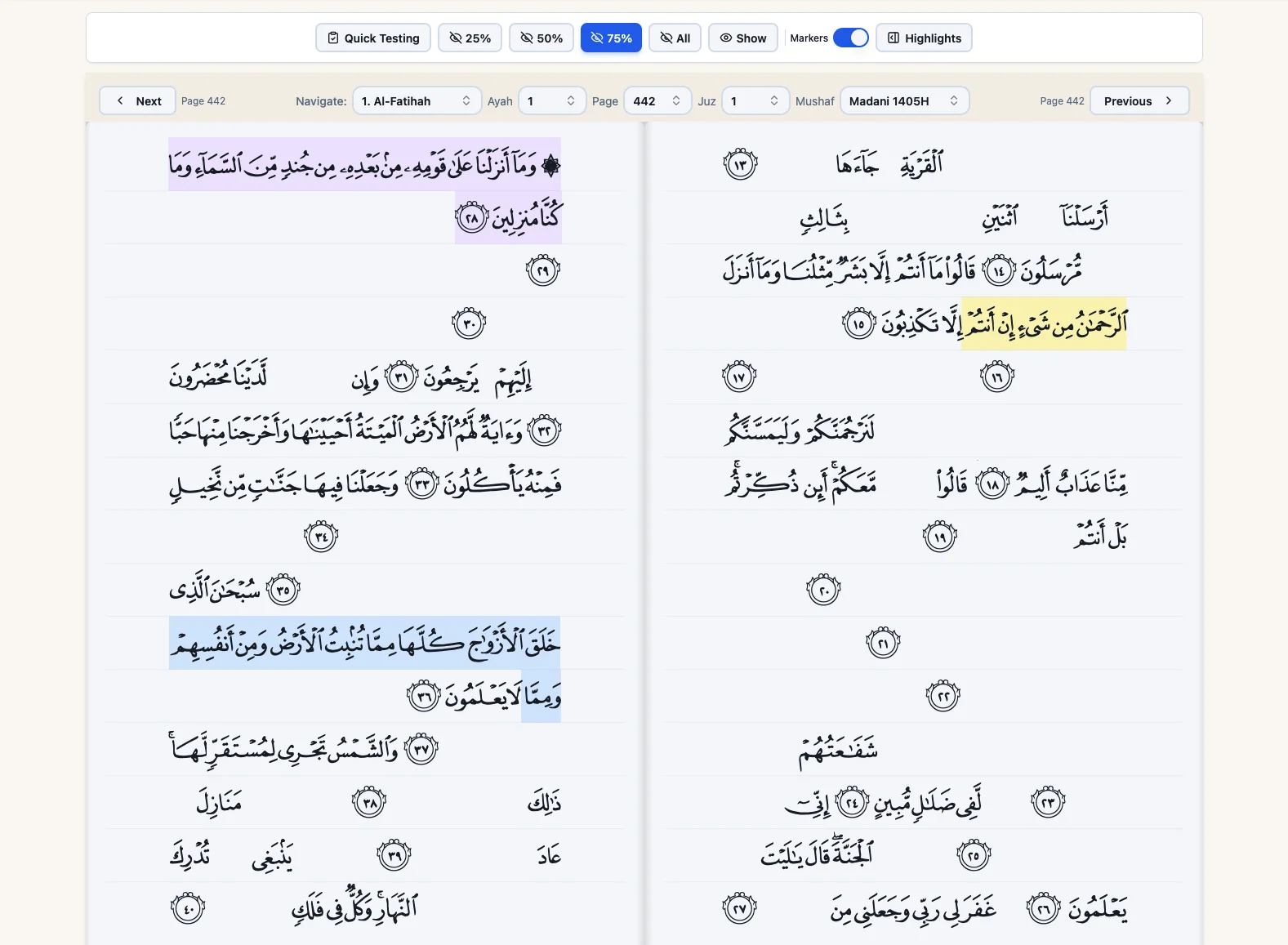
Surah Luqman is 34 ayat on 57 lines of the Madani mushaf, pages 411 to 414, and it takes about 11 minutes to recite at Mishary Alafasy’s pace. Learn Luqman’s advice to his son (31:12-19) first, since it fills page 412 from the top line to the bottom, then add the rest at about three lines a day and you’ll have the whole surah in three weeks.
If you looked this surah up for Luqman’s advice, perhaps to learn it with a child, start there. That page gets the most space below, phrase by phrase. And if you already know the end of Al-Kahf, read the section on 31:27 before you start, because it’ll save you a week of untangling.
At a glance
- Where it sits: surah 31, juz 21 (para 21), pages 411 to 414. The text starts on line 3 of page 411, after the title and basmalah, and ends on line 14 of page 414.
- Length: 34 ayat, 546 words, 57 lines. That’s 3.8 pages of text spread over four pages.
- Luqman’s advice: 31:12-19, exactly one page (412). Eight ayat, 146 words.
- Time to recite: about 7 minutes with Saud ash-Shuraym, 11 with Alafasy and 18 at al-Husary’s teaching pace. The advice page alone is 2.9 minutes with Alafasy.
- Time to memorize: 19 days of new text at 3 lines a day (three weeks with review days), 12 at 5 lines, 8 at half a page, 4 at a full page.
- Watch for: 31:27 against Al-Kahf 18:109, and 31:14-15 against Al-Ankabut 29:8 and Al-Ahqaf 46:15.
Surah Luqman at a glance
- Surah
- 31
- Juz
- 21
- Mushaf
- Pages 411 to 414
- Ayat
- 34
- Length
- About 3.8 pages
- Recited in
- about 11 minutes
How many days will it take?
| New lines a day | Days |
|---|---|
| 3 (a few lines) | 19 days |
| 5 (a third of a page) | 12 days |
| 7 (half a page) | 9 days |
| 10 (two thirds of a page) | 6 days |
| 15 (a full page) | 4 days |
Counts days of new memorization on the 57 lines of Surah Luqman. Add revision on top. Make a day-by-day plan.
Test yourself
Memorized Surah Luqman? Find the ayat you’re not sure of.
Quran Memorizer asks you what comes next, which ayah is missing and which look-alike ayah goes where, on the same Madani mushaf pages you learned from. With Premium, Daily Review brings your weakest ayat back first, so you can revise Surah Luqman a little every day.

Free to start, no card needed. On the web or iPhone, choose Surah Luqman as what you want to be tested on.
More on Surah Luqman: All surah guides
What is Surah Luqman about? The five sections
Luqman is a Makkan surah, the third of four in a row that open with Alif Lam Mim (Al-Ankabut, Ar-Rum, Luqman and As-Sajdah). Its page breaks make it easier to memorize. Every page turn falls between two ayat, and three of its four pages hold one complete section each:
- 31:1-11, page 411 after the title (13 lines, 2.6 minutes with Alafasy). The Book as “guidance and mercy for the doers of good”, then the man who buys “the amusement of speech” and turns away from the ayat as if he hadn’t heard them. It moves to creation, the heavens “without pillars that you see”, mountains and rain, and ends on a challenge: “So show Me what those other than Him have created.”
- 31:12-19, all of page 412 (15 lines, 2.9 minutes). Luqman’s advice to his son, with two ayat in the middle where Allah speaks about parents.
- 31:20-28, all of page 413 (15 lines, 2.7 minutes). Back to the signs: everything in the heavens and earth made subject to you, people who’d rather follow “that upon which we found our fathers”, “the most trustworthy handhold” in 31:22, and every tree on earth as a pen in 31:27.
- 31:29-32, the first nine lines of page 414 (1.5 minutes). Night entering day, the sun and moon on their course, ships on the sea, and people who call on Allah sincerely when “waves come over them like canopies”.
- 31:33-34, lines 9 to 14 of page 414 (1.1 minutes). “A Day when no father will avail his son, nor will a son avail his father at all”, then the five things only Allah knows.
A surah built around a father advising his son reaches, in its second-to-last ayah, a Day when no father can help his son. Once you’ve noticed that, the ending is hard to forget.
Some mushafs also mark rukus, shorter reading sections flagged in the margin. Those divide Luqman into four instead: 1-11, 12-19, 20-30 and 31-34. Either way, the advice is a unit of its own.
Luqman’s advice to his son, ayah by ayah (31:12-19)
The 146 words on page 412 take 2.9 minutes with Alafasy and 4.6 at al-Husary’s teaching pace. 31:12 opens line 1 and 31:19 closes line 15.
Luqman gives his son nine instructions on this page:
- Don’t associate anything with Allah (31:13).
- Establish prayer (31:17).
- Enjoin what is right (31:17).
- Forbid what is wrong (31:17).
- Be patient over what befalls you (31:17).
- Don’t turn your cheek away from people (31:18).
- Don’t walk proudly through the earth (31:18).
- Be moderate in your pace (31:19).
- Lower your voice (31:19).
In between, Allah Himself tells us to be grateful to Him and to our parents (31:14-15).
The Quran tells us Allah gave Luqman wisdom and says little else about him. Ibn Kathir reports that the early scholars differed over his identity, and that most held he was a righteous servant of Allah who wasn’t a prophet.
Who is speaking on page 412?
Settle this before you memorize a word, because the page changes voice three times. In 31:12 Allah tells us He gave Luqman wisdom. In 31:13 Luqman speaks. In 31:14 and 15 Allah speaks again, in the first person (“Be grateful to Me”, “Then to Me will be your return”), about how we treat our parents.
Al-Qurtubi describes these two ayat as a parenthesis set inside Luqman’s advice. At 31:16 Luqman picks up where he left off, which is why Saheeh International opens that ayah with “[And Luqman said]”.
Every ayah in Luqman’s voice ends on a reason that begins with إِنَّ (inna, “indeed”): association with Allah is great injustice (13), Allah is Subtle and Aware (16), that is of the matters requiring resolve (17), Allah doesn’t like the boastful (18), and the most disagreeable of sounds is the donkey’s (19).
The two ayat where Allah speaks about parents (14 and 15) carry إِلَىَّ (ilayya, “to Me”) instead. When an ending won’t come, ask yourself whose voice you’re in.
Ayah 12: wisdom starts with gratitude
وَلَقَدْ ءَاتَيْنَا لُقْمَـٰنَ ٱلْحِكْمَةَ أَنِ ٱشْكُرْ لِلَّهِ ۚ وَمَن يَشْكُرْ فَإِنَّمَا يَشْكُرُ لِنَفْسِهِۦ ۖ وَمَن كَفَرَ فَإِنَّ ٱللَّهَ غَنِىٌّ حَمِيدٌ
“And We had certainly given Luqman wisdom [and said], ‘Be grateful to Allah.’ And whoever is grateful is grateful for [the benefit of] himself. And whoever denies [His favor] – then indeed, Allah is Free of need and Praiseworthy.”
Luqman 31:12, Saheeh International translation. Compare translations on quran.com
Two lines, which the mushaf’s two pause marks split into three short phrases: the command to be grateful, then whoever is grateful, then whoever denies. The first piece of wisdom the Quran names is gratitude, and the root sh-k-r turns up three times in this one ayah. Hold on to أَنِ ٱشْكُرْ (ani-shkur, “be grateful”). It comes back two ayat later.
Ayah 13: the first “O my son”
وَإِذْ قَالَ لُقْمَـٰنُ لِٱبْنِهِۦ وَهُوَ يَعِظُهُۥ يَـٰبُنَىَّ لَا تُشْرِكْ بِٱللَّهِ ۖ إِنَّ ٱلشِّرْكَ لَظُلْمٌ عَظِيمٌ
“And [mention, O Muhammad], when Luqman said to his son while he was instructing him, ‘O my son, do not associate [anything] with Allah. Indeed, association [with Him] is great injustice.’”
Luqman 31:13, Saheeh International translation. Compare translations on quran.com
This is the first of three ayat with يَـٰبُنَىَّ (ya bunayya, “O my son”), running from line 2 to line 4. Here it comes after Luqman is introduced, as the seventh word, while 16 and 17 open with it. Luqman starts where everything starts, with tawhid, worshipping Allah alone.
It’s also the ayah the Prophet ﷺ used to explain another one. When Al-An’am 6:82 was revealed, about believers who don’t mix their belief with wrong, his companions found it hard. He told them it didn’t mean what they’d understood, and pointed them to Luqman’s words to his son here (Sahih al-Bukhari 4776; also Sahih Muslim 124a).
Ayah 14: Allah speaks about parents
وَوَصَّيْنَا ٱلْإِنسَـٰنَ بِوَٰلِدَيْهِ
حَمَلَتْهُ أُمُّهُۥ وَهْنًا عَلَىٰ وَهْنٍ
وَفِصَـٰلُهُۥ فِى عَامَيْنِ
أَنِ ٱشْكُرْ لِى وَلِوَٰلِدَيْكَ
إِلَىَّ ٱلْمَصِيرُ
“And We have enjoined upon man [care] for his parents. His mother carried him, [increasing her] in weakness upon weakness, and his weaning is in two years. Be grateful to Me and to your parents; to Me is the [final] destination.”
Luqman 31:14, Saheeh International translation. Compare translations on quran.com
There’s no pause mark anywhere in 31:14, which runs from line 4 to line 6, so you’ll need your own breath points. The five above work well: the command, the mother’s carrying, the two years, the gratitude, and the return.
The reason given is the mother’s: she carried him “in weakness upon weakness”, and “his weaning is in two years”. When the Prophet ﷺ was asked who most deserves good companionship, he said “Your mother” three times before he said “Your father” (Sahih al-Bukhari 5971).
Then أَنِ ٱشْكُرْ returns. In 31:12 the gratitude was to Allah; here it’s “to Me and to your parents”. Same two words, now with parents added, and a link from one ayah to the other.
Ayah 15: one limit, and kindness all the same
وَإِن جَـٰهَدَاكَ عَلَىٰٓ أَن تُشْرِكَ بِى مَا لَيْسَ لَكَ بِهِۦ عِلْمٌ فَلَا تُطِعْهُمَا ۖ
وَصَاحِبْهُمَا فِى ٱلدُّنْيَا مَعْرُوفًا ۖ
وَٱتَّبِعْ سَبِيلَ مَنْ أَنَابَ إِلَىَّ ۚ
ثُمَّ إِلَىَّ مَرْجِعُكُمْ فَأُنَبِّئُكُم بِمَا كُنتُمْ تَعْمَلُونَ
“But if they endeavor to make you associate with Me that of which you have no knowledge, do not obey them but accompany them in [this] world with appropriate kindness and follow the way of those who turn back to Me [in repentance]. Then to Me will be your return, and I will inform you about what you used to do.”
Luqman 31:15, Saheeh International translation. Compare translations on quran.com
This is the long one: 29 words over lines 6 to 9. Its three pause marks cut it into the four lines above, and you can learn them one at a time.
Read it slowly, because it’s often quoted loosely. The ayah names one situation: parents who strive to make you associate with Allah something you have no knowledge of. In that, you don’t obey them. Even then, the very next words are “accompany them in [this] world with appropriate kindness”, which Ibn Kathir explains as carrying on treating them with respect. Nothing here hands anyone a general license to disobey their parents, and the kindness never switches off.
Al-Qurtubi says many mufassirun link these two ayat to Sa’d ibn Abi Waqqas, whose mother swore she wouldn’t speak to him, eat or drink until he left his faith. She held out for three days, until she fainted. Sa’d’s own account is in Sahih Muslim 1748c.
Asma’ bint Abi Bakr shows the other half of the ayah. Her mother, still a polytheist, came to visit, and when Asma’ asked the Prophet ﷺ whether she should keep good relations with her, he said yes (Sahih al-Bukhari 2620).
Ayah 16: the mustard seed
يَـٰبُنَىَّ إِنَّهَآ إِن تَكُ مِثْقَالَ حَبَّةٍ مِّنْ خَرْدَلٍ فَتَكُن فِى صَخْرَةٍ أَوْ فِى ٱلسَّمَـٰوَٰتِ أَوْ فِى ٱلْأَرْضِ يَأْتِ بِهَا ٱللَّهُ ۚ إِنَّ ٱللَّهَ لَطِيفٌ خَبِيرٌ
“[And Luqman said], ‘O my son, indeed if it [i.e., a wrong] should be the weight of a mustard seed and should be within a rock or [anywhere] in the heavens or in the earth, Allah will bring it forth. Indeed, Allah is Subtle and Aware.”
Luqman 31:16, Saheeh International translation. Compare translations on quran.com
Luqman is back, three lines down at line 9, and the picture is easy to remember: a wrong as small as a mustard seed, hidden in a rock, or in the heavens, or in the earth, and Allah brings it out. Learn the three places as a sequence, صَخْرَةٍ (rock), ٱلسَّمَـٰوَٰتِ (heavens), ٱلْأَرْضِ (earth), and the middle of the ayah gets much easier.
Split it after يَأْتِ بِهَا ٱللَّهُ (“Allah will bring it forth”) and learn the short close, إِنَّ ٱللَّهَ لَطِيفٌ خَبِيرٌ, as its own piece.
Ayah 17: four commands in one breath
يَـٰبُنَىَّ أَقِمِ ٱلصَّلَوٰةَ وَأْمُرْ بِٱلْمَعْرُوفِ وَٱنْهَ عَنِ ٱلْمُنكَرِ وَٱصْبِرْ عَلَىٰ مَآ أَصَابَكَ ۖ إِنَّ ذَٰلِكَ مِنْ عَزْمِ ٱلْأُمُورِ
“O my son, establish prayer, enjoin what is right, forbid what is wrong, and be patient over what befalls you. Indeed, [all] that is of the matters [requiring] resolve.”
Luqman 31:17, Saheeh International translation. Compare translations on quran.com
The last “O my son”, on lines 11 to 13: four commands with no pause between them. Ibn Kathir explains why patience is part of it: whoever enjoins good and forbids wrong will meet harm from people. Pray, speak up, then bear what speaking up costs. That’s the order.
Ayah 18: a turned cheek and a strut
وَلَا تُصَعِّرْ خَدَّكَ لِلنَّاسِ وَلَا تَمْشِ فِى ٱلْأَرْضِ مَرَحًا ۖ إِنَّ ٱللَّهَ لَا يُحِبُّ كُلَّ مُخْتَالٍ فَخُورٍ
“And do not turn your cheek [in contempt] toward people and do not walk through the earth exultantly. Indeed, Allah does not like everyone self-deluded and boastful.”
Luqman 31:18, Saheeh International translation. Compare translations on quran.com
Luqman stops saying يَـٰبُنَىَّ on line 13. 31:18 opens وَلَا (wa la, “and do not”) and 31:19 opens وَٱقْصِدْ (waqsid, “and be moderate”). Two pictures: a cheek turned away from people, and a strut. Saheeh International’s footnote on the cheek is a good one to read aloud to a child: “Rather, respect them by directing your face and attention to them.”
Ayah 19: your pace and your voice
وَٱقْصِدْ فِى مَشْيِكَ وَٱغْضُضْ مِن صَوْتِكَ ۚ إِنَّ أَنكَرَ ٱلْأَصْوَٰتِ لَصَوْتُ ٱلْحَمِيرِ
“And be moderate in your pace and lower your voice; indeed, the most disagreeable of sounds is the voice of donkeys.’”
Luqman 31:19, Saheeh International translation. Compare translations on quran.com
Eleven words, and the page ends on line 15. Pace, voice, donkeys. Young children often find it the easiest to picture.
Listen to the endings from 16 to 19 and you’ll hear the same close each time, a long vowel and then r: خَبِيرٌ، ٱلْأُمُورِ، فَخُورٍ، ٱلْحَمِيرِ (khabir, al-umur, fakhur, al-hamir). If an ending comes out on a different sound, you’ve made a mistake somewhere.
How does the order hold together?
Read top to bottom, the page moves from the inside out: belief (13), parents (14 and 15), Allah’s knowledge of the smallest deed (16), prayer and dealing with people (17), how you carry your face and your walk (18), and last of all, how you use your voice (19).
Tip: Count the nine instructions on your fingers after each recitation: one in 13, four in 17, two in 18, two in 19. Finish on eight and you’ve skipped one, and the gap tells you where.
Quran Memorizer’s tests take a scope as small as a few ayat. Set it to 31:12-19 and run “Put ayat in the correct order”, then “Recall the ayah that comes before or after”, and you’ll find out whether you still know the order with the page closed. It works on iPhone, iPad and the web, and you can try the test first.
How do you memorize Surah Luqman in three weeks?
At about three lines a day, with every seventh day kept for review, Surah Luqman takes 21 days. We’d start with page 412. It stands on its own, and once it’s solid, you can build the rest of the surah around it. If you’d rather go in mushaf order, run the same chunks from 31:1 and the advice comes at the end of week one and into week two.
Lines refer to the standard 15-line Madani mushaf (604 pages). In another print the ayah ranges still work. Times are for one listen to the day’s new ayat, with Alafasy and with al-Husary’s teaching (muallim) recitation.
| Day | Ayat | Page: lines | Alafasy | Husary |
|---|---|---|---|---|
| 1 | 31:12-13 | 412: 1-4 | 0:37 | 0:59 |
| 2 | 31:14 | 412: 4-6 | 0:29 | 0:33 |
| 3 | 31:15 | 412: 6-9 | 0:33 | 0:55 |
| 4 | 31:16 | 412: 9-11 | 0:29 | 0:44 |
| 5 | 31:17 | 412: 11-13 | 0:19 | 0:35 |
| 6 | 31:18-19 | 412: 13-15 | 0:29 | 0:47 |
| 7 | Review | |||
| 8 | 31:1-5 | 411: 3-6 | 0:43 | 1:05 |
| 9 | 31:6-7 | 411: 6-9 | 0:41 | 1:14 |
| 10 | 31:8-10 | 411: 10-14 | 0:54 | 1:25 |
| 11 | 31:11 | 411: 14-15 | 0:16 | 0:24 |
| 12 | 31:20-21 | 413: 1-5 | 0:51 | 1:29 |
| 13 | 31:22-24 | 413: 5-9 | 0:45 | 1:17 |
| 14 | Review | |||
| 15 | 31:25-26 | 413: 10-12 | 0:30 | 0:50 |
| 16 | 31:27-28 | 413: 12-15 | 0:36 | 1:02 |
| 17 | 31:29-30 | 414: 1-4 | 0:43 | 1:21 |
| 18 | 31:31-32 | 414: 4-9 | 0:49 | 1:21 |
| 19 | 31:33 | 414: 9-12 | 0:35 | 1:06 |
| 20 | 31:34 | 414: 12-14 | 0:33 | 0:54 |
| 21 | Review |
If you learn by listening, twenty plays of the new portion take 5 to 18 minutes with Alafasy, since no day’s portion runs past 54 seconds. At al-Husary’s teaching pace, budget up to half an hour. Listen until the sound is familiar, recite from memory, then check against the page.
Before adding anything new, recite from the start of the current page up to yesterday’s ayah. On the first day of a new page, recite the whole previous page instead. A few days have a specific job:
- Day 7. Page 412 three times from memory. Then start cold at 31:16, and again at 31:18, without running up from the top. That’s the habit our random-ayah spot test builds, and it shows you which joins are weak.
- Day 11. Once 31:11 is in, carry straight on into 31:12. Page turns are where gaps usually show up.
- Day 14. 31:1-24 in one sitting: pages 411 and 412 and the top of 413.
- Day 16. If you know Al-Kahf, recite 18:109 straight after 31:27 and listen for the differences listed further down.
- Day 21. The whole surah, about 11 minutes with Alafasy, then start from a few ayat picked at random.
Faster works if you have the time. Five lines a day gets you through the new text in 12 days, and half a page a day takes 8. Don’t squeeze out the review days, though. Without them, the four pages never join up into one surah you can recite straight through.
Which recitation? For learning, we’d pick Alafasy’s steady pace or al-Husary’s teaching recitation, which is slow enough to follow word by word. Once the surah is memorized, a quicker reciter like Shuraym, at about 7 minutes for the whole surah, makes daily revision cheaper. Our list of the best reciters for memorization, ranked by pace, has more options.
Free tool
Want this on a calendar? The hifz plan generator maps Surah Luqman to dates at 3 lines a day (19 sessions) or 5 (12). It follows mushaf order, so if the advice is your goal, start on page 412 anyway. Open the hifz plan generator →
Which ayat get mixed up with Surah Luqman?
Many of the mix-ups in Luqman come from outside it: ayat elsewhere in the Quran that start like a Luqman ayah and then go somewhere else. The biggest one is in Al-Kahf.
31:27 and Al-Kahf 18:109
If you’ve memorized the end of Al-Kahf, prepare for this one. Both ayat picture the sea spent on writing Allah’s words and the words outlasting it, and they share two roots: m-d-d (to supply) and n-f-d (to run out). Those two shared roots are what pull a memorizer from one ayah into the other.
وَلَوْ أَنَّمَا فِى ٱلْأَرْضِ مِن شَجَرَةٍ أَقْلَـٰمٌ وَٱلْبَحْرُ يَمُدُّهُۥ مِنۢ بَعْدِهِۦ سَبْعَةُ أَبْحُرٍ مَّا نَفِدَتْ كَلِمَـٰتُ ٱللَّهِ ۗ إِنَّ ٱللَّهَ عَزِيزٌ حَكِيمٌ
“And if whatever trees upon the earth were pens and the sea [was ink], replenished thereafter by seven [more] seas, the words of Allah would not be exhausted. Indeed, Allah is Exalted in Might and Wise.”
Luqman 31:27, Saheeh International translation. Compare translations on quran.com
قُل لَّوْ كَانَ ٱلْبَحْرُ مِدَادًا لِّكَلِمَـٰتِ رَبِّى لَنَفِدَ ٱلْبَحْرُ قَبْلَ أَن تَنفَدَ كَلِمَـٰتُ رَبِّى وَلَوْ جِئْنَا بِمِثْلِهِۦ مَدَدًا
“Say, ‘If the sea were ink for [writing] the words of my Lord, the sea would be exhausted before the words of my Lord were exhausted, even if We brought the like of it in [continual] supplement.’”
Al-Kahf 18:109, Saheeh International translation. Compare translations on quran.com
Word by word, here’s what changes:
- The opening. Al-Kahf starts قُل (qul, “Say”) and then لَّوْ كَانَ. Luqman starts وَلَوْ أَنَّمَا, with no “Say”.
- Pens or ink. In 18:109 only the sea, as ink (مِدَادًا). In 31:27 every tree on earth becomes pens (مِن شَجَرَةٍ أَقْلَـٰمٌ), and the word for ink isn’t in the Arabic at all. Saheeh International supplies it in brackets.
- The extra supply. Al-Kahf has وَلَوْ جِئْنَا بِمِثْلِهِۦ مَدَدًا, “even if We brought the like of it”. Luqman has يَمُدُّهُۥ مِنۢ بَعْدِهِۦ سَبْعَةُ أَبْحُرٍ, seven more seas.
- Whose words. Al-Kahf says “the words of my Lord” twice (لِّكَلِمَـٰتِ رَبِّى, then كَلِمَـٰتُ رَبِّى). Luqman says كَلِمَـٰتُ ٱللَّهِ once.
- Which runs out. In Al-Kahf the sea runs out first (لَنَفِدَ ٱلْبَحْرُ قَبْلَ أَن تَنفَدَ). In Luqman the words aren’t exhausted (مَّا نَفِدَتْ), and nothing else is said to run out.
- The ending. 18:109 closes on مَدَدًا, in Al-Kahf’s long -a rhyme. 31:27 closes إِنَّ ٱللَّهَ عَزِيزٌ حَكِيمٌ.
The quickest way we know to tell them apart: Al-Kahf’s is a “Say” ayah, words the Prophet ﷺ is told to say, so it says “my Lord”, and it has one sea plus one more like it. Luqman’s counts: trees, a sea, seven seas, and it names Allah.
The word for pens appears in only two places in the whole Quran (3:44 and here), and “seven seas” appears only here. Ibn Kathir adds that the seven signals a vast amount and isn’t a count of the world’s oceans.
Our guide to memorizing the last 10 ayat of Al-Kahf covers this pair from the other side. For the general method, finding the exact word where you switch and then comparing the two places side by side, see how to memorize similar Quran verses without mixing them up.
The parents ayat: 31:14-15, 29:8 and 46:15
وَوَصَّيْنَا ٱلْإِنسَـٰنَ بِوَٰلِدَيْهِ opens exactly three ayat in the Quran, and each one carries on its own way:
- Al-Ankabut 29:8 (page 397) adds حُسْنًا (“goodness”), says لِتُشْرِكَ, and does everything in a single ayah, ending إِلَىَّ مَرْجِعُكُمْ with no ثُمَّ before it.
- Luqman 31:14 (page 412) adds nothing after بِوَٰلِدَيْهِ and goes straight to the mother: حَمَلَتْهُ أُمُّهُۥ وَهْنًا عَلَىٰ وَهْنٍ. Then 31:15 says عَلَىٰٓ أَن تُشْرِكَ, adds the kindness and the path to follow, and puts ثُمَّ before إِلَىَّ مَرْجِعُكُمْ.
- Al-Ahqaf 46:15 (page 504) adds إِحْسَـٰنًا, has كُرْهًا twice, and counts in months: ثَلَـٰثُونَ شَهْرًا, thirty of them.
If حُسْنًا comes out after بِوَٰلِدَيْهِ while you’re reciting Luqman, you’ve moved onto page 397. Luqman’s version goes straight to the mother, and it’s the only one of the three that needs two ayat to finish.
Smaller twins to check
- 31:17’s ending, إِنَّ ذَٰلِكَ مِنْ عَزْمِ ٱلْأُمُورِ. Ash-Shura 42:43 has لَمِنْ with an extra lam, and Al ‘Imran 3:186 opens the phrase with فَإِنَّ. Those three are the only places it occurs.
- 31:18 and Al-Isra 17:37 share وَلَا تَمْشِ فِى ٱلْأَرْضِ مَرَحًا. Al-Isra goes on to say you’ll never tear the earth apart or reach the mountains in height. Luqman puts the cheek first and ends on كُلَّ مُخْتَالٍ فَخُورٍ.
- 31:21 and Al-Baqarah 2:170 both quote people who’d rather follow the way of their fathers. Luqman has وَجَدْنَا and ends with Satan inviting them to the Blaze. Al-Baqarah has أَلْفَيْنَا and ends with fathers who “understood nothing”.
- 31:29 says كُلٌّ يَجْرِىٓ إِلَىٰٓ أَجَلٍ مُّسَمًّى. It’s the only place where كُلٌّ يَجْرِىٓ is followed by إِلَىٰٓ. The other three (13:2, 35:13 and 39:5) say كُلٌّ يَجْرِى لِأَجَلٍ.
- 31:30 and Al-Hajj 22:62 are identical except that 22:62 has هُوَ before ٱلْبَـٰطِلُ. Luqman leaves it out.
Two name pairs inside the surah
Two pairs of Allah’s names close ayat in Luqman, once without al- and once with it. 31:12 ends غَنِىٌّ حَمِيدٌ, while 31:26 ends هُوَ ٱلْغَنِىُّ ٱلْحَمِيدُ. 31:9 ends وَهُوَ ٱلْعَزِيزُ ٱلْحَكِيمُ, while 31:27 ends عَزِيزٌ حَكِيمٌ.
In both pairs the version with al- comes with هُوَ (huwa, “He”). See huwa, add the al-.
How do you remember the five things in 31:34?
The last ayah of the surah, lines 12 to 14 of page 414, lists five things only Allah knows. It’s worth memorizing on its own, and its order is easy to check once you see the shape.
إِنَّ ٱللَّهَ عِندَهُۥ عِلْمُ ٱلسَّاعَةِ وَيُنَزِّلُ ٱلْغَيْثَ وَيَعْلَمُ مَا فِى ٱلْأَرْحَامِ ۖ وَمَا تَدْرِى نَفْسٌ مَّاذَا تَكْسِبُ غَدًا ۖ وَمَا تَدْرِى نَفْسٌۢ بِأَىِّ أَرْضٍ تَمُوتُ ۚ إِنَّ ٱللَّهَ عَلِيمٌ خَبِيرٌۢ
“Indeed, Allah [alone] has knowledge of the Hour and sends down the rain and knows what is in the wombs. And no soul perceives what it will earn tomorrow, and no soul perceives in what land it will die. Indeed, Allah is Knowing and Aware.”
Luqman 31:34, Saheeh International translation. Compare translations on quran.com
Three statements about Allah come first: He has knowledge of the Hour, sends down the rain, and knows what is in the wombs. Then two about us: no soul perceives what it will earn tomorrow, and no soul perceives in what land it will die. Three, then two. Count them on your fingers in that order (the Hour, rain, wombs, tomorrow, the land you’ll die in) and you’ll notice at once if one goes missing.
The Prophet ﷺ recited this ayah in the hadith of Jibril, right after saying the Hour is “one of five things which nobody knows except Allah” (Sahih al-Bukhari 4777). Ibn ‘Umar narrated that he called them “the keys of the Unseen” and recited the same ayah (Sahih al-Bukhari 4778).
Saheeh International’s footnote reads “what is in the wombs” as “every aspect of the fetus’ present and future existence”.
Does Surah Luqman have special benefits?
You’ll see it claimed that whoever recites Surah Luqman will have Luqman as a companion on the Day of Judgement. That line comes from a long narration attributed to Ubayy ibn Ka’b that promises a reward for one surah after another, and scholars agree it’s fabricated. Ibn al-Jawzi said there’s no doubt about it (IslamQA answer 46531 explains why scholars reject the Ubayy narration as a whole). We couldn’t verify any authentic hadith that singles out Surah Luqman for a reward of its own.
You’ll also see it recommended during pregnancy, perhaps because 31:14 speaks of a mother carrying her child “in weakness upon weakness”. We didn’t find a hadith that ties the surah to pregnancy. Reciting any part of the Quran is good at any time; it’s the specific promises that need a source.
What is authentic is that the Prophet ﷺ quoted this surah. He used 31:13 to explain an ayah of Al-An’am, and he recited 31:34 when he spoke of the five things only Allah knows. Both are covered above.
How do you learn Luqman’s advice with a child?
Page 412 makes a good first long passage for a child who already knows some short surahs. Every ayah has something to picture, and the whole page takes under five minutes even at a teaching pace.
- Start at the bottom of the page. With a young child, begin at 31:19 (11 words), then add 31:18, then 31:17, working upward. Each new ayah leads into one they already know, so every session ends on something easy. Older children can go top to bottom.
- Give every ayah a picture. Wisdom and saying thank you (12). “O my son” (13). A mother carrying her baby, and two years until weaning (14). A path that leads back to Allah (15). A mustard seed in a rock, in the sky, in the ground (16). Prayer, good, bad and patience (17). A cheek turned away and a proud walk (18). A calm pace, a quiet voice and a donkey’s bray (19).
- Cut the long ones at the pause marks. 31:15 has four phrases, so give it four days, one phrase each. Split 31:16 after يَأْتِ بِهَا ٱللَّهُ.
- Listen for the “O my son”s. Three ayat have يَـٰبُنَىَّ: 13, 16 and 17. In 13 it comes after “Luqman said to his son”, and in 16 and 17 it’s the first word. Have your child say it a little louder each time it comes. It tells you straight away if they’ve skipped 16.
- Ayat 14 and 15 need a simple explanation. Something like: Allah tells us to thank Him and to thank our parents. Allah comes first, and we’re always kind to our parents. That’s faithful to the ayat without asking a young child to think through hard family situations.
Play al-Husary’s teaching recitation while you go. It’s slow and clear, and the whole page takes 4.6 minutes at his pace, so a child can hear it twice in under ten.
The Prophet ﷺ said the best of you are those who learn the Quran and teach it (Sahih al-Bukhari 5027), and a parent going through page 412 with a child is doing both at once. You may also hear a narration that promises parents a crown whose light outshines the sun. Al-Albani graded it da’if, meaning weak (Sunan Abi Dawud 1453), so lean on the authentic one instead.
For the full routine, from the first listen to the first recitation without help, see our step-by-step method for teaching a child a new surah.
Revising Luqman
Start tomorrow with the top four lines of page 412, ayat 12 and 13, and say them again the next day before you add 31:14.
Once the whole surah is in, recite it from memory once a week, about 11 minutes at Alafasy’s pace, or 7 with Shuraym. Start some of those sessions cold from 31:16, 31:27 or 31:33 instead of the top, and recite 31:11 into 31:12 every time so the first page turn stays joined. When you revise Al-Kahf, recite 18:109 and then 31:27 back to back now and then, so the two ayat stay separate in your head.
Strong hifz is built a little every day. When you want to test yours, Quran Memorizer works on iPhone and iPad and on the web.