Children usually forget surahs they knew because new lessons take up all the Quran time, and the older surahs go weeks without being heard. It’s normal, and for a child on Juz Amma a short daily rotation of about 5 to 10 minutes is usually enough to bring the older surahs back.
The pattern is easy to spot once you know it. Last week’s lesson is perfect, the surahs from two months ago are wobbly, and the ones from last year either come out in a rush or not at all. That spread from recent to old points straight at revision.
At a glance
- Usual cause: new lessons squeeze out revision, so recent surahs are fine and older ones aren’t.
- Finding the weak ones: a 10 to 15 minute check, sorting each surah into solid, shaky or gone.
- Daily revision time: about 5 minutes a day if your child knows 10 or 20 surahs, 7 to 10 minutes for all of Juz Amma.
- Juz Amma in numbers: 37 surahs, 564 ayat, 271 lines, pages 582 to 604 of the Madani mushaf.
- Is it a sin? An IslamWeb fatwa notes that, according to all the scholars, a child isn’t held accountable for forgetting before puberty.
Why does my child forget surahs they used to know?
It’s usually arithmetic. A child at madrasa or with a weekly teacher gets a new lesson, practices it all week, recites it, and gets the next one. Nobody plans when Al-Fajr, learned in March, will be heard again. After six weeks of silence it’s patchy. After six months it may be gone. If madrasa time mostly goes on new lessons, our guide to helping your child revise madrasa lessons at home covers how to fit a little revision into a busy school evening.
A few other causes are worth checking for:
- Moving on too fast. A surah that was recited once to the teacher and passed is held lightly. It can sound fine on the day and be shaky a fortnight later.
- Only ever starting from ayah 1. Lots of children can run a surah from the top like a song, but freeze if you start them in the middle. That’s chain memory, and we explain it in why you can recite a surah but freeze when tested.
- Learning by ear alone. Children who memorized from audio without looking at the page tend to mix up surahs that sound alike, because they’ve got no picture of where an ayah sits.
- Bad timing. Asking a tired eight-year-old to recite at 8:30pm, after school and madrasa, tests their energy more than their memory. A surah that falls apart at bedtime may be perfectly fine on Saturday morning.
None of this means your child is bad at hifz or isn’t trying. Adults who memorize go through exactly the same thing, which is why hifz teachers build revision into every week.
Is it normal, and is it a sin for a child to forget?
It’s normal. The Prophet ﷺ compared the one who knows the Quran by heart to the owner of tied camels: keep them tied and you hold on to them, let them go and they wander off (Sahih al-Bukhari 5031). In another narration he said it escapes more readily than a camel from its tether (Sahih al-Bukhari 5033; the same meaning is in Sahih Muslim 791). The answer in both is practical: revise. Neither narration treats forgetting as a mark against the person.
Some children have been told that forgetting a surah is a major sin, and it frightens them. The two narrations usually behind that are weak: Sunan Abi Dawud 1474 is graded da’if by Al-Albani, and Jami’ at-Tirmidhi 2916 is graded da’if by Darussalam.
Scholars do differ about adults who forget through neglect. An IslamWeb fatwa sets out those views, quotes the Permanent Committee that someone who forgot because they became busy “is not sinful”, and notes that, according to all the scholars, a person isn’t held accountable for forgetting that happened before puberty. For the full picture, read is it a sin to forget the Quran you memorized?
For a child, that comes down to two sentences. Everyone forgets. Going back to it is the good deed. And here’s an ayah to share with them when it feels hard:
“And We have certainly made the Qur’ān easy for remembrance, so is there any who will remember?”
Al-Qamar 54:17, Saheeh International translation. Compare translations on quran.com
How do I find out which surahs my child has forgotten?
Do one short check before you change anything. Guessing wastes weeks, because the surah you’re worried about is often fine and the one you never think about is the real problem. Sit with the mushaf open on your side, and have three columns on a piece of paper: solid, shaky, gone.
- Start each surah from the top. If it comes out cleanly with no help, it’s solid. One or two prompts, shaky. If you’re prompting every ayah or it won’t start, it’s gone.
- Then start one from the middle. Read an ayah aloud and ask, “What comes after this?” A surah that only works from ayah 1 goes in shaky, even if the first test went well.
- Finish with “which surah is this?” Read the opening of three or four surahs at random. Hesitation here tells you which ones are getting mixed up.
How long this takes depends on how much your child knows. The last 10 surahs, Al-Fil to An-Nas, are 30 lines and take about 5 minutes to recite straight through, so you can hear every one. All of Juz Amma takes close to an hour at a steady pace, which is too much for one sitting. For a child with 37 surahs, test the first two or three ayat of each surah plus one middle prompt, and spread it over three evenings if you need to. If you can’t read Arabic yourself, our guide to checking your child’s hifz at home shows how to follow along anyway.
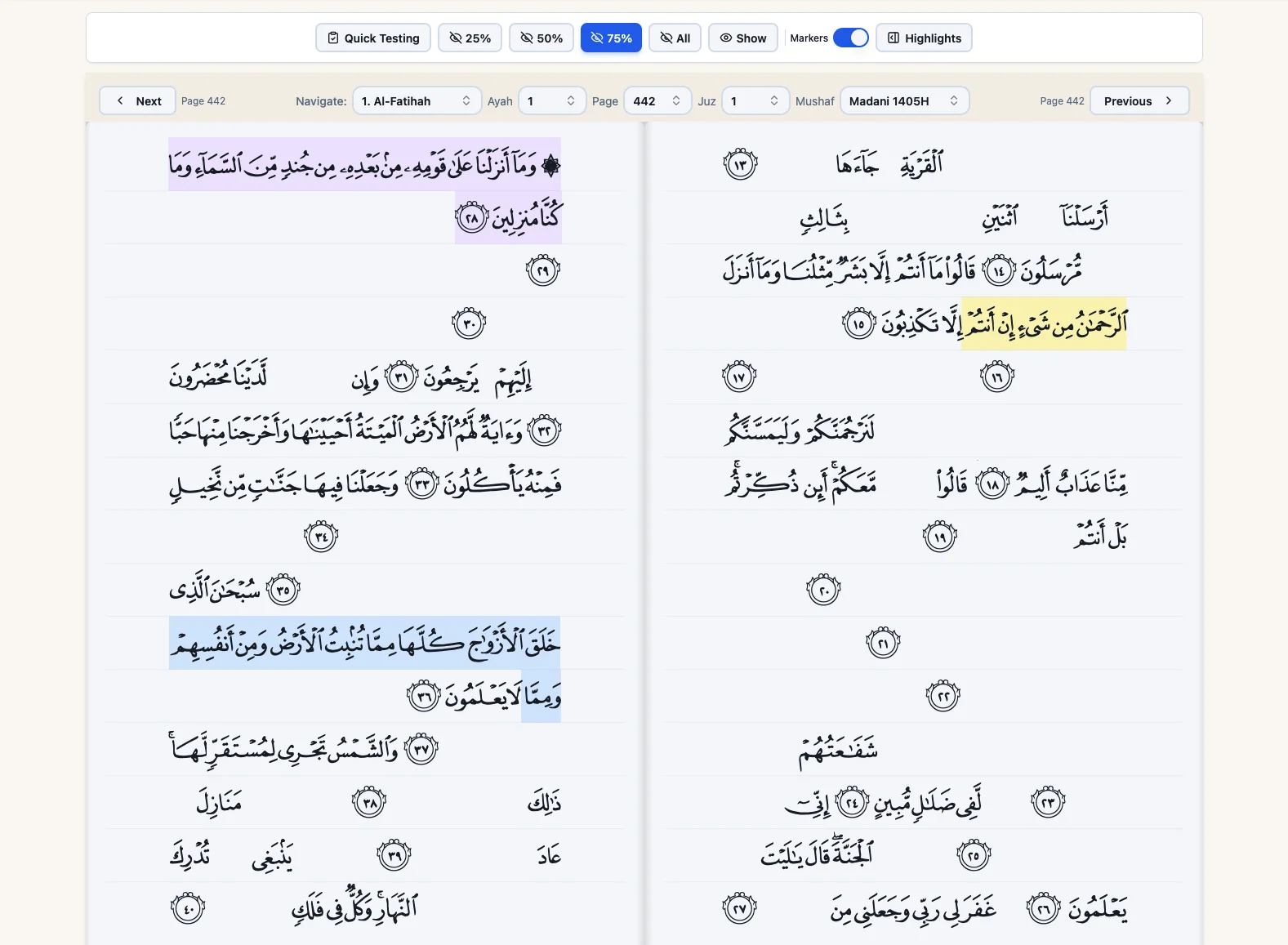
Older children and teens can run a version of this themselves. In Quran Memorizer you can set a test to one surah or the whole of Juz Amma, with next ayah, previous ayah and which-surah questions. The ayat they miss point straight at the weak surahs. It runs in any browser, Android phones included, and there’s a test to start with.
What’s a good weekly revision routine for a child?
The aim is that every surah your child knows gets heard at least once a week, and the shaky ones more often. Here’s what that costs in time. Heard straight through at a steady pace, the last 10 surahs take about 5 minutes, the last 20 about 15 and the whole of Juz Amma about 55, so the bigger the set, the more you spread it across the week.
The minutes are measured from Mishary Alafasy’s recitation on quran.com, which gives a fair planning figure for a confident child reciting from memory. A younger child will often be slower, and a teaching pace like Al-Husary’s takes about one and a half times as long or more.
| Child knows | Lines | Revision a day |
|---|---|---|
| Last 10 (105 to 114) | 30 | 3 to 5 min |
| Last 20 (95 to 114) | 80 | about 5 min |
| Juz Amma (78 to 114) | 271 | 7 to 10 min |
If your child knows 10 surahs
Al-Fil to An-Nas is short enough to do every day: 30 lines, about 5 minutes, 7 if your child recites slowly. If your child prays, the sunnah prayers are a good place to recite a couple of them too. If that’s too much alongside new lessons, split it in half and alternate:
- Day one: Al-Fil, Quraysh, Al-Ma’un, Al-Kawthar and Al-Kafirun (105 to 109), 15 lines, about 3 minutes.
- Day two: An-Nasr, Al-Masad, Al-Ikhlas, Al-Falaq and An-Nas (110 to 114), 15 lines, about 2 minutes.
Each surah then comes round three or four times a week, or every day if you do all ten, which is plenty at this stage.
If your child knows 20 surahs
At-Tin to An-Nas is 80 lines, so split it into three groups of roughly 5 minutes each and go round twice in a six-day week (A, B, C, A, B, C), so each surah is heard twice:
- Group A: At-Tin to Al-Bayyinah (95 to 98), 24 lines, a little under 5 minutes.
- Group B: Az-Zalzalah to Al-Humazah (99 to 104), 26 lines, about 5 minutes.
- Group C: Al-Fil to An-Nas (105 to 114), 30 lines, just over 5 minutes.
Tip: Watch Al-Bayyinah. It has only 8 ayat but runs to 10 lines, the longest of the last 20 surahs by lines, and its long ayat make it easy to lose your place. If group A keeps going wrong, check this surah first.
If your child knows all 37 surahs of Juz Amma
Now you’re looking at 271 lines. Six groups of 35 to 56 lines cover the whole juz once a week, each surah heard once, in 7 to 10 minutes a day (13 to 17 at a slow teaching pace), on top of the current lesson:
- Day 1: An-Naba and An-Nazi’at (78 to 79), 40 lines, about 9 minutes.
- Day 2: ‘Abasa, At-Takwir and Al-Infitar (80 to 82), 35 lines, about 7 minutes.
- Day 3: Al-Mutaffifin, Al-Inshiqaq and Al-Buruj (83 to 85), 43 lines, about 10 minutes.
- Day 4: At-Tariq to Al-Balad (86 to 90), 50 lines, about 10 minutes.
- Day 5: Ash-Shams to Al-Bayyinah (91 to 98), 47 lines, about 9 minutes.
- Day 6: Az-Zalzalah to An-Nas (99 to 114), 56 lines, about 10 minutes.
- Day 7: rest, or the weak list only.
Days 1 and 3 hold the three longest surahs in the juz, An-Naba, An-Nazi’at and Al-Mutaffifin, at 19 to 20 lines each. They’re the ones that get put off, so try not to skip those two days. By minutes, Days 3 and 4 are the longest, at about 10 each.
Add a weak list
Whatever size the rotation, anything that went in the shaky column gets heard every day for a week as well as on its normal day. Once it’s come out clean on two days running, it drops back into the rotation. Gone surahs are different: treat them like a new lesson, a few ayat at a time, before they rejoin the weekly cycle.
Free tool
For a child who’s finished Juz Amma, the manzil planner marks pages 582 to 604 as memorized, lets you flag the weak ones, and builds a daily cycle that brings them back more often, with a sheet you can print and tick off. Open the manzil planner →
Has my child forgotten the surah, or mixed it up with another?
Sometimes a surah only looks forgotten. Juz Amma has a handful of phrases that appear in more than one place, and a child who reaches one can cross into the wrong surah without noticing. Three show up again and again.
At-Tin 95:6 and Al-Inshiqaq 84:25 both begin “Except for those who believe and do righteous deeds” (Saheeh International) and end with a reward uninterrupted. The only difference in the Arabic is one letter: فَلَهُمْ in At-Tin, لَهُمْ in Al-Inshiqaq. Al-‘Asr 103:3 opens with the same Arabic words and then turns to advising one another to truth and patience. So a child who goes from At-Tin straight into Al-‘Asr hasn’t lost At-Tin. They’ve followed a shared phrase down the wrong road.
“Wa ma adraka ma…” (“And what can make you know what is…”, in Saheeh International’s wording) turns up in Al-Infitar, At-Tariq, Al-Balad, Al-Qadr, Al-Qari’ah, Al-Humazah and others. The word that follows tells you which surah you’re in: the Day of Recompense, the night comer, the difficult pass, the Night of Decree, the striking calamity, the crusher. Teach that word and a lot of these mix-ups sort themselves out.
In At-Takathur, ayat 3 and 4 are almost the same, and the second starts with ثُمَّ (“then”). Children sometimes drop it, or skip ayah 4 altogether and jump to ayah 5. That’s a small fix, and the rest of the surah may be perfectly fine.
When you find a mix-up like this, put both surahs side by side in the mushaf and let your child point to the difference. If your child doesn’t read yet, play the two ayat one after the other and let them hear it. Spotting the difference for themselves is easier to remember than being corrected again and again.
Should we stop new lessons until the old surahs are back?
Usually not completely. Cut the size of the new lesson before you cut revision. If your child is learning five lines a day, drop to two or three and spend the saved time on the rotation. A smaller lesson is often easier on a child than no lesson at all, because new surahs are the part that feels like progress.
A full pause makes sense when the check shows more surahs shaky or gone than solid. Two or three weeks of revision only, with the weak list every day, is a sensible first block for a child on Juz Amma. Do the check again at the end, and restart new lessons once the solid column is the biggest. Talk to the teacher first so the madrasa isn’t pushing new lessons while you’re holding them back at home. Our guide on whether to pause new memorization to revise walks through the lighter options and a sample week.
What should I say instead of “you knew this last week”?
That sentence is true, and it almost never helps. A child who’s stuck already knows they knew it. Hearing it turns a memory problem into a shame problem, and children who feel ashamed start avoiding recitation, which makes the forgetting worse. Here are some lines that work better in the moment:
- “Let’s find it together. What’s the first word of this ayah?”
- “You got the first four ayat on your own. Let’s do the rest side by side.”
- “This one hasn’t been recited for a while. That’s my job to plan, not yours.”
- “Look at the page for ten seconds, then close it and try again.”
- For a child who can’t read yet: “Listen to it once with me, then you say it.”
- “It’s going on our list for this week. By Friday it’ll be back.”
The Sunnah gives you words too. The Prophet ﷺ said it’s a bad thing for someone to say “I have forgotten such-and-such verse”, because they have been caused to forget it (Sahih al-Bukhari 5032). For a child, that wording takes the blame out of it. And it helps to know that the Prophet ﷺ himself once heard a man reciting at night and said he’d reminded him of ayat he had been caused to forget (Sahih al-Bukhari 5038).
For the child who finds it hard, there’s a promise worth telling them. The one who recites the Quran while struggling with it and finding it difficult has two rewards (Sahih Muslim 798a). Every time they stop, look and try again counts.
When should I talk to the teacher?
Bring it up early, and bring the results of your check with you. “She’s forgotten some surahs” is hard for a teacher to act on. “Of her 20 surahs, 13 are solid, 5 are shaky and Al-Bayyinah and Al-‘Adiyat are gone” gives them something to work with. Ask how revision is handled in class, whether they’d rather slow new lessons for a few weeks, and whether your child can recite the weak list to them as well as to you.
It’s also worth a conversation if a month of steady home revision hasn’t moved the shaky column at all, or if your child is suddenly reluctant to recite to anyone. That second one can be about confidence, and a teacher who knows can go gently.
Questions people ask
How long should a child revise each day?
For a child on Juz Amma, 5 to 10 minutes of revision a day, on top of the new lesson, is enough to hear every surah at least once a week. Younger children may do better with two short sittings of 3 or 4 minutes than one long one.
Is there a surah that helps a child’s memory?
We don’t know of an authentic surah set aside for memory. A short Quranic dua you can teach your child is “My Lord, increase me in knowledge” (رَّبِّ زِدْنِى عِلْمًا, Ta-Ha 20:114, Saheeh International). Revision is still what brings surahs back.
My child forgets surahs during salah. What helps?
Salah is a good test, because there’s no prompt. Let your child pray with this week’s rotation surahs rather than Al-Ikhlas every time, and treat any that stall in prayer as weak-list surahs.
Does my child need to understand the meaning to remember a surah?
Children memorize well without it, though meaning helps with mix-ups. Knowing that Al-Qari’ah is about the striking calamity and Al-Humazah about the scorner and mocker helps a child tell the “wa ma adraka” lines apart when they start to blur.
Where to start this week
Do the check, pick the rotation that matches what your child knows, and start the weak list tomorrow. Two weeks of 5 to 10 minutes a day usually shows you which surahs are coming back and which need more time. For older children and teens who test themselves, Quran Memorizer’s Daily Review (part of Premium) builds each session from their own answers, so the ayat they get wrong come back first. You can try the test in any browser, and the app is also on iPhone and iPad.