
“How do I memorize faster?” is probably the most common question people ask about hifz. Search it on YouTube and you’ll find videos promising a page in ten minutes. Some of those techniques are useful. Most of them skip the part that decides whether speed matters at all: whether the page is still there next month.
Speed only counts if you still remember the page later. These are the things that make memorizing quicker, roughly in order of how much difference they make, plus a few popular shortcuts that tend to cost you later.
1. Read fluently before you memorize
The biggest hidden cost in memorization is reading. If you’re sounding out words as you go, every repetition is slow and you’re splitting your attention between decoding and remembering. Learners who read the mushaf smoothly often memorize much faster than those who don’t, with no other change.
If your reading is shaky, spend a few weeks reading a page or two aloud every day, with someone correcting you, before you push the memorization pace. It feels like a detour, but it saves you time in the end.
2. Listen before you repeat
Play the passage from a clear, steady reciter two or three times while you follow in the mushaf. By the time you start repeating, you already know how it sounds, where the reciter pauses, and how each ayah ends. Many students find they already remember part of the lesson before they’ve said a word.
Choose one reciter and stick with them, at least for the passage you’re on. Slower, measured recitations like Mahmoud Khalil al-Husary or Muhammad Siddiq al-Minshawi’s teaching recordings are popular for this. There’s more on choosing audio in Memorizing the Quran by Listening.
3. Memorize in small pieces and join them
Trying to swallow a whole page at once is slow. Breaking it down is faster, as long as you put the pieces back together:
- Recite ayah 1 until you can say it without looking.
- Recite ayah 2 until it’s solid.
- Recite ayat 1 and 2 together, three times.
- Learn ayah 3, then recite 1 to 3 together.
Long ayat can be split at a natural pause. The joining step is where most of the speed comes from, because it stops you having to relearn the page as a whole at the end.
4. Pick your best hour
Most people memorize noticeably faster at certain times of day. For many it’s after Fajr, when the house is quiet and the mind is fresh. For others it’s late at night. Spend a week trying your lesson at different times and note how long it takes. Then protect that hour.
Whatever time you choose, put your phone in another room. Notifications cut into memorization far more than people think, because every interruption makes you start the current ayah over.
Ustadh Asim Khan, writing on MuslimMatters about memorizing as a working adult, learned about half a page after Fajr, revised it on the drive to work, and recited the new portion in each salah. On days he couldn’t manage half a page, he did two or three lines rather than nothing.
5. Use the shape of the page
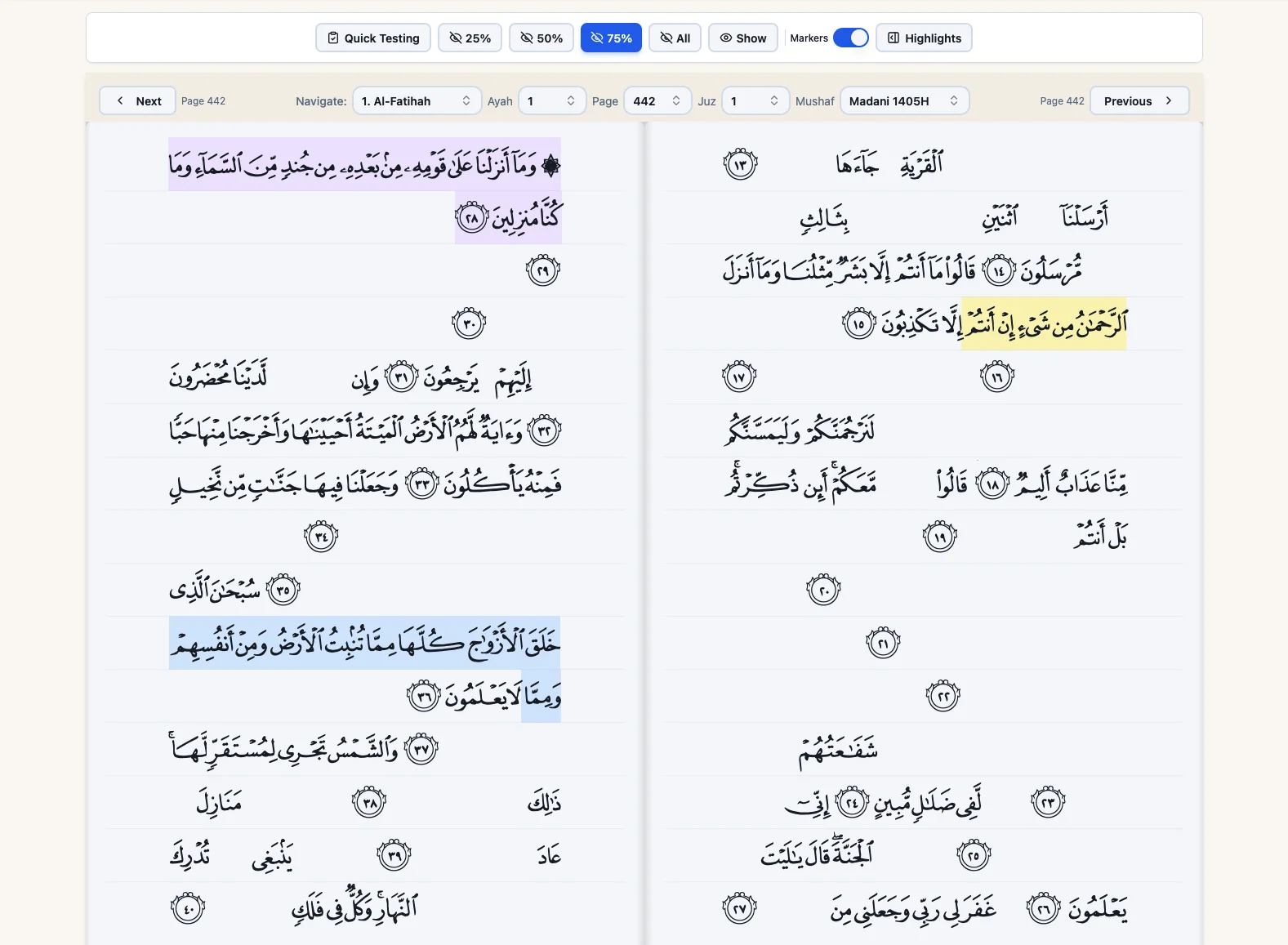
Visual memory does a lot of the work. If you always memorize from the same mushaf, you’ll start to remember that an ayah starts on the left side, three lines down, just after a surah heading. Huffaz use this constantly, often without realizing.
Help it along: before memorizing, look at the shape of the page. Notice where ayat begin and end. When reciting from memory, picture the page. This is also why switching between mushaf prints slows people down. See Why You Should Memorize From One Mushaf.
6. Recite it to someone the same day
Having to recite to a teacher or family member at a fixed time gives you a deadline, and deadlines make people efficient. It also catches errors before they set. A mistake you catch on day one costs a minute. The same mistake caught a month later costs an hour.
7. Revise a little every day
This sounds backwards, but daily revision makes you faster. When last week’s lessons are solid, today’s lesson has something stable to attach to. When they’re shaky, you spend half your session patching them up. Ten minutes of review before every new lesson pays for itself.
Memorizing one short surah quickly
A short surah from Juz Amma can go in during one sitting. Al-Kawthar and Al-Asr are three ayat each, and most people who read fluently can learn either in a few minutes. Here’s the routine we’d use:
- Listen three times while you follow in the mushaf. Don’t recite yet.
- Split it at the rhyme. Short surahs tend to end each ayah on the same sound. All three ayat of Al-Kawthar end in “-ar”, so each ayah is a natural piece.
- Join as you go. Learn the first piece, then the second, then say both together. Add each new piece to the chain.
- Recite it from memory twice with the mushaf closed. If you stumble, open it, fix that spot and start again from the top.
- Test it the next morning before you look at it. That’s the result that counts.
Then use it in salah that day and the next. A surah you’ve prayed with a few times holds up better than one you repeated 50 times in a single hour. For anything longer, how long each surah takes to memorize gives realistic times, and memorizing a surah in one day walks through a full day’s plan.
Shortcuts that cost you later
Repeating until it sticks, then never again
Saying a page 40 times in one sitting will get it into your head for the day. Without review over the next week, most of it will be gone. Fewer repetitions spread over several days work better than a big block on one day.
Skipping the joins
If you memorize each ayah separately and never practice the transitions, you’ll be able to recite every ayah but get stuck between them. This is the most common cause of hesitation when reciting to a teacher. Tip 11 in our Quran memorization tips shows how to drill them.
Measuring progress only in new pages
Fast new memorization with a growing pile of forgotten juz isn’t progress. Track how much you can recite fluently. That number matters more than how many pages you’ve covered.
Rushing the Quran itself
When the Prophet ﷺ was receiving revelation, Allah told him not to hurry with the Quran before its revelation was complete, and to say, in the Saheeh International translation, “My Lord, increase me in knowledge” (Ta-Ha 20:114). That ayah was about revelation, but many scholars use it as a reminder for students too. Recite with care. Speed comes from good habits.
A realistic target
If you read fluently and use the steps above, half a page in 30 to 45 minutes is a good pace for most adults, and a full page in about an hour is achievable with practice. Some people are faster. A few are much slower, and that’s fine. The one who struggles with the Quran gets a double reward (Sahih Muslim 798a).
To see what your pace means for the whole Quran, look at How Long Does It Take to Memorize the Quran?
Free tool
Test a target before you commit to it. Pick your daily lines and study days and see exactly where you’d be each week. Open the hifz plan generator →
Questions people ask
Can you memorize a surah in 5 minutes?
A three-ayah surah like Al-Kawthar or Al-Asr, yes, especially if you’ve heard it many times before. A surah of a page or more, realistically no. The honest test is whether you can recite it the next morning without looking. If you can’t, give it another few minutes then, and again the day after.