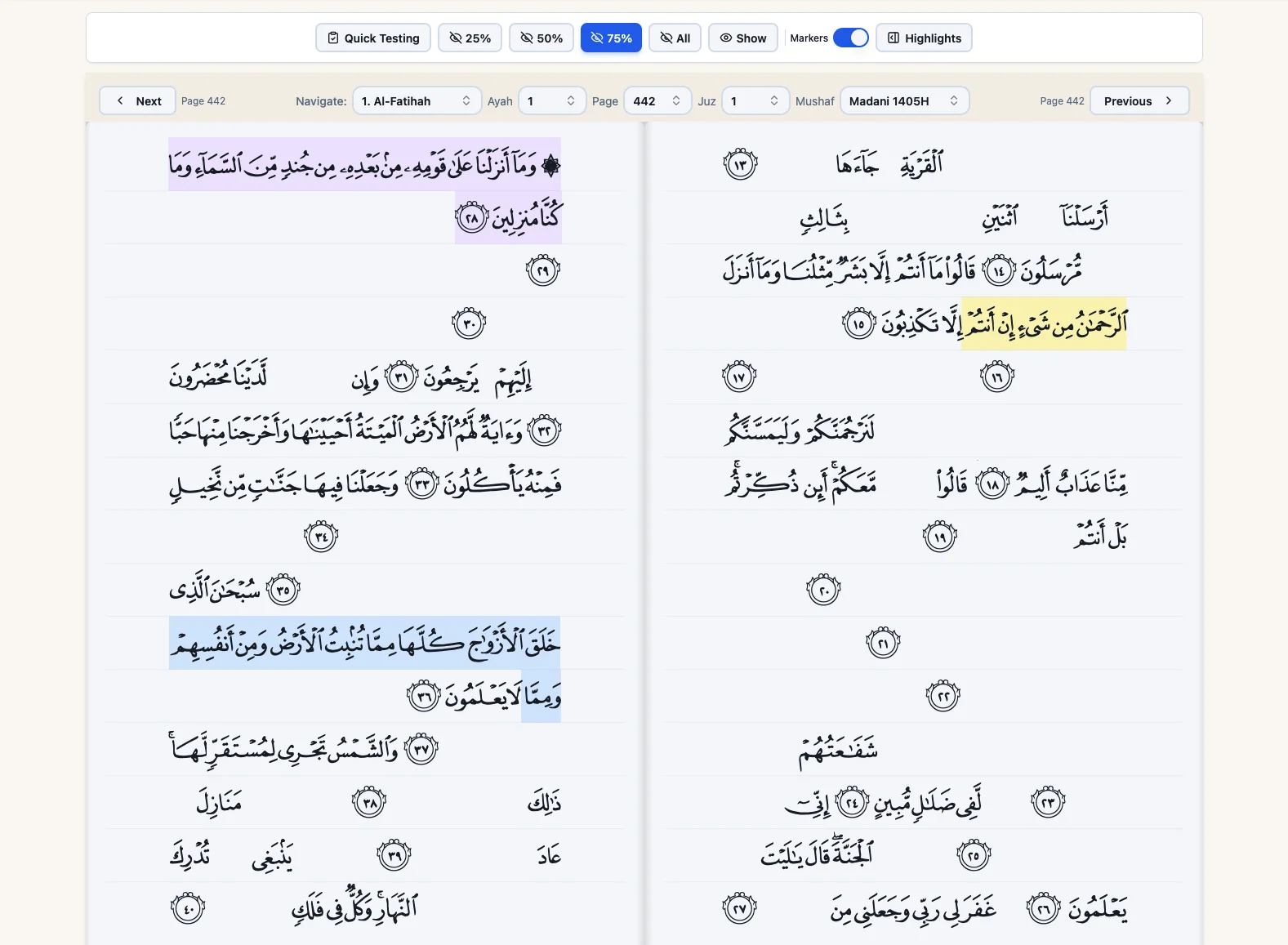

Yes, you can memorize the Quran by listening, and some people, especially those who can’t read Arabic yet, learn short surahs entirely by ear. For anything longer, use audio to learn how a passage sounds, follow it in the mushaf, then recite it aloud from memory with the audio off and have a teacher or a test check you.
- Before you memorize: play the day’s lesson two or three times while you follow in the mushaf.
- While you memorize: loop one ayah, recite along with it, then stop the audio and say it alone.
- The next morning: recite the lesson from memory before you play anything.
- For revision: listening on your commute is a top-up. Reciting from memory is what counts as revision.
Played in the background while you scroll your phone, though, a recording mostly gives you a vague sense that you’ve been “doing Quran”. The difference is in how you use it, which reciter you pick, and what you pair it with.
Why listening helps
The Quran was first received and taught by hearing. The Prophet ﷺ heard it from Jibril, recited it to his companions, and listened to them recite back. He even asked Abdullah ibn Mas’ud to recite to him, saying he liked to hear it from others (Sahih al-Bukhari 5049), and wept when Ibn Mas’ud reached An-Nisa 4:41 (Sahih al-Bukhari 5050).
Practically, listening helps in three ways:
- Pronunciation. You hear how each word should sound before you start repeating it, so you don’t memorize your own mistakes.
- Rhythm. Recitation has a natural flow of pauses and stops. Once you’ve heard it a few times, you start to remember how the ayat run together.
- Extra hours of exposure. You can listen while walking, driving or cooking, which adds exposure on days when you can’t sit with the mushaf.
Listening alone isn’t enough
People who memorize mainly by listening tend to run into the same problems. They can recite along with the recording but freeze without it. They confuse similar passages, because the sound is close. And they often can’t start from the middle of a surah, because they’ve only ever heard it from the beginning.
The fix is to combine listening with reading and recall. Use audio to learn how the passage sounds. Use the mushaf to see it. Use recall, with the mushaf closed and the audio off, to actually memorize it.
A listening routine that works
Before you memorize
Play the day’s lesson two or three times while following in the mushaf with your finger. Don’t try to memorize yet. Just notice how each ayah begins, where the reciter pauses, and any words you’d have pronounced differently.
While you memorize
Some people like to play one ayah on repeat, recite along with it a few times, then stop the audio and recite alone. That works well for short ayat. For longer ones, use the audio to check yourself after you’ve tried from memory.
Apps that loop a range of ayat help here. The Quran Memorizer player lets you pick a start and end ayah and repeat it 1, 3, 5, 10 or 20 times, at speeds from 0.75× to 1.5×.
After you memorize
Listen to the lesson again later in the day, ideally while doing something with your hands. Then, the next morning, recite it without audio before you play anything. If you play the recording first, you won’t find out what you actually remember.
For revision
Listening to older juz on your commute is a good habit, but treat it as a top-up rather than revision. Real revision means reciting from memory. A nice middle ground: play a passage, pause before each ayah, and say it before the reciter does.
Choosing a reciter for hifz
The best reciter for memorization isn’t necessarily the one you find most beautiful. You want someone:
- Clear and steady. Every letter distinct, no rushing.
- Measured in pace. Slow enough that you can follow and repeat.
- Consistent. The same style from surah to surah, so your ear doesn’t have to adjust.
- Reciting the same riwayah you’re memorizing. Most English speakers memorize in Hafs ‘an ‘Asim, which is what nearly all popular recordings use.
Reciters commonly recommended for hifz include:
- Mahmoud Khalil al-Husary. Very clear and precise. His mu’allim (teaching) recording, where children repeat after him, is used by hifz schools around the world.
- Muhammad Siddiq al-Minshawi. Also has a teaching recording with children repeating. Slow and very clear.
- Mishary Rashid Alafasy. Clear, moderate pace, and his recordings are easy to find in every app.
- Abdullah Basfar and Ali Jaber. Steady, unhurried recitations popular with learners.
- Ayman Suwayd. Known for tajweed teaching. Good if you want to learn the rules as you go.
The best choice is often the reciter you’ll actually listen to every day. If you love a reciter’s voice, you’ll play their recitation more, and that matters.
Once you’ve chosen, stick with them for at least a full juz. Switching reciters mid-surah means getting used to new pauses and a new pace.
A note on beautiful voices
The Prophet ﷺ told Abu Musa al-Ash’ari that he had been given one of the beautiful voices of the family of Dawud (Sahih al-Bukhari 5048), and told the companions to beautify the Quran with their voices (Sunan Abi Dawud 1468). Listening to good reciters naturally improves your own recitation over time, which makes reciting more enjoyable and keeps you coming back.
Common questions
Can I memorize the Quran only by listening?
Some people, especially those who can’t read Arabic yet, do memorize short surahs by ear. For larger amounts, you’ll get much further combining listening with reading the mushaf, because it gives you the visual structure of each page and helps with similar passages.
Should I listen at normal or slow speed?
Start with a slow, measured recording at normal speed. If a recording is too fast, reduce the speed to 0.75× rather than switching to a different reciter.
Is it okay to listen without paying full attention?
Background listening adds familiarity and is better than silence. Just don’t count it as revision. What actually strengthens your hifz is reciting from memory.
For a full method that combines listening, reading and recall, see How to Memorize One Page of the Quran a Day.