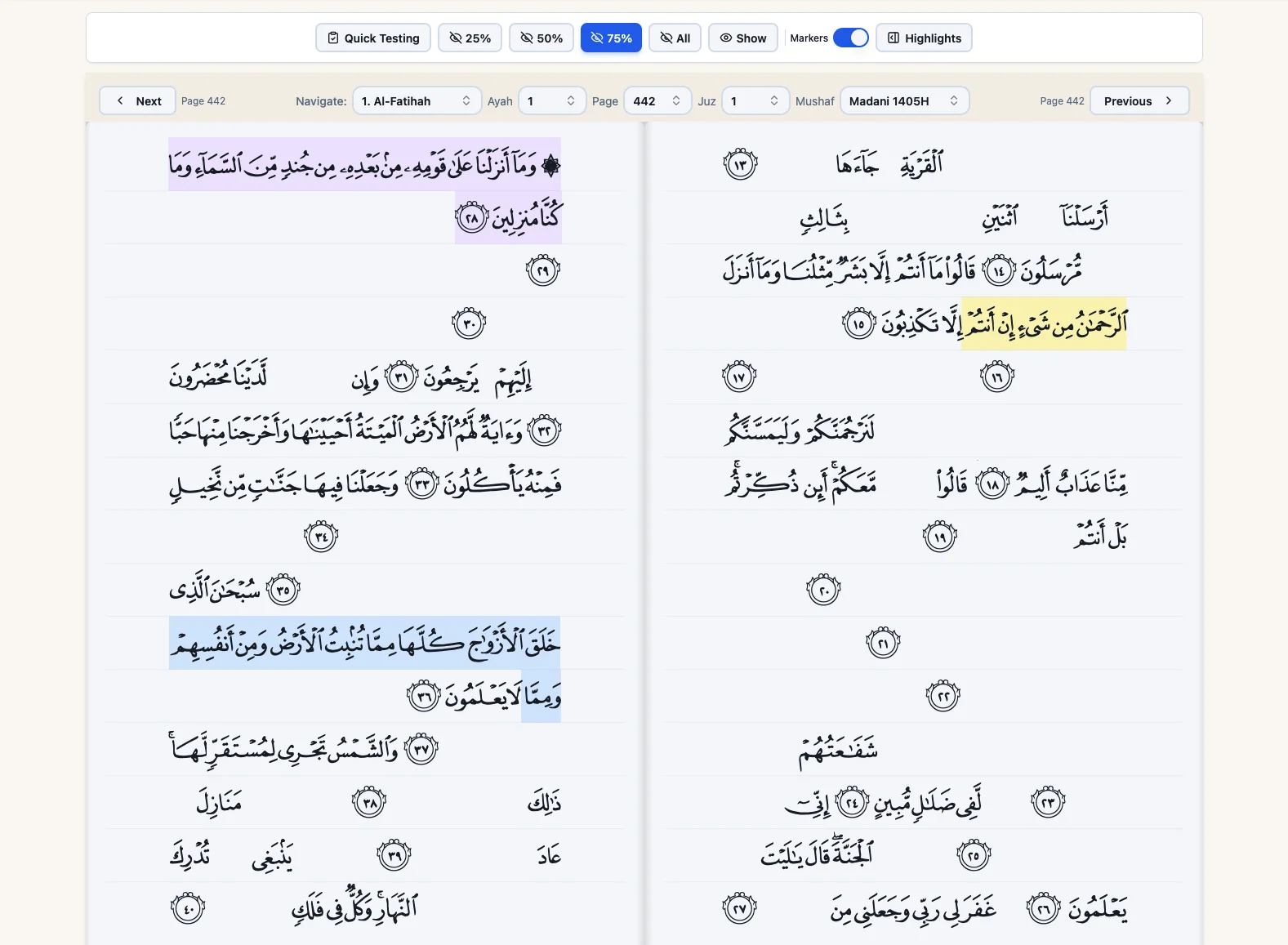
الْحَمْدُ لِلَّهِ رَبِّ الْعَالَمِينَ، وَالصَّلَاةُ وَالسَّلَامُ عَلَى رَسُولِ اللَّهِ، وَعَلَى آلِهِ وَأَصْحَابِهِ أَجْمَعِينَ
All praise is due to Allah, Lord of the worlds, and may blessings and peace be upon the Messenger of Allah, his family and all of his companions.
As-salamu alaikum wa rahmatullah.
Memorizing the Quran should change how you live, as well as what you can recite.
Most people who begin memorizing the Quran share the same goal: to carry the words of Allah within them. The Quran is the final revelation for all of mankind, and memorizing it in its entirety is one of the greatest things we as Muslims can strive for.
But hifz is about more than completing pages or reaching the end. It’s easy to turn memorization into a checklist, moving from surah to surah and juz to juz just to get it done. Over time, that can make the process feel heavy or disconnected.
The deeper goal is to be shaped by the Quran, so that what you memorize changes how you think and act. Memorizing the Quran also means applying it.
This is for anyone who wants to approach memorizing the Quran with that mindset. It treats hifz as part of daily life rather than something to finish as fast as possible. With the right intention, what you memorize won’t stay only in your mind. It begins to settle in your heart, and from there, it starts to show in your actions, your habits, and the way you carry yourself.
Before getting into memorization methods, it’s worth stepping back and asking a more important question: what are we meant to do in relation to the Quran? What was ordained upon us?
Allah says:
كِتَـٰبٌ أَنزَلْنَـٰهُ إِلَيْكَ مُبَـٰرَكٌۭ لِّيَدَّبَّرُوٓا۟ ءَايَـٰتِهِۦ وَلِيَتَذَكَّرَ أُو۟لُوا۟ ٱلْأَلْبَـٰبِ
“[This is] a blessed Book which We have revealed to you, [O Muhammad], that they might reflect upon its verses and that those of understanding would be reminded.” (Saheeh International)
The purpose described here is clear: the Quran was revealed to be reflected upon and acted on, as well as recited and memorized.
In another place, Allah says:
أَفَلَا يَتَدَبَّرُونَ ٱلْقُرْءَانَ أَمْ عَلَىٰ قُلُوبٍ أَقْفَالُهَآ
“Then do they not reflect upon the Quran, or are there locks upon [their] hearts?” (Saheeh International)
The ayah invites self examination: if the Quran is not moving a person, the problem may not be the Quran but the state of the heart. Its message is a reminder to read with reflection, humility, and a willingness to change.
How the Companions Lived the Quran
To understand how the Quran should be memorized and applied, it helps to first look at the best example for humanity.
Aisha (RA) was once asked about the character of the Prophet ﷺ, and she replied,
“The character of the Messenger of Allah (ﷺ) was the Qur’an.”
The statement is brief, but it says a great deal. The teachings of the Quran showed in how the Prophet ﷺ spoke, acted and dealt with people.
That same approach carried into the Companions. When verses were revealed, they did not treat them as information to store away. They treated them as guidance to respond to.
Commands were acted on, warnings made them careful, and promises gave them hope.
The Quran is something that requires integration into one’s own life. You can see this in how quickly the Companions of the Prophet ﷺ would align themselves with what was revealed. One clear example is the prohibition of alcohol. The prohibition didn’t come all at once. The Quran addressed it in stages, first exposing its harm, then restricting it around prayer, until the final command came to avoid it completely.
When that final ruling was revealed, the response was immediate.
Anas ibn Malik reported:
I was serving Abu ‘Ubaida, Abu Talha and Ubai bin Ka`b with a drink prepared from ripe and unripe dates. Then somebody came to them and said, “Alcoholic drinks have been prohibited.” (On hearing that) Abu Talha said, “Get up. O Anas, and pour (throw) it out! So I poured (threw) it out.
There was no hesitation once the command was clear. What had been normal the day before was abandoned the moment Allah prohibited it.
That is what set their relationship with the Quran apart: action followed revelation.
Consider this: if Allah, Lord of the Heavens and the Earth, were to address you directly with a command, would your heart contain even a moment of hesitation? Would you not rush to obey, out of awe, love, and fear of Him?
Yet many tend to forget we have this already. This is precisely what the Quran is: the speech of Allah, sent down through His final Messenger, Muhammad ﷺ.
If we remain unmoved by it, the question is never whether the message is powerful enough. The question is whether our hearts are truly open enough to receive it.
A Practical Framework: Memorize to Act, as Well as to Retain
So how can we apply what we memorize regarding the Quran?
If you want your Quran memorization to fundamentally change you as a person, you have to supplement memorizing with intention, understanding, and action.
What follows is a simple five-step routine of what this can look like.
1. Begin with intention, not habit
Before opening the mushaf, pause for a moment.
Remind yourself what you are about to do. You are about to engage with the words of Allah. This is not akin to reading any ordinary book, studying for exams, or reading the news. Most scholars hold that wudu is required to touch the mushaf, and being in a state of purity is recommended whenever you recite.
Make wudu and then follow up with a du’a. Seek refuge in Allah from all evil, ask for forgiveness from sins committed knowingly and unknowingly, purify your intentions, and ask Allah to allow the Quran to enter and settle in your heart.
The Prophet ﷺ said:
“The reward of deeds depends upon the intentions and every person will get the reward according to what he has intended.”
Your Quran memorization session is an act of worship. So begin it as one. What you intend at the start shapes what you take away at the end.
2. Take less, but take it seriously
Don’t rush to memorize a full page if you don’t really know what it’s saying.
Take three to five ayat at a time. Repeat them until the Arabic starts to flow without looking. Then begin to think about what you just read.
Ask yourself: what is Allah saying here? Is He giving a command, a warning, a promise, or describing something? How does this passage connect to the rest of the surah themes?
You don’t need to be a scholar to do this. A reliable translation is enough to begin the process of understanding. You can use various websites, such as Quran.com to compare several English translations side by side. There are many available apps as well these days. Not to mention any local masjid will have translations available, some in multiple languages.
And when you want to go deeper, turn to tafsir from scholars such as Ibn Kathir or others, whose explanations are rooted in the Quran, Sunnah, and understanding of the Companions.
3. Do not move on until something has landed
This is the heart of the method.
Before you move to the next set of ayat, think about how you can apply what you just memorized. So first, it’s understanding the meaning in the earlier step, and now ways in which the meaning can be carried out.
Sometimes the answer will be clear. It can be an explicit ayah that calls for specific action. For example,
وَأَقِيمُوا۟ ٱلصَّلَوٰةَ وَءَاتُوا۟ ٱلزَّكَوٰةَ وَٱرْكَعُوا۟ مَعَ ٱلرَّٰكِعِينَ
“And establish prayer and give zakah and bow with those who bow [in worship and obedience].” (Saheeh International)
The application is clear: pray consistently, pay zakah, which purifies wealth and supports those in need, and pray with the congregation instead of cutting yourself off from other believers.
Other times, you may not see the application right away, and that’s fine. Don’t force it. Just hold onto it. Write it down. Let it stay with you until the meaning becomes clear.

Not every ayah will turn into a visible action in the moment. But every ayah should leave something behind, even if it is just a new awareness, a small shift in your thinking, or a deeper sensitivity to something you had overlooked before.
For example, an ayah about gratitude might make you say Alhamdulillah more often, even for the small favors of Allah that we take for granted, like your ability to breathe or even your ability to comprehend these words right now.
An ayah about lowering the gaze might make you more careful with your eyes. With widespread fitnah all around us, you may feel prompted to be more intentional with what you view, especially on social media.
An ayah about the Hellfire might make you seek forgiveness from Allah. We do not know which of our actions will bring us the mercy of Allah when we stand before Him. It may be the very istighfar you make now that changes the trajectory of your life for the better.
As the Prophet ﷺ taught, none of us will enter Jannah by our deeds alone; it is Allah’s mercy that ultimately admits us (Sahih Muslim 2818a). Within that mercy, even small consistent actions of worship can become magnified in ways which we can never know.
4. Revise with reflection, not just repetition
Revision is what protects memorization. The Prophet ﷺ warned how quickly the Quran can leave a person if it is not carefully maintained.
He said,
“Commit yourself to the Qur’an, for by Him in whose Hand is my soul, it is surely more prone to break away than a camel in its bind.”
Revision keeps the words with you. Reflection is what carries them into your heart.
Many people can memorize new ayat quickly. MashaAllah, some can take in a page or more a day. But fewer are able to hold onto what they have already learned. It’s like the gym: many people can build strength for a few months, but holding on to it for years takes a different level of consistency.
Hifz is a lifelong commitment. If memorization is about taking in, then revision is about holding on.
As you repeat what you have memorized, return to the meaning. Think about the themes of the passage. You will start to see connections forming in your mind. Similar lessons appearing in different surahs. Recurring reminders. Patterns in how Allah addresses different situations.
For example, when you review verses about gratitude (like in Surah Ibrahim 14:7 or Surah An-Nahl 16:114), you’ll notice how they link thanks to faith and obedience. When you then come across stories of hardship, like the trials of Prophet Ayyub or the losses of Prophet Yusuf, peace be upon them, you’ll see the other side of it: in difficulty, patience and trust in Allah are what lead to relief and reward.
Revision, when paired with reflection becomes guidance.
5. Measure what is changing
Most students of hifz keep track of how many pages or juz they have completed, and that is useful. It gives structure and a sense of direction.
But over time, another measure becomes more important.
Not what you have finished, but what has stayed with you.
As your memorization builds, you begin carrying larger portions of the Quran with you. At that point, the question is no longer about how well you can recite a few surahs or juz. It becomes about the direction of your life.
Are you becoming more conscious of what comes out of your mouth and how you behave, because you’re afraid of backbiting and hurting others? Are there habits you used to accept, like delaying prayers, that are starting to feel heavier and easier to walk away from? Are there moments when you stop yourself while alone, where before you would have gone ahead without thinking, because you feel that Allah is watching?
Remember that Allah says in the Quran,
كُلُّ نَفْسٍۢ ذَآئِقَةُ ٱلْمَوْتِ ۗ وَنَبْلُوكُم بِٱلشَّرِّ وَٱلْخَيْرِ فِتْنَةًۭ ۖ وَإِلَيْنَا تُرْجَعُونَ
“Every soul will taste death. And We test you with evil and with good as trial; and to Us you will be returned.” (Saheeh International)
There is no guarantee that we will wake up tomorrow. When you are studying for a difficult subject in school, and your grades are not so good, you might tell yourself, “I still have time to improve and do better on the next exam.” In this scenario at least you know when the semester ends. At least you know how much time you have left to change your grade and get a passing score.
But when it comes to life, the biggest of all exams and trials? Allah is the only one who knows. And we don’t get second chances to pass. Our ‘grades’ are sealed at the time of death.
If your last breath came today, wouldn’t you want it to find you living the way Allah intended?
When you memorize the Quran, remember to live by it.
Measuring and becoming aware of the positive changes taking place in your character, habits, and choices gives you the sense of direction you need to stay on the straight path.
The Reward Waiting for the Companion of the Quran
One hadith describes what awaits the person who commits to the Quran.
The Prophet ﷺ said:
“It shall be said (meaning to the one who memorized the Qur’an): ‘Recite, and rise up, recite (melodiously) as you would recite in the world. For indeed your rank shall be at the last Ayah you recited.’”
Jami` at-Tirmidhi 2914 (graded hasan by Darussalam)
Scholars have explained that this refers to the one who memorized the Quran and lived by it, with a sincere intention for Allah (see this explanation on Islam Q&A).
The more of the Quran a person holds in their heart and acts on, the higher their rank.
Read next: Ibrahim’s dua in Surah Ash-Shu’ara, a short passage that shows what a believer asks for when everything is on the line.
May Allah make our memorization of the Quran an act of worship, our understanding a means of guidance, and our recitation a source of mercy in this world and the Hereafter.
Jazaakumullahu khairan.