A Quran memorization game that tests your hifz is a recall game: you finish an ayah, name the one before or after, or place a verse in its surah. Quizzes about prophets, tafsir or “guess the surah by emoji” are trivia, and they can’t tell you whether An-Naba is still in your head.
That split matters, because search results for “Quran quiz app” mix the two freely, and only one kind checks what you’ve memorized.
At a glance
- Games that check memorization: finish the ayah, next and previous ayah, which surah, ayah order, missing word, mutashabihat, page position.
- Games that don’t: trivia about stories, meanings and Islamic history. Good for knowledge, but they don’t test hifz.
- Hardest formats to fake: previous ayah and mutashabihat.
- No install needed: several quizzes run in a browser, so Android phones and laptops are covered.
- The rule that makes any game useful: set the scope to what you’ve memorized, write down the misses, then fix them in the mushaf.
Which Quran games test memorization?
Ask one question of any game: could I answer this if I’d never memorized the passage? If yes, it’s trivia. “Which prophet was swallowed by a whale?” is answerable by anyone who’s heard the story. “What comes after innal insana lafi khusr?” is only answerable if Al-‘Asr is in your memory, word for word.
Autocomplete shows how often the two get mixed. Type “quran quiz app” and Google offers “islam quiz app” and “quran trivia app” right beside “quran test app”. Type “guess the surah” and you’ll see “guess the surah by emoji”, a party game where a sun and a moon point you to Ash-Shams. It’s fun at a family iftar. It won’t tell you whether you can recite Ash-Shams.
Trivia has its place. Knowing what a surah is about helps you memorize it. This page is about the other kind: games that check the words and where they sit.
What does each game format train?
Every recall game is a variation on a few questions hifz teachers have asked for generations. Here’s what each one checks, with an example from Juz Amma (pages 582 to 604 of the Madani mushaf) and a way to make it harder once it gets easy.
Finish the ayah
You see or hear the start of an ayah and complete it. Given illal ladhina amanu from Al-‘Asr 103:3, you’d carry on through wa ‘amilus salihati to the end, wa tawasaw bis sabr. It trains the inside of an ayah, especially how it ends.
It’s the gentlest format, because the opening words do a lot of the work. To make it harder, start from the middle of a long ayah, or cut the prompt down to a single word. The “finish the ayah challenge” clips on social media are this format with a timer and an audience. They’re fun, and they’re a fair first check. We’ve written up how to play finish the ayah at home, with variations for kids and adults.
Next ayah
You’re given a full ayah and recite the one after it. Given 112:1, qul huwa Allahu ahad, you answer 112:2, Allahus samad. This trains the joins between ayat, where a solid reciter can still hesitate.
Next ayah rides on momentum. Your tongue already knows the path forward from years of reciting in salah, so you can score well here and still be shaky. Make it harder by drawing the prompt at random from a whole juz instead of a single surah.
Previous ayah
Same idea, backwards. Given 78:2, ‘anin naba-il ‘azim, you name 78:1, ‘amma yatasa-alun, the opening of page 582 and of Juz Amma itself:
عَمَّ يَتَسَآءَلُونَ
عَنِ ٱلنَّبَإِ ٱلْعَظِيمِ
There’s no momentum to lean on, so it shows whether you hold the passage as a map or only as a chain you can run forwards.
Once you’ve memorized more than Juz Amma, spend most of your quiz time here and on mutashabihat. Those two show up the gaps that next-ayah drills hide.
Which surah (guess the surah)
You hear or read an ayah and name its surah. It trains location: knowing where a passage is in the Quran, which you need the moment someone asks you to start from “the ayah about the camels” (that’s Al-Ghashiyah 88:17, on page 592). If you’ve searched “quran guesser” or “quran ayat guesser”, this is the game you were after. No single product owns that name; it’s the format several apps and bots offer.
With four multiple-choice options in Juz Amma, it gets easy fast, since the short surahs sound so different from each other. Drop the options and answer out loud, or move the game to juz 29, where Al-Mulk, Al-Qalam and Al-Haqqah sit back to back and the openings are less familiar.
Ayah order
Three to five ayat are shuffled and you put them back in sequence. A word-order version does the same inside a single ayah. It trains sequence without asking you to produce the words, so it’s a good bridge for newer students who freeze when asked to recite cold.
Missing word
An ayah appears with a gap and you supply the word. In 103:2, innal insana la___ khusr, the answer is fi. It looks trivial, but it catches the small words people drop under pressure: a fa where there should be a wa, a missing la. Spelling the missing word letter by letter, as some apps ask, also checks your Arabic script.
Similar verses (mutashabihat)
These questions show you a phrase that appears in more than one place and ask you to place it. Al-Baqarah 2:5 (page 2) and Luqman 31:5 (page 411) are word for word the same in Arabic:
أُو۟لَـٰٓئِكَ عَلَىٰ هُدًى مِّن رَّبِّهِمْ ۖ وَأُو۟لَـٰٓئِكَ هُمُ ٱلْمُفْلِحُونَ
Show that ayah alone and ask “which surah?” and both answers are correct. That’s the lesson. You only know where you are from what came before: in Al-Baqarah it closes the passage about those conscious of Allah (2:2 to 2:5); in Luqman it follows “guidance and mercy for the doers of good” (31:3). Both surahs open with alif lam mim, then a line on the Book as guidance, then a description of the people it guides, before reaching the same ayah. Recite either opening fast and it’s easy to cross over.
A good mutashabihat game gives you that context, or asks you to recite the ayah before. For a full method, see how to stop mixing up similar verses.
Which page, and where on it
You’re asked which page an ayah sits on, or what’s at the bottom of page 601 before you turn over. It trains the visual map a lot of students lean on: the ayah that opens the page, the surah heading halfway down. This only works against the mushaf you memorized from. Page numbers here follow the 604-page, 15-line Madani layout, so if you learned from a 13-line IndoPak mushaf, your numbers will differ and a page game built on Madani pages won’t match your memory.
Refrains, the hard mode
Some surahs repeat a line, which turns “which ayah is this?” into a real test. Fa bi-ayyi ala-i rabbikuma tukadhdhiban appears 31 times in Ar-Rahman’s 78 ayat, from 55:13 to 55:77. Waylun yawma-idhin lil mukadhdhibin appears 10 times in Al-Mursalat’s 50. Ask someone to recite the ayah before the seventh refrain in Ar-Rahman and you’ll find out quickly how well they know the surah’s structure.
How do you run a surah test?
A surah test is any of the formats above with the scope set to one surah. Take Al-Mulk, 30 ayat on pages 562 to 564. Ask five next-ayah questions, five previous-ayah questions and two page questions (“what opens page 563?”), and draw the prompts from across the surah rather than the first page, which tends to get the most practice. Twelve questions make a short session you can repeat each week.
Any quiz with a surah filter can run this, and so can a friend with a mushaf. The same shape works for the other surah tests people search for, such as Al-Kahf, Yasin or Maryam, with more questions for the longer surahs.
Which apps and websites have Quran memorization games?
Plenty of apps and sites offer these formats, and they change often, so we’ve described the kinds of game you’ll find rather than naming them. Check any app’s listing before you commit.
Quick-round recall games
These are mostly phone apps built around short rounds.
- Surah and next-ayah rounds. Some apps run a handful of quiz types, such as which surah, next ayah and previous ayah, and let you filter practice to chosen surahs. A few add leaderboards or play with friends.
- Listening games. Others are audio-led: you hear an ayah, then name its surah and juz. Some go further, with ayah completion, similar ayat and page questions, such as which mushaf page an ayah sits on or how one page runs into the next.
- Single-format apps. Some do one thing only: they show a random ayah and you name the next one.
- Multiple-choice quizzes. Some generate multiple-choice questions from the Uthmani text and draw wrong options from similar verses, which makes the choices harder to guess. The better ones let you mark what you’ve memorized, so questions come only from those parts.
- Spelling games. A few turn missing words into a word game: you spell the gap from a grid of Arabic letters. They’re strong on word-level precision and spelling, and lighter on sequence.
Quizzes with a review plan or lessons around them
- Timed quizzes with a planner. Some apps pair timed quiz types (arranging words, completing the verse, verse order, naming the surah, next and previous ayah) with points and a review planner, sometimes built on spaced repetition.
- Daily review plans. Others build a daily review around question types like continue the verse, fill a blank, spot a swapped word, name the ayah before and reorder words, with mutashabihat drills on top.
- Lesson-first apps. Some are learning apps first, with gamified lessons that include fill-in-the-blank, ayah ordering and “what comes next?” quizzes. Many keep part of this behind a subscription.
Quran games online (no install)
These work on Android phones, Chromebooks and laptops as well as iPhones.
- Browser quiz sites. Several sites run a long list of question types in the browser: which surah, complete the verse, first word of the next verse, last word of the verse before, which of two verses comes first, and which verse resembles another. Some offer timed rounds, a survival mode or a daily challenge where everyone gets the same questions.
- Web versions of quiz apps. Some of the phone quizzes above also run in a browser, so you can carry on from a laptop.
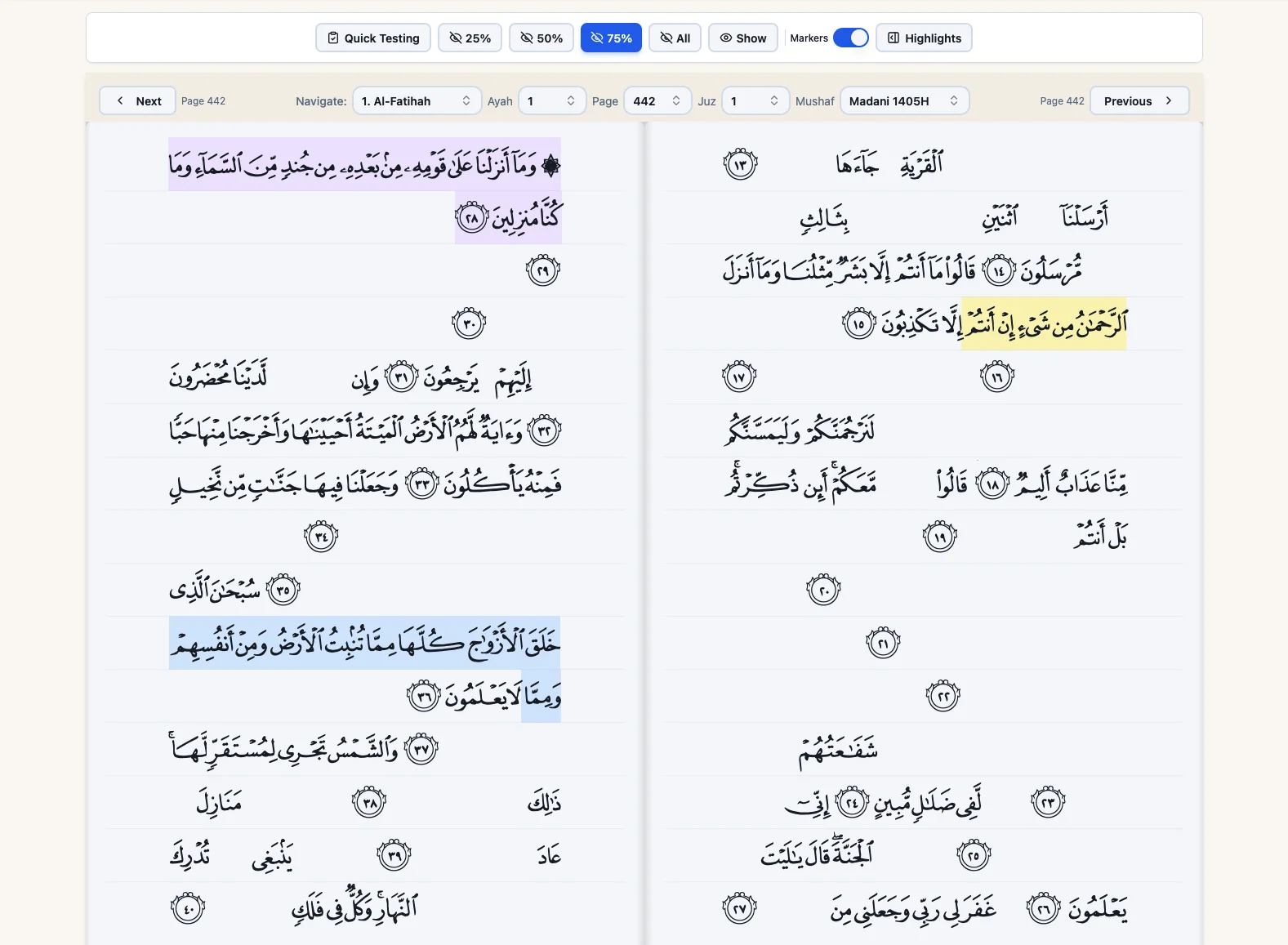
- Quran Memorizer has test modes for next and previous ayah, ayah beginnings and endings, missing words, ayah order, final harakat, page memory, mutashabihat and which surah, on a scope from a few ayat to a juz. You can try sample questions at app.quranmemorizer.com/test straight away; full tests on a surah or juz need an account. The same account works in the iPhone and iPad app, and Premium adds Daily Review, built from your own answers so weak ayat come back first.
Teachers also build one-off quizzes on platforms like Wayground and Quizalize. Quality varies with the person who wrote them, so check the answers against a mushaf before you trust the score.
Apps that listen instead of quizzing
A different approach is to recite aloud and let an app follow along. Some apps, Tarteel among them, can test you by listening as you recite.
How do you play without an app?
Every format above started in a halaqa with a teacher and a mushaf. You need one person holding the book and one person reciting, and a scope agreed first: only what the reciter has memorized. For a child halfway through Juz Amma, that might be An-Nas back to Al-Fajr.
- The holder opens the mushaf at random within that range and reads the first few words of an ayah. The reciter continues for three ayat.
- Every third round, go backwards: read an ayah and ask for the one before it.
- After each recitation, ask “where are we?” The reciter names the surah and, if they learned from the same mushaf, the page.
- The holder notes every stumble with its ayah reference. Then swap roles.
Ten minutes of this after dinner catches things an app can miss, because the person holding the mushaf hears every hesitation and half-second pause. Our random ayah spot test walks through the solo version, for when there’s nobody to hold the book. The Prophet ﷺ said the best of you are those who learn the Quran and teach it (Sahih al-Bukhari 5027), and a parent quizzing a child at the kitchen table is part of that.
How do you get real value from a Quran quiz?
A game is a check. It tells you where the gaps are, and the fixing happens in the mushaf. (Our guide to testing your Quran memorization covers what quizzes can and can’t tell you, and nine other ways to check.) The Prophet ﷺ compared the person who knows the Quran by heart to the owner of hobbled camels: keep them tied and you hold on to them; let them loose and they run off (Sahih al-Bukhari 5031). A quiz is a quick way to find out which camel has come loose.
- Match the scope to your hifz. Questions drawn from the whole Quran are noise if you hold three juz. Every app above that lets you pick surahs, parts or juz is doing you a favor; use that setting.
- Don’t chase streaks or speed. A timer rewards guessing, and a streak can push you to play the surahs you already know. If a game’s scores keep climbing while your recitation in salah doesn’t change, tighten the scope.
Then write down each miss with its reference. “Got 78:31 wrong” is something you can fix; “7 out of 10” isn’t. Open the mushaf at that ayah, recite the three ayat around it five times, and look at where they sit on the page. Come back to the same question two or three days later, because answering right straight after looking proves little.
Tip: With multiple-choice questions, cover the options with your thumb and say the answer out loud first. Then check it against the choices. You’ve turned a recognition test into a recall test, and recall is what you need when you’re leading salah.
If you can recite a surah fine on your own and still blank when a game or a teacher drops you into the middle of it, that’s normal and fixable. We’ve explained why you can recite but freeze when tested, and what helps.
Is it okay to turn the Quran into a game?
“Which surah?” and “continue from here” are two of the oldest questions in a hifz halaqa. A game asks them on a screen. What changes the feel is how the game treats the text. A few things we’d hold to, as manners rather than rulings: no betting or stakes on answers, no joke penalties for a wrong ayah, and the same care with the words on screen that you’d give a printed mushaf. If you have a fiqh question about a specific game, ask a scholar you trust.
The point of every round is the Quran held in the chest, as Allah describes it:
بَلْ هُوَ ءَايَـٰتٌۢ بَيِّنَـٰتٌ فِى صُدُورِ ٱلَّذِينَ أُوتُوا۟ ٱلْعِلْمَ ۚ وَمَا يَجْحَدُ بِـَٔايَـٰتِنَآ إِلَّا ٱلظَّـٰلِمُونَ
“Rather, it [i.e., the Qur’ān] is distinct verses [preserved] within the breasts of those who have been given knowledge. And none reject Our verses except the wrongdoers.”
Al-‘Ankabut 29:49, Saheeh International translation. Compare translations on quran.com
Questions people ask
What is a Quran guesser?
It’s a game that shows or plays an ayah and asks you to guess something about it: usually which surah it’s from, sometimes the next ayah. No single app or site owns the name. Several phone apps and browser quizzes offer versions of it.
What’s a surah test?
A check on one surah you’ve memorized, such as a Surah Al-Mulk or Surah Al-Kahf test, with every question drawn from that surah. The worked Al-Mulk example above shows a twelve-question version.
Is there a free Quran memorization game online?
Yes. Several browser quizzes are free to play, and many quiz apps are free to download, though some keep modes behind a subscription.
Are there Quran memorization games for Android?
Yes, several quiz apps are on Android. The browser quizzes in this guide also work in Chrome on any Android phone, and so does the Quran Memorizer test.
Do “finish the ayah” challenge videos test your hifz?
A little. They check whether you recognize a well-known ayah, and they’re a good way to get children excited. They don’t check the parts of your hifz you rarely recite, which is where a scoped quiz or a spot test helps more.
Pick one format you find hard, previous ayah or mutashabihat, and run it on last month’s surahs this week. If you want somewhere to do that on any device, the Quran Memorizer test works on iPhone, iPad and the web.