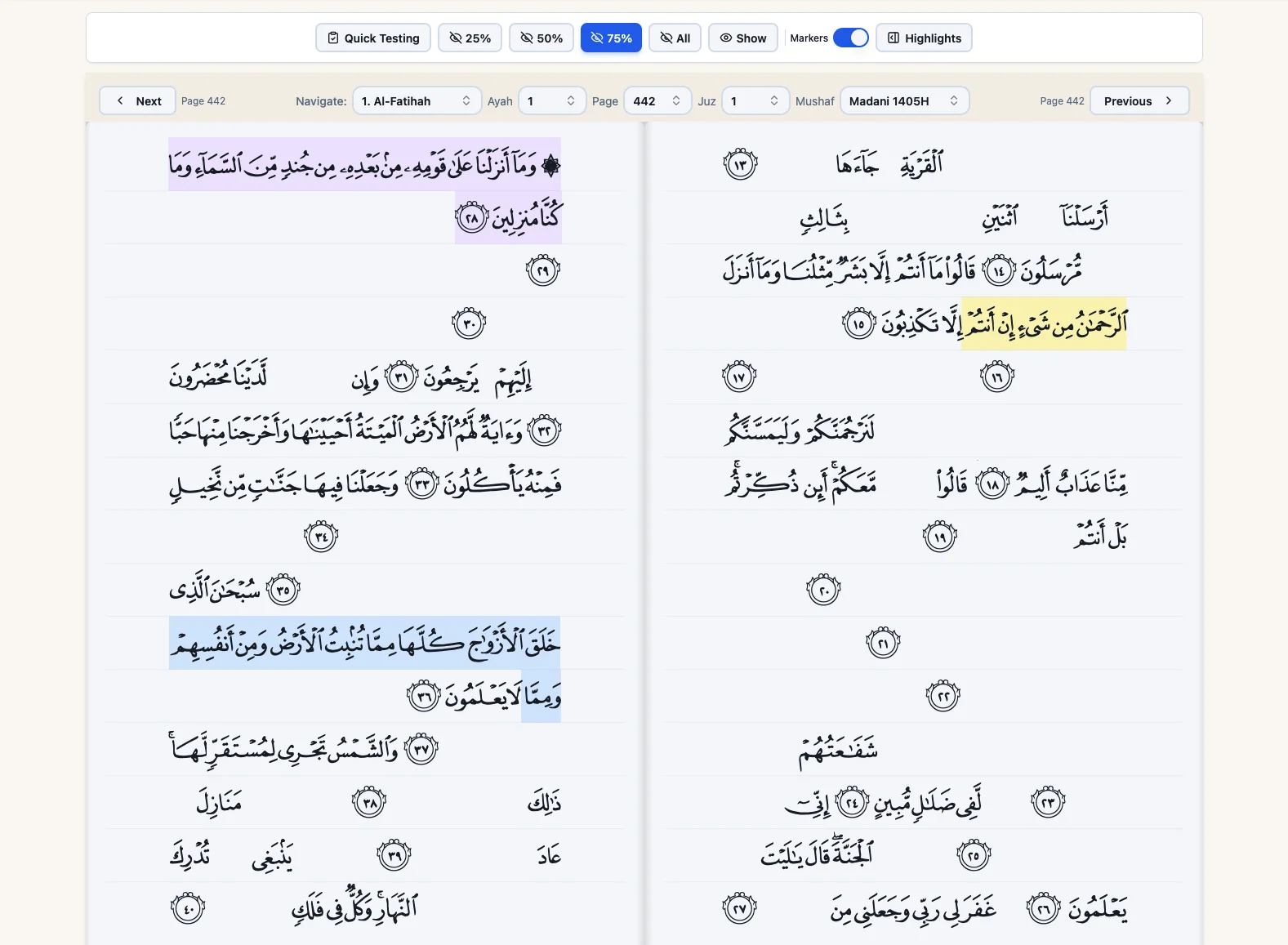
You can recite the surah. Start at ayah 1 and you’ll go all the way to the end without a slip. Then your teacher says “carry on from wa idha qila lahum“, and there’s nothing there. Or a friend reads an ayah and asks which surah it’s from, and you’re suddenly not sure.
It usually doesn’t mean your hifz is weak. More often, you’ve only been checking it one way.
In short
- Reciting from the start checks your flow: can you get through the passage cleanly?
- Being asked questions checks your recall: can you find any ayah, from any direction, without a run-up?
- Most revision only trains the first. The fix is a routine that checks both, every week.
Two different things you’re checking
When you recite a surah from its opening, every ayah hands you the next one. Your tongue knows the rhythm, your ear knows the sound, and you just keep going. It’s real memorization, but it’s memorization of a route.
Teachers and exams don’t only ask for the route. They drop you in the middle, ask what came before, or read the first half of an ayah and wait for the second. Those questions take away the run-up, and the only way to answer them is to have each ayah stored well enough to find on its own.
So there are really two checks:
- Reciting aloud catches slips in the words themselves: a dropped word, a wrong harakah, a skipped line, two ayat swapped.
- Being asked questions catches gaps in recall: ayat you can only reach from the one before, similar ayat you mix up, old juz you’ve started forgetting.
If you only do the first, the second set of problems stays hidden until the day someone tests you.
Check one: recite with the mushaf closed
This is the check you probably already do. To make it count:
- Close the mushaf. Reading along feels like revision, but your eyes are doing the remembering.
- Recite out loud, at your normal pace. Mumbling lets small mistakes slide.
- Have someone, or something, listen. A teacher or a friend is best. Recording yourself and playing it back with the mushaf open works too, and there are apps such as Tarteel that follow along as you recite and point out slips.
- Mark every mistake, even the ones you corrected straight away. A simple mistake log shows you which spots keep coming back.
Check two: answer questions you can’t run up to
This is the check most people skip, because it’s awkward to set up on your own. These are the questions that expose recall gaps:
- What comes next? Start from a random ayah, not the first one.
- What came before? Going backwards is much harder, and it’s exactly what a teacher’s spot test does.
- How does it end? Hear the start of an ayah and finish it.
- Which surah is this from? Especially for ayat that appear, almost word for word, in more than one place.
- Which of these two is it? Look-alike ayat need to be checked side by side. Our guide to memorizing similar verses covers why.
You can do this with a friend, with flashcards, or by opening the mushaf at random. That’s also what we built Quran Memorizer for: it asks you these questions on the surahs and juz you’ve marked as memorized, so you don’t have to set anything up. The free test runs in your browser, and Premium adds a daily review that comes back more often to the ayat you get wrong. If that sounds useful, try the free test on a surah you think you know well. It’s a quick way to find out whether you know the route or the ayat.
A weekly routine that covers both
Neither check replaces the other, so put both in your week. Here’s a simple routine that fits around school or work:
- New lesson (daily): once it’s memorized, recite it aloud with the mushaf closed, to someone or to a recorder, until it comes out clean.
- Recent lessons (daily): the next morning, test the same lines with questions. Start from the middle. Say what comes before ayah 7 without starting at ayah 1.
- Older hifz (daily, a portion): answer questions on one slice of everything else you know, so each juz gets checked every few weeks. Our revision plan guide shows how to split it.
- Once a week: recite a full portion to your teacher or a hifz partner. Bring your mistake log so the time goes on the spots that need it.
Whatever tools you use for each step, the point is the same: one check for the words, one for the recall.
How to tell it’s working
After a few weeks you should notice two things. Your teacher’s spot tests stop being frightening, because being dropped into the middle is now normal practice. And the mistakes you log start to change: fewer forgotten openings and mixed-up surahs, and more small, fixable slips. Those small slips are the ones a teacher can fix in a single lesson.
For more ways to check yourself, see how to test your Quran memorization and the random-ayah spot test.
Questions people ask
Why can I recite a surah from the start but not from the middle?
Because each ayah you recite is the cue for the next one. Starting from the beginning, you’re following a chain. Starting in the middle, you have to find your place without the ayat before it, which is a different skill, and one most people never practise.
Is reading from the mushaf enough to revise?
It helps your accuracy and keeps the picture of the page fresh, but it doesn’t test you. With the words in front of you, you recognise them instead of recalling them. Revision needs at least some reciting or answering with the mushaf closed.
Do I still need a teacher if I use an app?
Yes. An app can tell you whether you remember an ayah, and some can follow your recitation, but a qualified teacher hears things no app does: makharij, the length of a madd, the habits you can’t hear in yourself. Use apps between lessons, not instead of them.
Is Quran Memorizer like Tarteel?
They check different things. Tarteel listens while you recite and points out slips. Quran Memorizer doesn’t listen to your recitation. It asks you questions from memory, like what comes next, what came before and which surah an ayah is from, and plans your revision around the ones you miss. Some people use one for each job.