Juz 30, also called Juz Amma, is the easiest juz to memorize. It comes first on all three things we measured: its ayat average 4.1 words, it holds 37 surahs, and only 10% of its words sit inside a four-word phrase that also turns up in another surah, the lowest share in the Quran.
Juz 29 comes second and Juz 27 third. Juz 28, the usual third juz for anyone memorizing backwards from An-Nas, comes 21st, because only four juz have longer ayat. It’s still a sensible third juz if you’re working backwards or want the two surahs recited at Jumu’ah, and we’ll show you how to plan for it.
“Easy” here means the mechanics of a daily lesson. It says nothing about the worth of any part of the Quran. Every juz is the speech of Allah, and Allah describes all of it as made easy to remember:
وَلَقَدْ يَسَّرْنَا ٱلْقُرْءَانَ لِلذِّكْرِ فَهَلْ مِن مُّدَّكِرٍ
“And We have certainly made the Qur’ān easy for remembrance, so is there any who will remember?”
Al-Qamar 54:17, Saheeh International translation. Compare translations on quran.com
So when this page calls Juz 3 “hard”, read it as “more repetitions per page”. Nothing on the list is out of reach.
At a glance
- Easiest juz: Juz 30 (Juz Amma), pages 582 to 604. 564 ayat, 4.1 words per ayah, 37 surahs.
- Next easiest: Juz 29 (431 ayat, 11 surahs), then Juz 27 (399 ayat, home to Ar-Rahman and Al-Waqi’ah).
- Hardest by the numbers: Juz 3, then Juz 2 and Juz 8. Long ayat, and one new surah or none.
- Shortest juz: Juz 30, by words (2,308) and by lines of text (271), even though it spreads over 23 pages. Fewest ayat: Juz 6, with 110.
- Time to recite Juz 30: about 40 to 60 minutes at a normal pace.
- Time per juz: 55 to 61 lesson days at five lines a day, 19 to 21 at 15 lines (one page’s worth) a day.
- Best first juz: Juz 30 for most adults and children. Starting from Al-Baqarah in mushaf order is a sound alternative.
All 30 juz, ranked from easiest to hardest
The table is listed from easiest (top) to hardest (bottom). “New surahs” counts the surahs whose first ayah falls inside the juz. “Shared %” is the share of words inside a four-word phrase that also appears in another surah. The score is the average of the three ranks, and lower is easier. The method sits right below the table.
| Juz | Ayat | Words per ayah | New surahs | Shared % | Score |
|---|---|---|---|---|---|
| 30 | 564 | 4.1 | 37 | 10.0 | 1.00 |
| 29 | 431 | 6.2 | 11 | 15.7 | 2.33 |
| 27 | 399 | 6.3 | 6 | 16.9 | 3.83 |
| 23 | 357 | 7.4 | 3 | 20.8 | 7.50 |
| 16 | 269 | 10.2 | 2 | 14.2 | 7.83 |
| 19 | 339 | 7.7 | 2 | 20.6 | 9.17 |
| 18 | 202 | 13.1 | 3 | 22.2 | 10.67 |
| 15 | 185 | 14.5 | 2 | 17.3 | 11.33 |
| 25 | 246 | 10.8 | 4 | 27.5 | 11.83 |
| 26 | 195 | 13.4 | 6 | 26.9 | 12.17 |
| 17 | 190 | 12.9 | 2 | 24.2 | 13.17 |
| 22 | 169 | 15.6 | 3 | 25.1 | 14.33 |
| 21 | 178 | 14.5 | 4 | 37.2 | 16.67 |
| 14 | 227 | 11.0 | 2 | 30.5 | 16.83 |
| 12 | 170 | 15.8 | 1 | 20.7 | 16.83 |
| 13 | 154 | 17.0 | 2 | 25.1 | 17.50 |
| 9 | 159 | 15.6 | 1 | 22.1 | 17.67 |
| 24 | 175 | 14.4 | 2 | 30.1 | 17.83 |
| 1 | 148 | 17.0 | 2 | 26.4 | 18.00 |
| 20 | 171 | 14.9 | 2 | 30.0 | 18.50 |
| 28 | 137 | 19.1 | 9 | 31.5 | 19.17 |
| 10 | 127 | 18.8 | 1 | 20.8 | 19.33 |
| 5 | 124 | 20.8 | 0 | 20.2 | 21.00 |
| 4 | 131 | 19.1 | 1 | 22.4 | 21.33 |
| 11 | 151 | 17.6 | 2 | 31.2 | 21.50 |
| 7 | 149 | 18.6 | 1 | 26.6 | 22.50 |
| 6 | 110 | 22.8 | 1 | 25.0 | 23.17 |
| 8 | 142 | 18.1 | 1 | 28.3 | 23.50 |
| 2 | 111 | 23.2 | 0 | 21.5 | 23.50 |
| 3 | 126 | 20.8 | 1 | 27.6 | 25.00 |
The table runs roughly back to front. The bottom five, Juz 2, 3, 6, 7 and 8, all fall between Al-Baqarah and Al-A’raf, and the top three all come from the last four juz, with Juz 28 the one left out because its ayat are long. The surprises are in the middle. Juz 16 and 19, both heavy with stories, beat every later juz in the mushaf except 23, 27, 29 and 30.
How did we measure which juz is easiest?
A juz is one thirtieth of the Quran (our guide to the 30 juz lists where each one starts), and most juz fill 20 pages of the 604-page Madani mushaf. A few run to 19, 21 or 23. By quran.com’s word count, every juz holds roughly the same amount of text, so what separates an easy juz from a hard one is how that text is cut up. We scored three things that shape a daily lesson:
- Average words per ayah. The ayah is the unit you repeat and then link to the next one. A four-word ayah fits in one breath. A 20-word ayah has to be cut into pieces before you can even start repeating it, so the lower this number, the easier the juz.
- Surahs started in the juz. Each new surah gives you a fresh opening to learn and a finish line you can test, so a juz scores better the more of them it starts. Juz 2 starts none at all, because it sits entirely inside Al-Baqarah.
- Shared phrasing. The percentage of a juz’s words that sit inside a run of four consecutive words also found in a different surah, ignoring harakat and pause marks. It’s a rough gauge of mutashabihat, the similar ayat that switch you onto the wrong track mid-recitation, and a lower figure scores better.
Each juz gets a rank from 1 to 30 on each measure, where 1 is easiest and tied values share the average rank. The score is the mean of the three ranks. Juz 29, for example, is 2nd on words per ayah, 2nd on surahs started and 3rd on shared phrasing, so its score is (2 + 2 + 3) ÷ 3 = 2.33. Juz 27 and Juz 26 both start six surahs, so they split 4th and 5th place and each gets 4.5.
Ranks use the rounded values in the table, so you can redo every sum, and the two exact ties (Juz 14 and 12, Juz 8 and 2) go to the juz with shorter ayat. The word data, juz boundaries and line numbers all come from the api.quran.com verse data for the Madani mushaf.
What the score leaves out
Ayat count isn’t scored. More ayat in the same amount of text means shorter ayat, so scoring both would count one thing twice. Refrains, ayat that repeat word for word, aren’t scored either, because they speed up the first pass and then cause counting mistakes in revision. Familiarity, the surahs you’ve heard in salah all your life, can’t be measured from the text at all.
The four-word test has blind spots too. It counts stock phrases such as “O you who have believed”, which rarely confuse anyone, and it misses repeats shorter than four words: An-Nazi’at 79:33 and ‘Abasa 80:32 are identical, but at three words each they don’t register. Nor can it see tajweed, or how well you read Arabic.
To make sure the formula wasn’t doing the talking, we ran five other versions: ayah length alone, the median ayah or the share of short ayat in place of the average, and two different pairs of measures. Juz 30, 29 and 27 took the top three places in every version. Juz 3 and 6 stayed in the bottom five every time, and Juz 2 did in four of the five.
Which juz is the shortest?
Juz 30, measured by what you actually memorize: 271 lines of text and 2,308 words. The page count hides it. Juz 30 spreads over 23 pages (582 to 604), more than any other juz, because 37 surah headers and basmalah lines take up room.
Shortest juz by lines of text in the Madani mushaf:
- Juz 30: 271 lines
- Juz 29: 278 lines
- Juz 26 and Juz 28: 282 lines each
- Juz 27: 287 lines
The longest is Juz 7 (Al-Ma’idah 5:82 to Al-An’am 6:110), at 304 lines and 2,774 words. That’s a gap of 33 lines, a little over two pages, between the shortest juz and the longest.
A short juz isn’t automatically an easy one. Juz 26 and 28 tie for third shortest and rank 10th and 21st. Juz 10 has the second-fewest words (2,389) and ranks 22nd. How the text is cut up matters far more than how much of it there is. If you want recitation times for every juz as well, see how long it takes to read each surah.
How long does it take to memorize a juz?
Because the text is so evenly spread, the calendar barely changes from one juz to the next. These are new-lesson days only, counted by lines of text in the Madani mushaf and rounded up. A “page” here means 15 lines of text, which is why Juz 30 takes 19 days at a page a day even though it covers 23 printed pages. Revision days come on top.
| Juz | Lines | 5 lines a day | Half a page a day | 1 page a day |
|---|---|---|---|---|
| 30 | 271 | 55 | 37 | 19 |
| 29 | 278 | 56 | 38 | 19 |
| 28 | 282 | 57 | 38 | 19 |
| 26 | 282 | 57 | 38 | 19 |
| 27 | 287 | 58 | 39 | 20 |
| 1 | 298 | 60 | 40 | 20 |
| 2 | 300 | 60 | 40 | 20 |
| 7 | 304 | 61 | 41 | 21 |
Every juz not in the table takes 59 or 60 lesson days at five lines, 39 or 40 at half a page and 20 at a page.
What changes is how a lesson feels. Five lines of Juz 30 hold about ten ayat, each one short enough to check on its own. Five lines of Juz 2 hold about two, and some of its ayat need more than five lines by themselves: 2:196 runs to 73 words, across seven lines.
Free tool
Pick any of the 30 juz, a pace of 3, 5, 7, 10, 15, 20 or 30 lines a day and a direction (from Al-Fatihah or from An-Nas), and get dated lessons by mushaf line. Open the hifz plan generator →
What makes the top five juz easier?
1. Juz 30 (Juz Amma), pages 582 to 604
Juz 30 is first on all three measures. It takes its name from ‘amma, the first word of An-Naba (“About what are they asking one another?”, 78:1, Saheeh International). Of its 564 ayat, 524 are six words or shorter, and the longest, Al-Bayyinah 98:8, runs to 21 words. Each of the 37 surahs is a small closed unit you can finish and test, which matters more than it sounds when you’re three weeks in and need to see progress. Our Juz Amma plan covers the order and the openings that get mixed up.
It’s also the juz you’ve heard most. The Prophet ﷺ recited Al-A’la and Al-Ghashiyah in the two Eid prayers and in Jumu’ah (Sahih Muslim 878a), and many adults come to Juz 30 already knowing a good handful of its short surahs from salah.
Tip: Al-Infitar 82:13 and Al-Mutaffifin 83:22 are the same ayah, inna al-abrara lafi na’im (“Indeed, the righteous will be in pleasure”), on pages 587 and 588. Learn what comes after each one. In Al-Infitar the next ayah turns to the wicked (82:14). In Al-Mutaffifin it moves to the adorned couches (83:23).
2. Juz 29 (Tabarak), pages 562 to 581
Juz 29 is named for Tabarak, the first word of Al-Mulk, and it starts with its heaviest surah: Al-Mulk averages 11.1 words per ayah. From there the juz settles into short ayat, 431 of them at 6.2 words on average (median 5), across 11 surahs, the second-most of any juz. Shared phrasing is low at 15.7%.
Al-Muzzammil’s last ayah, 73:20, runs 78 words, almost four times the longest ayah in Juz 30, so give it a day of its own. Al-Mursalat’s refrain, “Woe, that Day, to the deniers” (77:15, Saheeh International), comes ten times in the surah and costs almost nothing to learn. Spend your effort on the ayah that follows each of the ten, because those handovers are where revision goes wrong.
Two of its surahs come with a reason to learn them early. Al-Mulk is the surah of thirty ayat that interceded for a man until he was forgiven (Jami’ at-Tirmidhi 2891, graded hasan), and the Prophet ﷺ recited Al-Insan in Fajr on Fridays (Sahih Muslim 879a).
3. Juz 27, pages 522 to 541
Juz 27 has more refrains than any other juz: 52 ayat whose exact Arabic appears somewhere else. Ar-Rahman’s “So which of the favors of your Lord would you deny?” (55:13, Saheeh International) comes 31 times, and the ayah quoted at the top of this page comes four times in Al-Qamar (54:17, 22, 32 and 40).
Under the refrains, its ayat are almost as short as Juz 29’s: 6.3 words on average against 6.2, with 71.4% of them six words or shorter. It starts six surahs (At-Tur, An-Najm, Al-Qamar, Ar-Rahman, Al-Waqi’ah and Al-Hadid) and runs from Adh-Dhariyat 51:31 to the end of Al-Hadid (57:29).
The catch is at the edges. The juz opens mid-story at 51:31, with Ibrahim asking his guests, “Then what is your business [here], O messengers?” (Saheeh International), so read 51:24 to 30 on page 521 first to know who’s speaking. At the other end, Al-Hadid averages 19.8 words per ayah, heavier than Juz 28 as a whole, and 57:20 alone is 39 words.
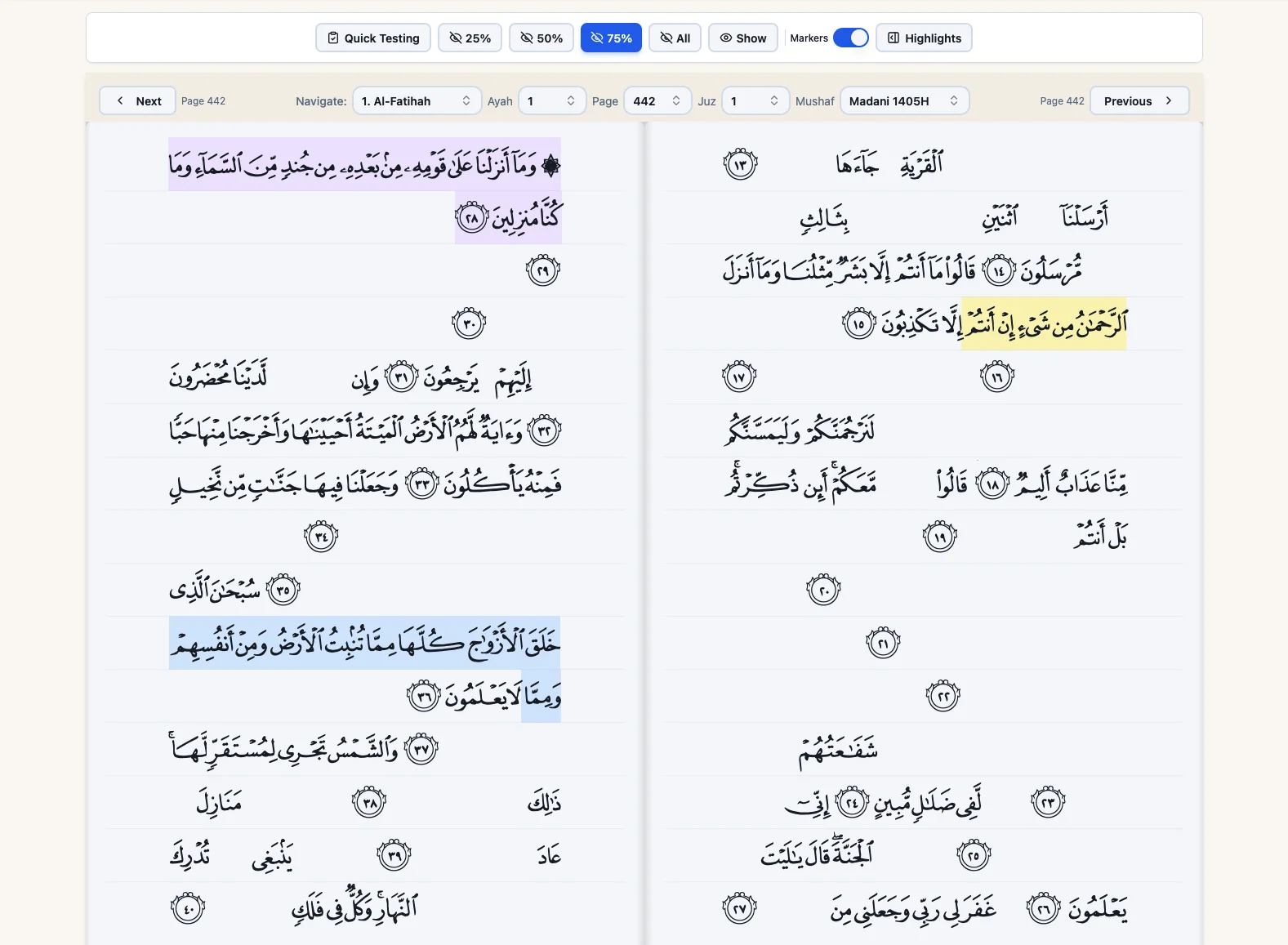
4. Juz 23, pages 442 to 461
Juz 23 runs from Ya-Sin 36:28 to Az-Zumar 39:31: 357 ayat at 7.4 words each (median 6), with As-Saffat and Sad in the middle. As-Saffat closes four of its prophet stories (Nuh, Ibrahim, Musa and Harun, and Ilyas) with lines like “Indeed, We thus reward the doers of good” (37:80, Saheeh International), which comes back word for word at 37:121 and 37:131.
Listen closely in Ibrahim’s story. The line appears at 37:110 on page 450 without its first word, إِنَّا (inna). Saheeh International translates both versions the same way, so only the Arabic shows the difference, and adding inna at 37:110 is the mistake to listen for.
Ya-Sin is split: ayat 1 to 27 sit in Juz 22 and the rest here. And Sad 38:72 to 83 retells the story of Adam and Iblis in ayat nearly identical to Al-Hijr 15:29 to 40, with seven exact pairs. If you already know Al-Hijr, expect the two to cross.
5. Juz 16, pages 302 to 321
Juz 16 is mostly stories, and a story carries its own sequence. The juz opens at 18:75, partway through Musa’s time with al-Khidr. Then Dhul-Qarnayn travels west, then east, then builds his barrier, and after Al-Kahf come Maryam and Musa again in Taha. Once you know what happens next, you’re most of the way to knowing which ayah comes next.
On the numbers, its ayat are longer (10.2 words) and it starts only two surahs, Maryam and Taha, but its shared phrasing, 14.2%, is the second lowest in the Quran after Juz 30. It also holds the last ten ayat of Al-Kahf (18:101 to 110).
Just behind it: Juz 19 in sixth, where Ash-Shu’ara closes one prophet’s story after another with the same lines (26:9 appears eight times), then Juz 18, 15, 25 and 26.
Why isn’t Juz 28 in the top three?
Juz 28 (Qad Sami’a, after the opening words of Al-Mujadila, pages 542 to 561) is the usual third pick for people working backwards, and on one measure it earns it: it starts nine surahs, the third-most of any juz. The other two pull it down.
- Long ayat. Its 137 ayat average 19.1 words, joint 25th of 30, and 18 of them run to 30 words or more. The longest, Al-Mumtahanah 60:10, is 55. Only one ayah in the whole juz is six words or shorter.
- Shared phrasing. 31.5%, 29th of 30, much of it from stock formulas such as “O you who have believed” and “whatever is in the heavens and whatever is on the earth”.
- Result. 21st overall.
So why is it such a common third juz? Its surahs are closed units of 11 to 24 ayat. As-Saf has 14, and Al-Jumu’ah and Al-Munafiqun have 11 each. The Prophet ﷺ recited those last two in the Jumu’ah prayer (Sahih Muslim 879a), so plenty of people half know them before they begin. And if you’re working backwards from An-Nas, it’s next in line.
We’d still call it a fine third juz for anyone who wants the Jumu’ah surahs or is carrying on backwards. Plan it by lines. A five-line lesson there is often two or three ayat, and if you track ayat you’ll feel behind on days you’re right on schedule.
Which surah is easiest and hardest in Juz 27 to 30?
Inside each of the last four juz, the spread between the lightest and heaviest surah is wide. Here’s where each one sits, by words per ayah.
- Juz 30. ‘Abasa has the shortest ayat at 3.2 words, with An-Nas, Al-Kawthar and Al-Qari’ah at 3.3. Al-Bayyinah is heavier than its size suggests: 8 ayat, but 11.8 words each and the most shared phrasing in the juz (54.3%), so plan it like a much longer surah. By word count, An-Nazi’at (46 ayat, 21 lines) and An-Naba (40 ayat, 20 lines) are the longest.
- Juz 29. The lightest surahs sit near the end: Al-Mursalat at 3.6 words per ayah, Al-Qiyamah at 4.1 (with only 3.0% shared phrasing) and Al-Muddaththir at 4.6. The heaviest is Al-Mulk at 11.1, and Al-Muzzammil’s 73:20 is the single longest ayah.
- Juz 28. At-Taghabun is the lightest at 13.4 words per ayah. Al-Mumtahanah is the heaviest at 26.8, home to 60:10.
- Juz 27. Al-Waqi’ah (3.9) and Ar-Rahman (4.5, with only 1.4% shared phrasing) are the lightest. Al-Hadid is the heaviest: 29 ayat at 19.8 words each.
Which juz is the hardest to memorize?
By the formula, Juz 3 is the hardest, then Juz 2, 8, 6 and 7, with Juz 11, 4 and 5 close behind. In practice that means each lesson covers fewer ayat and needs more repetitions.
- Juz 3 (2:253 to 3:92) ranks last. It holds the longest ayah in the Quran, 2:282 on recording debts, at 128 words, and starts only one surah, Al ‘Imran. It also holds two islands most people already know: Ayat al-Kursi (2:255) and the last two ayat of Al-Baqarah (2:285 to 286).
- Juz 2 (2:142 to 2:252) sits entirely inside Al-Baqarah, so it starts no surahs at all. Its ayat average 23.2 words, the most of any juz, and 28 of them run to 30 words or more.
- Juz 8 (6:111 to 7:87) has no single very long ayah; its longest, 6:151, is 42 words. It sits in the bottom third on all three measures at once, and its shared phrasing is easy to hear. In Al-A’raf, Nuh, Hud, Salih and Shu’ayb each call their people with the same words, “O my people, worship Allah; you have no deity other than Him” (7:59, 65, 73 and 85, Saheeh International), and Surah Hud repeats the call for three of them (11:50, 61 and 84).
- Juz 6 has the fewest ayat of any juz, 110, at 22.8 words each, second only to Juz 2. With Juz 4 and 5 it carries the long legal passages of An-Nisa and Al-Ma’idah. The inheritance ayah, 4:12 in Juz 4, is 88 words on its own.
Shared phrasing is a different kind of hard. Juz 21 has the most of any juz (37.2%), and its best-known set is four ayat that open with the same Arabic words, rendered in 31:25 as “And if you asked them, ‘Who created the heavens and earth?’” (Saheeh International). Two of them, 29:61 and 31:25, sit inside Juz 21. The others are 39:38 and 43:9. In 29:61 the question runs on to the sun and the moon, and each of the four ends differently.
Plan for more days per page and more repetitions per ayah, and settle on a smaller daily lesson before you reach these juz. The Prophet ﷺ said that the one who finds reciting the Quran difficult and stumbles through it gets two rewards (Sahih Muslim 798a). So the effort itself is rewarded.
Why are some easy juz hard to revise?
The features that make a juz quick to learn can trip you up later. Refrains are the obvious case. Juz 27 has 52 refrain ayat, Juz 19 has 47, and Juz 23 and 29 have 33 each. They go in fast. Then, three months later, you’re mid-surah asking yourself which repetition you’re on.
Twin ayat are the other case: identical Arabic in two places. Juz 29 and 30 share several, and since most people learn those two juz back to back, this is where the mix-ups start. Here’s one:
فَهُوَ فِى عِيشَةٍ رَّاضِيَةٍ
That’s fa huwa fi ‘ishatin radiyah, Al-Haqqah 69:21 on page 567 and Al-Qari’ah 101:7 on page 600. Saheeh International words the English a little differently, but the Arabic is the same. What tells them apart is the next ayah: in Al-Haqqah it’s the garden on high (69:22), and in Al-Qari’ah it’s the one whose scales are light (101:8).
Other pairs worth marking in your mushaf:
- Al-Mursalat 77:15 and Al-Mutaffifin 83:10, waylun yawma’idhin lil-mukadhdhibin: Al-Mursalat’s refrain turns up once more
- Al-Qalam 68:15 and Al-Mutaffifin 83:13, which end on asatiru al-awwalin (“legends of the former peoples”), crossing from Juz 29 into Juz 30
- Al-Haqqah 69:40 and At-Takwir 81:19, innahu la-qawlu rasulin karim, also Juz 29 into Juz 30
- Al-Muddaththir 74:55 and ‘Abasa 80:12, fa man sha’a dhakarah, also Juz 29 into Juz 30
- Inside Juz 30 itself: Al-Mutaffifin 83:9 and 83:20, and 83:23 and 83:35; Al-Inshiqaq 84:2 and 84:5; Al-Kafirun 109:3 and 109:5
- Al-Qalam 68:46 to 47 and At-Tur 52:40 to 41, linking Juz 29 with Juz 27
- Al-Ma’arij 70:29 to 32 and Al-Mu’minun 23:5 to 8, four identical ayat in a row, linking Juz 29 with Juz 18
- Al-Mursalat 77:44 and As-Saffat 37:80, linking Juz 29 with Juz 23
Retold stories create twins too. Musa’s encounter with Pharaoh gives 7:107 to 108 and 26:32 to 33 (the staff and the white hand), then 7:121 to 122 and 26:47 to 48 (the magicians’ declaration of faith), each pair crossing from Juz 9 to Juz 19. When you reach the second ayah of a pair, open the mushaf at the first one and read the two side by side that same day. Our guide to similar ayat (mutashabihat) has the full method.
Which juz should you memorize first?
Adults starting out
Start with Juz 30. Four-word ayat let you check yourself every few seconds instead of every few minutes, and if you’re still learning to read Arabic, a teacher can correct you one short ayah at a time before you ever have to carry a long one. Our Juz Amma guide suggests going backwards from An-Nas while the surahs are tiny, and if you plan to carry on into Juz 29, switching to forward order once they get longer.
Children
Juz 30 again, and the precedent goes back to the Companions. Ibn ‘Abbas said he was a boy of ten when the Prophet ﷺ died, and that by then he had learned the Muhkam. Sa’id ibn Jubair explained that the Muhkam is what people call the Mufassal (Sahih al-Bukhari 5035, 5036).
On the view Ibn Kathir calls correct, the Mufassal runs from Surah Qaf on page 518 to the end of the mushaf. That’s 87 pages: the last four of Juz 26, then all of Juz 27 to 30. (Some scholars start it at Al-Hujurat, page 515.) For the day-to-day side, read how to help your child memorize the Quran.
Coming back after a gap
Test before you choose. Recite each surah you think you still have, or ask someone to read you the start of a random ayah and carry on from there, and note where you stall. Juz 30 tends to come back first, because every short ayah hands you a fresh cue. Bring back whatever you recite in salah before anything else, so your prayers aren’t waiting on the rest.
If you’d rather go in mushaf order
Starting at Al-Baqarah has strong backing. Shaykh Ibn ‘Uthaymeen advised beginning with Al-Baqarah, unless you’ve already memorized from the Mufassal, which some people find easier because its surahs and ayat are shorter and they hear them so often from imams (IslamQA 22332). He also put care for what you’ve already memorized ahead of memorizing a lot.
If you go this way, Juz 1 is the easiest of the first eight juz: it ranks 19th, at 17.0 words per ayah, and opens with Al-Fatihah. Juz 2 and 3 are the slowest stretch in the whole Quran, so decide on a smaller lesson before you reach 2:142. Three lines a day there is roughly one ayah.
What should you memorize after Juz Amma?
By the numbers, Juz 29 comes next, then Juz 27. That gives you two more juz of short ayat while the surahs slowly lengthen. Juz 29 opens with Al-Mulk on pages 562 to 564, and at five lines a day the whole juz is about eight weeks of lessons.
Going backwards? Then Juz 28 is next. Plan it by lines, as above.
Revising Juz Amma while the next juz goes in
Whichever juz you choose next, test the whole of your first juz before starting it. A juz-wide test catches what surah-by-surah practice hides: which surah an ayah belongs to, and how each surah’s last ayah hands over to the next surah.
In Quran Memorizer you can set a test’s scope to a whole juz and get asked for the next ayah, the previous ayah or the surah an ayah belongs to. Its mutashabihat practice shows you a shared phrase and asks you to place it in the right surah and ayah. That’s the drill for pairs like 69:21 and 101:7.
Then revise Juz 30 every week while Juz 29 goes in, about three of its 23 pages a day. The Prophet ﷺ told his companions to stay committed to the Quran, because it gets away faster than a camel from its tether (Sahih al-Bukhari 5033). If you use Daily Review in Quran Memorizer (Premium), it builds each session from your own answers, so the Juz 30 ayat you’ve missed come back first.
Start today with An-Nas or An-Naba, whichever way you’re heading, and revise it tomorrow before adding anything new. Every juz in that table, Juz 3 included, gets memorized the same way: a few lines a day, revised before the next few.