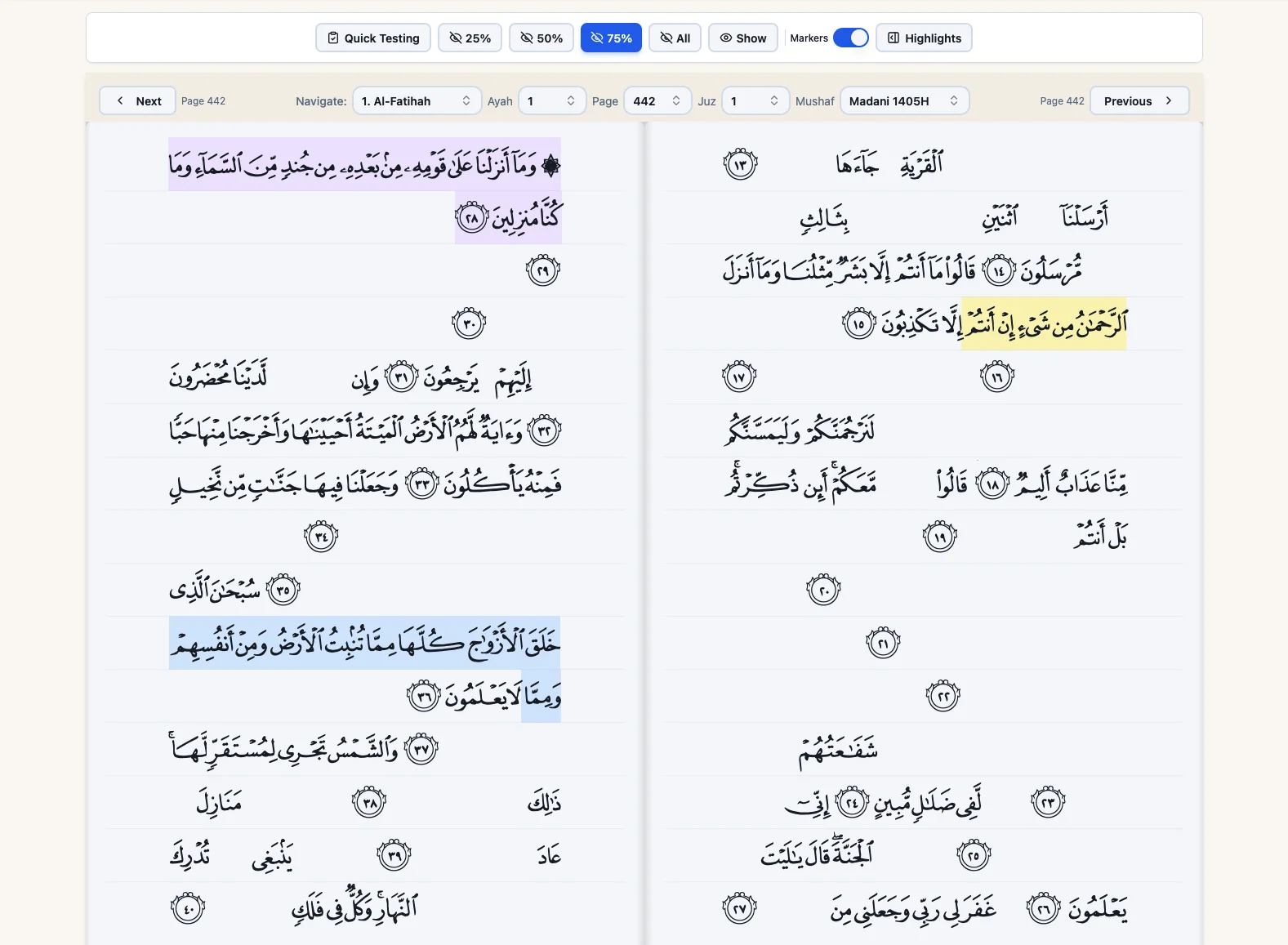

Surah Al-Mulk takes about a week to memorize if you learn five lines a day, and anywhere from 3 to 11 days depending on your pace. It’s 30 ayat on 33 lines of the 15-line Madani mushaf, so a page a day gets you there in three days and three lines a day in eleven.
| Lines a day | Days | Who it suits |
|---|---|---|
| 3 | 11 | Kids, or a first surah after a long break |
| 5 | 7 | Most adults with a job and a family |
| 7 | 5 | Steady learners who revise every day |
| 10 | 4 | People who already know the sound of it well |
| 15 (a page) | 3 | Full-time students and hifz classes |
The number that matters more is what happens near the end. Ayat 23 to 25 are nearly identical to ayat in other surahs, and if you already know Ya-Sin or Al-Mu’minun, that’s where you’ll lose time. More on that below.
At a glance
- Where it sits: the first surah of juz 29, pages 562 to 564.
- Length: 30 ayat on 33 lines. That’s 13 lines on page 562, a full page on 563 and 5 lines on 564.
- Time to recite: about 4½ minutes with Ash-Shuraym, 7½ with Alafasy, 11 with Al-Husary (full breakdown).
Which pace should you pick?
Pick the row in the table above that matches what you can hold on a normal day, not your best day. Those are new-memorization days only, counted in lines of the 15-line mushaf.
We’d pick five lines for most people. Al-Mulk’s ayat are short and many of them start with the same words, so a smaller daily piece gives you time to separate them before the next one arrives.
Tip: Add one review day for every week of new lines. At five lines a day that makes it eight days, and the eighth is the day you recite the whole surah from memory without looking.
How long does Al-Mulk take to recite?
About seven minutes at a steady pace, and anywhere from four and a half to eleven depending on the reciter. These are measured from full recordings of the surah:
- Saud Ash-Shuraym: 4.5 minutes
- Abdur-Rahman As-Sudais: 5.9 minutes
- Yasser Ad-Dossari: 6.4 minutes
- Muhammad Siddiq Al-Minshawi: 6.9 minutes
- Mishary Alafasy: 7.4 minutes
- Abdul Basit Abdus-Samad: 8.1 minutes
- Mahmoud Khalil Al-Husary: 11 minutes, or 10 in his teaching recording
That gap matters when you’re learning. Al-Husary’s teaching recording leaves a pause after each ayah so you can repeat after him. Alafasy sits in the middle: clear and steady without being slow. If you can follow one reciter all the way through, hearing the same voice each time helps you remember the words.
Read next: how long it takes to read every surah, timed the same way.
What does a seven-day plan look like?
Five lines a day, cut where the ayat end so you never stop mid-sentence:
- Day 1: ayat 1 to 5, the opening on page 562 (about six lines).
- Day 2: ayat 6 to 10, from the people of the Fire to “if only we had been listening”.
- Day 3: ayat 11 to 15. This crosses from page 562 onto 563, so practice the turn.
- Day 4: ayat 16 to 20, the “do you feel secure” ayat and the birds.
- Day 5: ayat 21 to 24. Slow down here; see the next section.
- Day 6: ayat 25 to 28, crossing onto page 564.
- Day 7: ayat 29 and 30, then the whole surah once from the start.
Read next: our section-by-section guide to Al-Mulk covers the repeated openings inside the surah, like the two “look again” ayat.
Which ayat slow people down?
Inside the surah, it’s the run of ayat that open with “qul” near the end. Outside it, three ayat have close twins elsewhere in the Quran, and those cost the most time for anyone who has memorized other surahs.
Ayat 23 and 24 have a matching pair in Al-Mu’minun
Al-Mu’minun 23:78 and 23:79 say almost the same two things, in the same order. The difference is the opening word: Al-Mulk says qul huwa (“Say, it is He”), Al-Mu’minun says wa huwa (“And it is He”).
قُلْ هُوَ الَّذِي ذَرَأَكُمْ فِي الْأَرْضِ وَإِلَيْهِ تُحْشَرُونَ
Say, “It is He who has multiplied you throughout the earth, and to Him you will be gathered.”
Al-Mulk 67:24, Saheeh International (quran.com)
وَهُوَ الَّذِي ذَرَأَكُمْ فِي الْأَرْضِ وَإِلَيْهِ تُحْشَرُونَ
And it is He who has multiplied you throughout the earth, and to Him you will be gathered.
Al-Mu’minun 23:79, Saheeh International (quran.com)
Ayah 23 has the same problem one step earlier. “And made for you hearing and vision and hearts; little are you grateful” closes 67:23, and almost the same words appear in 32:9 and 23:78. An-Nahl 16:78 shares the middle, hearing, vision and hearts, but ends differently: la’allakum tashkurun, “that perhaps you would be grateful”.
It helps to think of Al-Mulk as the surah of “qul”. From ayah 23 to the end, six of the eight ayat begin with it. If you catch yourself starting 67:24 with “wa huwa”, you’ve crossed into Al-Mu’minun.
Ayah 25 appears word for word in six surahs
“And they say, ‘When is this promise, if you should be truthful?’” is identical in Yunus (10:48), Al-Anbiya (21:38), An-Naml (27:71), Saba (34:29), Ya-Sin (36:48) and Al-Mulk (67:25). The ayah itself is easy. The trouble is what comes after it.
If you know Ya-Sin, your tongue will want to carry on with 36:49, “They do not await except one blast”. In Al-Mulk the next ayah is the answer to the question: “Say, ‘The knowledge is only with Allah, and I am only a clear warner’” (67:26).
Learn 67:25 and 67:26 as one unit, never apart. A question followed by its “qul” answer is the pattern of this whole closing section.
Can you memorize Al-Mulk in one day?
Some people can, especially if they’ve heard it recited every night for years. Thirty-three lines in a day is a lot of new material, though, and most people forget a lot of it without a plan for the next week. If you try it, recite the whole surah again the next morning, three days later and a week later. The first of those is the one people skip, and it’s the one that decides whether you still remember the surah a month later.
How do you know it’s really memorized?
Being able to recite it from the start is the first test. The harder one is starting from the middle: can you pick up at ayah 17, or say what comes after 67:25 without running through the ayat before it? That’s exactly what the Quran Memorizer test asks you to do, one random ayah at a time.