Everyone who memorizes the Quran forgets some of it. Huffaz who finished decades ago still have weak pages. The Prophet ﷺ himself was told by Allah: “We will make you recite, [O Muhammad], and you will not forget, except what Allah should will” (Saheeh International) (Al-A’la 87:6-7). Forgetting is part of being human.
So the aim is to make sure what you forget comes back quickly, and to stop small gaps from turning into lost juz. That comes down to a handful of habits, most of which are boring and all of which work.
Why we forget memorized Quran
The Prophet ﷺ described this directly. Someone who has memorized the Quran is like the owner of tied camels: if he keeps them tied he keeps them, and if he lets them go they run off (Sahih al-Bukhari 5031). He also told his companions to keep up their recitation, because the Quran escapes from people’s hearts faster than camels escape their ropes (Sahih al-Bukhari 5032).
Notice what the comparison implies. Camels don’t run off because the owner is weak or stupid. They run off because they weren’t checked. Memorized Quran is lost the same way, through neglect rather than some flaw in you.
Memory research says the same thing in different language. Without retrieval, we forget newly learned material fastest in the first days and weeks. Each time you successfully pull it back out of memory, you remember it for longer before it weakens again.
Habit 1: Never skip the review of recent lessons
The most fragile part of your hifz is whatever you learned in the last two or three weeks. It feels strong because it’s fresh, which is exactly why people neglect it, and then it goes quickly.
Recite your recent lessons every single day, before you start anything new. In many hifz schools this is called sabqi, and teachers treat it as non-negotiable. If you only have fifteen minutes on a busy day, spend them here instead of on a new lesson. Sabaq, Sabqi and Manzil Explained shows how to set it up.
Habit 2: Rotate through everything else
Older material needs less attention, but it still needs some. The usual approach is a fixed cycle: you revise a set amount every day, and over a week or two (or a month, if your hifz is large) you get through all of it.
A simple way to size it: if you have five juz memorized and want to revise everything every week, that’s about 15 pages a day. If that’s too much, stretch the cycle to two weeks. What matters is that nothing goes untouched for months. See How to Revise the Quran for schedules at different hifz sizes.
Free tool
Mark your pages strong, shaky or weak and get a daily revision cycle that brings the weak pages back more often. Open the manzil planner →
Habit 3: Recite from memory, not from the page
Reading a page you’ve memorized feels like revision, but it isn’t doing much. Your eyes are carrying you. The work that keeps memorization alive is recall: closing the mushaf and producing the words yourself.
Research backs this up strongly. In a well-known study, students who tested themselves on a passage remembered much more of it a week later than students who spent the same time rereading it (Roediger and Karpicke, 2006). The same principle applies to the Quran: recite first, then open the mushaf to check.
Habit 4: Space it out
Cramming a page twenty times in one sitting gets it into your head for today. Reciting it five times spread over a week is far more likely to stay with you. A large review of research on spaced practice found the same pattern across hundreds of experiments: spreading out the same amount of practice produces far better long-term memory than massing it together (Cepeda and colleagues, 2006).
In practice: recite a new lesson several times on the day you learn it, again the next morning, again a few days later, and then in your regular cycle. This happens naturally if you follow sabaq, sabqi and manzil.
Habit 5: Use it in salah
Reciting in prayer is the oldest revision method there is. The Prophet ﷺ would recite long portions at night, and Hudhayfah described him reciting Al-Baqarah, An-Nisa and Al Imran in a single rak’ah (Sahih Muslim 772).
Salah forces real recall because there’s no mushaf in front of you and nobody to prompt you. It also catches weak transitions very quickly. Try using your sunnah prayers for recent lessons and your night prayer, even two rak’at, for older juz.
Habit 6: Fix mistakes the day you find them
When you stumble on an ayah, don’t just glance at the mushaf and move on. Find out exactly what went wrong. Was it the first word? A join between two ayat? A similar phrase from a different surah? Then fix that specific point: recite the two ayat around the join five times, or compare the similar passages side by side.
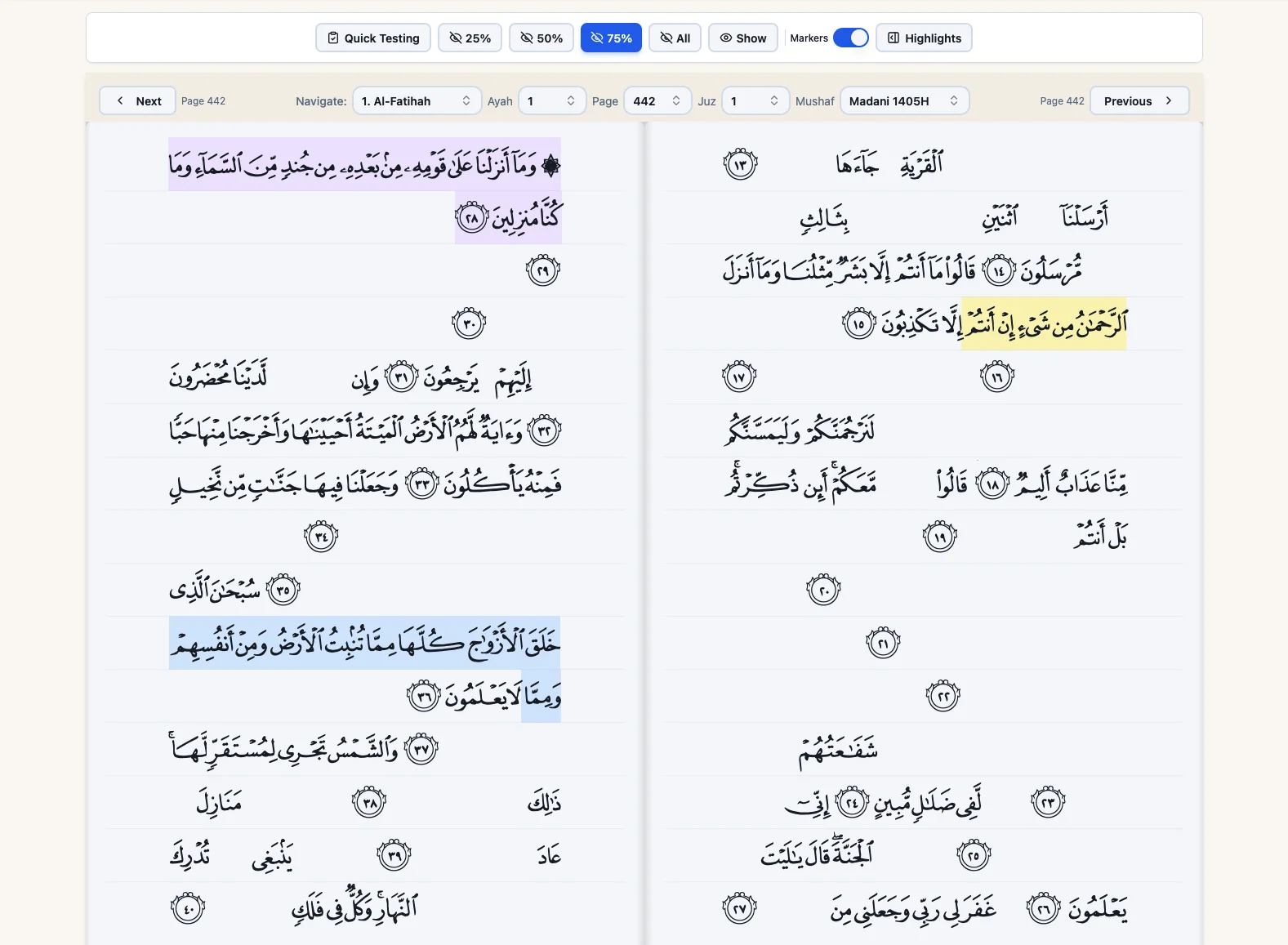
Mark the spot in your mushaf with a light pencil dot, or use highlights in an app, so you can see your weak points at a glance. Memorizing Similar Verses Without Mixing Them Up goes into the hardest category of mistakes in detail.
Habit 7: Sleep
Memory is consolidated during sleep. A major review of the research describes how sleep after learning strengthens new memories and helps fit them into what you already know (Diekelmann and Born, 2010). This is one reason many teachers recommend memorizing a new lesson and then reviewing it the next morning.
Pulling late nights to squeeze in more Quran tends to backfire. A rested mind memorizes faster and holds on longer.
Shaykh Abdur-Rahman Mangera builds this into the daily lesson: repeat the new portion 10 to 15 times in the evening, sleep on it, then revise it before or after Fajr (Zamzam Academy).
What the Sunnah says about the word “forgot”
There’s a small adab here worth knowing. The Prophet ﷺ disliked people saying “I forgot such and such ayah” and told them to say instead that they had been made to forget it (Sahih al-Bukhari 5032, Sahih Muslim 790). The scholars explained this as a reminder that forgetting comes from Allah’s decree and from our neglect, and isn’t something to announce casually.
You may also come across a narration in Sunan Abi Dawud saying that anyone who learns the Quran and forgets it will meet Allah in a maimed state. Its chain is graded weak (Sunan Abi Dawud 1474), so don’t let it frighten you into giving up. The authentic narrations already make the point: keep reviewing.
If you’ve already forgotten a lot
If you’re reading this because juz you memorized years ago are now patchy, start small. Pick the juz you remember best, get it back to fluent, and then move to the next. Relearning is much faster than learning from scratch. How to Re-memorize the Quran After Forgetting It lays out a full plan.
Make the system do the remembering
The biggest threat to your hifz is losing track of what needs review. When you have fifteen juz, it’s easy to keep revising the ones you like and drift away from the ones that are hard.
That’s the problem the Quran Memorizer daily review was built for. It brings back recent lessons every day, rotates through the rest of your hifz a portion at a time, and asks more questions about the spots where you keep getting things wrong. An app, a notebook or a wall chart all work. What matters is having something outside your head keeping track.
More guides: Is it a sin to forget the Quran you memorized? · Reading the mushaf vs reciting from memory