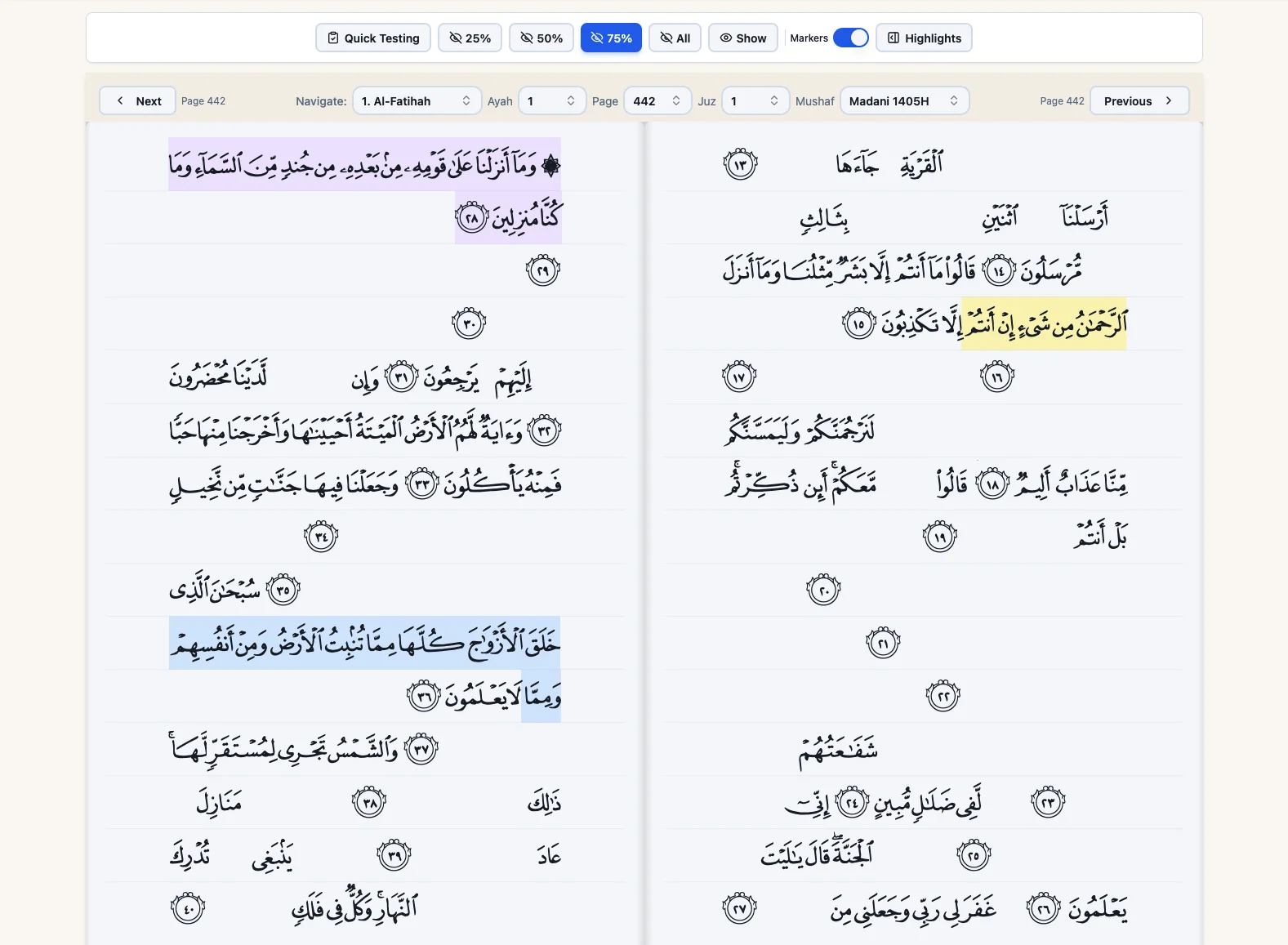
About 17 days, if you learn five lines a day. Surah Ya-Sin, also spelled Yasin or Yaseen, is 83 ayat on 84 lines of the 15-line Madani mushaf, and five lines a day covers that in 17 lessons.
Add a review day after every six lessons, plus one at the end, and that becomes 20 days. Seven lines a day, about half a page, comes to exactly two weeks.
The days that run long are the ones holding ayat that turn up, word for word or nearly, in other surahs. If you already know Al-Mulk, ayah 48 is the one to watch, because it’s 67:25 word for word. Ayah 46 does the same with Al-An’am 6:4.
At a glance
- Where it sits: pages 440 to 445. Ayat 1 to 27 are in juz 22, and juz 23 begins at ayah 28, the first line of page 442.
- Length: 83 ayat (verses) on 84 lines, or 5.6 pages. That’s 10 lines on page 440, four full pages, then 14 lines on page 445.
- Time to recite: about 10 minutes with Ash-Shuraym, 17½ with Alafasy, 26 with Al-Husary’s teaching recording (full breakdown).
- Time to memorize: 17 days at 5 lines a day, 12 at 7 lines (about half a page), 6 at a page a day.
How many days at your pace?
Divide 84 by the number of lines you can learn well on an ordinary day, then round up. Base it on a normal Tuesday, with work and family in it. That’s your count of new lessons. The last column adds a review day after every six lessons, plus one at the end, the same pattern as the two-week plan below.
| Lines a day | New-lesson days | With review days |
|---|---|---|
| 3 | 28 | 33 |
| 5 | 17 | 20 |
| 7 (about half a page) | 12 | 14 |
| 10 | 9 | 11 |
| 15 (a page) | 6 | 7 |
We’d pick five lines for most people taking on Ya-Sin as their first long surah. Its ayat are short, and 55 of the 83 end in -un when you stop on them, so neighbors sound alike and trade places when you learn too many at once. Five lines is about five ayat, few enough that you can hear where each one ends before you add tomorrow’s lesson.
Seven lines is realistic if you’ve heard Ya-Sin recited for years, and plenty of people have. You’re mostly fixing words to a recitation you can already hear in your head, and the two-week plan below is written for that reader. Ten lines or a full page suits full-time students and hifz classes.
Three lines a day suits children and anyone coming back after a long break: 28 days of lessons, just over a month with review days.
You may have heard that Ya-Sin takes two to four months at three to five new lines a day. The arithmetic doesn’t back that up. Three to five lines a day is 17 to 28 days of new lessons, and even doubling that for review gets you to five to eight weeks. Taking two months is fine if that’s what your weeks allow. Four months, though, is more than double what three to five lines a day adds up to.
At a page a day, the six lessons are exactly the six pages. Every page of Ya-Sin opens with a fresh ayah (36:13, 36:28, 36:41, 36:55 and 36:71 start pages 441 to 445), so a page-a-day lesson never stops halfway through one.
Comparing Ya-Sin with other surahs? Our table of how long each surah takes runs the same arithmetic for 20 popular surahs at three paces, and it has Ya-Sin at the same 84 lines and 17 days.
Free tool
Pick Ya-Sin and a lines-a-day pace, and the hifz plan generator puts every lesson on a date. It splits by lines, so finish each lesson at the nearest ayah end. Open the hifz plan generator →
How long does Ya-Sin take to recite?
About 17½ minutes to read aloud at a steady pace. Ash-Shuraym, the fastest full recording we timed, finishes in a little over 10, and Al-Husary’s teaching recording takes 26:
| Reciter | Time (min:sec) |
|---|---|
| Saud Ash-Shuraym | 10:14 |
| Abdur-Rahman As-Sudais | 12:30 |
| Abdul Basit Abdus-Samad | 14:27 |
| Yasser Ad-Dossari | 15:15 |
| Muhammad Siddiq Al-Minshawi | 15:52 |
| Mishary Alafasy | 17:36 |
| Mahmoud Khalil Al-Husary | 23:47 |
| Al-Husary, teaching recording | 26:22 |
Al-Husary’s teaching recording is the longest because it’s made for repeating. He leaves about six seconds after each ayah so you can say it back, and those gaps add up to roughly 7½ of its 26 minutes. Alafasy pauses for about a sixth of a second. Learn new lessons with the teaching recording, and time your day with a regular one.
How many minutes a day is that?
Alafasy’s pace works out to about three minutes a page, so a five-line lesson is roughly a minute of audio (47 to 72 seconds, depending on where it’s cut). Listen to it five times, then recite it from memory until you’ve had ten clean runs, and the new lines take roughly 15 to 20 minutes. Some ayat will need more runs than that.
The part that grows is the run-through before each lesson. Reciting from 36:1 takes Alafasy about 2 minutes to the end of page 440, 5½ to ayah 27, 11½ to ayah 54 and nearly 17 to ayah 80, and your own pace from memory will often be slower. Plan for a day closer to 35 minutes by the last week, so it doesn’t surprise you.
Read next: how long it takes to read each surah, measured the same way from full recordings.
What does a two-week plan look like?
Seven lines a day for 12 lessons, cut where ayat end. Days 7 and 14 are review days, so the table skips them. The last column is how long Alafasy takes to recite that day’s new ayat, which tells you more about the load than an ayah count. Day 1 has ten ayat and day 2 has six, yet day 1 is the shorter listen. Every lesson sits between 1:17 and 1:45.
| Day | New ayat | Page | Audio (Alafasy) |
|---|---|---|---|
| 1 | 1 to 10 | 440 | 1:35 |
| 2 | 11 to 16 | 440 to 441 | 1:41 |
| 3 | 17 to 22 | 441 | 1:18 |
| 4 | 23 to 30 | 441 to 442 | 1:45 |
| 5 | 31 to 36 | 442 | 1:17 |
| 6 | 37 to 43 | 442 to 443 | 1:22 |
| 8 | 44 to 49 | 443 | 1:26 |
| 9 | 50 to 55 | 443 to 444 | 1:21 |
| 10 | 56 to 64 | 444 | 1:35 |
| 11 | 65 to 70 | 444 | 1:22 |
| 12 | 71 to 77 | 445 | 1:24 |
| 13 | 78 to 83 | 445 | 1:29 |
On day 7, recite ayat 1 to 43 from memory, about 9 minutes at Alafasy’s pace. On day 14, recite the whole surah once without stopping, to someone following in the mushaf if you can, and jot down every ayah where you hesitated.
- Four lessons cross a page: days 2, 4, 6 and 9. Practice the join itself, the last ayah of one page and the first of the next, said together until they feel like one sentence.
- Day 4 also crosses into juz 23 at ayah 28, the top line of page 442. It’s a natural place to start a recitation, so make that line solid.
- Expect day 8 to be slow. Ayat 46 and 48 both have exact twins in other surahs (see the next section), so it takes longer than its 1:26 of audio suggests.
- The last lesson holds three ayat with close relatives elsewhere: 81, 82 and 83. Don’t save day 13 for a rushed morning.
On the five-line plan we’d pick for most people, Ya-Sin divides just as neatly: 17 lessons, two on page 440 and then exactly three per page, so every third lesson finishes at the bottom of a page. The lessons start at ayat 1, 9, 13, 18, 22, 28, 33, 37, 41, 47, 51, 55, 61, 67, 71, 76 and 81, and each one is about a minute of Alafasy.
Prefer to split it by meaning instead of by lines? Our section-by-section guide to Ya-Sin divides it into six sections and covers the repeats inside the surah, from the three wa ayatun lahum ayat to the man who came running.
Which ayat slow people down?
The repeats inside Ya-Sin, the three wa ayatun lahum ayat and the three built on sayhatan wahidatan (one blast), are taken apart in the guide linked above. This part is about Ya-Sin’s mutashabihat, the ayat with near-identical twins in other surahs. They’re slower because your tongue met the other version first.
Which of them will cost you time depends on what you already know. If Ya-Sin is your first long surah, two matter now: ayah 48, if you know Al-Mulk, and ayah 10, if you know the opening of Al-Baqarah. The rest start to matter once you’ve memorized a few juz.
Ayah 48 appears word for word in six surahs
وَيَقُولُونَ مَتَىٰ هَـٰذَا ٱلْوَعْدُ إِن كُنتُمْ صَـٰدِقِينَ
And they say, “When is this promise, if you should be truthful?”
Ya-Sin 36:48, Saheeh International translation. Compare translations on quran.com
The same seven words appear in Yunus 10:48, Al-Anbiya 21:38, An-Naml 27:71, Saba 34:29 and Al-Mulk 67:25. You’ll have the ayah itself in a minute. The work is in what comes next, and that changes from surah to surah.
In four of those five surahs, the next ayah opens with qul (Say). In Al-Anbiya it opens with law ya’lamu. Only in Ya-Sin does the reply arrive as the blast: ma yanzuruna illa sayhatan wahidatan, “They do not await except one blast” (36:49, Saheeh International).
The closest twin is Saba 34:29 on page 431, nine pages before Ya-Sin. Saba is in juz 22 and 36:48 is on page 443, early in juz 23, so if you memorize juz 22 and 23 in order you’ll meet this ayah twice within a dozen pages.
Our Al-Mulk timing guide warns anyone who knows Ya-Sin that 67:25 will pull them into 36:49. The pull runs both ways. If Al-Mulk is solid, your tongue will reach for qul innama al-‘ilmu ‘inda Allah right after 36:48.
Tip: Practice 36:48 and 36:49 as a pair, so the question never sits on its own in your memory. In Ya-Sin, “when?” is followed straight away by the blast.
Ayah 46 matches Al-An’am 6:4 word for word
وَمَا تَأْتِيهِم مِّنْ ءَايَةٍ مِّنْ ءَايَـٰتِ رَبِّهِمْ إِلَّا كَانُوا۟ عَنْهَا مُعْرِضِينَ
And no sign comes to them from the signs of their Lord except that they are from it turning away.
Ya-Sin 36:46, Saheeh International translation. Compare translations on quran.com
All 11 words match Al-An’am 6:4. Saheeh International words the ending differently there (“they turn away therefrom”), but the Arabic is identical. What comes next splits them: Ya-Sin continues with wa idha qila lahum anfiqu, the call to spend (36:47), and Al-An’am with fa-qad kadhdhabu bil-haqq (6:5).
Ya-Sin gives you its own clue here. Ayah 46 sits between two ayat that both open wa idha qila lahum: 36:45 tells them to beware, and 36:47 tells them to spend. So after 46 you go straight back to the words you said just before it.
All three ayat sit on lines 3 to 8 of page 443. Picture them as one block, with 46 as the short line in the middle.
Ayah 11 ends in karim, its Al-Mulk relative in kabir
إِنَّمَا تُنذِرُ مَنِ ٱتَّبَعَ ٱلذِّكْرَ وَخَشِىَ ٱلرَّحْمَـٰنَ بِٱلْغَيْبِ ۖ فَبَشِّرْهُ بِمَغْفِرَةٍ وَأَجْرٍ كَرِيمٍ
You can only warn one who follows the message and fears the Most Merciful unseen. So give him good tidings of forgiveness and noble reward.
Ya-Sin 36:11, Saheeh International translation. Compare translations on quran.com
إِنَّ ٱلَّذِينَ يَخْشَوْنَ رَبَّهُم بِٱلْغَيْبِ لَهُم مَّغْفِرَةٌ وَأَجْرٌ كَبِيرٌ
Indeed, those who fear their Lord unseen will have forgiveness and great reward.
Al-Mulk 67:12, Saheeh International translation. Compare translations on quran.com
Only one word matches exactly, bil-ghayb (unseen), yet the shape is the same: fearing unseen, then forgiveness and a reward. That shape is what mixes them. Fatir 35:18, four pages before Ya-Sin, adds a third version that shares Ya-Sin’s innama tundhiru and then says alladhina yakhshawna rabbahum.
Two details sort it out. Ya-Sin names ar-Rahman (the Most Merciful) where the other two have rabbahum (their Lord), and this is the first of four times ar-Rahman appears in Ya-Sin (36:11, 15, 23 and 52). The second is the last word. Ya-Sin closes on karim and Al-Mulk on kabir, two words close enough in sound to swap without noticing. If you learned Al-Mulk first, kabir is the word that will come out on autopilot.
Ayah 82: “Be, and it is,” the version with amruhu
إِنَّمَآ أَمْرُهُۥٓ إِذَآ أَرَادَ شَيْـًٔا أَن يَقُولَ لَهُۥ كُن فَيَكُونُ
His command is only when He intends a thing that He says to it, “Be,” and it is.
Ya-Sin 36:82, Saheeh International translation. Compare translations on quran.com
إِنَّمَا قَوْلُنَا لِشَىْءٍ إِذَآ أَرَدْنَـٰهُ أَن نَّقُولَ لَهُۥ كُن فَيَكُونُ
Indeed, Our word to a thing when We intend it is but that We say to it, “Be,” and it is.
An-Nahl 16:40, Saheeh International translation. Compare translations on quran.com
The closing words kun fa-yakun belong to a whole family of ayat. Four of them say idha qada amran fa-innama yaqulu lahu kun fa-yakun: Al-Baqarah 2:117, Ali ‘Imran 3:47, Maryam 19:35 and Ghafir 40:68. An-Nahl 16:40 uses the majestic plural, “We”: qawluna, aradnahu, naqula.
Of those six, only Ya-Sin’s opens innama amruhu (His command is only). Hold on to amruhu and the rest follows.
Day 13 holds this ayah’s neighbors too, and both have relatives. 36:81 asks a-wa laysa alladhi khalaqa as-samawati wal-ard and answers itself at once: bala wa huwa al-khallaqu al-‘alim. Al-Isra 17:99 asks nearly the same thing, with a-wa lam yaraw anna Allaha and qadirun in place of bi-qadirin, then moves on without a bala.
The last ayah, 36:83, shares bi-yadihi malakutu kulli shay’ with Al-Mu’minun 23:88. There it’s a question, qul man. Ya-Sin uses the same words to glorify Allah in its final ayah: fa-subhana alladhi.
Five more look-alikes, briefly
- 36:10 and Al-Baqarah 2:6 share the same eight words, sawa’un ‘alayhim a-andhartahum am lam tundhirhum la yu’minun. Ya-Sin opens with wa sawa’un, Al-Baqarah with inna alladhina kafaru. If you learned 2:6 on page 3 of the mushaf years ago, expect it to step in.
- 36:74 opens with the same five words as Maryam 19:81, wa-ttakhadhu min duni Allahi alihatan. Ya-Sin’s version is about help: it ends la’allahum yunsarun, and 36:75 carries on with la yastati’una nasrahum. Maryam’s is about honor, li-yakunu lahum ‘izza.
- 36:40 ends wa kullun fi falakin yasbahun, and Al-Anbiya 21:33 has the same ending without the wa. In Ya-Sin it also closes page 442, so it’s a page turn and a twin at once.
- In 36:65 the mouths are sealed, so tongues have no part in it: hands speak and feet testify, and the ayah ends yaksibun. An-Nur 24:24 is the one with tongues, alongside hands and feet, and it ends ya’malun.
- 36:30 comes right after the people of the town are extinguished in 36:29, and it opens with a lament, ya hasratan ‘ala al-‘ibad, before ma ya’tihim min rasulin. Al-Hijr 15:11 starts plainly with wa ma. Az-Zukhruf 43:7 is the one with nabiyyin.
Can you memorize Ya-Sin quickly, even in one day?
Quickly, yes. A page a day is the fast end of a normal pace: six days of new lessons, seven with a review day.
In one day, some people can, usually people who’ve heard it recited for years and already carry most of the sound. For most learners, 84 lines in a day is heavy going. It’s 5.6 pages, more than five times that fast daily pace.
If you want to try, split the day into six sittings, one page each. A page runs 2:12 to 3:20 of Alafasy, so the listening won’t be what stops you.
Plan the follow-up before you start. If you learn it on a Saturday, recite all 84 lines from memory on Sunday morning, again on Tuesday, and once more the following Saturday. Sunday morning matters most. It shows you what you still remember the next morning while the gaps are still small enough to fill in a few minutes.
And if it takes you three weeks instead of a day, nothing is lost. The Prophet ﷺ said that the one who falters in the Quran and finds it hard “will have two rewards” (Sahih Muslim 798a).
How do you know it’s really memorized?
Start with the whole surah, 36:1 to 36:83, without the mushaf. At Alafasy’s pace that’s about 17½ minutes. Time yourself once and note every ayah where the clock kept running while you searched for a word. The harder tests start in the middle, where nothing runs you up to the ayah:
- Start cold at the top of each page: 36:13, 36:28, 36:41, 36:55 and 36:71. Picture the page first, then begin.
- Say what comes after 36:46, 36:48 and 36:81 without reciting the ayah before them. You’re listening for wa idha qila lahum anfiqu, ma yanzuruna illa sayhatan and innama amruhu.
- Go backwards. What comes before 36:41? (The end of page 442, wa kullun fi falakin yasbahun.) And before 36:55?
- Recite the repeats in order without a pause: the three wa ayatun lahum ayat (33, 37 and 41), then the three blast endings, khamidun, yakhissimun and muhdarun (29, 49 and 53).
- Leave Ya-Sin alone for a week, then recite it. Whatever wobbles is where your review time should go.
The week away matters most. The Prophet ﷺ said to stay committed to the Quran, because it breaks away faster than a camel from its tether (Sahih al-Bukhari 5033). Seven days without Ya-Sin shows you exactly which ayat need more revision.
Read next: why you can recite a surah from the start but not from a random ayah, with a short spot-test routine.
Revising Ya-Sin
Once the last lesson is done, Ya-Sin moves from new lessons into revision. For the first month, recite the whole surah from memory once a week. At around 17½ minutes it fits in one sitting, or split it at ayah 28, where juz 23 begins, and do each half on a different day.
Between those full recitations, test it with no run-up. The Quran Memorizer test gives you an ayah from the scope you pick and asks for the one before or after it. Set it to Ya-Sin and see whether 36:48 leads you to the blast or to a qul. It’s free to start and works in any browser, Android phones included.
For today, that’s ayat 1 to 8 on the five-line plan, about a minute of Alafasy, or 1 to 10 if you’re following the two-week plan. Say them from memory tomorrow before you add the next lesson.