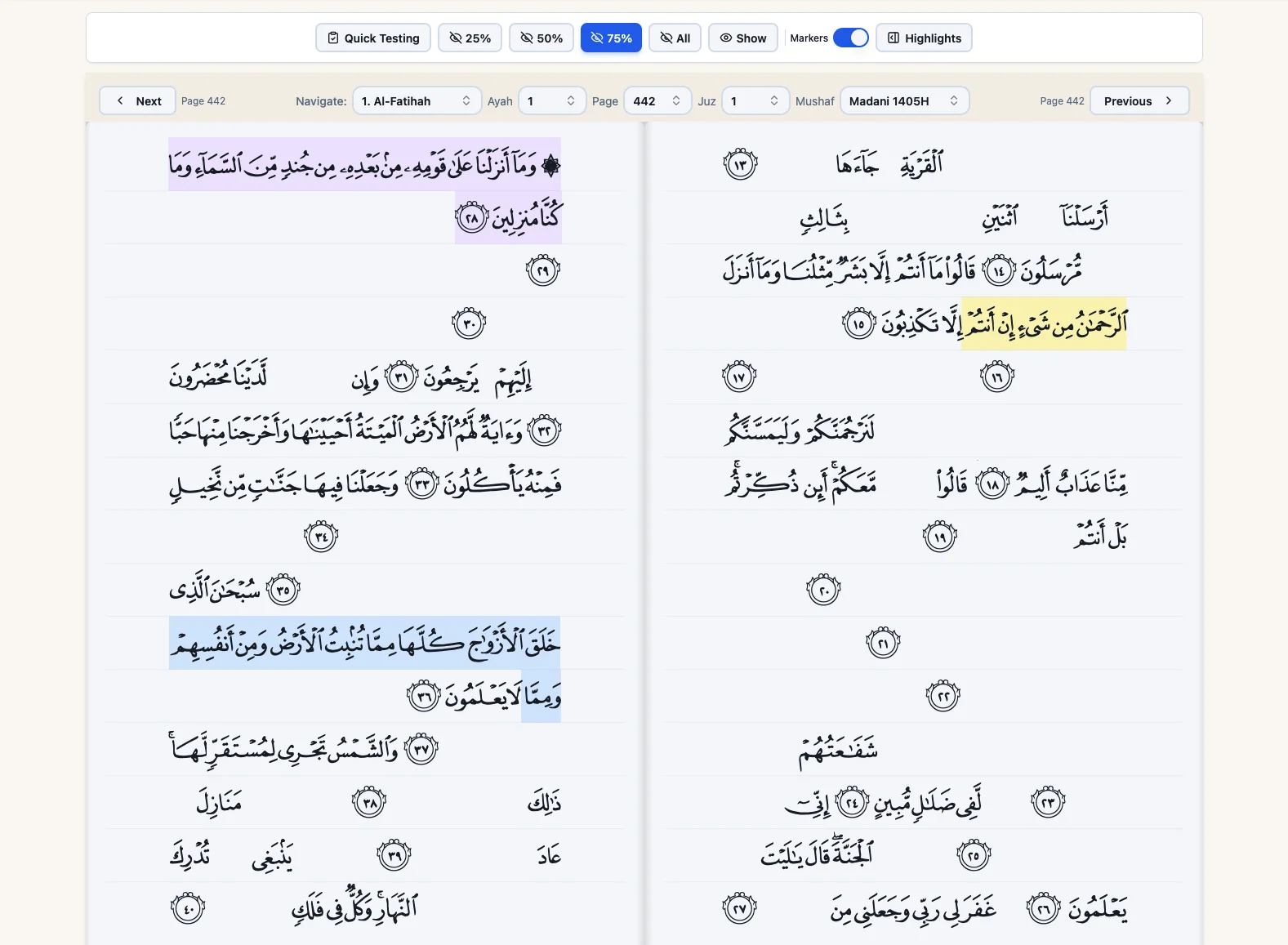
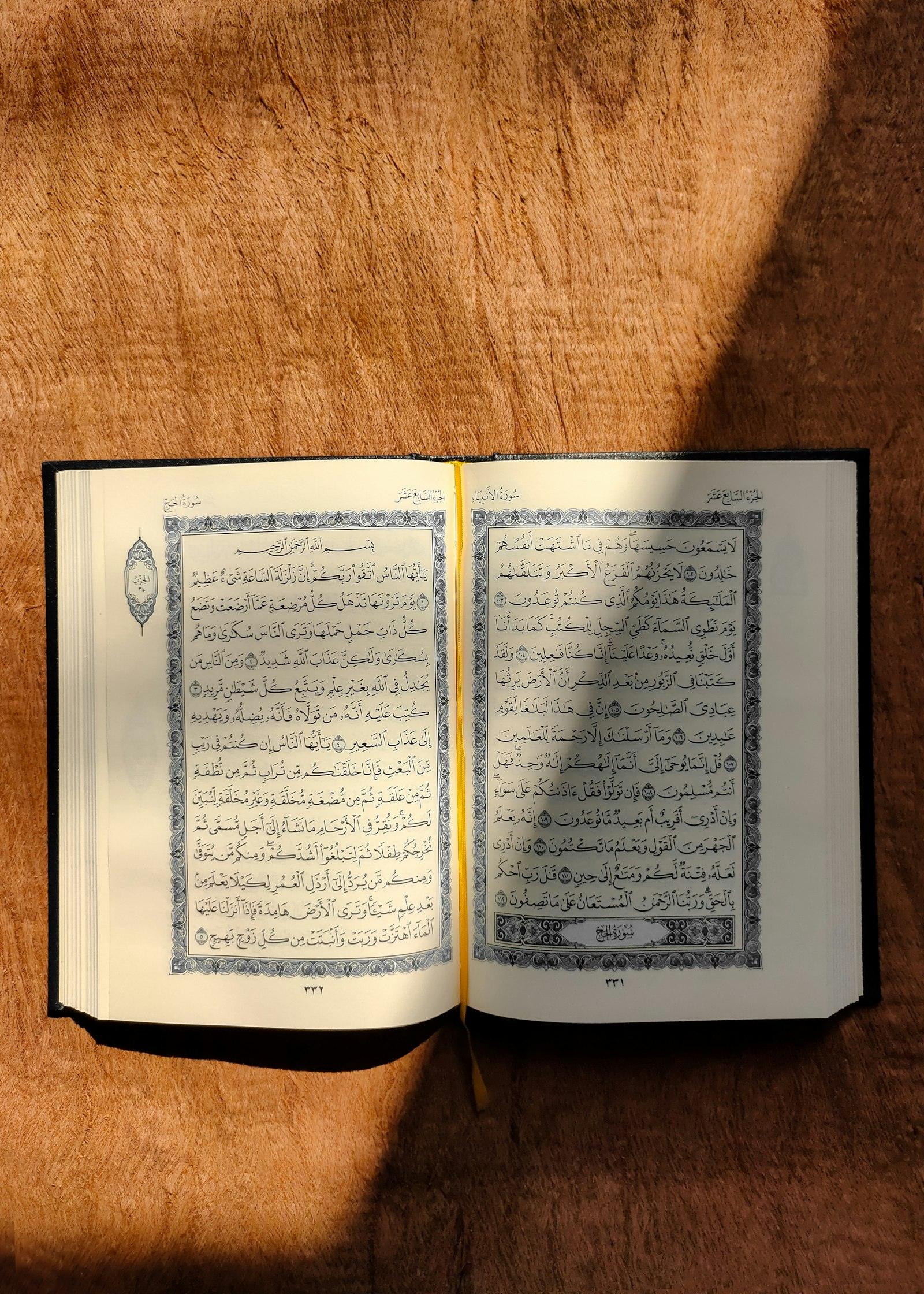
A page a day is the classic hifz pace. At that rate you’d finish the Quran in about 20 months without breaks, or two and a half years with normal life in the way. It’s a big daily lesson for a beginner and a comfortable one for someone experienced.
Here are the mechanics: how to actually get one page of the Madani mushaf into your memory in a single session, and what to do over the next few days so you still remember it.
Why the page is a good unit
In the 15-line Madani mushaf, every page ends at the end of an ayah, and most juz are exactly 20 pages. That makes the page a natural chunk. It also means your visual memory can work for you: when you recite, you can picture the page, the position of each ayah, and where the lines break.
If you memorize from a different print, the same method works. Just be consistent. See Why You Should Memorize From One Mushaf.
Before you start: look at the page
Spend two minutes studying the page before you try to memorize anything. Notice:
- How many ayat are on it, and which are long or short.
- Where each ayah begins: which line, which side.
- Any phrases that repeat on the page or that you know from elsewhere.
- Natural sections: a change of subject, a story starting, a surah heading.
This gives you a map. You’ll memorize faster when you know where you’re going.
A one-hour session, step by step
This assumes you read fluently. If you don’t, expect it to take longer, and consider a smaller lesson for now.
1. Listen (5 minutes)
Play the page from your chosen reciter twice while following with your finger. Don’t try to memorize yet. Just get the sound and rhythm. Memorizing the Quran by Listening has tips on choosing a reciter.
2. Read the whole page (10 minutes)
Read it aloud slowly, start to finish, five to ten times. Pay attention to how each ayah begins and ends, because that’s where most mistakes happen later.
3. Memorize in chunks (30 minutes)
Split the page into three or four chunks of three to five lines each, ideally at natural breaks between ayat.
For each chunk:
- Take the first ayah (or the first line, if the ayah is long). Read it three times, then recite it with your eyes closed. Repeat until you can say it without looking.
- Do the same with the next ayah.
- Recite both together, three times.
- Keep adding one ayah at a time, always reciting from the start of the chunk.
When you finish a chunk, recite it as a whole three times from memory before moving to the next.
4. Join the chunks (10 minutes)
Recite chunk 1 and 2 together. Then 1 to 3. Then the whole page. The joins between chunks are weak points, so give them extra repetitions.
5. Recite the full page from memory (5 minutes)
Recite the whole page without looking, three times. If you stumble, check the mushaf, fix that spot, and start the page again.
Later the same day
Recite the page again a few hours later, and again before you sleep. Using it in salah is ideal: the sunnah prayers before Dhuhr, or your night prayer. It’s a real test, because there’s nothing to glance at.
The next morning
Before you start a new page, recite yesterday’s from memory. This is the most important step of all. Sleep helps you remember what you learned, and the morning check shows you which bits you’ve already forgotten. Fix those before you add anything new.
The next two weeks
A new page should be recited every day for at least a week or two, alongside the pages before it. This is called sabqi in many hifz circles. After that it moves into your regular rotation. Sabaq, Sabqi and Manzil Explained shows how to set that up.
When a page won’t go in
Some pages are harder. Lists of names, passages similar to others you’ve memorized, or long ayat with unfamiliar words can all slow you down. If you’re past 90 minutes and the page still isn’t solid:
- Stop for the day. Recite what you have, then come back after sleep.
- Split the remaining part into smaller chunks.
- Look up the meaning. Understanding what the passage says often makes the order of ayat easier to remember. See Should You Learn the Meaning While Memorizing?
- If the difficulty is a phrase that appears elsewhere, compare the two side by side. Memorizing Similar Verses explains how.
It’s fine for one page to take two days. The Prophet ﷺ said the one who struggles with the Quran gets a double reward (Sahih al-Bukhari 4937).
Is a page a day right for you?
A page a day works well if:
- Your reading is fluent.
- You have 60 to 90 minutes for the new lesson, plus time for revision.
- Last week’s pages are still coming back cleanly.
If any of those isn’t true, half a page is a better daily lesson. You’ll still finish the Quran, just over a longer stretch, and your hifz will be stronger for it. How Much Quran Should You Memorize Each Day? helps you choose.
Very few people start at a page a day. Sister Julie, a convert who memorized the Quran while working part-time, told MuslimMatters that she began with half a page in the morning and half in the afternoon, rose to two pages a day, and reached four near the end. She called her teacher to recite after every page.
Free tool
Compare a page a day with a smaller lesson: choose your daily lines and study days and see the finish date and exact pages for each. Open the hifz plan generator →
Revising the older pages
At a page a day you’re adding about a juz every three weeks. That’s fast enough that you can start forgetting older pages without noticing. The Quran Memorizer app can hide parts of each page so you test recall instead of rereading, and its daily review keeps cycling back to older pages, with more questions on the ones you keep missing.