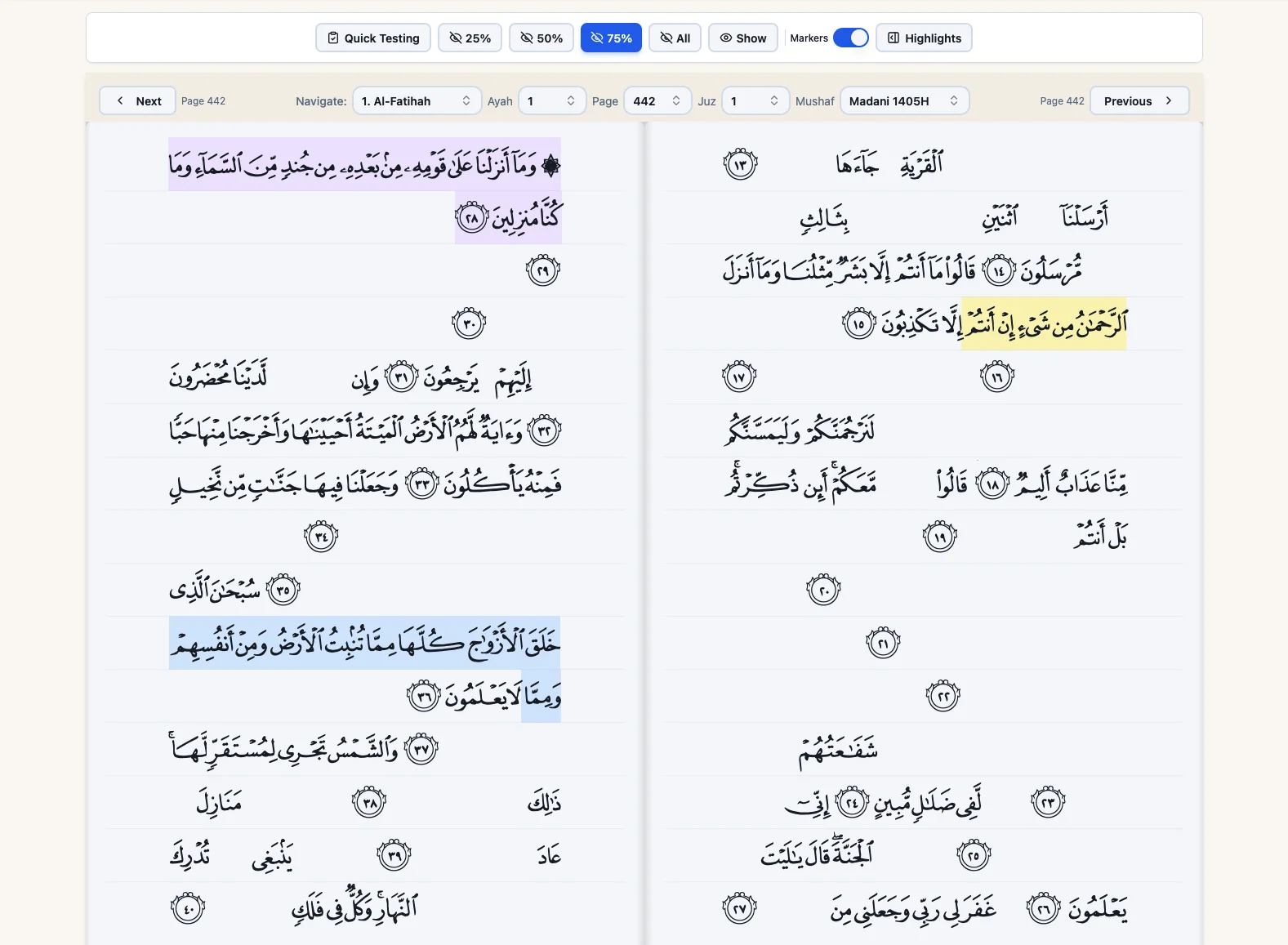
Memorizing the whole Quran in a year is possible. People do it every year, mostly in full-time programs. But it asks for more than most people expect, and the plan has to account for revision from the first week, or the year ends with 30 juz memorized and 20 of them shaky.
Here’s what a one-year hifz involves, who it suits, and a plan you can adapt. If the numbers don’t fit your life, there’s a section at the end on two-year and three-year versions.
The math
The Madani mushaf has 604 pages. If you take one day a week off new memorization for revision, and allow two weeks for illness or travel, you have about 300 memorization days in a year.
604 pages divided by 300 days is just over two pages a day.
Two pages a day is a lot. For most people it means two to three hours of new memorization and another two to three hours of revision, every day, for a year. That’s why one-year hifz is usually done full time.
Who it suits
A one-year plan tends to work for people who:
- Read the mushaf fluently and have decent tajweed already.
- Have most of the day free: a gap year, a sabbatical, time between school and university, or retirement.
- Have a teacher who can hear them every day.
- Have memorized before, even a few juz, so they know how they learn.
It’s a poor fit if you’re still learning to read, working full time, or caring for small children. That doesn’t mean you can’t become a hafiz. It means a longer plan will get you there with your hifz in better shape.
A one-year schedule
This is a typical day in an intensive program, adapted for someone studying at home with a teacher:
| Time | Task |
|---|---|
| After Fajr (2 hours) | New lesson: two pages. Listen, read, memorize, join. |
| Morning (1 hour) | Recite the new lesson to your teacher. |
| Midday (1 hour) | Sabqi: the last 20 pages, every day. |
| Afternoon (1.5 hours) | Manzil: older juz in rotation. |
| Evening (30 minutes) | Listen to tomorrow’s lesson. Recite today’s in salah. |
That’s about six hours, with breaks for prayer, meals and rest. Some programs go longer. Very few successful ones go much shorter.
One day a week has no new lesson. Use it to recite a larger chunk of older material, ideally to your teacher.
Free tool
See what a year looks like at your real pace. Choose your daily lines and study days and get a dated plan with exact pages and revision. Open the hifz plan generator →
Planning by month
Thinking in months makes it easier to see whether you’re on track:
- Months 1 to 3: Juz 30 to 23, about 2.5 juz a month. Revision is light, so this is the time to build momentum.
- Months 4 to 6: Juz 22 to 15. Revision is growing. You might drop to 1.5 pages on some days.
- Months 7 to 9: Juz 14 to 7. This is where most people struggle. Your manzil is now 20 juz or more.
- Months 10 to 12: Juz 6 to 1, plus a full revision of everything.
You don’t have to start from the end. Many programs go from Al-Baqarah forward. Starting from juz 30 front-loads the shorter surahs, which helps early motivation.
Revision is where one-year plans fail
The pages aren’t the hard part. The hard part is that by month eight you have twenty juz to revise while still adding two pages a day.
The Prophet ﷺ advised Abdullah ibn ‘Amr, who was finishing the Quran every night, to complete it once a month instead, and when he insisted he could do more, allowed him seven days (Sahih al-Bukhari 5052). The same narration records that Abdullah used to recite a seventh of the Quran during the day to his family, checking his memorization so the night recitation would be easier. That’s a seventh of the Quran every day, recited to someone. Few huffaz revise that much today, but it shows the scale of revision a full hafiz has to plan for.
Practical rules that keep a fast plan safe:
- Sabqi is never skipped. The last 20 pages, every day, from memory.
- Manzil cycles through everything at least every two weeks. As your hifz grows, that means more pages a day.
- If more than a third of your manzil needs the mushaf, pause new lessons for a few days and repair.
Sabaq, Sabqi and Manzil Explained goes through how to divide this time.
Keep the Quran’s pace in mind
Speed isn’t a virtue by itself. Allah describes reciting the Quran in measured, deliberate tartil (Al-Muzzammil 73:4), and the Quran itself was revealed in parts over years. A one-year plan is fine if it lets you recite properly and remember what you’ve learned. If it starts to mean mumbling through pages to hit a number, slow down.
Two-year and three-year versions
If six hours a day isn’t realistic, these are far more common and still ambitious:
| Plan | New lesson | Daily time |
|---|---|---|
| Two years | One page, 6 days a week | 2.5 to 3.5 hours |
| Three years | Two-thirds of a page, 6 days a week | 1.5 to 2.5 hours |
| Five years | Half a page, 5 days a week | About 1 hour |
All of these get you to the same place. How Long Does It Take to Memorize the Quran? has more detail on picking a pace.
Tracking a fast plan
With two pages a day, you can’t afford to lose track. Keep a log of every lesson, mark weak pages, and know at any moment which juz haven’t been revised for longest.
The Quran Memorizer daily review does this for you: it brings back your recent lessons every day, works through the rest in rotation, and pushes more questions toward the pages you keep getting wrong. On a plan this intense, that tracking helps make sure the year ends with 30 strong juz rather than a long repair job.