
If you’re starting hifz as an adult, you’ve probably heard that it’s easier for children. In some ways it is. Children have more free time and fewer responsibilities, and many of them memorize quickly by ear.
But adults have real advantages too. You choose to do this, so you’re less likely to quit when it gets boring. You can plan your own revision. You often understand more of what you’re reciting. And you know your own schedule well enough to build something that fits it. Plenty of people start in their thirties, fifties or seventies and get a long way.
What adults rarely have is time, so everything below is built around that.
Start smaller than you think
The most common mistake adults make is setting a lesson size based on their best day. A page a day feels doable on a quiet Saturday. On a Tuesday after work, with dinner to make and children to put to bed, it isn’t.
Start with something you could manage on a bad day:
- New to hifz or reading slowly: 3 to 5 lines a day.
- Reading fluently: half a page a day.
- Some hifz experience and a teacher: up to a page.
Five lines a day, five days a week, is a juz in about three months and the whole Quran in about seven years. Half a page a day is about five years. Neither is fast, but both are realistic, and either one is far better than an ambitious plan that stops in March. Once you’ve picked a size, our Quran memorization tips help you get more out of each session.
Find your time
Most adults find their hifz time in one of these slots:
- Before or after Fajr. Quiet, few interruptions, mind fresh. It’s a popular choice for good reason.
- The commute. Listening to tomorrow’s lesson, or revising from memory if you walk or take the train.
- Lunch break. Fifteen minutes of revision.
- After the children are asleep. Works for some, but many people are too tired to memorize well at this point.
You don’t need one long block. Two or three short sessions often work better: new lesson in the morning, revision at lunch, recitation in your evening prayer.
Sample routines
Full-time job, no children (about an hour)
- After Fajr (35 minutes): yesterday’s lesson, recent lessons, new lesson.
- Commute (15 minutes): listen to tomorrow’s lesson.
- Evening (15 minutes): older revision, ideally in two rak’at of night prayer.
Parent of young children (about 40 minutes)
- Before Fajr or after (20 minutes): new lesson of a few lines and yesterday’s lesson.
- During the day (10 minutes): recent lessons, recited quietly while doing chores.
- Isha and witr (10 minutes): older revision in salah.
Shift worker or irregular schedule
- Fix the session to an event, not a clock time: “straight after I wake up” or “the first prayer of my shift”.
- Keep a “minimum day” plan: on the worst days, recite yesterday’s lesson and nothing else.
Free tool
Turn your routine into a dated plan: choose what you’re memorizing, your daily lines and the days you study, and get exact pages with revision. Open the hifz plan generator →
Tell your teacher the truth about your week
If you have a teacher, describe your actual week to them, including late shifts, travel, caring for parents and anything else. An assignment built for your best day will fail on the rest. Agree in advance how the lesson changes when you have less time: smaller new lesson, same revision.
Protect revision first
When time is short, adults tend to keep the new lesson and drop the revision, because new pages feel like progress. It should be the other way around. A missed new lesson costs you one day. Skipped revision costs you pages you’ve already worked for.
A simple rule: never start a new lesson until you’ve recited yesterday’s. Sabaq, Sabqi and Manzil Explained explains how to divide revision time, and spreading it out across the week, rather than cramming it on weekends, makes it far more effective (Cepeda and colleagues, 2006).
When you miss days
You will. A sick child, a work deadline, a family visit. When it happens:
- Don’t double up. Trying to catch up two lessons at once usually leaves both weak.
- Restart with revision. Spend the first session back reciting your recent lessons.
- Resume new lessons at the normal size, or a little smaller for a few days.
If you’ve been away for weeks, give yourself a week of revision only before adding anything new.
Use what you understand
One real advantage adults have is meaning. Before memorizing a passage, read its translation, and if you can, a short tafsir. Knowing that a passage is a story, an argument, or a list of the qualities of believers makes the order of ayat far easier to remember. Reflecting on the Quran is something Allah asks of us in any case (Sad 38:29). Should You Learn the Meaning While Memorizing? has practical suggestions, and Yaqeen Institute has a helpful piece on connecting with the Quran through reflection.
Be patient with yourself
Adults often feel embarrassed at how slowly they memorize compared to children. Remember the hadith: the one who recites fluently is with the honorable scribes, and the one who struggles through it gets two rewards (Sahih Muslim 798a). If the words come hard for you, that struggle is rewarded too.
And memorization is only part of the goal. The aim is to live by what you memorize. How to Memorize the Quran and Actually Live By It talks about that side of hifz.
Let a tool keep track
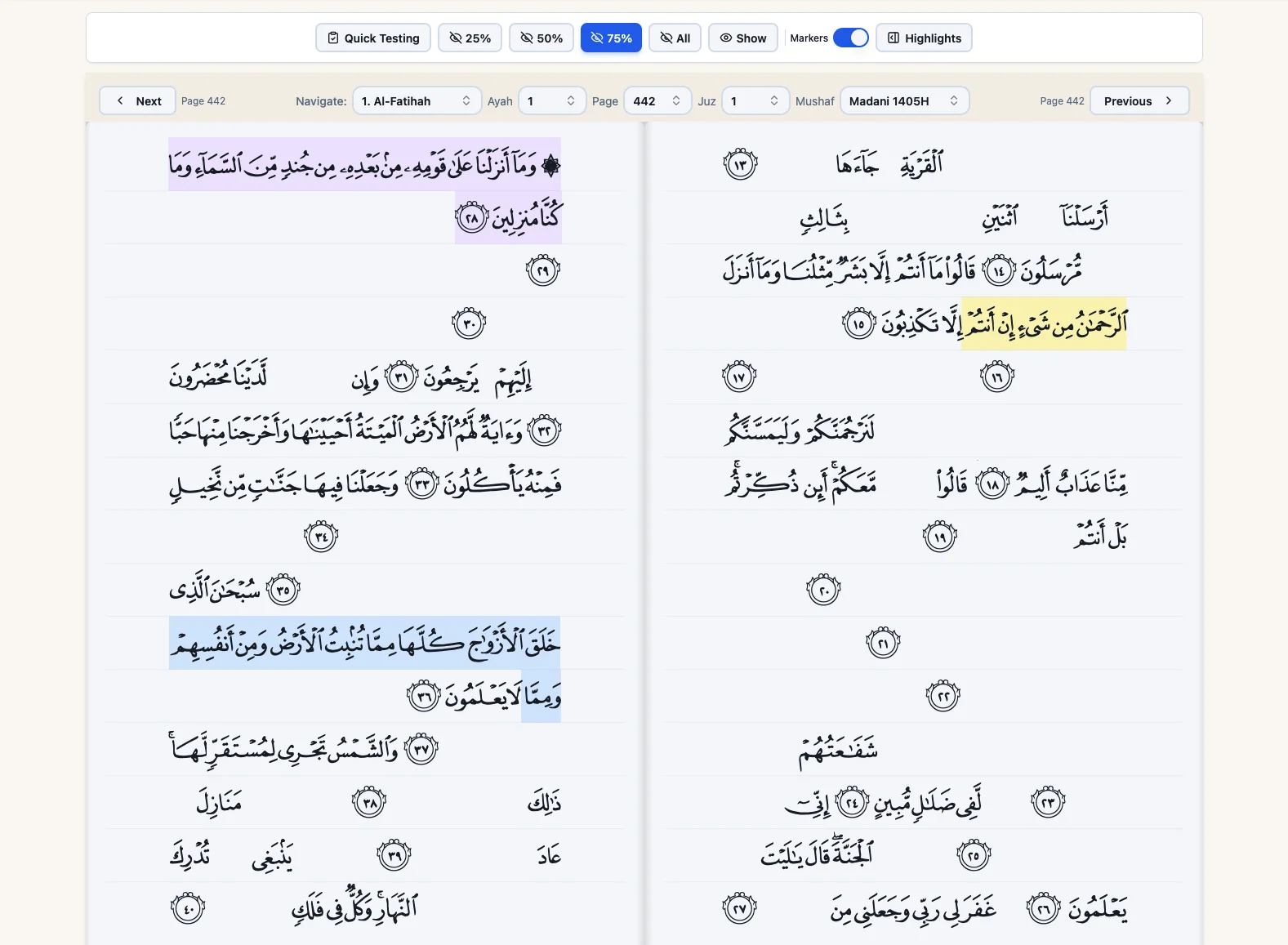
The hardest part of adult hifz is often the mental load: remembering what you’ve memorized, what’s due for revision, which pages are weak. The Quran Memorizer daily review takes that off your plate. Open it for ten minutes on your commute and it gives you recent lessons, a portion of older material, and extra questions on whatever you’ve been getting wrong.
More guides: Hifz with a full-time job and children · A minimum hifz routine for busy days