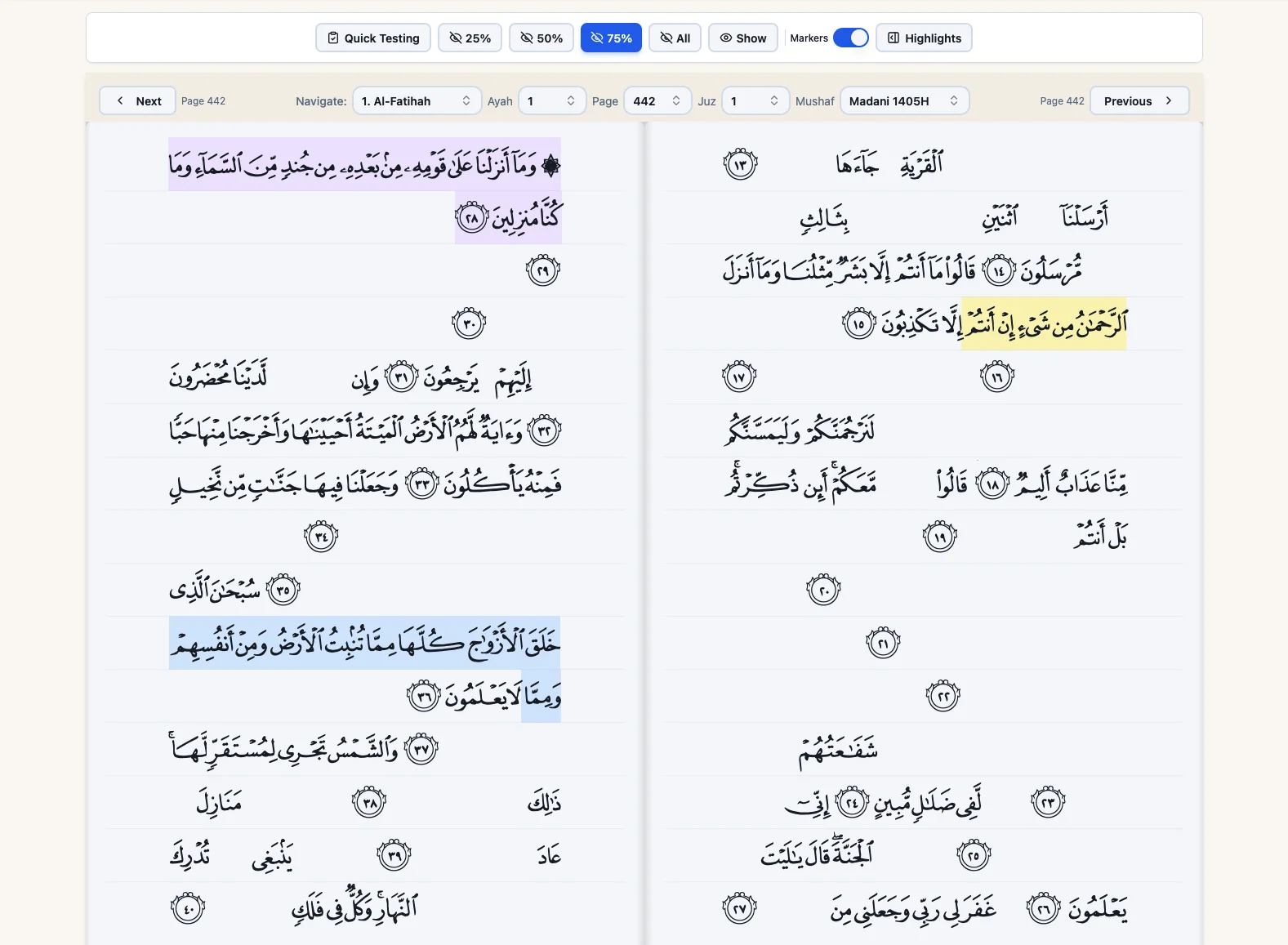

A Quran app that listens to you recite catches the mistakes you make out loud: a skipped word, a wrong word, sometimes a wrong vowel. A recall test asks you questions you answer in silence, and it catches the things smooth recitation hides, like a weak join between two ayat or a similar verse filed under the wrong surah.
So the real choice depends on what you’re checking today, and whether you can recite out loud where you are. If you came here looking for a hifz AI app, it helps to know which half of revision it covers before you lean on it.
At a glance
- Listening apps check: what you say aloud against the text, word by word.
- Recall tests check: whether you can start anywhere, find the next or previous ayah, place similar verses and picture the page.
- Time cost: reciting a page aloud takes about 2 to 3 minutes at a steady pace; a 20-page juz takes roughly 40 minutes to an hour.
- Where each works: listening needs your voice, or at least a whisper; recall questions work on a silent train or in a library.
- Still essential: a qualified teacher for tajweed and pronunciation.
What does a Quran recitation checker actually catch?
You hide the text, start reciting, and the app follows along. When what it hears doesn’t match the mushaf, it marks the word. Listening apps are built around this, and it helps when you revise alone, because you rarely hear your own dropped word.
The details vary by app, so read the store listing before you rely on one. Some listening apps say on their store listings that they flag skipped and wrong words and incorrect tashkeel (the short vowel marks, also called harakat), and some say they can follow a whisper in a quiet room. Not every listening app checks vowels. At least one says plainly on its listing that it doesn’t currently detect errors in harakat or tajweed.
So a listening app is good at catching:
- a word you dropped in the middle of a long ayah
- a word swapped for a close neighbor, such as a different ending on the same root
- an extra word you carried over from a similar passage
- in some apps, a wrong vowel on a word
If you’re counting on an app to catch harakat, check that its listing says it checks them.
What can’t a listening app tell you?
It needs your voice, for a start. A whisper may be enough for some apps, but you still need somewhere you can move your lips without the person next to you leaning away. Some apps also recognize speech on their own servers, so they need a connection while you recite.
Reciting from the start also gives you momentum. When you begin at the top of a passage, each ayah cues the next one. Hifz is meant to feel like that, but it means a listening check can show a clean page when the joins underneath are weak. Start the same page at its fourth ayah, cold, and the picture changes. We wrote about this in why you can recite a surah but freeze when tested.
And it can’t judge tajweed the way a teacher does. Catching a wrong vowel is a different job from hearing that a madd (a stretched vowel) ran short, or that a letter came from the wrong place. A teacher does that part.
What does a silent recall test catch?
A recall test drops you into the middle of your hifz and asks a question. You answer by tapping, so there’s no run-up and nothing to hear. Recall tests can ask several kinds of question, and each one finds a different weak spot:
- Next and previous ayah. Shown one ayah, can you give the one after it, or the one before? The “before” direction often feels harder, and it’s where weak joins tend to show up first.
- Ayah beginnings and endings. Many ayat open with the same few words. Knowing which ending belongs to which opening is a separate skill from reciting.
- Missing words. A gap in a passage you know shows whether you hold the exact wording or just the gist.
- Ayah order. Put four shuffled ayat back in sequence. If you learned mainly by listening, this one can surprise you.
- Similar verses. Shown a shared phrase, can you place it in the right surah and ayah? Experienced huffaz get caught here too. Our guide to memorizing similar verses covers the pairs that trip people.
- Page position. Does this ayah sit at the top of the page or near the bottom? Visual memory of the 604-page mushaf is a backup when sound alone fails.
Each question takes seconds, so you can get through twenty on a short bus ride.
What a recall test can’t hear
It can’t hear you at all. A recall test won’t know if you mispronounce a letter, rush the madd or stumble through a passage you could identify perfectly on a screen. Answering correctly that ayah 24 follows ayah 23 is a different act from reciting 23 into 24 at a steady pace in front of your teacher.
So when you score well, go and recite the passage. When you score badly, open the mushaf first.
Why does reciting to a listener still come first?
Reciting to someone who checks you goes back to the Prophet ﷺ himself. Jibril reviewed the Quran with the Prophet ﷺ every Ramadan (Sahih al-Bukhari 4997).
The Quran itself also describes hearing a passage before reciting it. Early in the revelation, the Prophet ﷺ was told not to hurry his tongue, and to follow the recitation once it had been recited to him:
لَا تُحَرِّكْ بِهِۦ لِسَانَكَ لِتَعْجَلَ بِهِۦٓ ﴿١٦﴾
إِنَّ عَلَيْنَا جَمْعَهُۥ وَقُرْءَانَهُۥ ﴿١٧﴾
فَإِذَا قَرَأْنَـٰهُ فَٱتَّبِعْ قُرْءَانَهُۥ ﴿١٨﴾
“Move not your tongue with it, [O Muḥammad], to hasten with it [i.e., recitation of the Qur’ān]. Indeed, upon Us is its collection [in your heart] and [to make possible] its recitation. So when We have recited it [through Gabriel], then follow its recitation.”
Al-Qiyamah 75:16-18, Saheeh International translation. Compare translations on quran.com
That order is worth copying with any new lesson: hear it recited correctly, then recite it back to someone who can check you. A teacher who listens to your sabaq (the new lesson) does both jobs, and if you don’t have one yet, finding a hifz teacher is worth the effort.
On the days between lessons, a listening app can cover some of the gap. Just remember what it’s doing. It checks words, and your teacher corrects recitation.
When do you need a test you can do in silence?
More often than you’d think. A lot of the free minutes in a week happen in places where reciting aloud isn’t possible, or isn’t kind to the people around you:
- on a bus, the Underground or the metro, with someone’s elbow in your side
- in a university library, or a quiet office between meetings
- in a shared bedroom, after the kids are finally asleep
- in the ten minutes before class, when you want to check your sabaq without performing it
- in a waiting room, which seems to run on a 40-minute delay
A whisper might work in some of these. In others, even moving your lips draws a look. Silent questions are made for those minutes.
One thing to be clear about, though. Scholars separate memory practice from tilawah (recitation as an act of worship), and they draw the line in slightly different places. The Shafi’i scholar Imam an-Nawawi, as Shaykh Amjad Rasheed explains on islamqa.org, held that recitation counts when you pronounce the words so you can hear yourself. Shaykh Mohammed Tosir Miah of Darul Ifta Birmingham writes that Allah may reward recitation in the mind, but the virtues in hadith are for recitation with the lips moving, even when no sound is made. He also notes two Hanafi views on the minimum recitation in salah: being able to hear yourself, or moving the tongue and lips without sound.
Either way, a silent tap test is memory practice, so you’ll still want to recite, in salah or quietly to yourself.
Quiet recitation has its own merit, too. The Prophet ﷺ compared reciting aloud to giving charity openly, and reciting quietly to giving it in secret (Jami’ at-Tirmidhi 2919, graded hasan). At-Tirmidhi noted that scholars preferred quiet recitation because it keeps a person safer from self-admiration.
Match the check to the day
Here’s how we’d pair each kind of check with the job in front of you:
- A new lesson you memorized this morning. Recite it aloud, to your teacher if you can, to a listening app or a family member following in the mushaf if you can’t. New ayat need checking word by word before anything else.
- Last week’s pages. Recite once aloud, then answer next and previous ayah questions from random points. If you can start anywhere, the pages are settling.
- An old juz you haven’t touched in a month. Start with silent questions to find the weak spots fast, then recite only those passages aloud. It’s quicker than reciting all 20 pages to find three bad joins.
- Similar verses that keep swapping. Silent recall, every time. A listening app will only catch the swap if you happen to make it while reciting.
- Your commute. Silent questions. Save reciting for home.
- The night before you recite to your teacher. Both. Recite the sabaq through once, then test the joins, so your teacher hears the version you’ve already checked.
Time is the other factor. A full listening check costs real minutes: about 2 to 3 minutes a page at a steady murattal pace (measured, even recitation), and Juz Amma takes 40 to 60 minutes to recite. Our table of how long each surah and juz takes to recite has the numbers at each reciter’s pace. Silent questions let you spot-check a juz in the time it takes to recite a page or two.
How do you test your hifz without a teacher?
If you’re studying alone for now, combine a few methods so you cover both sides:
- Record yourself reciting a page with the mushaf closed, then play it back while following the text. The pauses you never notice while reciting are obvious on playback.
- Ask a family member to follow in the mushaf while you recite. They don’t need to read Arabic fluently to spot a missing line.
- Use a listening app for word-level checks on the passages you can recite aloud.
- Use silent recall questions for joins, order and similar verses, wherever you are.
- Write down every ayah you got wrong, and start your next session there.
Our guide to ten ways to test your hifz goes through each method in more detail.
Tip: When a test flags a mistake, recite the two ayat on either side of it aloud before moving on. Errors often sit in the join, and fixing one ayah in isolation doesn’t fix how you arrive at it.
And if the red marks start to pile up, remember that the Prophet ﷺ said the one who recites with difficulty and stumbles has two rewards (Sahih Muslim 798a). Finding your mistakes is how you fix them.
Where does Quran Memorizer fit?
Quran Memorizer is the silent side of this. It asks recall questions like the ones above on any scope from a few ayat to a surah or juz, in a browser (Android phones and laptops included) or on iPhone and iPad, with one account across both. With Premium, Daily Review builds each session from your own answers so it asks most about your weak ayat.
The routine we’d suggest: recite the new lesson to a teacher or a listening app, then revise and test it in Quran Memorizer through the week. You can try the hifz test in your browser.
Questions people ask
Can an app replace a hifz teacher?
No. A listening app can flag a skipped or wrong word, and a recall test can show you which joins are weak, but neither one corrects your makharij (the points each letter is pronounced from) or gives you an ijazah (a teacher’s certification, with a chain of recitation). Use apps to arrive at your teacher better prepared, and to revise in the days between lessons.
Can you trust what a recitation checker flags?
Test it on a passage you know cold. Recite it once cleanly, then once with a word deliberately dropped and a vowel changed, and you’ll see quickly what it catches. Treat its marks as prompts to open the mushaf, and leave the final word to your teacher.
Is a recitation app the same as a Quran reading app?
They do different jobs. Reading-habit apps count the pages you read each day. Listening apps check what you recite aloud against the text. Recall tests check what you remember by asking questions. If you’re comparing two apps, first check which of those jobs each one does.
Can a recitation app work offline?
It depends on the app. Some listening apps recognize speech on their servers and need a connection while you recite. Read the store listing or help pages before you plan to use one on the metro or a flight.
Does testing my hifz silently count as reciting the Quran?
It counts as memory practice. Imam an-Nawawi tied recitation to hearing yourself, and Darul Ifta Birmingham ties the virtues in hadith to moving your lips, so pair silent tests with real recitation, whether that’s a whisper or your salah. The section on silent tests above has the details and sources.
What does tarteel actually mean?
The word means measured, unhurried recitation. It appears in Al-Muzzammil 73:4, which Saheeh International translates as “recite the Qur’ān with measured recitation.” When people search “tarteel vs hadr” or “tarteel vs tajweed”, they mean recitation styles: tarteel is slow and deliberate, hadr is quicker, and tajweed is the set of rules that applies at every pace.
Recite your new pages to someone who can hear you, and test the older ones in the quiet minutes. Strong hifz is built a little every day.