
There’s no single best Quran memorization app, because each good one does a different job. Some listen while you recite from memory and flag your mistakes, like Tarteel, Hifz AI and HifzPath. Others play a qari on repeat so you can learn a new passage by ear, like Quran.com. And smaller apps are built for testing what you’ve already memorized, or for logging lessons for a teacher.
We make Quran Memorizer, one of the apps below. Nonetheless, this is an unbiased review: the information on each app is taken from its own website and app store page, so you can make an informed decision.
The ten apps at a glance
| App | Runs on | What it’s best at | Pricing model |
|---|---|---|---|
| Tarteel | iPhone, iPad, Android | Listening as you recite from memory and flagging word-level mistakes | Free to download; Premium subscription for mistake detection |
| Hifz AI | iPhone, iPad, Android | Recitation checking on your phone, with offline use and repeat loops | Free trial, then monthly, yearly or lifetime |
| HifzPath | Android, web (iOS planned) | Word-by-word recitation check with hidden verses and quizzes | Free to use; Play listing shows in-app purchases |
| Quran.com | Web, iPhone, iPad, Android | Reading and listening to reciters with audio repeat | Free |
| SABR | iPhone, iPad, Android | A step-by-step plan for memorizing a surah | Free to start; Premium in-app |
| Retain Quran | iPhone, iPad, Android | Spaced-repetition flashcards you recite aloud | Free, no ads |
| Quran Memorizer | Web, iPhone, iPad | Testing what you’ve already memorized, then a daily review from your answers | Test yourself in the browser; Premium subscription |
| Hifz Tracker | iPhone, Android, web portal | Logging lessons and revision for students, parents and teachers | Free for one user; per-student plans |
| BeHafizh | Android | Simple tracking, an audio loop and a memorization test | Free |
| Quranly | iPhone, iPad, Android | Building a daily reading habit | Free to download; subscription |
The list is grouped by what you need help with: someone to listen, help learning the new lesson, a way to test older portions, a record of progress, or simply opening the mushaf every day. Hifz has all of these parts, and most people only need an app for one or two of them.
Which apps listen to you recite and catch mistakes?
These use speech recognition. You hide the words, recite from memory, and the app follows along and marks what you got wrong. They all need a microphone and somewhere you can recite out loud, so think about where you’d actually use one. On a crowded train, you probably won’t.
1. Tarteel
Tarteel is the app most people have heard of, with over 10 million downloads on Google Play. You hide the verses and recite, and its Premium mistake detection flags wrong words, skipped words and incorrect tashkeel. You can tap a highlighted mistake to compare what you said with the ayah. Test Mode starts you at random points in what you’ve memorized, which is closer to how a teacher tests you than starting at ayah 1 every time.
Some of it costs nothing: recitation follow-along, listening to reciters, and voice search, where you recite a phrase and it finds the ayah. You can read in Madani or Indo-Pak script. The voice features need a stable internet connection. Free to download on iPhone, iPad and Android, with a Premium subscription (there’s a free trial) for mistake detection and the hidden-verses mode.
2. Hifz AI
Worth a look if you’d rather your recordings didn’t leave your phone. Hifz AI’s site says the speech model runs on the device and nothing is uploaded, and once you’ve downloaded a surah it works offline. Its recitation check colors mistakes red and correct words green.
It also does the listening side well. Hifz Mode is a listen, pause, repeat loop where you choose the number of repetitions and the gap. You can repeat a single ayah, loop a range, or use “Repeat Until Correct”, and there’s an option to hide the text while you practice. One thing that confuses people: its store name is “Hifz AI: Tarteel Quran”, but it’s a separate app from a different developer (M. Awais). iPhone, iPad and Android. There’s a free trial with a set number of checks, then a monthly, yearly or lifetime plan.
3. HifzPath
HifzPath matches what you say against the mushaf word by word. Each correct word turns green, and a wrong word just waits for you to get it right. It has verse hiding with hints when you’re stuck, quizzes (next ayah, fill in the blank, ordered review), looping a range, and random ayat drawn from a surah, a juz or everything you’ve marked as memorized. Points only come from reciting, so you can’t earn them by tapping through screens. You can also memorize together as a family, a halaqa or a class.
It’s on Android and in the browser, with iOS planned. The site says it’s free to use with no account needed to start, though the Play listing does show in-app purchases. Speech recognition needs an internet connection.
A note on all three, and on Retain Quran below: speech recognition for Quranic Arabic is hard to get perfect. Treat a listening app as a first listener, then recite to a person who knows tajweed.
Which apps help you learn the new lesson?
This is the first stage of hifz: hearing your sabaq (the new lesson) recited again and again until you can say it without looking.
4. Quran.com
If you just need a good mushaf and a qari on repeat, start here. Quran.com is a website for reading, listening and studying, with reading goals and learning plans. Its own apps are free: Quran for Android has 15+ recitations with highlighting, customizable audio repeat, and translations and tafsir in over 20 languages, and the iOS app is an ad-free mushaf that its listing describes as being for reading, memorizing and listening. On iPhone you can set a verse or a range to repeat anywhere from once to 100 times, slow the reciter down to 0.25× or speed up to 2×, and download audio and pages. It doesn’t test you, and that’s not what it’s for.
5. SABR
The one to pick if you like being told what to do today. SABR gives you a roadmap for the surah you choose and adapts it to your pace. Its site mentions a 9-day plan for Al-Fatihah and a 34-day plan for Ya-Sin. You listen and repeat each ayah, then practice recalling it, and the site describes a spaced-repetition review board that sorts surahs into Due, Weak, Strong and Mastered. There’s also an AI recitation coach that listens word by word.
It’s available in English, French and Arabic, on iPhone, iPad and Android, and its site has a browser demo of the recitation engine. Free to start, with Premium as an in-app purchase.
Which apps test what you’ve already memorized?
Memorizing an ayah and still knowing it three months later are two different problems. These apps are for the second one. If you’d like to try testing without any app first, our guide on how to test your Quran memorization has ways to do it with a mushaf and a friend.
6. Retain Quran
Retain Quran is completely free and has no ads. Its flashcards listen while you recite and use spaced repetition to schedule when each card comes back. You can also hide verses on the mushaf and recite with AI mistake detection, which is in beta. The listing says plainly that it doesn’t yet catch tashkeel-level errors or tajweed precision, which is useful to know before you rely on it.
There are lesson plans with daily targets, a hasanat dashboard with a leaderboard, and a choice of 13, 15 or 16-line mushaf in Madani or Indo-Pak layout. The listing also has 20+ reciters you can listen to offline. iPhone, iPad and Android.
7. Quran Memorizer
Quran Memorizer is built for testing what you’ve already memorized. The hifz test runs in your browser, so it works on Android phones and laptops too, and there’s an app for iPhone and iPad. You pick a scope (one surah, a juz, your memorized portion or the whole Quran) and then a question type. There are 16 of them, including next and previous ayah, how an ayah begins or ends, a missing ayah, putting ayat in order, similar ayat (mutashabihat) and naming the surah.
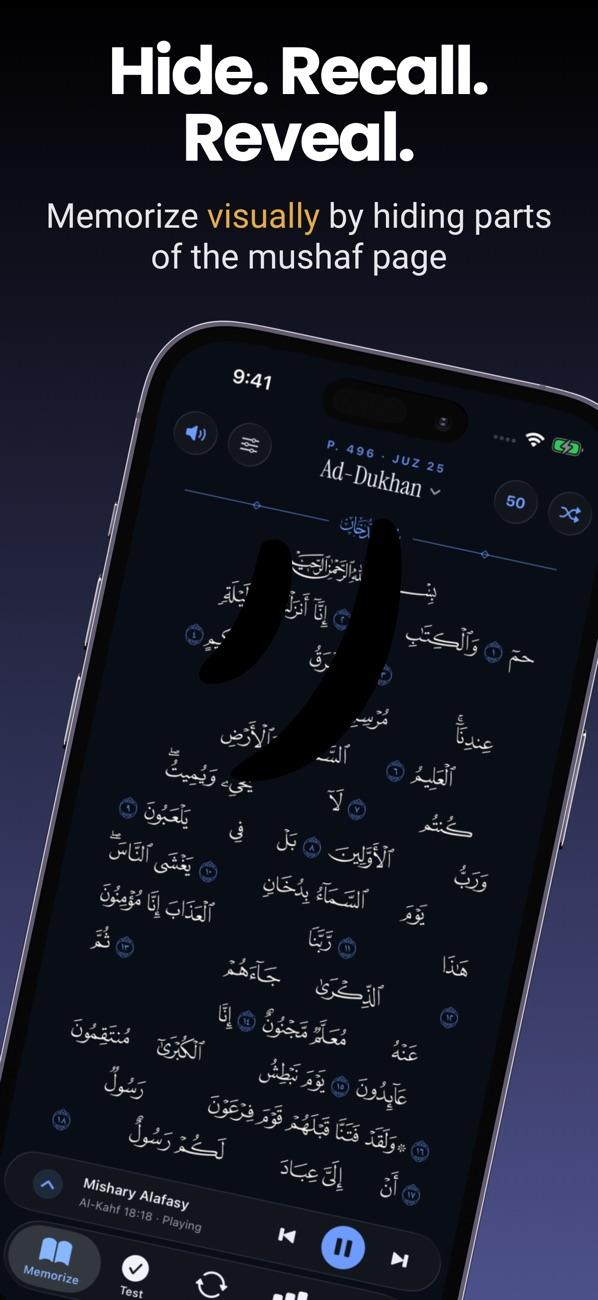
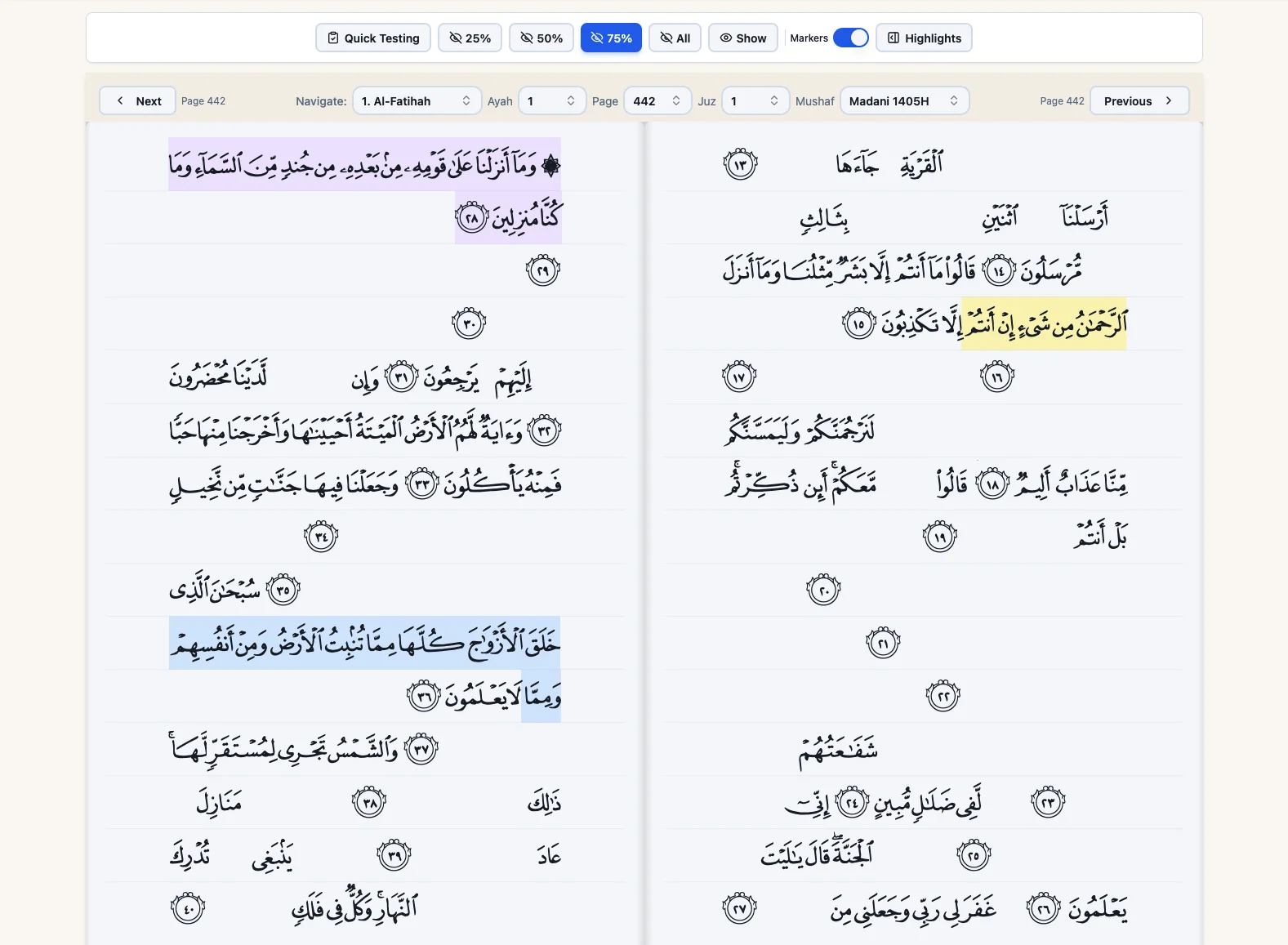
On the mushaf, you can hide 25%, 50%, 75% or the whole page and recite what’s underneath, and you can loop any range with a recitation playing. The daily review is built from your own answers. Each day it brings back what you learned recently plus one portion of everything else, in turn, and asks most about the ayat you’ve been getting wrong. The daily review and every hide level are part of Premium.
It doesn’t listen to your recitation through the microphone, so it pairs well with one of the listening apps above. More than 1,000 hifz students use it.
Which apps track hifz progress?
8. Hifz Tracker
Hifz Tracker, from Sidr Productions in the UK, is a logbook rather than a tester. You record the new lesson, revision and retention each day, see it on a progress calendar, and get charts and weekly summaries. A hifz calculator estimates when you’ll finish at your current pace. There’s a student mode and a teacher mode, and a review and exam mode where a teacher or parent scores accuracy, fluency and tajweed.
Personal use is free for one person. Parents and schools pay per student, and those plans include a web portal. iPhone and Android. A paper notebook can do the same job for one student. The app is worth it when a teacher has twenty students, or a parent wants to see the week’s sabaq without asking.
9. BeHafizh
A small, simple Android app from Gudeg Barakah that comes up a lot in Indonesian searches. BeHafizh lets you tick off what you’ve memorized by surah and ayah, and colors the surahs you find difficult. Its memorization test adapts to you, and the audio player repeats a range you choose with the reciter you like. It won the application design category in a university Musabaqah Tilawatil Quran in 2015, and its listing says it’s 100% free. It hasn’t been updated since April 2023, and there’s no iPhone version.
What if your problem is reading every day?
10. Quranly
Quranly isn’t a memorization app, and it doesn’t claim to be. It’s a reading habit app: you set a daily target, and it tracks verses, pages, time and hasanat, with streaks, reminders and challenges. You can connect with friends and family, and there’s a weekly leaderboard. If you struggle to open the mushaf at all, it’s a sensible companion to any app above. iPhone, iPad and Android, free to download with a subscription.
Which app hides the words so you can recite from memory?
This is one of the most common questions, and several apps on this list do it in different ways:
- Hide and recite aloud, with mistakes flagged: Tarteel (Premium), HifzPath, Hifz AI and Retain Quran.
- Hide part of the page and recite to yourself: Quran Memorizer, which hides 25%, 50%, 75% or the whole page of a standard Madani mushaf. That’s useful if you can’t recite out loud where you are.
If you memorized from one mushaf, practice on the same layout. Your visual memory of the page is tied to where each ayah sits, and a different layout moves everything around.
How do you choose the right hifz app for you?
Start from your situation, then pick one or two apps for the parts you’re missing.
- New and learning short surahs. A listen-and-repeat app does most of the work. Add a testing app once you’ve memorized a handful, because short surahs are easy to mix up once there are ten of them.
- Studying with a teacher. Your teacher already listens to your sabaq, so a recitation app adds less. A testing or review app between classes helps you arrive with your recent lessons (sabqi) and older juz (manzil) already checked.
- Revising alone as an adult. If you can recite aloud at home, a listening app stands in for a study partner. If most of your spare minutes are on a train or at a desk, silent testing fits them better. Our guide to how to revise the Quran covers how much to revise at each stage.
- On Android or a laptop. Everything here except BeHafizh runs on Android, and Quran.com, HifzPath and Quran Memorizer also work in a browser. There are more browser options in Quran memorization websites.
- Finished hifz years ago. You need a rotation through all thirty juz, so look at the apps that bring back what you got wrong. There’s a full routine in revision after completing hifz.
A pairing that works for many people: recite the new lesson to a listening app like Tarteel, then use a testing app for the older portions you don’t recite every day. If you can recite fine but go blank when someone tests you, read why you freeze when tested. It explains why the two skills are different.
Free tool
An app works better with a plan behind it. Pick your pages, daily lines and study days, and get a day-by-day schedule with revision built in. Open the hifz plan generator →
What should you check before you subscribe?
- The last update date. An app that hasn’t been touched in a year or more may not run well on a new phone.
- The mushaf layout. If you memorized from a 15-line Madani mushaf, test on one.
- Microphone and internet. Recitation apps need you to speak out loud, and most need a connection. Check that against where you actually revise. If you’ll use it on a flight or somewhere with weak signal, switch to airplane mode at home and try one full session first.
- What you get before paying. “Free” on a store listing can mean fully free, free with optional donations, a free core with a paid tier, or a short trial before a subscription. On the App Store, an app with no In-App Purchases section is the first kind. Most apps here let you start without paying, with mistake detection or scheduling in the paid tier, so try the free part for a week first.
- What “memorization” means in the name. Look at the screenshots. It can mean a reader with a repeat button or a full review planner.
- Where your progress is saved. Some apps store it on the phone, others in an account that syncs. Hifz takes years, so check what happens if you change phones or want to revise on a tablet at home.
- Help with similar ayat. Mutashabihat cause a large share of hifz mistakes, and they’re hard to drill on paper. See whether the app can show you a shared phrase and ask which ayah you’re in. Our guide to memorizing similar verses explains why this matters.
A big reciter library matters less than it looks on the store page. One or two clear reciters you actually use is enough. Streaks are similar: they help some people, but an app that makes you feel guilty for missing a day can push you away from it.
Questions people ask
What is the best app to memorize the Quran?
It depends on the job. Tarteel, Hifz AI, HifzPath and Retain Quran listen to you recite and flag mistakes. Quran.com is good for listening and repeating a new lesson, and SABR gives you a step-by-step plan. Retain Quran and Quran Memorizer help you test what you’ve already memorized, and Hifz Tracker logs progress for a teacher or parent.
Is there an app to test my hifz?
Yes. Tarteel’s Test Mode starts you at random points while you recite, and Hifz AI and HifzPath check your recitation with the words hidden. Quran Memorizer tests you with 16 question types, like next ayah, missing ayah and similar ayat, on any surah, juz or your whole hifz, in a browser or on iPhone.
Are there free Quran memorization apps?
Yes. Retain Quran is completely free with no ads, and Quran.com’s apps for iPhone and Android are free. BeHafizh on Android says it’s 100% free, and HifzPath is free to use, though its Play listing shows in-app purchases. Hifz Tracker is free for one person. Tarteel, SABR and Quranly are free to download with paid tiers, and Hifz AI gives you a free trial before a subscription.
What are some alternatives to Tarteel?
Hifz AI, HifzPath and Retain Quran also listen while you recite with the words hidden. Hifz AI does it on your phone and works offline, HifzPath runs on Android and the web, and Retain Quran is free with no ads. If you want to test yourself without reciting aloud, a quiz-based app like Quran Memorizer works alongside any of them.
Is there a Quran memorization tracker app?
Hifz Tracker is built for it: you log the new lesson, revision and retention each day, and teachers and parents can follow several students. BeHafizh on Android lets you tick off surahs and ayat as you memorize them, and Quranly tracks daily reading rather than memorization.
Which hifz apps work on a laptop or in a browser?
Quran.com, HifzPath and Quran Memorizer all run in a browser, and Hifz Tracker has a web portal for its parent and school plans. SABR’s site has a browser demo of its recitation engine.
Which Quran memorization apps work offline?
Hifz AI works offline once you download a surah, including its recitation check. Retain Quran’s 20+ reciters can be listened to offline, and Quran.com’s iPhone app lets you download audio and pages. Tarteel’s voice features and HifzPath’s speech recognition need an internet connection.
Can an app replace a hifz teacher?
No. A teacher corrects your tajweed, sets your lessons and notices things no app will. Apps help most in the hours between classes: repeating the new lesson, testing older ones and keeping a record.
Which two will you pair?
Pick one app for learning new ayat and one for checking the old ones. Use them for two weeks, then drop whichever you stopped opening. Apps are tools. The ayah below says where the Quran is really kept.
“Rather, it [i.e., the Qur’ān] is distinct verses [preserved] within the breasts of those who have been given knowledge. And none reject Our verses except the wrongdoers.”
Al-‘Ankabut 29:49, Saheeh International translation.
If testing is the part you’re missing, test yourself on a surah you know well and see which ayat need work.