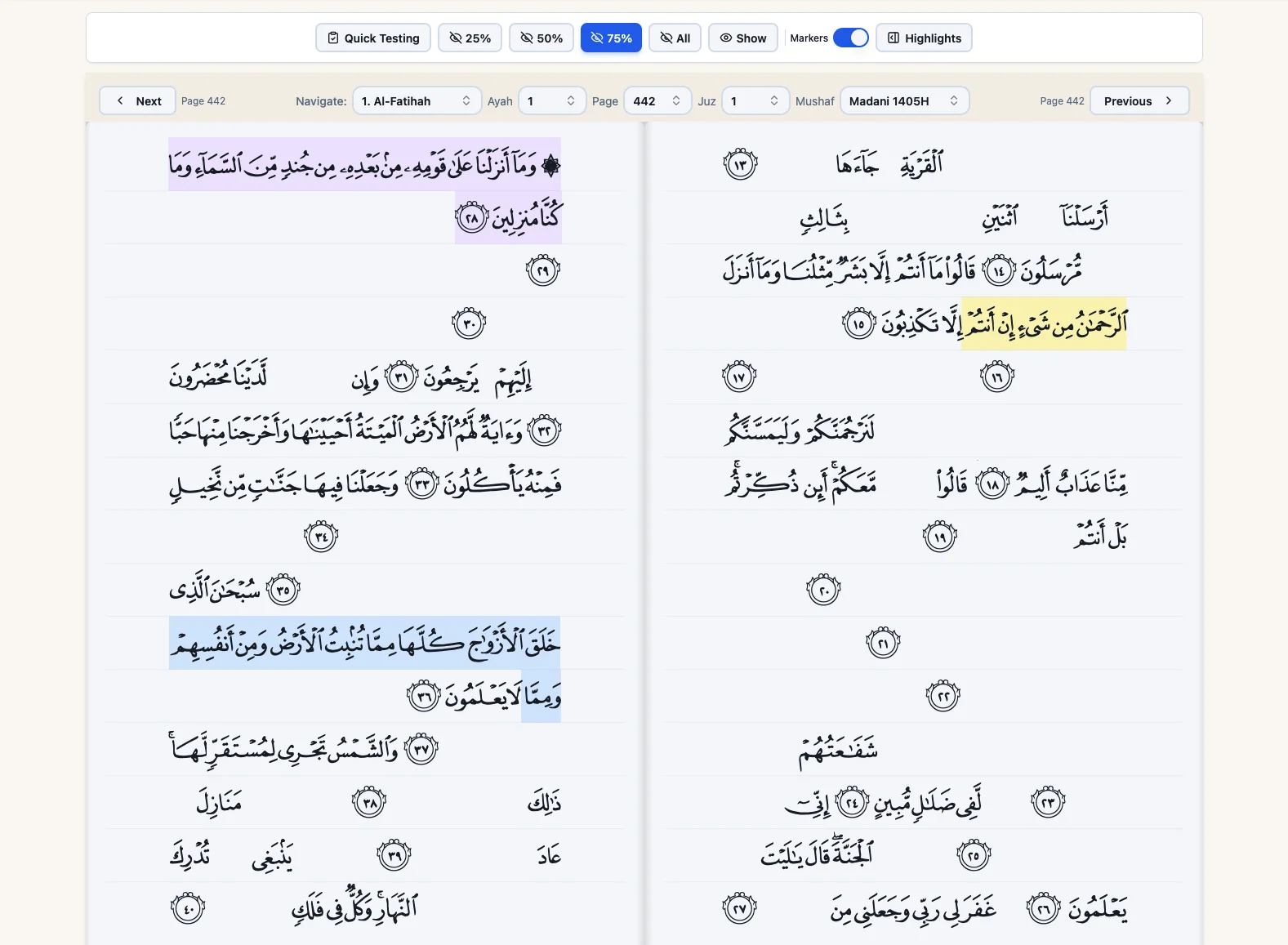
About five months, if you memorize five lines a day. Al-Baqarah is 286 ayat on 711 lines of the 15-line Madani mushaf, from page 2 to page 49. At five lines a day that’s 143 days of new memorization, and closer to five and a half months once you add a review day each week.
Looking for reading time instead? Reciting all of Al-Baqarah takes about 2 hours. See how long Surah Al-Baqarah is for times by reciter and an easy way to split it into sittings.
At a page a day it’s 48 days, about seven weeks. That’s the pace of a full-time hifz class, and it only works if your revision keeps up with it.
At a glance
- Where it sits: nearly the first two and a half juz of the Quran, pages 2 to 49.
- Length: 286 ayat on 711 lines, just under 47½ full pages.
- Time to recite: about an hour and 40 minutes at Sudais’s pace, two hours with Alafasy, three hours twenty with Al-Husary.
- Time to memorize: 143 days at 5 lines a day, 48 days at a page a day.
How many days at your pace?
Pick the row you can hold on an ordinary day, not your best one. These are days of new memorization, counted in lines of the 15-line mushaf.
| Lines a day | Days | Roughly |
|---|---|---|
| 3 | 237 | 8 months |
| 5 | 143 | 5 months |
| 7 | 102 | 3½ months |
| 10 | 72 | 2½ months |
| 15 (a page) | 48 | 7 weeks |
For most adults we’d start at five lines and only move up once a whole month has gone by without your revision falling behind. Al-Baqarah is long enough that you start forgetting the first pages while you’re still learning the last ones, so the pace you can sustain matters more than the pace you can manage this week.
Tip: Add one review day for every six days of new lines. At five lines a day that’s about 24 extra days, and they’re what make the first stage still solid when you reach the third.
How long does Al-Baqarah take to recite?
Between an hour and a half and nearly four hours, depending on the reciter. Our Al-Baqarah reading-time guide splits that by juz and by sitting. These are measured from full recordings of the surah:
- Saud Ash-Shuraym: 87 minutes
- Abdur-Rahman As-Sudais: 99 minutes
- Yasser Ad-Dossari: 121 minutes
- Mishary Alafasy: 121 minutes
- Muhammad Siddiq Al-Minshawi: 137 minutes
- Abdul Basit Abdus-Samad: 144 minutes
- Mahmoud Khalil Al-Husary: 200 minutes, or 233 in his teaching recording
Al-Husary’s teaching recording leaves a pause after each ayah so you can repeat it back. For a surah this size that’s a real help early on. Later, a faster reciter is what you’ll use to hear the whole surah in one sitting.
Read next: how long it takes to read every surah, timed the same way.
A plan in three stages
Al-Baqarah splits cleanly where the juz change, and each stage is a sensible goal on its own:
- Stage 1: ayat 1 to 141, pages 2 to 21 (291 lines). About 59 days at five lines a day. From “Alif Lam Mim” through the stories of the Children of Israel and Ibrahim.
- Stage 2: ayat 142 to 252, pages 22 to 41 (300 lines). About 60 days. The qiblah, fasting, Hajj, family law, and Talut and Jalut. This is the whole of juz 2.
- Stage 3: ayat 253 to 286, pages 42 to 49 (120 lines). About 24 days. It opens two ayat before Ayat al-Kursi (2:255), on the same page, and ends with the last two ayat of the surah.
Finish each stage before starting the next, and recite the stage you’ve just finished once a week until the surah is done. If you’ve already memorized Ayat al-Kursi or the last two ayat, stage 3 will go faster than its line count.
Read next: our full plan for memorizing Al-Baqarah, and how to memorize Ayat al-Kursi.
Which ayat slow people down?
Al-Baqarah tells several stories that come back later in the Quran, mostly in Al-A’raf, with small changes in the wording. If you know Al-A’raf, these are where your tongue will wander. One pair is even inside Al-Baqarah itself.
Ayat 48 and 123 are near twins inside the surah
Both open “And fear a Day when no soul will suffice for another soul at all”, and both end “nor will they be aided”. The middle swaps round: in 2:48 intercession comes first and compensation second. In 2:123 compensation comes first, and intercession “will not benefit”.
وَاتَّقُوا يَوْمًا لَّا تَجْزِي نَفْسٌ عَن نَّفْسٍ شَيْئًا وَلَا يُقْبَلُ مِنْهَا شَفَاعَةٌ وَلَا يُؤْخَذُ مِنْهَا عَدْلٌ وَلَا هُمْ يُنصَرُونَ
And fear a Day when no soul will suffice for another soul at all, nor will intercession be accepted from it, nor will compensation be taken from it, nor will they be aided.
Al-Baqarah 2:48, Saheeh International (quran.com)
وَاتَّقُوا يَوْمًا لَّا تَجْزِي نَفْسٌ عَن نَّفْسٍ شَيْئًا وَلَا يُقْبَلُ مِنْهَا عَدْلٌ وَلَا تَنفَعُهَا شَفَاعَةٌ وَلَا هُمْ يُنصَرُونَ
And fear a Day when no soul will suffice for another soul at all, and no compensation will be accepted from it, nor will any intercession benefit it, nor will they be aided.
Al-Baqarah 2:123, Saheeh International (quran.com)
Tip: The earlier ayah puts shafa’ah (intercession) first. First ayah, first word to watch.
Adam in the garden: 2:35 and 7:19
In Al-Baqarah it’s wa kula minha raghadan: “eat therefrom in [ease and] abundance from wherever you will”. Al-A’raf drops minha raghadan and says fa kula min haythu shi’tuma: “eat from wherever you will”. The rest, “do not approach this tree”, is the same in both (2:35, 7:19).
Entering the town: 2:58 and 7:161
The two ayat give the same instructions in a different order. Al-Baqarah says “enter the gate bowing humbly” and then “say, hittah“. Al-A’raf says “say, hittah” first and then “enter the gate”. Al-Baqarah also opens with udkhulu (enter) where Al-A’raf has uskunu (dwell), and ends khatayakum where Al-A’raf ends khati’atikum (2:58, 7:161).
Saved from Pharaoh’s people: 2:49, 7:141 and 14:6
Three ayat, three small differences. Al-Baqarah says najjaynakum and yudhabbihuna (slaughtering). Al-A’raf says anjaynakum and yuqattiluna (killing). Ibrahim has Musa speaking to his people, with anjakum and wa yudhabbihuna, adding a wa (2:49, 7:141, 14:6).
Learn each of these pairs together the week you reach them. Read the other ayah once, say aloud what’s different, then go back to Al-Baqarah. It costs five minutes and saves you from mixing them for years.
More on this: how to memorize similar verses without mixing them up.
Can you memorize Al-Baqarah in a month?
Thirty days means about 24 lines a day, a page and a half. Some full-time students do it, and some do it faster with a teacher listening every day. For most people it’s a recipe for a surah that feels finished in week four and has gaps by week eight. If a month is your goal, plan the month after it too: a quarter of the surah every week, recited from memory, until you can recite all four quarters without help.
How do you know it’s really memorized?
Reciting from the start is the easy test, because each ayah leads you into the next. The real one is starting anywhere: can you pick up at 2:183, or say what comes after 2:58 without running through the page? With 286 ayat, that’s the difference between knowing each ayah and only knowing the surah in order. It’s exactly what the Quran Memorizer test asks you to do, one random ayah at a time.